
In the realm of power transmission, the pursuit of mechanisms offering higher load capacity, greater efficiency, and extended service life is perpetual. Among cylindrical worm drives, a superior alternative emerged from pioneering Chinese research in the 1970s: the Planar Double-Enveloping Hourglass Worm Gear Drive, often categorized under the broader family of high-performance screw gear systems. This distinctive screw gear configuration is characterized by a concave, hourglass-shaped worm enveloped by a gear wheel, resulting in multi-tooth, dual-line contact with a favorable lubrication angle. Compared to its cylindrical counterparts of similar size, this screw gear exhibits significantly enhanced load-bearing capability, transmission efficiency, and operational longevity. The fundamental principle involves a two-stage enveloping process: first, a planar tool surface generates the hourglass worm (the primary screw gear element), and second, this precise worm is then used as a tool to generate its conjugate mating gear. Despite over four decades of development and successful application in heavy industries like metallurgy, mining, and shipping, its wider adoption is constrained by persistent challenges in parametric design, precision control, and manufacturing cost. This article, from a first-person perspective of the field’s evolution, synthesizes the domestic research and developmental status in China, distilling key achievements and technologies in design, manufacturing, and measurement. We conclude by outlining critical future research directions necessary to propel this advanced screw gear technology forward.
The mathematical foundation for this complex screw gear was established early. The tooth surface of the planar enveloping hourglass worm, a spatial complex curved surface, can be derived from the meshing principle between a generating plane and the worm blank. Let the generating plane Σ1 be defined in its own coordinate system S1(O1-x1, y1, z1). The worm coordinate system S2(O2-x2, y2, z2) is connected to it through a series of rotational and translational transformations involving the fundamental design parameters: center distance a, generating ratio i12, and the inclination angle of the generating plane β. The family of generating planes in S2 creates an envelope, which is the worm tooth surface Σ2. The meshing equation is given by:
$$ \mathbf{n}^{(1)} \cdot \mathbf{v}^{(12)} = 0 $$
where $\mathbf{n}^{(1)}$ is the unit normal vector of the generating plane Σ1, and $\mathbf{v}^{(12)}$ is the relative velocity vector between the generating tool and the worm at the contact point. Solving this equation simultaneously with the family of surface equations yields the mathematical model of the worm tooth surface, a crucial foundation for all subsequent analysis and manufacturing of this screw gear.
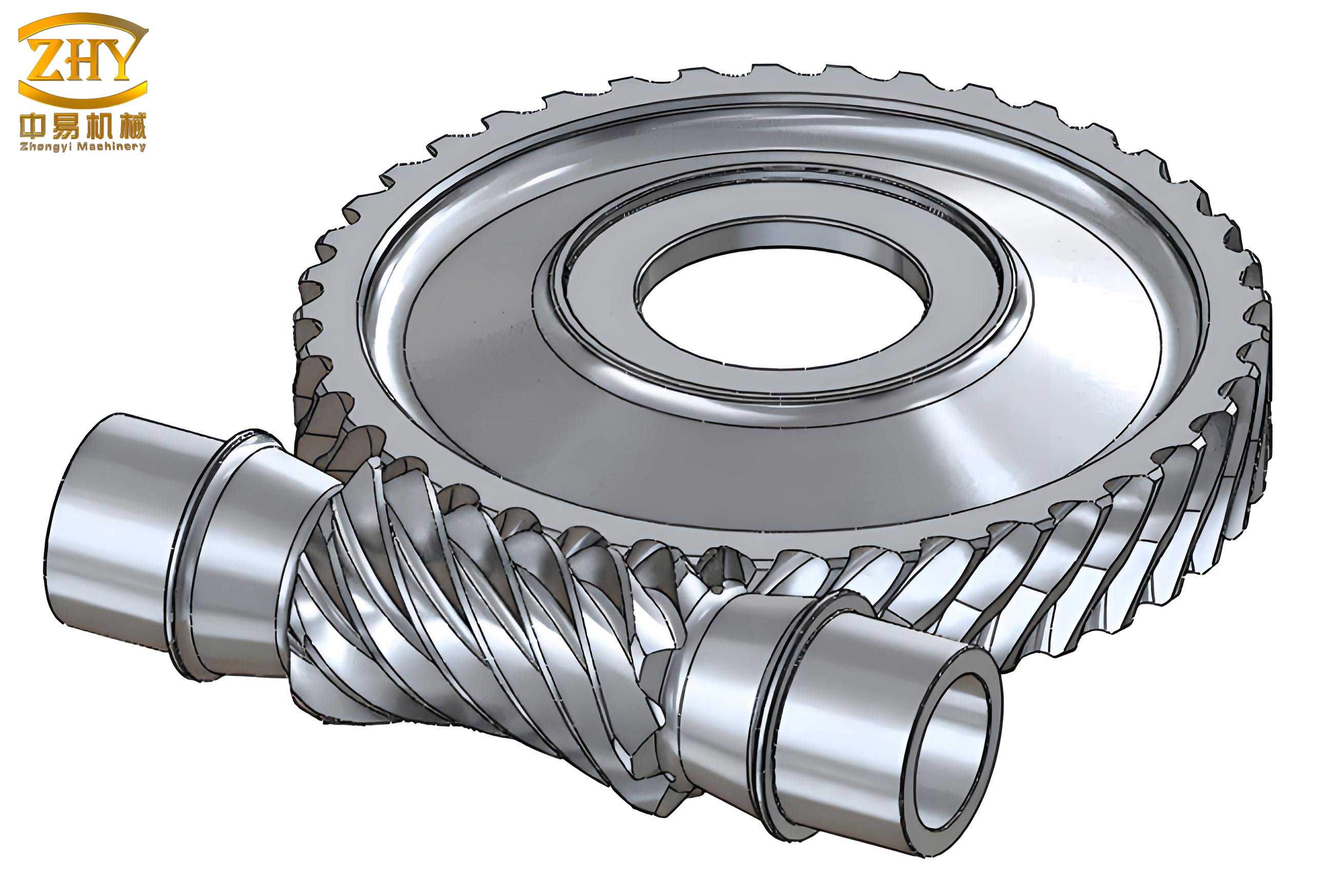
Design Technology: Modeling, Analysis, and Optimization
Accurate three-dimensional modeling of the worm and gear tooth surfaces is paramount for modern design processes, including finite element analysis and CNC programming. Two primary approaches exist. The first involves calculating discrete points on the tooth surface, such as instantaneous contact lines, using the derived mathematical models in computational software like MATLAB, and then importing these point clouds into CAD software for surface fitting. This method, while precise, is computationally intensive and inflexible to parametric changes. The second, more direct approach is digital simulation of the generation process itself. By virtually replicating the relative motions between the tool and workpiece in CAD environments and performing boolean operations, a solid model is created. This method bypasses complex meshing equation solving but requires careful control over simulation step size to balance accuracy and computational load, a key consideration in screw gear digital twin development.
The analysis of meshing characteristics is a cornerstone of screw gear design. Macroscopic evaluation focuses on the pattern of instantaneous contact lines on the gear tooth surface and the identification of limit curves that define the boundary of the working area. For an unmodified drive, the contact lines on the gear tooth form a distinctive pattern, often featuring a crossover region where contact frequency is high, making it a potential site for initial pitting fatigue. Microscopic performance is assessed through parameters like the induced normal curvature, relative entrainment velocity (which affects lubrication film formation), and the lubricant entrapment angle. Recent research has expanded into Loaded Tooth Contact Analysis (LTCA), which investigates the influence of manufacturing errors, assembly misalignments, and elastic deformations under load on the actual contact pattern, load distribution among contacting teeth, and transmission error. This analysis reveals that in an unmodified screw gear, the contact load distribution is not uniform, typically being higher at the ends of the contact lines and exhibiting a specific pattern within the secondary contact zone.
Given the multitude of geometric parameters (e.g., generating plane angle β, primary base circle diameter, module, number of worm threads), systematic optimization is essential to maximize the performance of the screw gear. Various optimization models have been proposed, differing in their choice of design variables, objective functions, constraints, and solving algorithms. The table below summarizes the common elements of these parametric optimization frameworks for the planar double-enveloping screw gear.
| Optimization Model Component | Typical Content |
|---|---|
| Design Variables | Generating plane inclination angle (β), primary base circle diameter, pitch diameter of the worm, number of worm threads (z1). |
| Objective Functions | Minimize the distance from the gear tooth top to the first contact line; maximize minimum oil film thickness; maximize transmission efficiency; minimize manufacturing cost; or a weighted multi-objective function. |
| Constraint Conditions | 1. Geometric constraints: Parameter boundaries. 2. Meshing constraints: Avoid undercutting and non-working zones on the worm; ensure proper contact line distribution and working start angle. 3. Strength constraints: Bending strength of worm, contact and bending strength of gear teeth. |
| Optimization Algorithms | Complex method, multi-objective programming, exterior penalty function method, fuzzy algorithms. |
Modification, or deliberate deviation from the theoretically conjugate design, is a powerful tool to enhance the practical performance of the screw gear. Two main modification philosophies exist. The first is based on altering the relative motion parameters between the first and second enveloping processes, such as using different center distances or transmission ratios. This results in a传动 that remains line-contact but changes the contact pattern. The second is mismatch modification, where the worm is generated with parameters slightly different from those of the hob used for the gear, or a different worm profile is employed, leading to localized contact. The choice of modification type profoundly affects the contact pattern. Based on the presence and treatment of limit curves on the gear tooth, modified drives are often classified as Type-I or Type-II. Their characteristics are contrasted below.
| Modification Type | Key Advantages | Key Disadvantages |
|---|---|---|
| Unmodified (Standard) | Full tooth contact on both worm and gear. | Presence of a contact line crossover zone on the gear, a weak point for pitting. |
| Type-I Modification | Full tooth contact on the gear; elimination of contact line crossover. | Shortened contact zone on the worm; potential presence of a limit curve; arched contact lines on gear with poor lubrication at the arch crown. |
| Type-II Modification | Full tooth contact on the worm; elimination of contact line crossover. | Presence of a rear transition zone and a limit curve on the gear tooth (which can be removed with proper modification量). |
The selection of modification type and its magnitude remains an area of active research and often relies on empirical experience. The goal is to excise the weak crossover or limit curve regions while maintaining a favorable contact pattern and adequate contact ratio throughout the mesh cycle of the screw gear.
Manufacturing Technology: From Traditional to CNC Methods
The manufacturing of high-precision planar enveloping hourglass worms and their corresponding hobs is the most critical and challenging aspect of producing this screw gear. Traditional methods employed dedicated machines with a rotary table to hold the cutting tool (single-point turning tool, milling cutter, or grinding wheel). The setup required meticulous adjustment of center distance via radial movement of the rotary table and the installation of change gears to set the transmission ratio. This process was time-consuming, limited in flexibility, and constrained by the physical size of the rotary table.
The advent of CNC technology has revolutionized the manufacturing of this screw gear, leading to several key innovations:
1. CNC Turning for Roughing: Using a standard CNC lathe with three-axis interpolation, the worm blank can be rough-turned by guiding the tool’s tip along a pre-calculated path approximating the tooth surface. More recent techniques utilize standard parting tools with macro programming and variable-lead threading functions to quickly generate a rough, non-enveloping worm profile, significantly reducing roughing time and cost.
2. Virtual Rotary Center Grinding: This is a breakthrough for finish-grinding the worm tooth surface. It eliminates the physical mechanisms for adjusting center distance and primary base circle radius. On a machine with a double-layer worktable (X, Z axes), a rotary table (B axis), and the worm spindle (C axis), a four-axis synchronous motion is executed. The X and Z axes perform circular interpolation, simulating the translational motion of a virtual tool center relative to the worm axis. The rotation angles of the B and C axes are synchronized with this interpolation according to the generating ratio. This method allows the use of a smaller, fixed-diameter grinding wheel, increases the machine’s working range, and simplifies operation, making it highly suitable for batch production of this精密screw gear component.
3. Five-Axis Flank Milling: Recognizing that the planar enveloping worm tooth surface is a ruled surface, five-axis CNC machining centers can be employed for high-efficiency flank milling. The tool path is generated based on the instantaneous contact lines of the worm. This method is particularly effective for ensuring uniform finishing allowance, thereby improving both final accuracy and grinding efficiency for the screw gear worm.
4. CNC Milling of the Worm Wheel: For large, single-piece, or small-batch worm wheels, manufacturing a dedicated hob is economically prohibitive. Direct CNC milling of the gear tooth space using ball-nose or end mills based on a 3D model becomes a viable alternative. The process involves discretizing the theoretical tooth surface, generating tool paths, and executing 3- or 4-axis milling operations.
5. CNC Relief Grinding of the Hob: Creating the required clearance angles on the complex tooth profile of the planar double-enveloping hob has historically been a major bottleneck. Advanced CNC grinding techniques, often implemented on modified virtual rotary center machines, now allow for precise grinding of the hob’s rake face, primary, and secondary relief surfaces in a single setup by controlling the relative orientation between the grinding wheel and the hob tooth. This ensures consistent clearance angles and edge preparation, which is vital for the hob’s performance and life, ultimately affecting the quality of the finished screw gear.
The table below compares the primary modern manufacturing methods for the worm component of the screw gear.
| Manufacturing Technology | Primary Advantages | Primary Disadvantages | Typical Application |
|---|---|---|---|
| CNC Rough Turning | High efficiency, uses standard machine tools. | Low accuracy, produces non-enveloping profile. | Rough machining of the worm. |
| Virtual Center Grinding | High precision and efficiency. | High machine cost, specialized equipment. | Batch finishing of worms. |
| Five-Axis Flank Milling | High precision, uses versatile machine tools. | Very high machine and programming cost, lower efficiency than grinding. | Prototype or single-piece finishing. |
For the worm wheel, while hobbing remains the most economically efficient method for batch production due to its high accuracy and speed, the development of reliable CNC hob grinding has been instrumental. For special cases, direct milling or even gear honing with a master worm (lapping) are employed, each with its own trade-offs in cost, accuracy, and setup time for the screw gear assembly.
Measurement Technology: Ensuring Precision
The non-cylindrical, variable-tooth-profile nature of the hourglass worm makes its metrology particularly challenging. Coordinate measurement methods, implemented on gear measuring centers or specialized instruments, have become the standard. These systems use a touch-trigger probe to sample points on the worm or hob tooth surface. The core principle is “electronic generation,” where the relative motions between the probe and the workpiece under test are controlled to trace a defined path on the theoretical surface, such as a section profile or a helix line.
For the worm, key measured items include:
– Lead (Helix) Error: Deviation of the actual tooth spiral from the theoretical one.
– Profile Error in the Throat Section: Deviation of the actual tooth profile in the central plane.
– Topography Error: Comprehensive deviation of the entire active tooth surface from its theoretical model.
Advanced measurement instruments dedicated to this screw gear are now available. They typically feature a horizontal layout with three linear axes (radial X, axial Z, vertical Y) and a rotary axis (θ) for the workpiece. By coordinating the motion of these axes and comparing the measured coordinates to the theoretical model, a complete map of the tooth surface errors can be obtained. This data is not only for quality control but is increasingly vital for manufacturing error correction, forming the feedback loop in a closed-loop manufacturing system.
For the worm gear pair assembly, specialized testers measure composite errors. These machines mount the assembled worm and gear, drive the worm, and use high-precision circular gratings on both the worm and gear shafts to measure the transmission error dynamically, yielding values for the single-flank composite error and the tooth-to-tooth composite error. Furthermore, they facilitate the inspection of contact pattern (via marking compound) under lightly loaded conditions and the measurement of actual center distance variation.
Future Research Directions and Conclusions
Despite significant progress, the full potential of the planar double-enveloping hourglass worm screw gear is yet to be realized. To address the persistent challenges and enable its efficient, high-precision, and cost-effective manufacturing, future research should focus on the following interconnected areas, ultimately aiming to build an integrated closed-loop system encompassing design, manufacturing, and measurement.
1. Advanced Modification Theory: Current studies often analyze meshing at discrete instants without load. Future work must involve full LTCA across the entire mesh cycle, considering the synergistic effects of modification, elastic deformations under operational loads, and manufacturing errors. This will enable the development of robust modification strategies that optimize contact stress distribution, transmission error, and efficiency for the screw gear under real working conditions.
2. Manufacturing Error Correction Technology: The error data from precision measurement must be effectively fed back to the manufacturing process. Research is needed to establish accurate error溯源 models that can identify the root causes (e.g., machine tool geometric errors, thermal errors, setting errors) from the measured tooth surface topography. Subsequently, intelligent correction algorithms should be developed to adjust CNC machining parameters or tool paths to compensate for these errors, forming the core of a closed-loop manufacturing cell for the worm and hob.
3. Worm Gear Pair Assembly Guidance Technology: Assembly remains an art based on trial-and-error contact pattern checking. A systematic methodology, based on pre-measured component errors and predictive TCA/LTCA simulation, should be developed to guide the optimal axial positioning of the worm and gear during assembly to achieve the best possible contact under load, minimizing the need for time-consuming manual adjustment of the screw gear set.
4. Hob Manufacturing Technology Enhancement: While CNC relief grinding is a leap forward, challenges remain with干涉 when grinding hobs with a high number of gashes or large helix angles. Research into new grinding kinematics, custom wheel profiling, or alternative manufacturing methods like inserted blade hobs with pre-machined profile and clearance could further streamline hob production.
5. Standardization and Industrial Software Development: The existing accuracy standards need revision to reflect modern measurement capabilities. More importantly, parameter standardization to ensure interchangeability between manufacturers is crucial for market growth. Concurrently, the development of comprehensive, user-friendly industrial software integrating parametric optimization, strength calculation, 3D modeling, CNC code generation, and simulation of meshing and manufacturing processes is essential to disseminate expertise and lower the barrier to high-quality design of this screw gear.
In conclusion, the planar double-enveloping hourglass worm gear drive represents a pinnacle of screw gear technology, offering unmatched performance in its niche. Chinese research has been instrumental in its development from theory to practice. The recent advancements in CNC machining and precision metrology have addressed some historical bottlenecks. The path forward lies in deepening our theoretical understanding of modified meshing under load, creating intelligent, data-driven closed-loop manufacturing and assembly systems, and establishing robust standards and software tools. By focusing on these areas, this high-performance screw gear technology can transition from a specialized component to a more widely adopted, reliable, and economically viable solution for demanding power transmission applications across modern strategic industries.