
The relentless pace of industrialization and modernization continues to drive an insatiable demand for energy. In this landscape, coal remains a primary pillar of the global energy supply, particularly in nations with abundant reserves. The efficiency and safety of coal extraction have been revolutionized by the integration of advanced mechanized equipment. At the heart of these powerful machines—from shearers and continuous miners to conveyors and hoists—lie critical power transmission systems. Among these, screw gear systems, encompassing worm gears and helical variations, alongside traditional parallel-axis gears, play a pivotal role. Their ability to deliver high torque, achieve substantial speed reduction in compact envelopes, and operate reliably under the harsh, variable conditions of an underground mine is paramount. This article delves into the performance characteristics of these传动 systems, with a particular focus on the unique advantages and design considerations of screw gear arrangements, providing a comparative analysis to inform optimal selection for mining applications.
Fundamental Operating Principles and Distinctions
The core distinction between transmission types lies in their kinematic design and force transmission. Parallel-axis gear传动, including spur and helical gears, operates on the principle of successive meshing between teeth on coplanar shafts. Power flows through a train of these meshing pairs, often arranged in multi-stage reducers to achieve the desired speed reduction and torque multiplication. The motion is primarily rotary, with forces acting radially and tangentially at the mesh point.
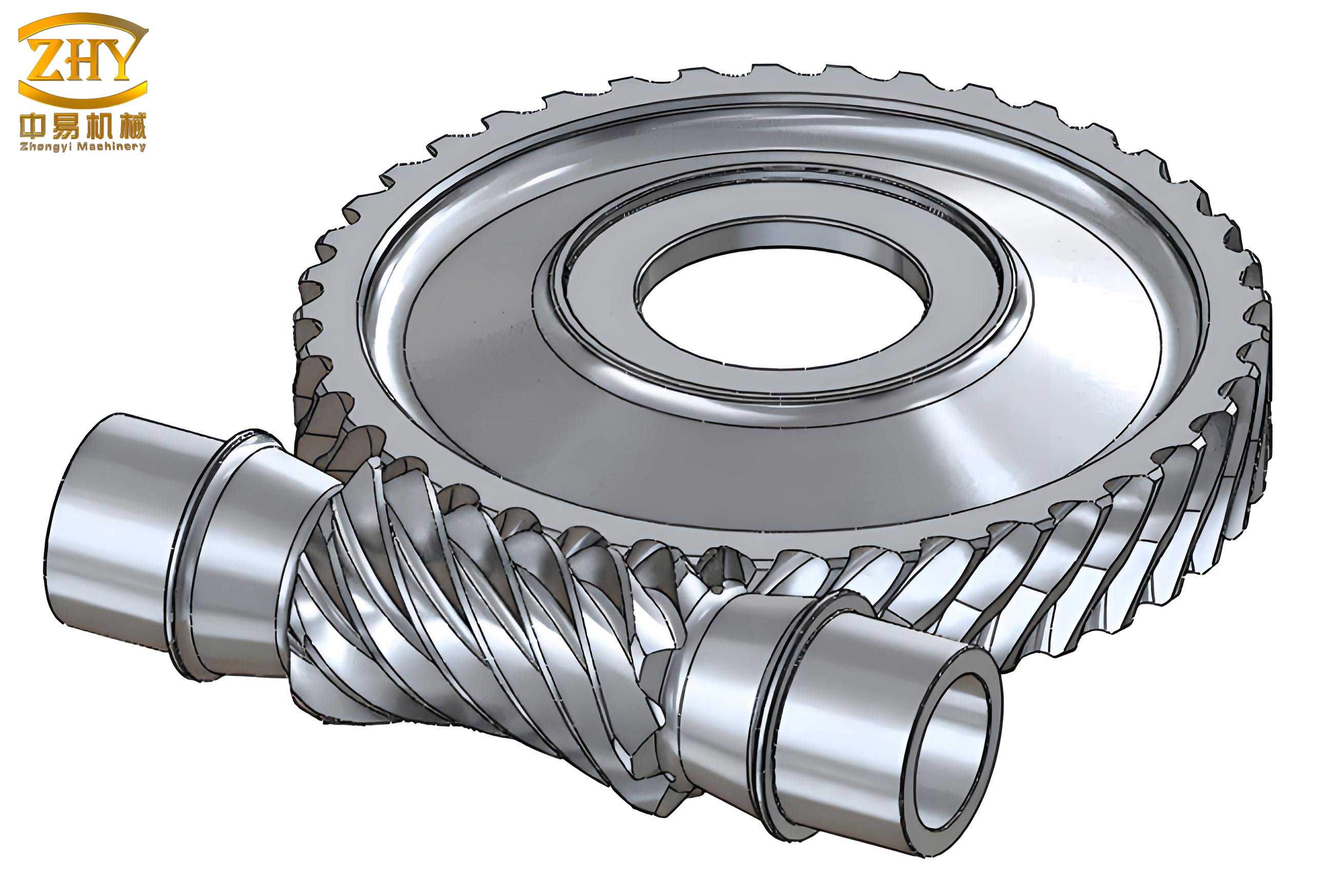
In stark contrast, the screw gear mechanism, most commonly exemplified by the worm and worm wheel, represents a non-intersecting, typically right-angled shaft configuration. The driving member, the worm, is essentially a threaded screw. As it rotates, its threads engage with the teeth of the worm wheel, causing it to turn. This interaction involves a significant sliding motion along the tooth face, which is a defining characteristic. A critical and often exploited feature of the single-start screw gear drive is its potential for irreversibility or self-locking; the worm can easily drive the wheel, but the wheel cannot back-drive the worm due to the high friction angles involved, a valuable safety feature in holding loads like in a brake or hoist system.
Comparative Performance Analysis: Gears vs. Screw Gears
Selecting the appropriate传动 system for a mining machine involves weighing a matrix of performance parameters. The following table and subsequent analysis highlight the key differences.
| Performance Parameter | Parallel/Bevel Gear Trains | Screw Gear (Worm Gear) Drives |
|---|---|---|
| Primary Motion | Rolling/Sliding | Predominantly Sliding |
| Shaft Orientation | Parallel (Spur/Helical) or Intersecting (Bevel) | Non-intersecting, Typically 90° |
| Efficiency | High (96-99% per stage) | Moderate to Low (40-95%), highly dependent on ratio and lubrication |
| Speed Reduction Ratio (Single Stage) | Moderate (Up to 10:1 typical) | Very High (5:1 to 100:1 common, up to 500:1 possible) |
| Compactness | Good for given ratio | Excellent for high ratios |
| Noise & Vibration | Moderate to High (depends on precision) | Very Low and Smooth Operation |
| Overhauling (Back-driving) | Generally reversible | Often self-locking (non-reversible) |
| Heat Generation | Relatively low | Can be significant, requiring thermal design |
| Material Pairing | Typically steel/steel | Hardened steel worm / bronze or copper-alloy wheel common |
Efficiency and Thermal Management: The sliding action in a screw gear is the primary source of its lower efficiency compared to the rolling-dominant action of precision gear trains. The efficiency (η) of a worm gear can be approximated based on the lead angle (γ) and the coefficient of friction (μ):
$$ η = \frac{\tan γ}{\tan(γ + φ)} $$
where φ = arctan(μ) is the friction angle. This shows that efficiency increases with lead angle. The lost energy converts to heat, making effective lubrication and sometimes even cooling systems crucial for high-power mining applications to prevent thermal overload and lubricant breakdown.
Torque Density and Ratio: The unparalleled advantage of the screw gear is its ability to provide massive speed reduction and torque multiplication in a single, compact stage. This eliminates the need for multiple gear stages, simplifying design and saving space—a critical factor in the confined environments of mining machinery. The transmission ratio (i) for a single-start worm gear is simply:
$$ i = \frac{Z_{wheel}}{Z_{worm}} = \frac{N_{worm}}{N_{wheel}} $$
where Z are the number of teeth (threads on the worm) and N are rotational speeds. With Z_worm as low as 1 (single-start) and Z_wheel easily exceeding 50, high ratios are effortlessly achieved.
Load Capacity and Wear: Due to the conformal contact (line contact evolving from point) in a screw gear set, the contact area is relatively large, leading to good load-carrying capacity. However, the intense sliding friction necessitates the use of dissimilar, anti-friction materials. The worm is typically made from case-hardened steel for durability, while the wheel is often cast from phosphor bronze or other copper-based alloys to minimize wear and galling. This material choice impacts cost but is essential for longevity. The wear rate is a critical design factor, often analyzed using the stress and velocity factor (s_v):
$$ s_v = \frac{W_t}{a b} \cdot v_{sliding} $$
where W_t is the tangential load, a and b are the contact area dimensions, and v_sliding is the sliding velocity. Minimizing this product is key to durability.
Design Considerations for Mining Applications: Backlash Control and Reliability
In precision positioning systems within mining equipment, such as in cutter-head positioning or conveyor alignment mechanisms, minimizing backlash—the play between meshing teeth—is essential. This “消隙” (clearance elimination) is a critical design challenge.
Backlash in Screw Gears: Backlash in a screw gear set arises from manufacturing tolerances, thermal expansion, and wear over time. Uncontrolled backlash leads to positioning errors, impact loads, noise, and reduced system stiffness. Several techniques are employed to mitigate it:
- Pre-loading via Adjustable Centers: Designing the housing to allow precise adjustment of the center distance between the worm and wheel enables pre-loading the mesh to eliminate play, though this can slightly increase friction and heat.
- Spring-Loaded Split Worm Wheels: Using a worm wheel split radially and forced apart by a spring or elastic element ensures constant tooth contact on both flanks, effectively taking up backlash automatically.
- Dual Worm (Tandem) Arrangements: Employing two worms, 180° out of phase, engaging the same wheel. One worm is fixed, while the other is axially spring-loaded. This configuration forces the wheel teeth to contact both worm flanks simultaneously, nullifying backlash. This is a highly effective but more complex and costly solution.
The required level of backlash control must be balanced against efficiency losses and thermal effects introduced by pre-loading.
Reliability and Mean Time Between Failures (MTBF): For critical mining machinery, reliability is non-negotiable. The concept of MTBF and the “bathtub curve” model of failure rates is directly applicable to传动 systems. Components like the screw gear assembly exhibit three life phases:
$$ λ(t) = \begin{cases}
\text{Decreasing (Early Failures)} & t < t_1 \\
\text{Constant (Random Failures)} & t_1 \leq t \leq t_2 \\
\text{Increasing (Wear-Out Failures)} & t > t_2
\end{cases} $$
where λ(t) is the failure rate.
- Early Failures (0 – t1): Attributed to manufacturing defects, improper assembly, or material flaws. Rigorous quality control, run-in testing (“burn-in” or “烤机”), and proper initial lubrication are used to weed out these failures before deployment underground.
- Random Failures (t1 – t2): The useful life period where failure rate is low and constant. Reliability during this phase is maximized by robust design, adequate service factor selection, and preventive maintenance.
- Wear-Out Failures (t2+): The failure rate rises sharply due to cumulative wear, fatigue, and material degradation. For the screw gear, this is often marked by excessive tooth wear, pitting, or a rise in operating temperature. Predictive maintenance—monitoring vibration, temperature, and lubricant condition—is key to replacing components before catastrophic failure.
Ensuring a long and flat “random failure” period for a mining screw gear drive involves precise thermal design, filtration of lubricants, and the use of wear-resistant materials. The use of synthetic lubricants with extreme pressure (EP) additives can significantly extend the wear-out threshold t2.
Advanced Design and Material Innovations
The pursuit of higher power density, efficiency, and longevity drives innovation in screw gear technology for mining.
Tooth Geometry Optimization: Modern design software allows for the optimization of tooth profile (ZA, ZN, ZI, ZK types) and lead modifications to improve load distribution, reduce stress concentrations, and enhance lubrication film formation. A common goal is to maximize the contact ratio and minimize the specific sliding velocities.
Materials and Surface Engineering: Beyond traditional bronze wheels, new materials are emerging:
| Material Pairing | Advantages | Challenges/Cost |
|---|---|---|
| Hardened Steel Worm / Polyamide Wheel | Very low noise, good wear resistance, low weight, corrosion-resistant | Lower thermal conductivity, limited load & temperature |
| Hardened Steel Worm / Aluminum-Bronze Wheel | Higher strength than phosphor bronze, better wear resistance | Higher cost, may be more prone to corrosion in certain environments |
| Through-Hardened/Dual-Phase Steel Worms | High core strength and toughness, good for shock loads | May not achieve same surface hardness as case-hardened |
Surface treatments like nitriding, carburizing, and advanced coatings (DLC, TiN) on the worm threads drastically reduce friction and wear.
Hybrid and Planetary-Screw Systems: To overcome the efficiency limitations of pure worm drives, hybrid systems combining an initial planetary stage with a final screw gear stage are used. This allows the planetary stage to handle the bulk of the speed reduction at high efficiency, while the screw gear provides the final, large ratio step and the desired right-angle output in a compact package, offering a superior balance of performance characteristics.
Conclusion
The evolution of mining machinery is inextricably linked to advancements in power transmission technology. While parallel-axis齿轮 trains offer high efficiency and reliability for many applications, the screw gear, with its exceptional compactness, high single-stage reduction ratios, smooth operation, and potential for self-locking, occupies a vital and often irreplaceable niche. The selection between传动 types is a nuanced decision based on a trade-off analysis of ratio requirements, space constraints, efficiency targets, thermal management capabilities, and need for positional accuracy (backlash control). For the harsh, demanding environment of coal mining, the robustness of a well-designed screw gear system, coupled with rigorous reliability engineering practices—from MTBF-focused testing to advanced material selection and proactive maintenance strategies—ensures these critical components deliver the performance and longevity required for safe, efficient, and continuous operation. Future trends point towards further integration of advanced materials, optimized geometries via digital twin simulations, and intelligent condition monitoring, solidifying the role of the screw gear as a cornerstone of modern mining机械 design.