
In this comprehensive discussion, I will delve into the semi-rolling cutting method specifically designed for hypoid gears featuring equal-height teeth and high reduction ratios. This technique is pivotal in manufacturing precision hypoid gear sets, which are essential in various mechanical transmission systems due to their ability to handle high torque and provide smooth, efficient power transfer between non-intersecting, offset axes. The focus here is on the specialized processing approach that combines form cutting for the gear wheel (larger gear) and generating cutting for the pinion (smaller gear), ensuring optimal meshing performance for these high-ratio hypoid gear pairs.
Hypoid gears, a subtype of spiral bevel gears, are characterized by their offset axes, which allow for higher reduction ratios and greater design flexibility compared to standard bevel gears. The equal-height tooth design, where the tooth depth remains constant across the face width, simplifies manufacturing and enhances load distribution. The semi-rolling cutting method, as I will explain, involves a hybrid process: the gear wheel is cut using a form-cutting technique with a rotating cutter, while the pinion is generated via a rolling motion relative to a imaginary gear that replicates the gear wheel. This approach is particularly suited for high-reduction-ratio hypoid gear sets, where traditional full generating methods may be inefficient or impractical. Throughout this article, I will emphasize the principles, adjustments, and calculations involved, incorporating tables and formulas to summarize key aspects, and repeatedly highlight the importance of hypoid gear technology in modern engineering.
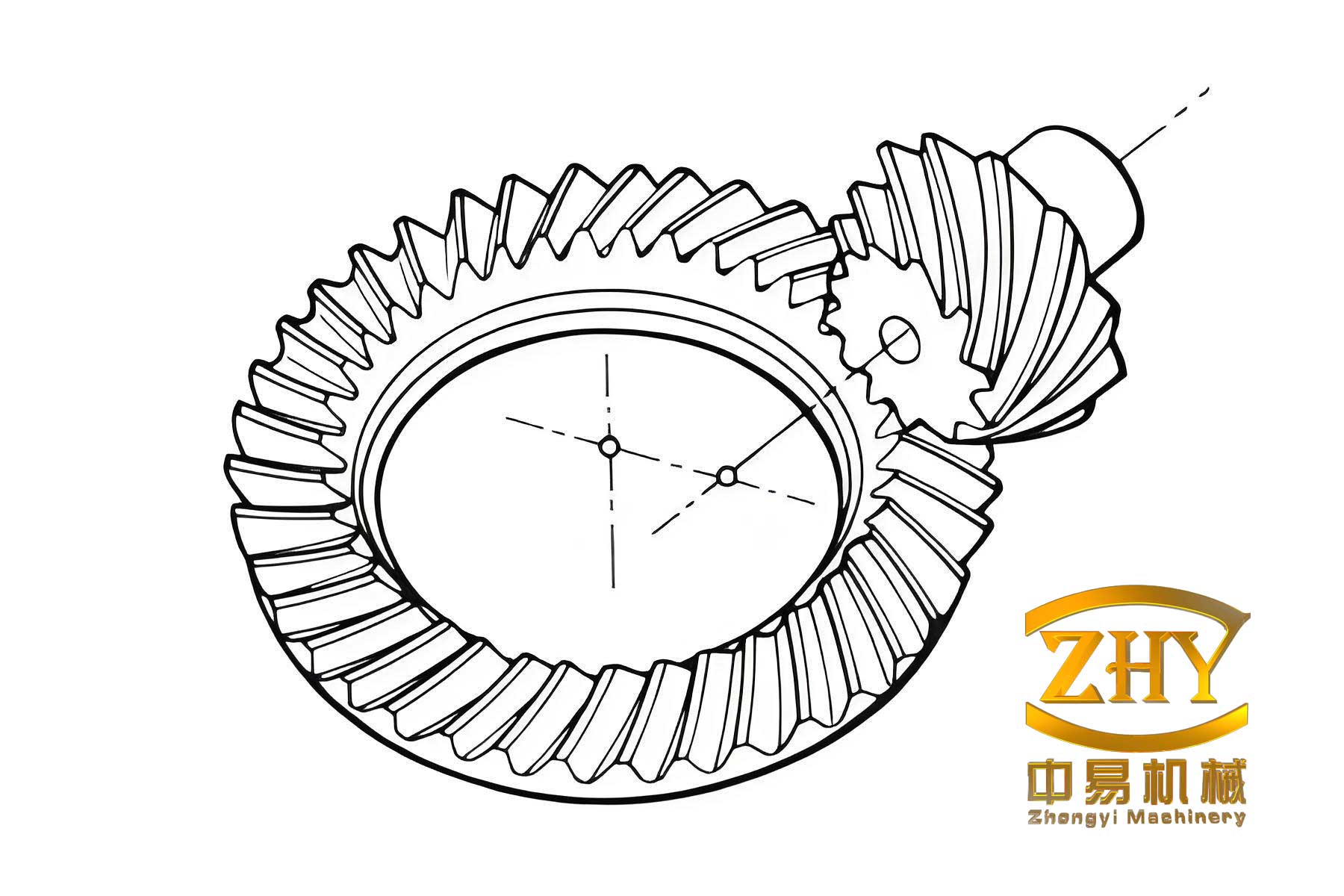
The core of the semi-rolling cutting method lies in its use of a dedicated machine tool, where the hypoid gear wheel is mounted vertically and the pinion horizontally, accommodating the offset and spiral angles. For the gear wheel, form cutting is employed using a cutter head whose blade profiles correspond to the conical surface generated by the rotating straight-edged tools. This results in simultaneous cutting of both concave and convex tooth flanks through a simple infeeding motion, eliminating the need for complex rolling motions. Conversely, the pinion is processed via a generating method based on the principle of reproducing the gear wheel as an imaginary gear. In this setup, the imaginary gear is identical to the actual gear wheel, simulating the meshing of the gear pair itself. This ensures conjugate action and precise tooth contact patterns for the hypoid gear set.
I will now detail the two primary structural configurations for these hypoid gears: the crown shape and the cone shape. Each requires specific adjustments and calculations during machining.
Crown Shape Hypoid Gear Processing
For crown shape hypoid gears, the pitch plane is a revolving surface containing the pitch point, which simplifies tooth line geometry as it remains parallel to the pitch plane and forms part of an arc consistent with the cutter diameter. This characteristic facilitates easier positioning of the cutter during machining. The ideal cutter for form cutting the gear wheel would have its axis perpendicular to the pitch plane, but this can cause secondary cutting issues. Therefore, in practice, a zero-degree pressure angle cutter is used, tilted at an angle to avoid such problems during rough milling.
The key adjustments involve horizontal and vertical cutter positions, derived from geometric relationships. Let me define the symbols commonly used in hypoid gear calculations:
| Symbol | Description |
|---|---|
| $E$ | Offset distance of the hypoid gear pinion axis |
| $\beta$ | Spiral angle of the gear wheel at the pitch point |
| $\beta’$ | Spiral angle of the pinion |
| $\delta$ | Pitch angle of the gear wheel (equal to face and root angles for equal-height teeth) |
| $\theta$ | Offset angle in the gear wheel’s rotational plane |
| $\phi$ | Offset angle in the pitch plane |
| $\alpha_0$ | Limit pressure angle in the normal plane |
| $R_m$ | Mean radius of the gear wheel |
| $L$ | Length of the gear wheel pitch cone element (mid-cone distance) |
| $\Delta L$ | Modification amount of the gear wheel pitch cone element |
| $r_0$ | Nominal cutter radius |
| $r_{0i}$ | Nominal ideal cutter radius |
| $a$ | Distance from the crossing point to the gear wheel pitch cone apex |
| $h_f$ | Gear wheel dedendum |
| $h_f’$ | Pinion dedendum |
| $\Delta r$ | Cutter radius correction amount |
| $Z_g$ | Gear wheel axis |
| $Z_p$ | Pinion axis |
For rough milling of the gear wheel using a zero-degree pressure angle cutter, the horizontal cutter position $X_0$ and vertical cutter position $Y_0$ are calculated as follows:
$$ X_0 = R_m \sin \beta – E \cos \beta $$
$$ Y_0 = R_m \cos \beta + E \sin \beta $$
Here, $\beta_0 = \beta – \alpha_0$, where $\beta_0$ is the tilt angle of the cutter axis relative to the pitch plane. It is crucial to select a standard cutter radius $r_0$ close to the ideal radius $r_{0i}$ to minimize deviations in tooth curvature, which could otherwise lead to excessive grinding allowances.
To achieve the theoretical tooth line, form grinding is employed for the gear wheel. In this process, the grinding wheel is dressed to match the cutter blade profile and tilted to simulate the ideal cutter. The ideal cutter radius for grinding is given by:
$$ r_{0i} = \frac{R_m}{\cos \beta} $$
The corresponding horizontal and vertical positions for grinding are:
$$ X_g = R_m \sin \beta $$
$$ Y_g = R_m \cos \beta $$
This setup ensures that the limit pressure angle $\alpha_0$ is maintained, the tooth line becomes a circular arc, and secondary cutting is avoided. The grinding wheel can be adjusted to the ideal radius more flexibly than standardized milling cutters.
For the pinion in crown shape hypoid gears, generating cutting is used with the cutter axis perpendicular to the pinion axis (and thus the pitch plane). The cutter must have inner and outer blades that coincide with the corresponding outer and inner blades of the ideal cutter used for grinding the gear wheel. The pinion is cut with the cutter top plane facing downward on the dedicated machine. The rough cutting positions are derived from the gear wheel positions, considering the opposite spiral angle:
$$ X_{p1} = -X_0 $$
$$ Y_{p1} = Y_0 $$
Fine cutting (or grinding) of the pinion involves separate control for concave and convex flanks. The fine cutting positions are calculated as:
For concave flank:
$$ X_{p2c} = X_{p1} – \Delta r \sin \beta $$
$$ Y_{p2c} = Y_{p1} + \Delta r \cos \beta $$
For convex flank:
$$ X_{p2v} = X_{p1} + \Delta r \sin \beta $$
$$ Y_{p2v} = Y_{p1} – \Delta r \cos \beta $$
The nominal cutter radius for pinion fine cutting equals the ideal cutter radius $r_{0i}$, with blade pressure angles set according to the ideal cutter. The pitch radii for inner and outer blades are computed based on the geometry of the hypoid gear set. For inner blade pitch radius $r_{pi}$ and outer blade pitch radius $r_{po}$:
$$ r_{pi} = r_{0i} + \frac{h_f}{2} + \left( \frac{h_f’}{2} \right) \tan \alpha_0 $$
$$ r_{po} = r_{0i} – \frac{h_f}{2} – \left( \frac{h_f’}{2} \right) \tan \alpha_0 $$
These adjustments ensure precise tooth contact and load distribution in the hypoid gear pair.
Cone Shape Hypoid Gear Processing
Cone shape hypoid gears offer a simpler processing method akin to conventional bevel gears, where the cutter axis is kept perpendicular to the pitch plane while maintaining the spiral angle $\beta$ at the pitch point. For a special case where the limit pressure angle $\alpha_0$ is zero, a zero-degree pressure angle cutter can be used directly for both gear wheel and pinion. However, I will focus on the general approach for high-ratio hypoid gears with equal-height teeth.
In the dedicated machine, the gear wheel is mounted vertically with its axis passing through the machine center. Since the pitch cone apex of the hypoid gear wheel often does not coincide with the crossing point, the pitch cone element length is modified as:
$$ L’ = L \pm \Delta L $$
where $+$ indicates the cone apex above the machine center, and $-$ indicates below.
The horizontal and vertical cutter positions for gear wheel machining are:
$$ X_0 = L’ \sin \delta – E \cos \beta $$
$$ Y_0 = L’ \cos \delta $$
The cutter feeds axially downward from the pitch plane to the dedendum $h_f$. Typically, cone shape hypoid gear wheels are made from special cast iron or bronze and do not require grinding.
For the pinion, generating cutting is performed with the cutter positioned to coincide with the gear wheel cutter’s blade profiles. The pinion is mounted horizontally, adjusted for offset $E$. The rough cutting positions mirror those of the gear wheel, accounting for opposite spiral angle direction:
$$ X_{p1} = -X_0 $$
$$ Y_{p1} = Y_0 $$
Fine cutting (or grinding) of the pinion follows similar separate flank control as for crown shape hypoid gears. The fine cutting positions are:
For concave flank:
$$ X_{p2c} = X_{p1} – \Delta r \sin \beta $$
$$ Y_{p2c} = Y_{p1} + \Delta r \cos \beta $$
For convex flank:
$$ X_{p2v} = X_{p1} + \Delta r \sin \beta $$
$$ Y_{p2v} = Y_{p1} – \Delta r \cos \beta $$
The pitch radii calculations for inner and outer blades are identical to those for crown shape hypoid gears, ensuring consistency in tooth geometry across different hypoid gear configurations.
Detailed Analysis and Formulas
To further elaborate on the semi-rolling cutting method, let me provide a deeper mathematical analysis. The meshing of hypoid gears involves complex spatial geometry, but the equal-height tooth design simplifies some aspects. The tooth surface equations can be derived based on cutter kinematics. For a gear wheel formed by a cutter with radius $r_0$ and tilt angle $\beta_0$, the tooth surface in parametric form is:
$$ \mathbf{r}_g(u,v) = \begin{bmatrix} (r_0 + u) \cos v – X_0 \\ (r_0 + u) \sin v – Y_0 \\ u \tan \alpha_0 \end{bmatrix} $$
where $u$ and $v$ are parameters along the tooth depth and width, respectively, with adjustments for spiral angle $\beta$.
The generating motion for the pinion involves simulating the meshing with the imaginary gear. The coordinate transformation between gear wheel and pinion axes is given by:
$$ \mathbf{T} = \begin{bmatrix} \cos \phi & -\sin \phi & 0 & E \cos \beta \\ \sin \phi & \cos \phi & 0 & E \sin \beta \\ 0 & 0 & 1 & 0 \\ 0 & 0 & 0 & 1 \end{bmatrix} $$
where $\phi$ is the rotation angle during generating. This ensures conjugate tooth surfaces for the hypoid gear pair.
Key parameters affecting hypoid gear performance include contact ratio, stress distribution, and efficiency. The contact ratio $C_r$ for equal-height teeth hypoid gears can be approximated as:
$$ C_r \approx \frac{L \cos \beta}{\pi m_n \cos \alpha_n} $$
where $m_n$ is the normal module and $\alpha_n$ is the normal pressure angle. High reduction ratios often necessitate larger spiral angles $\beta$, which enhance smoothness but require precise control in machining.
I summarize critical adjustment formulas for both crown and cone shapes in the table below:
| Adjustment | Crown Shape Formula | Cone Shape Formula |
|---|---|---|
| Gear Wheel Rough Cut $X_0$ | $R_m \sin \beta – E \cos \beta$ | $L’ \sin \delta – E \cos \beta$ |
| Gear Wheel Rough Cut $Y_0$ | $R_m \cos \beta + E \sin \beta$ | $L’ \cos \delta$ |
| Ideal Cutter Radius $r_{0i}$ | $\frac{R_m}{\cos \beta}$ | Not typically used for form cutting |
| Pinion Rough Cut $X_{p1}$ | $-X_0$ | $-X_0$ |
| Pinion Rough Cut $Y_{p1}$ | $Y_0$ | $Y_0$ |
| Pinion Fine Cut Concave $X_{p2c}$ | $X_{p1} – \Delta r \sin \beta$ | $X_{p1} – \Delta r \sin \beta$ |
| Pinion Fine Cut Concave $Y_{p2c}$ | $Y_{p1} + \Delta r \cos \beta$ | $Y_{p1} + \Delta r \cos \beta$ |
| Pinion Fine Cut Convex $X_{p2v}$ | $X_{p1} + \Delta r \sin \beta$ | $X_{p1} + \Delta r \sin \beta$ |
| Pinion Fine Cut Convex $Y_{p2v}$ | $Y_{p1} – \Delta r \cos \beta$ | $Y_{p1} – \Delta r \cos \beta$ |
These formulas are essential for setting up the machine tool accurately. The cutter radius correction $\Delta r$ is typically determined based on trial cuts or simulation to optimize tooth contact patterns for the hypoid gear set.
Practical Considerations and Applications
In practice, the semi-rolling cutting method for hypoid gears requires meticulous attention to machine alignment, cutter sharpness, and material properties. The dedicated machine must maintain precise relationships between the gear wheel and pinion axes, often incorporating CNC controls for automated adjustments. For high-ratio hypoid gears, where the reduction ratio can exceed 10:1, the offset $E$ and spiral angle $\beta$ are significant, influencing cutter positioning and tooth geometry.
When machining hypoid gears with equal-height teeth, the constant tooth depth simplifies tooling design but demands consistent cutter profiles across the face width. I recommend using high-quality carbide or ceramic cutters for milling and grinding to withstand the forces involved and ensure surface finish. Lubrication and cooling are critical to prevent thermal distortion, especially during grinding operations.
The applications of these hypoid gears span industries such as automotive differentials, aerospace transmissions, and industrial machinery, where high torque capacity and compact design are paramount. The semi-rolling cutting method enables efficient production of custom hypoid gear sets with tailored reduction ratios, supporting advancements in electric vehicles and robotics where precise motion control is needed.
To illustrate the impact of parameter variations, consider a hypoid gear set with $E = 30 \text{ mm}$, $\beta = 45^\circ$, $R_m = 100 \text{ mm}$, and $\alpha_0 = 20^\circ$. Using the formulas above, the ideal cutter radius for crown shape grinding is:
$$ r_{0i} = \frac{100}{\cos 45^\circ} \approx 141.42 \text{ mm} $$
The rough cutting positions for the gear wheel would be:
$$ X_0 = 100 \sin 45^\circ – 30 \cos 45^\circ \approx 70.71 – 21.21 = 49.50 \text{ mm} $$
$$ Y_0 = 100 \cos 45^\circ + 30 \sin 45^\circ \approx 70.71 + 21.21 = 91.92 \text{ mm} $$
These values guide the machine setup for producing a high-performance hypoid gear pair.
Conclusion
In summary, the semi-rolling cutting method for high-ratio hypoid gears with equal-height teeth is a sophisticated manufacturing technique that combines form cutting and generating principles. Through detailed adjustments and calculations, it ensures accurate tooth geometry and optimal meshing for demanding applications. I have covered the crown and cone shape configurations, provided key formulas and tables, and discussed practical aspects. The repeated focus on hypoid gear technology underscores its importance in modern mechanical systems. By mastering this method, manufacturers can produce reliable and efficient hypoid gear sets that meet the growing needs of high-torque, precision transmissions. As technology evolves, further refinements in CNC machining and simulation will enhance the production of these critical components, solidifying the role of hypoid gears in advanced engineering solutions.