
Gear transmissions are fundamental components in modern machinery, prized for their compactness, high efficiency, and stable transmission ratios. Among various gear types, herringbone gears offer distinct advantages by combining the benefits of helical gears while canceling out axial forces. This allows for the use of larger helix angles, typically between 25° and 40°, leading to smoother operation and higher load capacity compared to spur or single helical gears. However, like all mechanical systems, herringbone gear reducers generate vibration and noise during operation due to inherent dynamic excitations. Accurate prediction and control of this vibration and noise are crucial for enhancing performance, reliability, and comfort, especially in demanding applications like marine propulsion. The primary source of gearbox radiated noise stems from the dynamic bearing forces, which are themselves excited by internal gear mesh fluctuations. Therefore, a comprehensive study linking the system dynamics to the acoustic radiation is essential for effective design optimization.
This analysis focuses on a single-stage herringbone gear reducer. The dynamic model incorporates key internal excitations and support characteristics. The gear mesh is modeled considering the time-varying mesh stiffness, which fluctuates as the number of teeth in contact changes during rotation. Manufacturing and assembly imperfections are accounted for through gear transmission error, modeled as a harmonic function. The model also includes the complex stiffness and damping properties of the plain bearings (sleeve bearings) that support the shafts. These bearings exhibit cross-coupled stiffness and damping coefficients, meaning a displacement or velocity in one direction can generate a force in a perpendicular direction, adding complexity to the system’s dynamic response.
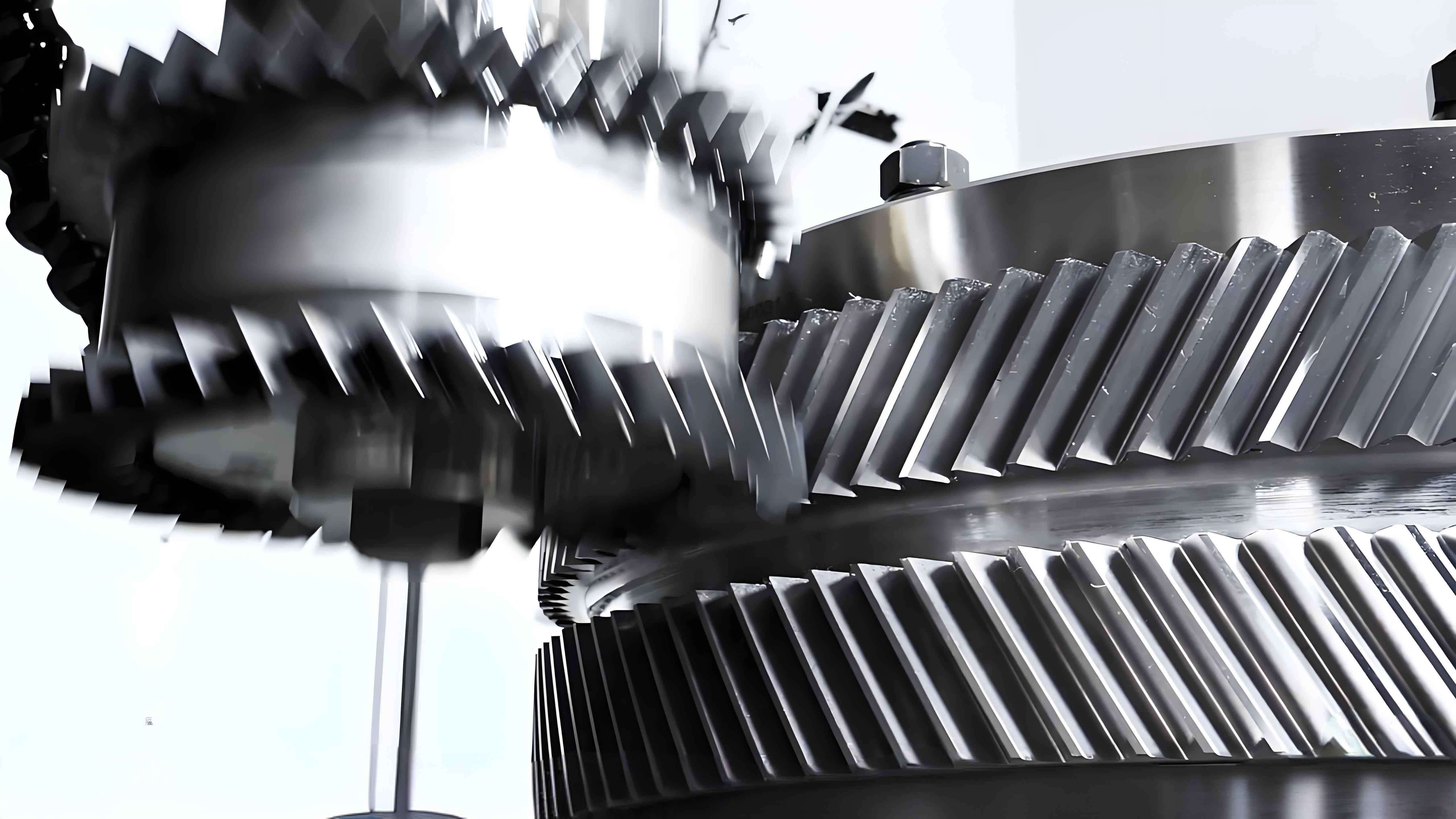
The core dynamic model is a 16-degree-of-freedom system representing the translational and rotational motions of the four gear halves (two on the input shaft, two on the output shaft). The model parameters for the specific reducer under study are summarized in Table 1.
| Parameter | Value |
|---|---|
| Gear Ratio | 37 / 106 |
| Normal Module (mm) | 5.0 |
| Pressure Angle (°) | 20 |
| Helix Angle (°) | 26.65 |
| Face Width (mm) | 92 |
| Input Speed (rpm) | 1600 |
The dynamic deformation along the line of action for each herringbone gear pair is crucial. For a gear pair, the total deformation \(\delta\) projected onto the line of action is a combination of the displacements of the pinion and gear, minus the excitation due to transmission error. For the two meshes of the herringbone gear (left and right helices), these deformations are:
$$
\begin{aligned}
\delta_1 &= (x_{p1} \sin\psi – y_{p1}\cos\psi + R_{p1}\theta_{p1}) \cos\beta_b + z_{p1} \sin\beta_b \\
&\quad – (x_{g1} \sin\psi – y_{g1}\cos\psi + R_{g1}\theta_{g1}) \cos\beta_b – z_{g1} \sin\beta_b – e\cos\beta_b \\
\delta_2 &= (x_{p2} \sin\psi – y_{p2}\cos\psi + R_{p2}\theta_{p2}) \cos\beta_b – z_{p2} \sin\beta_b \\
&\quad – (x_{g2} \sin\psi – y_{g2}\cos\psi + R_{g2}\theta_{g2}) \cos\beta_b + z_{g2} \sin\beta_b – e\cos\beta_b
\end{aligned}
$$
where \(x, y, z\) are translational displacements, \(\theta\) is torsional displacement, \(R\) is the base circle radius, \(\beta_b\) is the base helix angle, \(\psi\) is the pressure angle relative to the coordinate system, and \(e\) is the transmission error. The mesh forces are then composed of elastic and damping components:
$$
F_{k} = k_m(t) \delta, \quad F_{c} = c_m \dot{\delta}
$$
where \(k_m(t)\) is the time-varying mesh stiffness and \(c_m\) is the mesh damping. Applying Newton’s second law leads to the system’s equations of motion:
$$
[M]\{\ddot{X}\} + [C]\{\dot{X}\} + [K(t)]\{X\} = \{P(t)\}
$$
where \([M]\), \([C]\), and \([K]\) are the global mass, damping, and stiffness matrices, \(\{X\}\) is the displacement vector, and \(\{P(t)\}\) is the force vector containing the input torque. The stiffness matrix \([K(t)]\) is time-dependent due to \(k_m(t)\). The bearing dynamic coefficients used in the model are listed in Table 2. Their asymmetric nature (\(k_{yx} \neq k_{xy}\)) is evident.
| Bearing | \(k_{xx}\) (10^8 N/m) | \(k_{xy}\) (10^8 N/m) | \(k_{yx}\) (10^8 N/m) | \(k_{yy}\) (10^8 N/m) | \(c_{xx}\) (10^5 N·s/m) | \(c_{xy}\) (10^5 N·s/m) | \(c_{yx}\) (10^5 N·s/m) | \(c_{yy}\) (10^5 N·s/m) |
|---|---|---|---|---|---|---|---|---|
| Input Bearing 1 | 1.16 | -2.7 | 3.2 | 6.5 | 3.4 | 0.69 | 0.69 | 4.3 |
| Input Bearing 2 | 1.1 | -2.5 | 2.9 | 6.3 | 8.9 | 1.9 | 1.9 | 12 |
| Output Bearing 1 | 1.4 | -3.8 | 4.3 | 7.9 | 4.7 | 0.85 | 0.85 | 5.7 |
| Output Bearing 2 | 0.95 | -1.6 | 2.1 | 5.9 | 5.9 | 1.6 | 1.6 | 8.7 |
The system of equations is solved in the frequency domain using the Fourier Series Method to obtain the steady-state dynamic response. The resulting displacements and velocities are then used to calculate the dynamic bearing forces, which act as the primary excitation for the gearbox housing. The bearing force in a given direction (e.g., x-direction for bearing \(i\) on shaft \(l\)) is given by:
$$
F_{lix} = k_{lixx}x_{li} + k_{lixy}y_{li} + c_{lixx}\dot{x}_{li} + c_{lixy}\dot{y}_{li}
$$
The spectrum of these forces reveals that the dominant excitation frequency is the gear mesh frequency (GMF) and its harmonics. The input shaft bearings, supporting the smaller, less massive pinion, show a richer frequency content with more pronounced higher harmonics compared to the output shaft bearings.
The dynamic bearing forces are applied as excitations at the bearing locations on a finite element model (FEM) of the gearbox housing. The housing is modeled with solid elements, fixed at its base. A modal analysis yields the natural frequencies of the structure, as shown in Table 3. The closely spaced modes at higher frequencies are notable.
| Mode | Frequency (Hz) | Mode | Frequency (Hz) | Mode | Frequency (Hz) |
|---|---|---|---|---|---|
| 1 | 206.72 | 8 | 637.97 | 15 | 870.15 |
| 2 | 370.50 | 9 | 678.50 | 16 | 905.69 |
| 3 | 455.75 | 10 | 754.44 | 17 | 932.89 |
| 4 | 487.48 | 11 | 780.26 | 18 | 976.78 |
| 5 | 521.00 | 12 | 808.73 | 19 | 992.90 |
| 6 | 573.91 | 13 | 833.66 | 20 | 1050.26 |
| 7 | 632.92 | 14 | 859.45 | 21 | 1083.32 |
A structural dynamic response analysis is performed using the mode superposition method to obtain the vibration velocity on the housing’s outer surface. This surface vibration data is then used as the boundary condition for a Boundary Element Method (BEM) model to calculate the radiated sound pressure into the surrounding air field. The analysis shows that the radiated noise spectrum is dominated by peaks at the gear mesh frequency and its harmonics. Furthermore, peaks are observed at the housing’s natural frequencies (e.g., 206.72 Hz, 370.50 Hz, 455.75 Hz), indicating resonant amplification of the vibration. The noise is generally higher near the bearing caps than at the top of the housing due to the dominant vibration patterns.
A critical aspect of designing quiet herringbone gear reducers is understanding how operational parameters and manufacturing quality influence the final noise output. Three key factors are analyzed: operating load, mesh stiffness fluctuation amplitude, and gear precision grade.
Effect of Operating Load: The load does not change the excitation frequencies but significantly affects their amplitudes. The overall sound pressure level (SPL) increases with load. For the studied herringbone gear system, the relationship between the radiated noise level \(L\) and the load \(F\) approximately follows a logarithmic trend, particularly at medium to high loads. This aligns with empirical models like Niemann’s formula, which suggests \(L(n \times F) = L(F) + 20 \log_{10}(n)\), where \(n\) is a load multiplier. However, at very light loads (below 8000 N·m in this case), the influence of gear errors is more pronounced, causing deviation from this simple logarithmic law. The calculated overall SPL values are summarized in Table 4.
| Load (N·m) | Overall SPL (dB) |
|---|---|
| 1,500 | 63.88 |
| 3,000 | 65.56 |
| 6,000 | 68.93 |
| 8,000 | 70.80 |
| 10,000 | 72.40 |
| 20,000 | 77.86 |
| 30,000 | 81.24 |
Effect of Mesh Stiffness Fluctuation: The time-varying mesh stiffness \(k_m(t)\) is characterized by its mean value and its fluctuation amplitude \(A\). Analysis shows that for a given load, a larger fluctuation amplitude leads to higher radiated noise. This effect is more significant at higher loads. As shown in Table 5, the increase in noise from a 20% reduction in fluctuation (0.8A) to the nominal value (1.0A) is smaller at light loads and becomes more substantial as load increases up to a point, after which the effect stabilizes. This is because at very high loads, the overall noise level is dominated by the load magnitude itself.
| Load (N·m) | SPL for 0.8A (dB) | SPL for 1.0A (dB) | SPL for 1.2A (dB) |
|---|---|---|---|
| 1,500 | 63.59 | 63.88 | 64.19 |
| 6,000 | 67.65 | 68.93 | 70.09 |
| 10,000 | 70.80 | 72.40 | 73.78 |
| 20,000 | 76.04 | 77.86 | 79.37 |
| 30,000 | 79.37 | 81.24 | 82.78 |
Effect of Gear Precision Grade: Gear precision, which governs the magnitude of transmission error \(e\), has a profound impact on noise, especially under light load conditions. Higher precision (e.g., Grade 3) yields significantly lower noise compared to lower precision (e.g., Grade 5) when the load is small. This is because under light load, the elastic deformation of the teeth is small, making the geometric error a major contributor to the dynamic excitation. As the load increases, the tooth deflection increases, effectively “softening” the impact of a fixed geometric error. Consequently, the noise benefit of higher-precision gears diminishes with increasing load, as illustrated in Table 6. Furthermore, gear precision primarily affects noise at frequencies related to the mesh frequency and its lower harmonics; its impact on high-frequency noise components is minimal.
| Load (N·m) | SPL for Grade 3 (dB) | SPL for Grade 4 (dB) | SPL for Grade 5 (dB) |
|---|---|---|---|
| 1,500 | 61.53 | 63.88 | 66.48 |
| 6,000 | 68.21 | 68.93 | 70.03 |
| 10,000 | 72.04 | 72.40 | 72.98 |
| 20,000 | 77.73 | 77.86 | 78.07 |
| 30,000 | 81.16 | 81.24 | 81.35 |
In conclusion, the vibration and noise radiation of a herringbone gear reducer are complex phenomena resulting from the interaction of dynamic excitations within the gear pair and the structural response of the housing. The established simulation methodology, integrating a nonlinear dynamic model of the herringbone gear system with FEM/BEM acoustic analysis, provides a powerful tool for prediction and analysis. Key findings indicate that radiated noise increases logarithmically with operating load at medium to high loads, is amplified by greater mesh stiffness fluctuations, and is most sensitive to gear precision grade under light operating conditions. For optimal quiet design of herringbone gear reducers, especially those operating across a wide load range, a balanced approach is necessary: employing high-precision gears is most beneficial for low-load noise reduction, while managing mesh smoothness and structural resonances is critical for performance across the entire operational envelope. This study offers valuable theoretical guidance for the design and development of low-noise herringbone gear transmission systems.