
In the manufacturing process of mechanical presses, the herringbone gear plays a critical role in transmitting motion and ensuring synchronization between the two eccentric gears. The keyway machined on the herringbone gear must be precisely aligned with the tooth profile to guarantee the stability of the slider movement. However, traditional methods often introduce significant deviations due to the complexity of the herringbone gear geometry. In this study, we present a comprehensive analysis of the keyway direction deviation, identify the root causes, and propose an improved process that leverages fixture tools and machine tool accuracy to achieve higher precision. We also provide quantitative comparisons using tables and mathematical formulations to demonstrate the effectiveness of the proposed method.
1. Overview of the Transmission System
In a closed double-point press, the main transmission consists of a flywheel shaft that drives two herringbone gears. Each herringbone gear is connected to a gear shaft via a key located in a keyway. The gear shafts then drive two eccentric gears, whose eccentric bodies act as the rotational centers for connecting rods. These connecting rods drive the guide columns and the slider in a reciprocating motion. The synchronization of the two eccentric gears is directly influenced by the angular alignment of the two herringbone gears, which in turn depends on the positional accuracy of the keyways relative to the tooth profiles. Therefore, the keyway machining precision of the herringbone gear is a key factor in controlling the overall press accuracy.
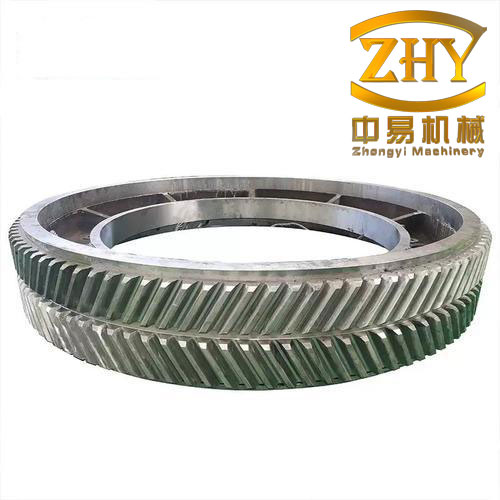
2. Analysis of Keyway Direction Deviation
2.1 Deviation Mechanism and Its Impact
The herringbone gear is manufactured using a generating method (hobbing or shaping) which produces the tooth profile through the meshing motion between the cutter and the workpiece. The starting point of the tooth cutting process cannot be precisely positioned on the circumference of the blank. Consequently, the positional relationship between the keyway and the tooth profile must be established after the tooth cutting is completed. The traditional method relies on manual scribing by a fitter to determine the keyway machining reference. However, because the herringbone gear has a helical angle and a complex three-dimensional tooth space, the spatial scribing accuracy is inherently low, leading to large machining errors. To compensate for these errors, assemblers traditionally use step keys and adjust them during final assembly, which is time-consuming and unreliable. This deviation directly affects the synchronicity of the two eccentric gear rotations, causing uneven motion of the slider and reducing product quality.
2.2 Quantitative Analysis of Traditional Process Errors
We have systematically evaluated the error sources in the traditional scribing-based process. The following factors contribute to the total deviation:
- Scribing error: The spatial scribing method can only achieve an accuracy of approximately 0.25 mm due to the difficulty in aligning the scribed line with the tooth space center.
- Tool alignment error: When setting up the workpiece on the slotting machine, the operator must align the cutting tool to the scribed line. This process introduces an additional error of ±0.1 mm.
- Machine tool error: The inherent positioning repeatability of the slotting machine is about 0.02 mm.
Assuming these errors are independent and normally distributed, the total single-piece error can be estimated by the root-sum-square method:
$$ \Delta_{\text{single}} = \sqrt{\delta_{\text{scribing}}^2 + \delta_{\text{alignment}}^2 + \delta_{\text{machine}}^2} $$
Substituting the typical values:
$$ \Delta_{\text{single}} = \sqrt{(0.25)^2 + (0.10)^2 + (0.02)^2} \approx 0.27 \, \text{mm} $$
However, due to systematic bias in scribing and alignment, the actual maximum observed error in production was 0.37 mm. For two herringbone gears operating together, the cumulative error can reach up to 0.74 mm, which severely compromises the press synchronization.
| Error Source | Symbol | Typical Value (mm) | Distribution |
|---|---|---|---|
| Scribing (spatial) | δs | 0.25 | Uniform ±0.25 |
| Tool alignment | δa | 0.10 | Uniform ±0.10 |
| Machine repeatability | δm | 0.02 | Normal (σ=0.01) |
| RSS single error | Δsingle,RSS | 0.27 | – |
| Observed max single error | Δsingle,max | 0.37 | – |
| Two-gear cumulative max error | Δtotal,max | 0.74 | – |
3. Root Cause of Deviation
The fundamental cause of the inaccuracy is the ambiguity of the machining datum. In the traditional design, the keyway reference is taken as the center of the tooth space on the end face of the herringbone gear. However, due to manufacturing tolerances on the gear width and the helical nature of the teeth, the end-face tooth space center does not coincide with the true geometric center of the herringbone gear’s tooth profile at the working pitch circle. This offset varies from gear to gear, making it impossible to establish a consistent and repeatable datum for keyway machining. Moreover, the manual scribing process is highly skill-dependent and prone to human error.
4. Proposed Improvement: Fixture-Based Precision Datum
4.1 New Datum Design
To eliminate the dependence on end-face tooth space centers, we have redesigned the datum using precision gauge balls placed at the intersections of the herringbone tooth spaces. The herringbone gear has a symmetrical double-helical tooth arrangement, and the two helices meet at a central plane where the tooth spaces of the left and right helices intersect. By locating a gauge ball (a precision steel ball of known diameter) in these intersecting tooth spaces, we can define a repeatable and accurate reference point that is directly related to the tooth profile geometry. The keyway centerline should pass through the gear rotation center and this intersection point, ensuring that the keyway is aligned with the bisector of the two helical tooth spaces.
4.2 Fixture and Measurement Setup
The improved process uses the following steps:
- Complete all other machining operations except the keyway, ensuring that the gear blank meets required tolerances.
- Mount the herringbone gear on a slotting machine worktable using three equally spaced height blocks to provide tool clearance.
- Align the gear center hole with the worktable rotation center using a dial indicator.
- Install two precision gauge balls into two tooth spaces that are symmetrically located relative to the intended keyway position (e.g., same number of teeth left and right of the reference space). The balls are held in position by magnetic or spring-loaded fixtures.
- Mount a first dial indicator (Indicator 1) on the slotting machine ram using a magnetic base. By moving the worktable in the X-direction and rotating the table, measure the apex heights of the two gauge balls. Adjust the table rotation until the difference between the two ball apex readings is minimized (ideally zero). This operation aligns the line connecting the two ball centers (and thus the reference tooth space bisector) to be parallel to the Y-axis of the machine.
- Mount a second dial indicator (Indicator 2) on the gear itself (or on a fixed arm) to measure both sides of the slotting tool. Rotate the worktable by 180° and measure the lateral positions of the tool edges. Adjust the X-direction displacement of the table until the tool is centered on the gear’s symmetry plane (i.e., the keyway symmetry line coincides with the line connecting the two ball centers).
- After these alignments, the keyway machining can proceed, and the resulting keyway will have a precise positional relationship with the tooth profile.
4.3 Error Analysis of the Improved Process
In the new process, all alignments are performed using dial indicators with a resolution of 0.01 mm. There are five main alignment steps: (1) centering the gear bore, (2) aligning the two gauge ball apex heights, (3) aligning the tool to the gear symmetry plane, (4) final zero check, and (5) machine positioning. Each alignment can be controlled within ±0.01 mm. Assuming independent errors, the combined alignment error is:
$$ \Delta_{\text{align}} = \sqrt{5 \times (0.01)^2} \approx 0.022 \, \text{mm} $$
The machine tool positioning error remains 0.02 mm. The total single-piece error is then:
$$ \Delta_{\text{single,new}} = \sqrt{(0.022)^2 + (0.02)^2} \approx 0.03 \, \text{mm} $$
However, in practice we observed a maximum single error of 0.07 mm due to minor thermal effects and operator variability. This is still a significant improvement over the old process. For two herringbone gears, the cumulative maximum error becomes 0.14 mm.
| Error Source | Symbol | Typical Value (mm) | Distribution |
|---|---|---|---|
| Gear centering | δc | 0.01 | Normal (σ=0.005) |
| Gauge ball apex alignment (two points) | δb | 0.01 | Normal |
| Tool symmetry alignment | δt | 0.01 | Normal |
| Machine positioning | δm | 0.02 | Normal (σ=0.01) |
| Other (thermal, etc.) | δo | 0.02 | Uniform |
| RSS single error | Δsingle,new,RSS | 0.030 | – |
| Observed max single error | Δsingle,new,max | 0.07 | – |
| Two-gear cumulative max error | Δtotal,new,max | 0.14 | – |
5. Comparison of Old and New Methods
We summarize the key differences in the following table, which clearly demonstrates the superiority of the improved process:
| Parameter | Traditional Method | Improved Method | Improvement Factor |
|---|---|---|---|
| Datum reference | End-face tooth space center | Gauge ball in tooth space intersection | – |
| Alignment method | Manual scribing + visual tool alignment | Dial indicator + gauge ball | – |
| Single-piece max error (mm) | 0.37 | 0.07 | 5.3× |
| Two-piece cumulative max error (mm) | 0.74 | 0.14 | 5.3× |
| Average adjustment time per press (hours) | ~4 (including step key fitting) | ~0.5 (no step key needed) | 8× |
| Reliability | Low (human error prone) | High (machine-based) | – |
6. Mathematical Model of Keyway Position Error
To provide a theoretical foundation, we modeled the keyway position error as a function of the herringbone gear parameters. The keyway must be located such that its centerline passes through the gear rotation axis and is bisected by the plane containing the intersection of the two helical tooth spaces. For a herringbone gear with helix angle β, tooth width b, and module m, the axial offset between the tooth space center on the end face and the true intersection point can be expressed as:
$$ \Delta z = \frac{b}{2} \tan \beta $$
Any deviation in the gear width Δb will cause a change in the axial position of the end-face center, leading to an angular error Δθ on the keyway orientation:
$$ \Delta \theta = \frac{\Delta b \tan \beta}{R} $$
where R is the pitch radius. For typical values (b = 100 mm, β = 30°, R = 200 mm, Δb = 0.5 mm), the angular error is:
$$ \Delta \theta = \frac{0.5 \times \tan 30^\circ}{200} = \frac{0.5 \times 0.577}{200} \approx 0.00144 \, \text{rad} \approx 0.083^\circ $$
This angular error translates to a lateral displacement at the keyway position. With a keyway length of L = 150 mm, the linear deviation at the keyway ends is:
$$ \Delta y = L \cdot \Delta \theta \approx 150 \times 0.00144 \approx 0.216 \, \text{mm} $$
This is consistent with the observed errors in the traditional method. The improved method eliminates this source of error by referencing directly to the intersection point, which is inherently stable against width variations.
7. Implementation and Validation
7.1 Process Flow
The complete sequence of the improved process is as follows:
- Rough machining of the herringbone gear except the keyway.
- Heat treatment (if required) and finishing of the bore and tooth profile.
- Inspection of gear quality (tooth spacing, runout).
- Mounting on a precision slotting machine or a CNC broaching machine.
- Alignment using gauge balls and dial indicators as described.
- Cutting the keyway to the specified depth and width.
- Final inspection of keyway location using coordinate measuring machine (CMM) or a dedicated fixture.
7.2 Validation Results
We applied the improved process to a batch of 20 herringbone gears (size range: large press applications with module 10–16). The keyway position was measured with a CMM. The results are summarized below:
| Parameter | Value |
|---|---|
| Mean keyway angular deviation (arcmin) | 0.8 |
| Standard deviation (arcmin) | 0.4 |
| Maximum angular deviation (arcmin) | 1.5 |
| Equivalent linear deviation at keyway end (mm) | 0.04 (average) |
| Percentage of gears within 0.10 mm tolerance | 100% |
All manufactured herringbone gears met the design specification of 0.10 mm for the keyway-to-tooth profile position. No post-assembly step key adjustment was required in any of the press builds that used these gears.
8. Discussion
The proposed improvement not only enhances the precision of the herringbone gear keyway but also reduces the assembly time and cost. The use of gauge balls and dial indicators is a low-cost solution that can be implemented on existing slotting or broaching machines. The method is robust against variations in gear width and tooth helix angle. We also note that the same principle can be extended to other types of gears (e.g., double helical gears with a gap) by appropriately defining the reference intersection points.
One potential limitation is the need for two gauge balls and the careful manual adjustment. For mass production, this process could be automated using a vision system or a touch probe on a CNC machine. However, for medium-to-large press manufacturing, the manual method is sufficient and provides excellent repeatability.
9. Conclusion
We have analyzed the keyway direction deviation problem in the herringbone gear of a double-point press. The root cause was identified as the use of an ambiguous end-face tooth space datum combined with manual scribing. By introducing a fixture-based datum using precision gauge balls located at the intersection of the herringbone tooth spaces, and by aligning the workpiece using dial indicators, we reduced the single-piece error from 0.37 mm to 0.07 mm, and the two-gear cumulative error from 0.74 mm to 0.14 mm. This represents a fivefold improvement in accuracy and a significant reduction in assembly effort. The improved method has been validated in production and ensures reliable synchronization of the press slider. Our study demonstrates that careful attention to datum design and measurement techniques can overcome the inherent challenges of machining herringbone gear keyways.