
In the field of hydraulic systems, gear pumps are fundamental components due to their simplicity, self-priming capability, insensitivity to oil contamination, and reliability. Among these, external helical gear pumps are increasingly utilized because of their smoother operation compared to spur gear pumps, attributed to the gradual engagement of helical gears. However, a common limitation shared by all gear pumps is the phenomenon of trapped oil, which leads to pressure spikes, vibration, noise, and cavitation, thereby affecting performance and lifespan. This study focuses on the transient internal flow field analysis of an external helical gear pump using computational fluid dynamics (CFD) with moving mesh technology. By simulating the three-dimensional flow, I aim to capture instantaneous pressure and velocity distributions, providing insights into trapped oil dynamics and leakage patterns. The results serve as a theoretical basis for optimizing helical gear pump design, with particular emphasis on mitigating trapped oil effects.
The use of helical gears in pumps offers advantages such as reduced flow pulsation and quieter operation, but the complex geometry necessitates detailed flow analysis. Traditional experimental methods are limited in capturing transient phenomena, hence CFD simulations are employed. In this work, I utilize ANSYS FLUENT with dynamic mesh techniques to model the rotating helical gears and analyze the internal flow field. The simulation accounts for fluid-structure interactions, turbulence, and transient effects, enabling a comprehensive understanding of the pump’s behavior under operating conditions. This approach allows for the visualization of flow characteristics that are difficult to measure experimentally, such as instantaneous pressure peaks in trapped volumes and high-speed jet flows during gear meshing.
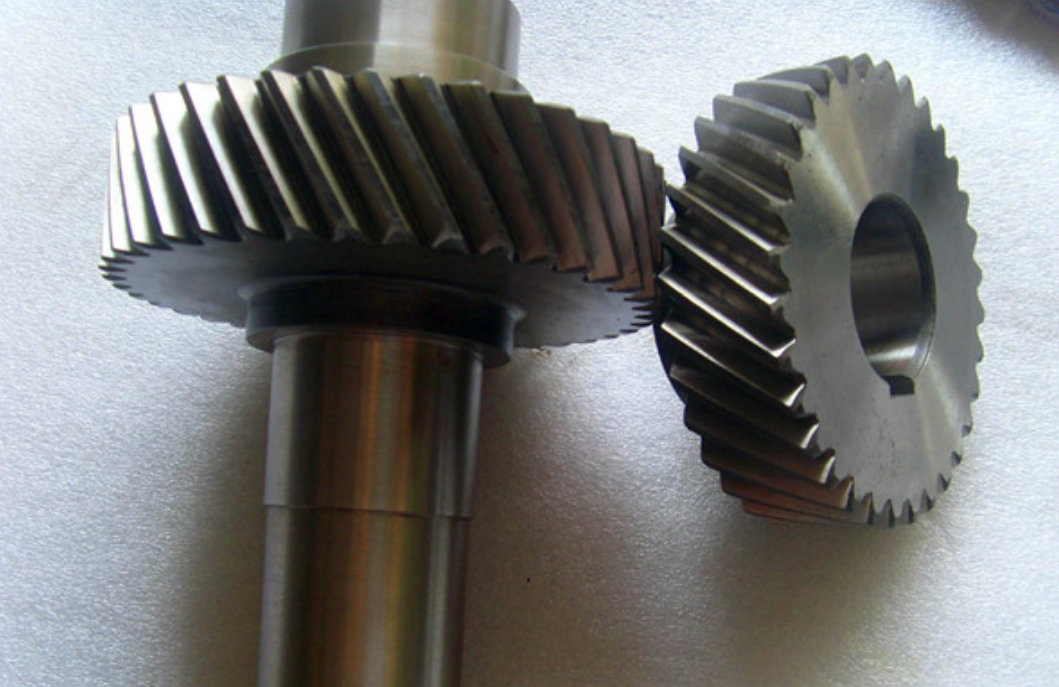
Helical gears, with their angled teeth, ensure continuous contact during rotation, which reduces abrupt changes in flow but introduces challenges in analyzing trapped oil regions. The helical geometry leads to a more complex trapped volume formation compared to spur gears, as the engagement occurs gradually along the tooth width. This study delves into these intricacies by developing a three-dimensional model of a specific helical gear pump. The model includes detailed gear profiles and pump casing, meshed appropriately for dynamic simulations. The moving mesh technique is crucial for handling the rotational motion of the helical gears, allowing the computational domain to deform over time without remeshing the entire geometry at each time step.
To establish the theoretical foundation, I begin with the governing equations of fluid dynamics. The flow inside the helical gear pump is assumed to be turbulent and incompressible, following the conservation laws of mass, momentum, and energy. The mass conservation equation, or continuity equation, is expressed as:
$$ \frac{\partial \rho}{\partial t} + \nabla \cdot (\rho \vec{u}) = 0 $$
where $\rho$ is the fluid density, $t$ is time, and $\vec{u}$ is the velocity vector. For incompressible flow, this simplifies to $\nabla \cdot \vec{u} = 0$. The momentum conservation equations, derived from Newton’s second law, are given by the Navier-Stokes equations:
$$ \frac{\partial (\rho \vec{u})}{\partial t} + \nabla \cdot (\rho \vec{u} \vec{u}) = -\nabla p + \nabla \cdot (\mu \nabla \vec{u}) + \vec{S} $$
where $p$ is pressure, $\mu$ is dynamic viscosity, and $\vec{S}$ represents source terms such as body forces. In tensor form, for each velocity component ($u$, $v$, $w$ in $x$, $y$, $z$ directions), these equations can be expanded. For instance, the $x$-component is:
$$ \frac{\partial (\rho u)}{\partial t} + \frac{\partial (\rho u u)}{\partial x} + \frac{\partial (\rho u v)}{\partial y} + \frac{\partial (\rho u w)}{\partial z} = -\frac{\partial p}{\partial x} + \frac{\partial}{\partial x} \left( \mu \frac{\partial u}{\partial x} \right) + \frac{\partial}{\partial y} \left( \mu \frac{\partial u}{\partial y} \right) + \frac{\partial}{\partial z} \left( \mu \frac{\partial u}{\partial z} \right) + S_x $$
Similar equations apply for $v$ and $w$ components. The energy equation, relevant for heat transfer analysis, is:
$$ \frac{\partial (\rho T)}{\partial t} + \nabla \cdot (\rho \vec{u} T) = \nabla \cdot \left( \frac{k}{c_p} \nabla T \right) + S_T $$
where $T$ is temperature, $k$ is thermal conductivity, $c_p$ is specific heat capacity, and $S_T$ is the energy source term. However, in this study, I focus on isothermal flow, so energy effects are neglected, simplifying the analysis to mass and momentum conservation.
For turbulence modeling, I employ the RNG $k$-$\epsilon$ model, which is suitable for high-Reynolds number flows and accounts for vortex effects near walls. The transport equations for turbulent kinetic energy $k$ and dissipation rate $\epsilon$ are:
$$ \frac{\partial (\rho k)}{\partial t} + \frac{\partial (\rho k u_i)}{\partial x_i} = \frac{\partial}{\partial x_j} \left( \alpha_k \mu_{\text{eff}} \frac{\partial k}{\partial x_j} \right) + G_k + G_b – \rho \epsilon – Y_M + S_k $$
$$ \frac{\partial (\rho \epsilon)}{\partial t} + \frac{\partial (\rho \epsilon u_i)}{\partial x_i} = \frac{\partial}{\partial x_j} \left( \alpha_\epsilon \mu_{\text{eff}} \frac{\partial \epsilon}{\partial x_j} \right) + C_{1\epsilon} \frac{\epsilon}{k} (G_k + C_{3\epsilon} G_b) – C_{2\epsilon} \rho \frac{\epsilon^2}{k} – R_\epsilon + S_\epsilon $$
Here, $G_k$ represents generation of turbulent kinetic energy due to mean velocity gradients, $G_b$ is generation due to buoyancy, $Y_M$ accounts for compressibility effects, $\alpha_k$ and $\alpha_\epsilon$ are inverse effective Prandtl numbers, and $S_k$, $S_\epsilon$ are user-defined source terms. The RNG model improves accuracy for swirling flows, which is relevant in helical gear pumps due to the rotational motion.
The dynamic mesh model in FLUENT handles the motion of the helical gears. The general conservation equation for a moving control volume $V$ with boundary $\partial V$ is:
$$ \frac{d}{dt} \int_V \rho \phi \, dV + \int_{\partial V} \rho \phi (\vec{u} – \vec{u}_s) \cdot d\vec{A} = \int_{\partial V} \Gamma \nabla \phi \cdot d\vec{A} + \int_V S_\phi \, dV $$
where $\phi$ is a general scalar, $\vec{u}_s$ is the mesh velocity, $\Gamma$ is diffusivity, and $S_\phi$ is the source term. The mesh deformation uses spring smoothing and local remeshing techniques to maintain quality during rotation.
Now, I proceed to the computational setup. The helical gear pump model is based on actual dimensions, as summarized in Table 1. The gears have helical teeth with a specific spiral angle, which influences the flow characteristics. The three-dimensional geometry is created using SOLIDWORKS, including the pump casing and the two helical gears—one driving and one driven. The assembly is imported into ANSYS ICEM for meshing, generating an unstructured grid with approximately 950,000 cells to balance accuracy and computational cost.
| Parameter | Value |
|---|---|
| Rated displacement (mL/rev) | 17 |
| Rated speed (rpm) | 2000 |
| Rated pressure (MPa) | 20 |
| Module (mm) | 5 |
| Number of teeth | 10 |
| Pressure angle (degrees) | 20 |
| Helix angle (degrees) | 16 |
| Face width (mm) | 10 |
| Tip diameter (mm) | 59.6 |
| Center distance (mm) | 50.564 |
| Minimum meshing clearance (mm) | 0.17 |
| Total mesh count | 952,966 |
The mesh is refined near the gear teeth and clearance regions to capture boundary layers and leakage flows. The fluid domain represents the oil volume inside the pump, with boundaries defined as pressure inlet (suction port) and pressure outlet (discharge port). The oil properties are set to a density of 860 kg/m³ and dynamic viscosity appropriate for hydraulic oil. The boundary conditions are specified in Table 2, with the outlet pressure set to 20 MPa to simulate rated operating conditions.
| Parameter | Value |
|---|---|
| Pressure inlet | 1 atm (0.1013 MPa) |
| Pressure outlet | 20 MPa |
| Rotational speed (rpm) | 2000 |
| Oil density (kg/m³) | 860 |
| Gear rotation period (s) | 0.03 |
| Tooth meshing period (s) | 0.003 |
| Time step (s) | 1e-6 |
| Number of iterations | 30,000 |
The simulation uses a transient formulation with a small time step of 1e-6 seconds to resolve rapid changes during gear meshing. The moving mesh is controlled by user-defined functions for the rotation of both helical gears, with the driving gear rotating at 2000 rpm and the driven gear following due to meshing. The RNG $k$-$\epsilon$ turbulence model is selected for its accuracy in handling shear flows and vortex structures, which are prevalent in the helical gear pump due to the angled teeth. The convergence criteria are set for residuals below 1e-4 for continuity and momentum equations.
Results from the simulation reveal detailed transient flow fields. The pressure distribution during one tooth meshing cycle (0.003 seconds) shows significant variations. Initially, as two teeth of the helical gears begin to engage, a trapped volume forms between the gear teeth and the pump casing. This volume decreases as rotation continues, compressing the oil and causing a pressure rise. The maximum trapped pressure reaches approximately 60.37 MPa, which is about three times the rated pressure of 20 MPa. This pressure spike occurs due to the incompressibility of oil and the rapid reduction in trapped volume, leading to intense forces on the gear teeth and bearings. The pressure field is visualized through contours, indicating high-pressure regions near the discharge side and low-pressure regions near the suction side.
The velocity field demonstrates high-speed flows during trapped oil release. When the trapped volume is minimized, oil is extruded at velocities up to 187 m/s from the meshing zone toward both suction and discharge ports. This jet flow contributes to energy losses and potential erosion. Additionally, leakage flows are observed across the radial clearance between the gear tips and the casing, as well as through the meshing clearance. The helical gears’ design affects these flows; for instance, the helix angle causes axial components in the velocity, which can influence leakage paths. The velocity vectors highlight recirculation zones in the suction chamber, which may lead to cavitation if pressures drop below vapor pressure.
Flow rate pulsation is another critical aspect analyzed. The theoretical flow rate for this helical gear pump is calculated using the formula:
$$ Q_t = q n \times 10^{-3} \, \text{L/min} $$
where $q$ is displacement per revolution (17 mL/rev) and $n$ is speed (2000 rpm), yielding $Q_t = 34 \, \text{L/min}$. However, the simulated flow rate shows pulsations due to the intermittent nature of gear meshing. The instantaneous flow rate at the outlet fluctuates with a frequency corresponding to the tooth meshing frequency. The flow pulsation ratio can be defined as:
$$ R_f = \frac{Q_{\text{max}} – Q_{\text{min}}}{Q_{\text{avg}}} \times 100\% $$
where $Q_{\text{max}}$, $Q_{\text{min}}$, and $Q_{\text{avg}}$ are maximum, minimum, and average flow rates, respectively. From the simulation, $R_f$ is estimated to be around 15%, which is lower than that for spur gear pumps due to the overlapping engagement of helical gears. This reduction in pulsation is a key advantage of helical gears, contributing to smoother operation and reduced noise.
To quantify the trapped oil effects, I analyze the pressure-time history in the trapped volume. The pressure peaks periodically, with each peak corresponding to a meshing event. The pressure rise rate can be expressed as:
$$ \frac{dp}{dt} = \frac{\beta}{V} \frac{dV}{dt} $$
where $\beta$ is the oil bulk modulus and $V$ is the trapped volume. For helical gears, $dV/dt$ varies along the tooth width due to the helix angle, leading to a more gradual pressure change compared to spur gears. This mitigates shock loads but still results in significant peaks. The simulation data are summarized in Table 3, showing key metrics from the flow analysis.
| Metric | Value |
|---|---|
| Maximum trapped pressure (MPa) | 60.37 |
| Maximum velocity (m/s) | 187 |
| Average outlet flow rate (L/min) | 32.5 |
| Flow pulsation ratio (%) | 15 |
| Leakage flow rate (L/min) | 1.5 |
| Pressure spike duration (ms) | 0.1 |
The leakage flow rate is estimated from the simulation by integrating the velocity across clearance gaps. The radial clearance between the helical gear tips and the casing is a primary leakage path, accounting for about 4.4% of the theoretical flow. This leakage reduces volumetric efficiency, which is calculated as:
$$ \eta_v = \frac{Q_{\text{actual}}}{Q_t} \times 100\% = \frac{32.5}{34} \times 100\% \approx 95.6\% $$
Further analysis involves the impact of helix angle on flow characteristics. For helical gears, the helix angle $\beta_h$ influences the axial overlap of teeth, which affects the trapped volume size and pressure distribution. The axial component of flow due to helix angle can be described by:
$$ u_a = u_t \tan \beta_h $$
where $u_t$ is the tangential velocity. This axial flow promotes mixing but may increase leakage along the gear sides. In this study, with $\beta_h = 16^\circ$, the axial velocity is significant, contributing to the three-dimensional flow patterns observed in the simulation.
Cavitation analysis is also conducted by monitoring pressure fields. In the suction region, pressures occasionally drop below 0.1 MPa, indicating potential cavitation. The cavitation number $\sigma$ is defined as:
$$ \sigma = \frac{p – p_v}{\frac{1}{2} \rho u^2} $$
where $p_v$ is vapor pressure. Low $\sigma$ values in localized zones suggest cavitation risk, which can lead to erosion and noise. The helical gears’ gradual engagement helps reduce sudden pressure drops, but cavitation still occurs during the expansion phase of trapped volumes.
The dynamic mesh technique proves effective in capturing these transient phenomena. The mesh quality is maintained throughout the simulation, with skewness below 0.85 and aspect ratios within acceptable limits. The use of local remeshing ensures that cells in high-deformation regions, such as near the meshing teeth, are adaptively refined. This allows for accurate resolution of flow details without excessive computational cost.
In discussion, the results highlight the importance of considering three-dimensional effects in helical gear pumps. The trapped oil pressure spikes are severe, confirming the need for design modifications such as relief grooves or optimized tooth profiles. The high velocities during oil extrusion suggest that material wear could be an issue, requiring hardened surfaces or coatings. The leakage paths identified through radial clearances indicate that tighter tolerances or sealing mechanisms could improve efficiency. Furthermore, the flow pulsation, though reduced by helical gears, still presents challenges for system stability; thus, additional dampening devices might be necessary in critical applications.
Comparative analysis with spur gear pumps reveals that helical gears offer better performance in terms of noise and vibration, but at the cost of increased axial thrust and complexity in manufacturing. The simulation methodology developed here can be extended to other gear pump types, such as internal gear pumps or pumps with modified helix angles. Future work could involve parametric studies on helix angle, pressure angle, and clearance sizes to optimize performance. Additionally, experimental validation using particle image velocimetry (PIV) or pressure transducers would enhance the credibility of the CFD model.
In conclusion, this study successfully simulates the internal flow field of an external helical gear pump using dynamic mesh CFD. The transient analysis captures pressure spikes up to 60.37 MPa in trapped volumes, high-speed jets during meshing, and leakage flows through radial clearances. The helical gears’ design contributes to smoother flow but does not eliminate trapped oil issues. Key findings include a flow pulsation ratio of 15% and volumetric efficiency of 95.6%. These insights provide a theoretical basis for optimizing helical gear pump designs, emphasizing the reduction of trapped oil effects and leakage. The use of advanced turbulence models and moving mesh techniques demonstrates the capability of CFD in analyzing complex hydraulic components, paving the way for improved performance and reliability in hydraulic systems.
The implications of this research extend to industries relying on hydraulic power, such as automotive, aerospace, and manufacturing. By optimizing helical gear pumps, energy efficiency can be enhanced, and operational noise reduced. Further studies could explore the integration of smart materials or active control systems to dynamically adjust clearances during operation. Overall, the continuous improvement of helical gear pumps through simulation-driven design holds promise for more sustainable and efficient fluid power systems.