
In recent years, the wind power industry has experienced rapid growth globally, with China leading in new installed capacity. However, the technical level of wind turbine components, especially key parts like gear shafts, still lags behind that of developed countries. Wind turbine gearboxes operate under harsh conditions—exposed to extreme temperatures, dynamic loads, and environmental factors—making their reliability critical. Among these components, high-speed gear shafts are particularly prone to failure, which can lead to costly downtime and safety risks. In this article, I will present a detailed failure analysis of high-speed gear shafts used in wind turbine gearboxes, focusing on a case where multiple gear shafts fractured during trial runs. Through comprehensive testing and analysis, I aim to identify the root cause and provide insights for improving manufacturing processes.
The gear shafts in question were made from 17Cr2Ni2MoA steel, a common material for high-strength applications due to its excellent hardenability and toughness. A batch of five gear shafts was produced, and after assembly and trial operation, four exhibited tooth breakage, resulting in scrapping of the shafts and halting of gearbox installation. This incident underscores the importance of rigorous quality control in the production of gear shafts. My analysis involved a series of tests, including chemical composition analysis, macro- and micro-examination of fractures, metallographic studies, hardness measurements, and scanning electron microscopy (SEM). The goal was to determine whether the failure was due to material defects, heat treatment issues, or design flaws, and to distinguish liability for the quality incident.
From a first-person perspective, I conducted this investigation to shed light on the failure mechanisms and prevent recurrence. Gear shafts are critical in transmitting torque and speed in gearboxes, and their failure can have cascading effects on entire systems. By sharing my findings, I hope to contribute to the advancement of gear shaft manufacturing technologies, particularly in the wind energy sector where reliability is paramount. Throughout this article, I will use the term ‘gear shafts’ frequently to emphasize the focus on these components, and I will incorporate tables and equations to summarize key data and theoretical aspects.
The production process for these gear shafts involved several steps: steelmaking, forging, rough machining, preliminary heat treatment (normalizing and tempering), ultrasonic testing, semi-finishing machining, carburizing and quenching heat treatment, finishing machining, assembly, and trial operation. The failure occurred during the trial run, indicating that the issue might be related to the final product state rather than early processing stages. My analysis will systematically explore each potential factor, with a particular emphasis on the surface carburizing treatment, which is crucial for enhancing wear resistance and fatigue strength of gear shafts.
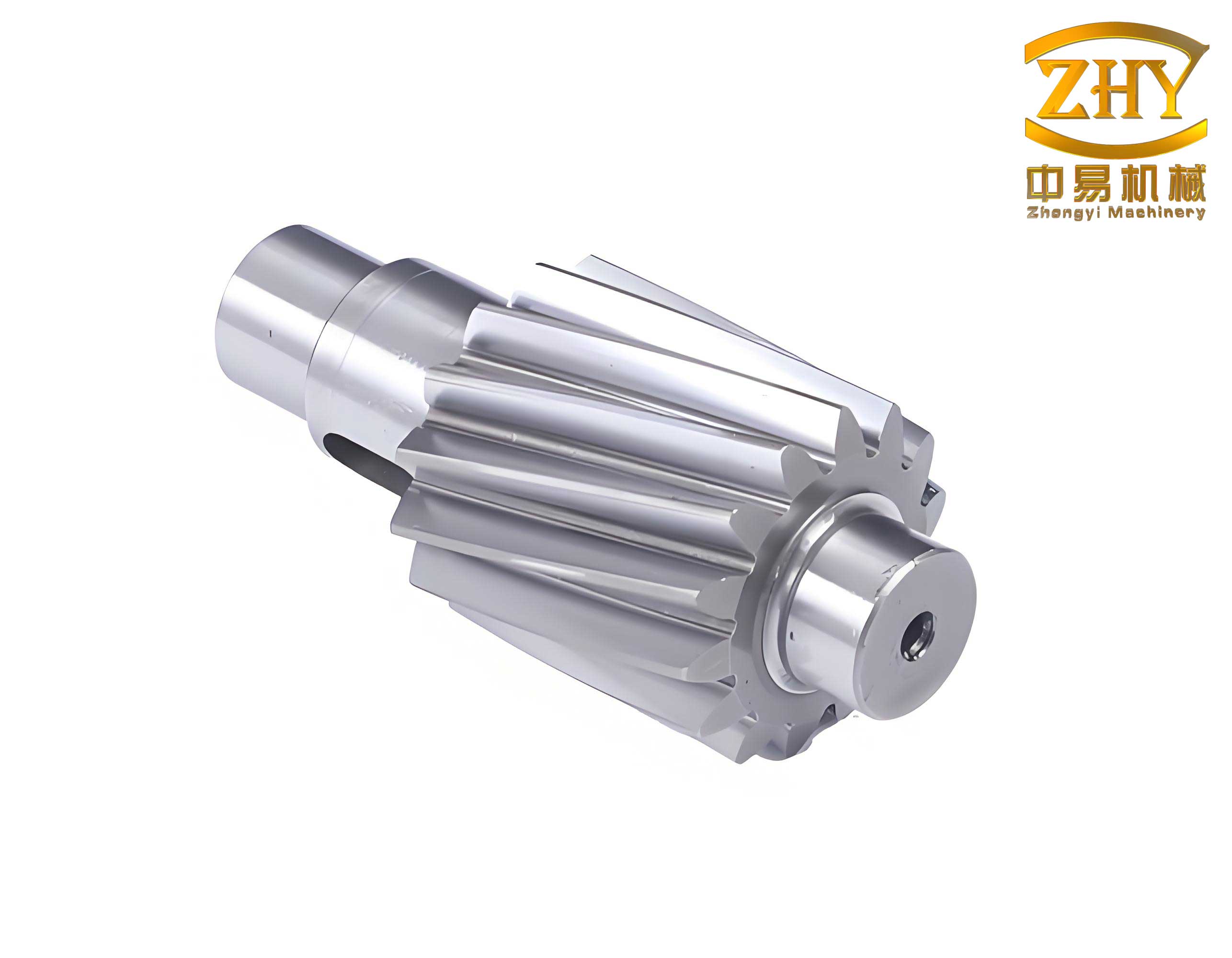
To begin, I performed chemical composition analysis using optical emission spectrometry according to ASTM E415-2008. The results, summarized in Table 1, show that the material composition of the failed gear shafts meets the technical requirements for 17Cr2Ni2MoA steel. This indicates that the failure is not attributable to material grade deviations or impurity elements. The table below provides a detailed comparison of measured values versus specifications.
| Element | Measured Value | Technical Requirement |
|---|---|---|
| C | 0.18 | 0.15–0.21 |
| Mn | 0.67 | 0.50–0.90 |
| Si | 0.25 | ≤0.40 |
| P | 0.009 | ≤0.015 |
| S | 0.002 | ≤0.005 |
| Cr | 1.64 | 1.50–1.80 |
| Ni | 1.51 | 1.40–1.70 |
| Al | 0.026 | 0.015–0.04 |
| Cu | 0.12 | ≤0.3 |
| V | 0.01 | – |
| H | ≤0.00002 | ≤0.0002 |
| O | 0.0013 | ≤0.0025 |
| N | 0.0148 | ≤0.015 |
| Mo | 0.29 | 0.25–0.35 |
Next, I conducted a visual inspection of the failed gear shafts. The breakage was concentrated in adjacent teeth on the shafts, with most fractures originating from the tooth roots. This pattern suggests that the root region experienced excessive stress during operation. Additionally, cracks were observed in unfractured teeth, also starting from the roots. The macro-fracture surfaces revealed two types of fractures: one with a single origin at the tooth root and clear fatigue beach marks, and another with multiple origins near the tooth surface, both showing fatigue characteristics. These observations point toward fatigue failure, which is common in dynamically loaded gear shafts.
For macrofractography, I cleaned the fracture surfaces and examined them under low magnification. The first type of fracture exhibited a smooth and bright origin area at the tooth root, followed by a propagation zone with distinct beach marks covering about 60% of the area, and a rough crystalline fast fracture zone covering 30%. The second type had multiple origins and a glossy surface with beach marks throughout. This indicates that the gear shafts underwent rapid fatigue failure, likely due to cyclic stresses exceeding the material’s endurance limit. The presence of beach marks is a classic indicator of fatigue in gear shafts, and their visibility suggests that the cracks propagated over a significant number of cycles before final rupture.
I also inspected the tooth surfaces for any abnormalities. On some teeth, I found extrusion marks with pits and cracks under microscopic examination. These marks likely resulted from contact with mating gears after initial tooth breakage, which altered the load distribution and accelerated failure in remaining teeth. This secondary damage complicates the analysis but reinforces the idea that the primary failure originated at the tooth roots.
To assess the internal quality of the gear shafts, I prepared transverse macro-metallographic specimens by sectioning the shafts and etching them with a 50% hydrochloric acid solution. The macro-structure appeared fine and dense, without significant defects like porosity, segregation, or voids. However, cracks were present in the tooth regions, with two types: one initiating from the tooth root and another from the pitch circle on the tooth surface. This aligns with the fracture observations and suggests that stress concentration at these locations played a key role.
Moving to microstructural analysis, I examined polished specimens under an optical microscope without etching to evaluate non-metallic inclusions. According to ASTM E45-2013, the inclusion levels were all below 1.0, indicating high material purity. After etching with 4% nital, I observed the microstructure near cracks. The cracks showed no oxidation or decarburization, and the surrounding matrix consisted of tempered martensite. Within the cracks, there were bright spherical particles that did not etch, suggesting they might be artifacts or embedded material. SEM-EDS analysis later confirmed that these particles had a composition similar to the matrix, indicating they are likely fragments from the fracture process rather than exogenous inclusions.
The carburized layer microstructure was evaluated per JB 6141.3-1992. The surface martensite and retained austenite, surface carbides, and core ferrite were all rated as grade 2, which is acceptable. The grain size, measured according to ASTM E112-2012, was grade 7, also within specifications. These results imply that the heat treatment process, in terms of microstructure and grain refinement, was properly conducted for the gear shafts.
However, a critical parameter for carburized gear shafts is the effective case depth, which directly affects fatigue performance. I measured the effective hardening depth using the micro-Vickers hardness method (ISO 2639-2002) with a 1 kg load and 12 s dwell time. The results, shown in Table 2, reveal that the case depth exceeded the technical requirement of 0.8–1.3 mm at all locations: tooth tip, tooth root, and tooth flank. This over-carburization, especially at the tooth root, can embrittle the material and reduce its fatigue strength.
| Location | Measured Depth (mm) | Technical Requirement (mm) |
|---|---|---|
| Tooth Tip | 1.79 | 0.8–1.3 |
| Tooth Root | 1.67 | 0.8–1.3 |
| Tooth Flank | 1.60 | 0.8–1.3 |
The hardness profile at the tooth root, for instance, can be modeled by an exponential decay function, where the hardness \( H \) as a function of depth \( x \) is given by:
$$ H(x) = H_s – (H_s – H_c) \cdot e^{-kx} $$
Here, \( H_s \) is the surface hardness, \( H_c \) is the core hardness, and \( k \) is a constant related to carburizing diffusion. For gear shafts, an optimal case depth ensures a balance between surface hardness and core toughness. Excessive depth, as observed, shifts the stress distribution unfavorably.
To further investigate, I performed SEM analysis on fracture surfaces. The fracture origin areas showed no evident defects like inclusions or pores. The propagation zones displayed fatigue striations, typical of cyclic loading. The fast fracture areas exhibited quasi-cleavage morphology. These micro-features confirm the fatigue nature of the failure. Additionally, EDS analysis of the spherical particles in cracks indicated compositions matching the base metal, with slight variations in Mo content, ruling out external contamination.
Based on these findings, I can discuss the failure mechanism. The gear shafts failed by rapid fatigue fracture, initiated at the tooth roots due to excessive bending stress. The root cause is the over-deep carburized layer, which increased martensite brittleness at the root region. In gear design, the tooth root experiences the highest bending stress during operation, as described by the Lewis formula for bending stress:
$$ \sigma_b = \frac{W_t}{F m Y} $$
where \( \sigma_b \) is the bending stress, \( W_t \) is the tangential load, \( F \) is the face width, \( m \) is the module, and \( Y \) is the Lewis form factor. For carburized gear shafts, the effective case depth should be optimized to withstand this stress without compromising toughness. When the case depth is too deep, the material at the root becomes more brittle, reducing its fatigue limit. The fatigue strength \( S_f \) can be approximated by:
$$ S_f = k_a k_b k_c S_e’ $$
where \( k_a \), \( k_b \), and \( k_c \) are modification factors for surface condition, size, and loading, respectively, and \( S_e’ \) is the endurance limit of the material. Over-carburization adversely affects \( k_b \) due to increased section size of hardened layer, lowering \( S_f \).
Moreover, the presence of multiple fatigue origins in some fractures indicates that after initial tooth breakage, the remaining teeth were overloaded, accelerating failure. The extrusion marks on tooth surfaces are consistent with this scenario. Thus, the failure propagated from a primary root-initiated crack to secondary cracks in adjacent teeth.
To prevent such failures in gear shafts, it is essential to control the carburizing process precisely. The effective case depth should be monitored using standardized tests, and heat treatment parameters must be optimized based on gear geometry and load conditions. For wind turbine gearboxes, where reliability is critical, non-destructive testing like residual stress analysis and ultrasonic inspection can be added to quality checks.
In conclusion, my analysis demonstrates that the breakage of high-speed gear shafts was caused by rapid fatigue fracture due to excessive carburized layer depth at the tooth roots. The material quality and microstructure were acceptable, but the case depth exceeded specifications, leading to embrittlement and reduced fatigue strength. This highlights the importance of stringent heat treatment control in manufacturing gear shafts. Future production should focus on optimizing carburizing duration and temperature to achieve the desired case depth, thereby enhancing the durability and performance of gear shafts in wind turbine applications.
Throughout this investigation, I have emphasized the role of gear shafts in power transmission systems and the need for rigorous quality assurance. By addressing this failure mode, manufacturers can improve the reliability of wind turbine gearboxes and contribute to the sustainable growth of wind energy. I recommend further research on case depth optimization and fatigue life prediction for gear shafts under dynamic loads.