
In the field of mechanical engineering, the manufacturing of power transmission components is critical, and among these, helical bevel gears hold a significant position due to their ability to transmit high loads with smooth operation, low noise, and minimal vibration. Traditional methods for producing helical bevel gears often involve cutting processes, which sever the metal fibers and compromise the continuity of the material structure, leading to reduced gear life and performance. In contrast, plastic forming techniques, such as rotary forging, offer a promising alternative by preserving metal flow lines, enhancing density, and improving mechanical properties like strength, wear resistance, and noise reduction. This study focuses on the application of rotary forging for helical bevel gears, utilizing three-dimensional finite element simulation to explore deformation mechanisms, metal flow patterns, and process optimization. The helical bevel gear, with its unique spiral tooth geometry, presents specific challenges in forming and demolding, which I address through innovative die design and computational analysis.
Rotary forging, also known as swing forging, is a progressive forming process where a conical die applies localized pressure on the workpiece axial end surface through a rolling motion. This method reduces the contact area significantly, allowing for continuous deformation with lower forces and energy consumption compared to conventional forging. For helical bevel gears, which typically have a small height-to-diameter ratio, rotary forging is particularly suitable as it minimizes defects like folding and ensures uniform metal distribution. In this article, I delve into the finite element modeling of the rotary forging process for helical bevel gears, examining key parameters such as stress-strain distributions, velocity fields, and load requirements. Furthermore, I propose a bearing-type cavity die to solve demolding issues inherent in helical bevel gear production. The insights gained from this simulation aim to advance the understanding of rotary forging applications for complex gear geometries and contribute to more efficient manufacturing practices.
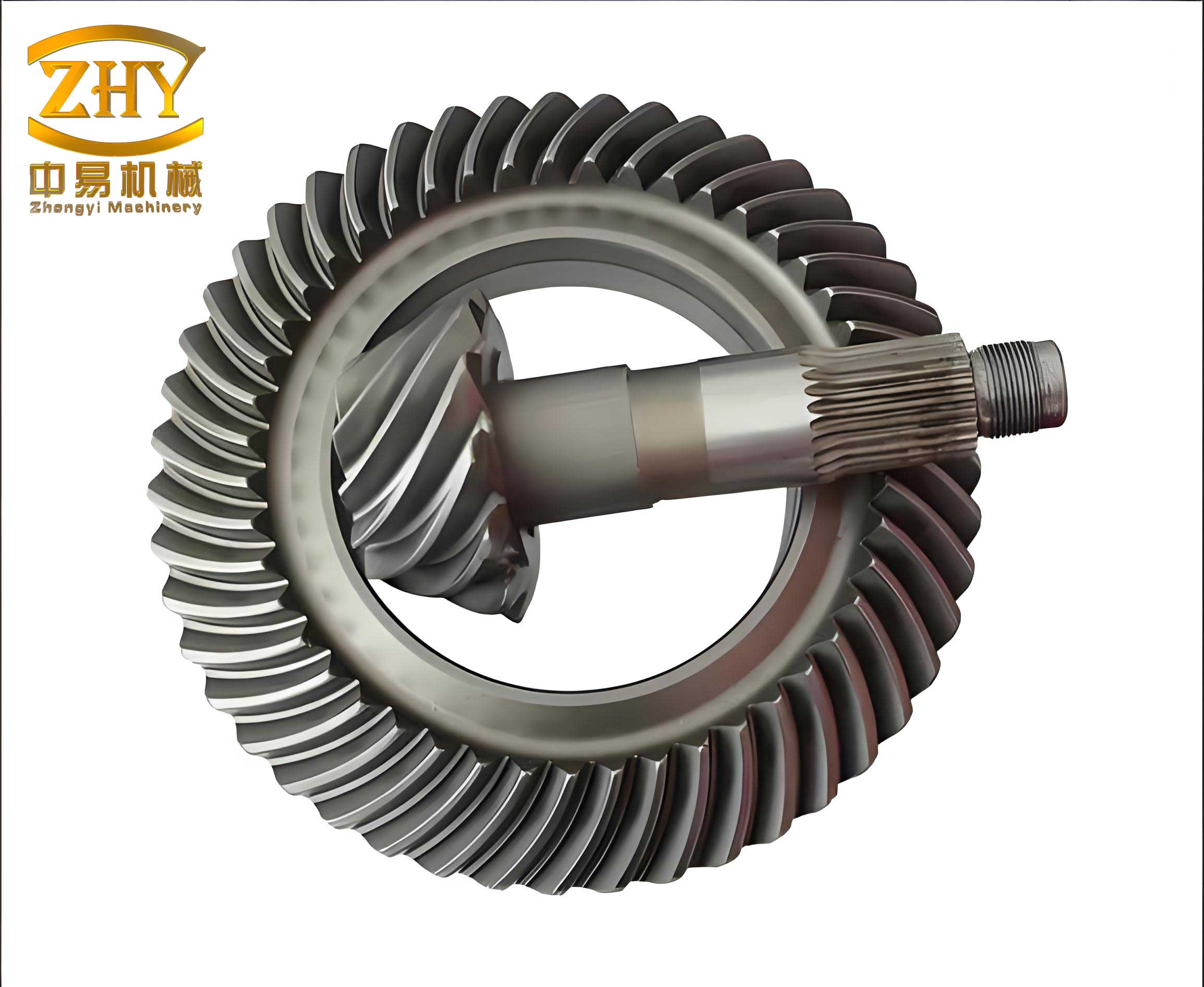
The helical bevel gear studied here has specific geometric parameters that influence the forming process. Key dimensions include the number of teeth (Z = 32), normal pressure angle (α = 20°), spiral angle (β = 20°), normal addendum coefficient (H = 1.25), normal clearance coefficient (C = 0.25), gear thickness (h₁ = 19.9 mm), large-end diameter (d₁ = 87 mm), small-end diameter (d₂ = 50.8 mm), and pitch angle (ε = 45°). These parameters define the complex spiral surface of the helical bevel gear, which necessitates careful consideration during simulation and die design. The initial billet dimensions are derived from volume consistency, with a large-end diameter of 87 mm, small-end diameter of 50.8 mm, and a height of 23 mm to ensure proper filling of the tooth cavities during forging. The material selected for analysis is AISI 4120 (20CrMn), a low-alloy steel commonly used in automotive applications due to its good hardenability and strength. The finite element model assumes a rigid-viscoplastic material behavior, neglecting elastic effects for simplicity, while incorporating strain hardening and strain rate sensitivity to accurately capture plastic deformation.
To establish the finite element model, I employ a three-dimensional approach using tetrahedral isoparametric elements for meshing the billet. The model includes a conical upper die that performs both orbital and rotational motions to simulate the rotary forging action, while the lower die remains stationary. The billet is positioned with the gear side facing downward into the cavity die, and constraints are applied to prevent rigid body displacement, mimicking practical setups with locating pins. The simulation parameters are summarized in Table 1, which outlines critical factors such as billet temperature, feed per revolution, die inclination angle, and rotational speeds. These parameters are optimized based on preliminary trials to ensure complete filling and minimize defects. The friction boundary condition follows a constant shear factor model, accounting for interfacial resistance between the die and workpiece, which affects metal flow and stress distribution.
| Parameter | Value |
|---|---|
| Billet Temperature (°C) | 850 |
| Feed per Revolution (mm/rev) | 0.3 |
| Die Inclination Angle (°) | 5 |
| Orbital Speed (rad/s) | 10.5 |
| Rotational Speed (rad/s) | 9.42 |
| Initial Mesh Size (min/max, mm) | 0.8 / 1.6 |
| Material | AISI 4120 (20CrMn) |
The theoretical foundation for this simulation relies on the rigid-viscoplastic finite element method, which is well-suited for large plastic deformation analyses. The material behavior adheres to the following assumptions: (1) Elastic deformation is negligible; (2) Body forces and inertia are ignored; (3) The material is homogeneous and isotropic; (4) Volume constancy holds during deformation; (5) The material obeys the von Mises yield criterion with isotropic hardening; and (6) Both strain hardening and strain rate hardening are considered. The governing equations include the equilibrium equations, constitutive relations, and compatibility conditions. For instance, the effective stress (\(\sigma_{\text{eff}}\)) and effective strain (\(\varepsilon_{\text{eff}}\)) are calculated based on the von Mises criterion:
$$\sigma_{\text{eff}} = \sqrt{\frac{3}{2} s_{ij} s_{ij}}$$
$$\varepsilon_{\text{eff}} = \sqrt{\frac{2}{3} \varepsilon_{ij} \varepsilon_{ij}}$$
where \(s_{ij}\) is the deviatoric stress tensor and \(\varepsilon_{ij}\) is the strain tensor. The constitutive relation incorporates strain rate sensitivity, expressed as:
$$\sigma = K \varepsilon^n \dot{\varepsilon}^m$$
where \(K\) is the strength coefficient, \(n\) is the strain hardening exponent, and \(m\) is the strain rate sensitivity exponent. For AISI 4120, typical values are \(K = 800 \, \text{MPa}\), \(n = 0.15\), and \(m = 0.01\) at elevated temperatures, though these are adjusted in the simulation based on empirical data. The friction model uses a constant shear factor \(\mu\), with a value of 0.3 assumed for hot forging conditions, to represent the shear stress at the die-workpiece interface:
$$\tau = \mu \sigma_y$$
where \(\tau\) is the frictional shear stress and \(\sigma_y\) is the yield stress of the material. These equations form the basis for the finite element analysis, enabling the prediction of deformation patterns and loads during rotary forging of helical bevel gears.
Simulation results reveal detailed insights into the deformation behavior of helical bevel gears under rotary forging. The process involves localized loading, where the conical die contacts the billet axially, creating distinct zones: an active deformation region (contact area) and a passive deformation region (non-contact area). As the die progresses, metal flow occurs primarily in the active region, with radial, axial, and tangential components due to the spiral geometry of the helical bevel gear. Figure 3 in the original text (not shown here) illustrates the distribution of effective stress and effective strain at different reduction percentages (40%, 70%, and 100%). At 40% reduction, metal begins to fill the upper tooth cavities, with higher stress and strain concentrations near the tooth root circle, reaching values around 250 MPa and 1.20, respectively. This indicates that initial deformation focuses on the upper portion of the helical bevel gear, driven by the axial pressure from the die.
As reduction increases to 70%, the lower part of the billet starts to deform, with metal flowing along the spiral tooth surfaces to fill the cavities uniformly. By 100% reduction, the tooth profiles are completely filled, and stress-strain peaks occur at the tooth tips and corners, with maximum effective stress of 320 MPa and effective strain of 2.0. This progressive filling ensures that metal fibers align continuously along the tooth contours, enhancing the mechanical integrity of the helical bevel gear. The velocity field distribution at full reduction, as shown in Figure 4 of the original text, demonstrates that metal flow velocities are highest in the contact region, following the spiral paths without intersections, which prevents defects like folding or incomplete filling. The velocity vectors radiate outward along the helix, confirming that the helical bevel gear design facilitates smooth metal movement during rotary forging.
A critical aspect of this study is the comparison of load requirements between rotary forging and conventional die forging for helical bevel gears. The load-stroke curve, derived from simulation data, indicates that rotary forging significantly reduces the forming force. For instance, at full reduction, the rotary forging load is approximately 550 kN, which is only about 1/15 of the load required in traditional die forging under identical conditions. This reduction is attributed to the localized contact and progressive deformation in rotary forging, which lowers the instantaneous pressure on the dies. The load comparison is summarized in Table 2, highlighting the efficiency of rotary forging for helical bevel gear production. Such savings in force translate to lower equipment costs, reduced energy consumption, and extended die life, making rotary forging an economically viable option for mass production of helical bevel gears.
| Forming Method | Maximum Load (kN) | Reduction Relative to Die Forging |
|---|---|---|
| Rotary Forging | 550 | 1/15 |
| Die Forging | 8250 (estimated) | Baseline |
Another innovative contribution of this work is the design of a bearing-type cavity die to address demolding challenges specific to helical bevel gears. Due to the spiral tooth surfaces, conventional ejection methods are ineffective, as the gear cannot be simply pushed out axially without damaging the teeth or the die. The proposed die structure, illustrated in Figure 6 of the original text, incorporates a rotating mechanism where the cavity die can freely rotate around the gear axis. During ejection, when an ejector pin applies an axial force to the forged helical bevel gear, the gear exerts a tangential force on the die via the spiral tooth contacts, causing the die to rotate synchronously. This rotational motion allows the helical bevel gear to be unscrewed from the cavity smoothly, minimizing wear and ensuring geometric accuracy. The bearing assembly includes cylindrical rollers, an outer ring, and an inner ring that serves as the cavity die, as detailed in Table 3. This design not only solves the demolding issue but also enhances the durability of the tooling for repeated use in helical bevel gear manufacturing.
| Component | Function |
|---|---|
| Inner Ring (Cavity Die) | Holds the helical bevel gear shape and rotates during ejection |
| Outer Ring | Supports the bearing structure and provides stability |
| Cylindrical Rollers | Facilitate smooth rotation with minimal friction |
| Ejector Pin | Applies axial force to initiate demolding |
To further analyze the metal flow dynamics in helical bevel gear rotary forging, I examine the strain rate distribution and its impact on microstructure evolution. The strain rate (\(\dot{\varepsilon}\)) varies across the workpiece, with higher values in the active deformation zones, which can influence grain refinement and mechanical properties. For helical bevel gears, the spiral angle (\(\beta\)) plays a key role in directing metal flow, as described by the helix equation:
$$x = r \cos(\theta), \quad y = r \sin(\theta), \quad z = \frac{p \theta}{2\pi}$$
where \(r\) is the radius, \(\theta\) is the angular position, and \(p\) is the pitch of the helix. This geometry ensures that metal particles follow curved paths, reducing the likelihood of stagnation zones that could lead to defects. The finite element simulation captures these paths, showing that the helical bevel gear tooth cavities are filled from the top downward, with the final filling occurring at the small-end tooth tips. This sequence is crucial for avoiding voids and ensuring density uniformity, which is vital for the fatigue resistance of helical bevel gears in service.
Moreover, the temperature distribution during rotary forging affects material flow and die wear. Although the simulation assumes isothermal conditions for simplicity, in practice, thermal effects can be significant. For helical bevel gears, the localized deformation in rotary forging may generate heat due to plastic work and friction, potentially altering the flow stress. A more advanced model could incorporate thermal coupling, using the heat conduction equation:
$$\rho c_p \frac{\partial T}{\partial t} = k \nabla^2 T + \dot{q}$$
where \(\rho\) is density, \(c_p\) is specific heat, \(k\) is thermal conductivity, and \(\dot{q}\) is the heat generation rate from deformation and friction. Future studies on helical bevel gear forging might explore such thermo-mechanical analyses to optimize process parameters like billet temperature and die cooling, further enhancing the quality of helical bevel gears.
The advantages of rotary forging for helical bevel gears extend beyond load reduction to include improved dimensional accuracy and surface finish. The continuous rolling action of the die polishes the tooth surfaces, reducing the need for post-machining. This is particularly beneficial for helical bevel gears used in precision applications, such as automotive differentials or aerospace transmissions. Additionally, the fine-grained microstructure resulting from progressive deformation can enhance hardness and wear resistance, extending the service life of helical bevel gears. Table 4 summarizes the key benefits observed from the simulation and design efforts, emphasizing why rotary forging is a superior method for helical bevel gear production compared to traditional techniques.
| Benefit | Description |
|---|---|
| Reduced Forming Load | Lower forces decrease equipment costs and energy usage for helical bevel gears |
| Improved Metal Flow | Continuous fibers enhance strength and fatigue resistance in helical bevel gears |
| Better Dimensional Accuracy | Tight tolerances reduce machining needs for helical bevel gears |
| Enhanced Surface Quality | Smoother tooth surfaces lower noise and wear in helical bevel gears |
| Efficient Demolding | Bearing-type die design simplifies ejection of helical bevel gears |
In conclusion, this study demonstrates the feasibility and advantages of rotary forging for manufacturing helical bevel gears through comprehensive three-dimensional finite element simulation. The helical bevel gear deformation process is characterized by progressive filling of tooth cavities along spiral paths, with minimal defects and uniform stress-strain distributions. The load analysis confirms that rotary forging requires only a fraction of the force needed in conventional die forging, offering economic and technical benefits. Furthermore, the innovative bearing-type cavity die solves the demolding challenge, enabling practical implementation for helical bevel gear production. These findings contribute to the advancement of plastic forming technologies for complex gear geometries, paving the way for wider adoption of rotary forging in industries reliant on high-performance helical bevel gears. Future work could focus on experimental validation, optimization of die materials, and integration of real-time control systems to further refine the process for helical bevel gears.
To expand on the theoretical aspects, the finite element method used here solves the boundary value problem for plastic deformation iteratively. The virtual work principle is applied, minimizing the functional \(\Phi\) given by:
$$\Phi = \int_V \bar{\sigma} \dot{\bar{\varepsilon}} \, dV + \int_{S_f} \tau |\Delta v| \, dS – \int_{S_t} T_i v_i \, dS$$
where \(\bar{\sigma}\) is the effective stress, \(\dot{\bar{\varepsilon}}\) is the effective strain rate, \(\tau\) is the frictional stress, \(\Delta v\) is the velocity discontinuity, \(T_i\) are surface tractions, and \(v_i\) are velocities. This formulation allows for accurate prediction of metal flow in helical bevel gears during rotary forging. Additionally, the mesh refinement strategy ensures convergence, with adaptive remeshing applied in high-strain regions to maintain accuracy. For helical bevel gears, this is crucial around tooth roots and tips where stress concentrations occur.
Another important consideration is the effect of process parameters on the final quality of helical bevel gears. Sensitivity analyses can be conducted by varying factors like die angle, feed rate, or rotational speed. For instance, increasing the spiral angle (\(\beta\)) might alter metal flow patterns, requiring adjustments in die design. Similarly, the billet temperature influences flow stress, as described by the Arrhenius-type equation:
$$\sigma = A \varepsilon^n \exp\left(\frac{Q}{RT}\right)$$
where \(A\) is a material constant, \(Q\) is activation energy, \(R\) is the gas constant, and \(T\) is absolute temperature. Optimizing these parameters for helical bevel gears can lead to even better performance and efficiency.
In summary, the helical bevel gear rotary forging process represents a synergy of advanced simulation techniques and innovative engineering design. By leveraging finite element analysis, I have uncovered deformation mechanics that underscore the suitability of rotary forging for helical bevel gears. The helical bevel gear geometry, with its spiral teeth, is well-accommodated by this method, resulting in superior mechanical properties and production economics. As industries continue to demand higher-performance components, rotary forging for helical bevel gears is poised to become a standard manufacturing approach, driven by insights from studies like this one.