
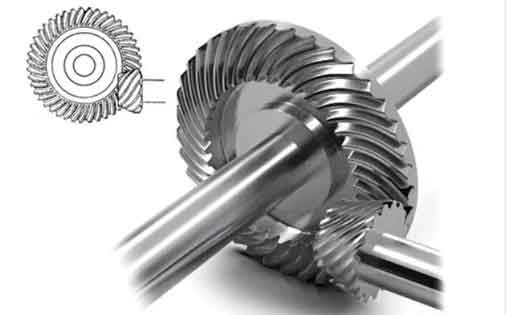
In the realm of power transmission, spiral bevel gears are indispensable components for transmitting torque and motion between intersecting, typically perpendicular, shafts. Their defining feature is the curved, oblique tooth form, which facilitates smoother engagement, higher load capacity, and reduced noise compared to straight bevel gears. The surface quality of these complex spatial tooth flanks is a paramount determinant of their ultimate performance. Variations in surface roughness, residual stress, and the presence of machining artifacts like burrs and grinding marks directly influence critical operational characteristics such as meshing efficiency, contact fatigue life, vibration, and noise generation. Consequently, implementing a robust finishing process as the final manufacturing step is crucial for enhancing the durability and reliability of spiral bevel gears in demanding applications like aerospace, automotive differentials, and heavy machinery.
Barrel finishing, or mass finishing, stands out as an exceptionally versatile and cost-effective terminal machining process. It involves loading components along with abrasive media (often shaped stones, ceramic pellets, or synthetic abrasives) and a compound (water mixed with chemicals) into a container or barrel. The container is then set in motion—rotating, vibrating, or centrifuging—inducing a complex, stochastic relative movement between the workpieces and the abrasive media. This action results in gentle cutting, peening, and polishing, effectively deburring, radiusing edges, improving surface finish, and inducing beneficial compressive residual stresses. Its ability to process multiple parts simultaneously in a single batch makes it ideal for improving the surface integrity of complex components like spiral bevel gears.
This article provides an in-depth, first-person perspective on the application of parallel-spindle barrel finishing for spiral bevel gears. It encompasses theoretical modeling of the process kinematics, discrete element method (DEM) simulation to analyze the microscopic interaction mechanics, and experimental validation of the resulting surface quality improvements. The goal is to establish a comprehensive understanding of how this process enhances the surface integrity of these critical power transmission elements.
Theoretical Foundation of Parallel-Spindle Finishing
The parallel-spindle configuration is a common barrel finishing setup where the rotational axis of the workpiece spindle is parallel to the rotational axis of the main barrel or tub. This geometry generates a predictable yet complex velocity field for the abrasive media relative to the gear tooth surface. Establishing a mathematical model for this motion is the first step in understanding and optimizing the process.
To simplify the kinematic analysis, we employ the principle of relative motion. We consider the barrel to be stationary. The workpiece (the spiral bevel gear) then undergoes two superimposed rotations: one around its own axis (simulating the spindle rotation) and one around the axis of the (now stationary) barrel, but in the opposite direction to the barrel’s actual rotation. This model is illustrated in the figure below.
Let’s define our coordinate systems. The fixed global coordinate system is \( O-xyz \), with the \( z \)-axis aligned with the (stationary) barrel axis. The workpiece rotates around point \( O_2 \) on the \( y \)-axis, at a fixed distance \( R \) from \( O \). A point \( A \) on the workpiece’s outer surface is located at a distance \( r \) from the workpiece axis \( O_2Z_2 \). The key angles are:
– \( \theta_1 \): The rotation angle of the workpiece center \( O_2 \) around the barrel axis \( OZ \).
– \( \theta_2 \): The rotation angle of point \( A \) around its own workpiece axis \( O_2Z_2 \).
If the barrel’s actual rotational speed is \( N \) (rpm) and the workpiece spindle speed is \( n \) (rpm), and assuming the barrel is held stationary, the equivalent rotational speeds become \( \dot{\theta}_1 = 2\pi N \) and \( \dot{\theta}_2 = 2\pi n \). The direction of \( n \) relative to \( N \) is crucial; typically, they are set in opposite directions to maximize relative velocity.
The position of point \( A \) in the global coordinate system can be found through sequential coordinate transformations. First, from the workpiece coordinate system \( (x_3, y_3, z_3) \) to the intermediate system attached to \( O_2 \), then to another intermediate system aligned with \( O \), and finally to the global system \( O-xyz \). The consolidated position vector \( \vec{P}_A \) is:
$$
\vec{P}_A = \begin{bmatrix}
x \\
y \\
z
\end{bmatrix} = \begin{bmatrix}
r \sin(\theta_1 – \theta_2) – R \sin \theta_1 \\
-r \cos(\theta_1 – \theta_2) + R \cos \theta_1 \\
0
\end{bmatrix}
$$
Substituting the time-dependent angles, \( \theta_1 = 2\pi N t \) and \( \theta_2 = 2\pi n t \), we get the parametric equations of motion. The instantaneous velocity of point \( A \), which is representative of the cutting speed imparted by the workpiece to a media particle in contact at that point, is obtained by differentiating the position vector with respect to time:
$$
\vec{v}_A = \frac{d\vec{P}_A}{dt} = \begin{bmatrix}
2\pi r (N – n) \cos[2\pi(N – n)t] – 2\pi R N \cos(2\pi N t) \\
2\pi r (N – n) \sin[2\pi(N – n)t] + 2\pi R N \sin(2\pi N t) \\
0
\end{bmatrix}
$$
The magnitude of this velocity, the effective cutting speed \( v_c \), is a critical parameter influencing material removal rate and surface finish. It is calculated as:
$$
v_c = |\vec{v}_A| = 2\pi \sqrt{ r^2 (N – n)^2 + R^2 N^2 + 2 R r N (N – n) \cos(2\pi n t) }
$$
This equation reveals the factors governing the finishing intensity. Let’s analyze the impact of key parameters:
1. Workpiece Radius (r): The cutting speed \( v_c \) increases linearly with the distance of the point from the workpiece axis. This implies that for a spiral bevel gear, the tooth tips and the larger-diameter ends of the teeth will experience a higher intensity of finishing action compared to the root areas or the smaller-diameter ends. This can lead to non-uniform wear if not managed properly.
2. Spindle and Barrel Speeds (n and N): The relationship is more complex. The term \( (N – n) \) is significant. Maximizing the absolute difference between \( N \) and \( n \) generally increases \( v_c \). However, the phase term \( \cos(2\pi n t) \) causes the speed to oscillate. A higher spindle speed \( n \) increases the frequency of this oscillation.
3. Center Distance (R): A larger \( R \) increases the orbital component of the speed (the term with \( R^2N^2 \)), generally raising the overall cutting velocity.
The following table summarizes the qualitative effect of increasing each parameter on the theoretical cutting speed \( v_c \):
| Parameter | Effect on Cutting Speed (v_c) | Practical Implication for Spiral Bevel Gears |
|---|---|---|
| Workpiece Radius \( r \) | Increases | Potential for non-uniform finishing; toe vs. heel region differences. |
| Barrel Speed \( N \) | Increases (dominant effect) | Higher stock removal rate, but risk of edge breakdown. |
| Spindle Speed \( n \) | Increases (when \( n \) is opposite to \( N \)) | Increases media/workpiece interaction frequency. |
| Center Distance \( R \) | Increases | Larger machines generate higher speeds. |
Discrete Element Method (DEM) Simulation of the Finishing Process
While the kinematic model provides a macro-scale view of velocities, the actual finishing process is governed by millions of microscopic, stochastic collisions and sliding contacts between abrasive media and the gear tooth surface. Predicting the outcome based purely on analytical models is intractable. This is where the Discrete Element Method (DEM) proves invaluable. DEM simulates the behavior of granular materials by modeling each individual particle (media piece) and calculating its interactions with other particles and geometry (the gear) based on contact physics laws.
For simulating barrel finishing of spiral bevel gears, we utilize a commercial DEM software, EDEM. The process involves several key steps:
1. Geometry and System Setup: The 3D CAD models of the finishing barrel and the spiral bevel gear are imported. Their relative positions are set according to the parallel-spindle configuration (distance \( R \)). To conserve computational resources, the system can be scaled down proportionally, ensuring the fundamental kinematic relationships are preserved.
2. Material and Contact Property Definition: Accurate simulation hinges on correct material properties. The abrasive media (e.g., ceramic triangles or spheres) and the gear material (e.g., case-hardened steel) are defined with their density, Poisson’s ratio, and shear modulus. Crucially, the contact properties between media-media and media-gear must be calibrated, including coefficients of static and rolling friction, and restitution.
3. Particle Generation and Motion: A large population of media particles (e.g., hundreds of thousands) is generated within the barrel. The rotational motions are then applied: the barrel rotates at speed \( -N \) (in the software’s coordinate system) and the gear rotates at speed \( +n \). The simulation runs for a specified physical process time.
4. Wear Modeling: To quantify material removal, a wear model must be coupled with the contact mechanics. A widely used approach is the Archard Wear model, which can be implemented in DEM. The incremental wear volume \( \Delta V \) at a contact point is given by:
$$
\Delta V = k \frac{F_n s}{H}
$$
where \( k \) is a dimensionless wear coefficient, \( F_n \) is the normal contact force, \( s \) is the sliding distance, and \( H \) is the hardness of the wearing surface (the gear). In DEM, the contact force and sliding velocity are computed at every time step for every contact, allowing for a spatially resolved calculation of wear on the gear’s surface.
The “Hertz-Mindlin with Archard Wear” contact model in EDEM integrates this calculation. Running simulations with different spindle speeds \( n \) (e.g., 50, 75, 115 rpm) while keeping barrel speed \( N \) constant allows us to investigate the effect of this parameter on the cumulative wear on the spiral bevel gear tooth flanks. The simulation results typically show that:
- Wear is not uniform. Due to the conical shape of spiral bevel gears, the smaller-diameter toe region often exhibits higher wear initially because of easier media access and potentially higher local pressures.
- The total wear volume over time increases with higher spindle speed \( n \), confirming the theoretical prediction that a larger \( (N – n) \) difference leads to more energetic contacts and higher material removal.
- The wear distribution pattern helps identify potential areas of over-finishing or under-finishing, guiding process optimization.
The table below provides an example set of parameters used in a typical DEM simulation for this application:
| Category | Parameter | Typical Value/Type |
|---|---|---|
| Geometry | Barrel Diameter | Scaled model (e.g., 0.5 m) |
| Gear Model | Spiral Bevel Gear (scaled) | |
| Center Distance \( R \) | Scaled proportionally | |
| Media Particles | Shape | Sphere |
| Diameter | 2 mm (normal distribution) | |
| Density | \( 4.0 \times 10^3 \, \text{kg/m}^3 \) | |
| Shear Modulus | 129 GPa | |
| Gear Material | Density | \( 7.8 \times 10^3 \, \text{kg/m}^3 \) |
| Shear Modulus | 70 GPa | |
| Hardness \( H \) | Defined for Archard model | |
| Contact Properties | Media-Media Friction | High (e.g., 0.5 static) |
| Media-Gear Friction | Moderate (e.g., 0.55 static) | |
| Wear Coefficient \( k \) | Calibrated value (e.g., \( 1 \times 10^{-5} \)) | |
| Process | Barrel Speed \( N \) | 50 rpm |
| Spindle Speed \( n \) | Variable: 50, 75, 115 rpm |
Experimental Investigation and Validation
Theoretical and simulation analyses must be grounded in experimental reality. An experimental study was conducted on disc-type spiral bevel gears used in an aerospace application. The goal was to validate the effectiveness of the parallel-spindle barrel finishing process and correlate the findings with the models.
1. Experimental Setup and Conditions:
– Gear Specimen: The gears were made of high-strength alloy steel (e.g., AISI 8620 or similar), case-carburized and hardened to approximately 59-60 HRC. Key parameters: Module ~4.4 mm, 41 teeth, 35° mean spiral angle.
– Pre-Finish State: Gears were ground after heat treatment and subjected to shot peening. The initial average surface roughness (Ra) of the tooth flanks was approximately 0.8 µm, with visible grinding marks and minor burrs.
– Finishing Equipment: A parallel-spindle barrel finishing machine was employed. The barrel had a large diameter (~1.26 m). The gear was mounted on a dedicated fixture, and its axis was set parallel to the barrel axis at a center distance \( R \) of 0.41 m.
– Process Media: A mixture of high-density ceramic abrasive media (triangular or spherical, ~2-3 mm in size) and a water-based compound was used. The fill level was about 70% of the barrel volume.
– Process Parameters: Barrel speed \( N \) was fixed at 45 rpm. The spindle speed \( n \) was varied in different test runs but maintained equal time in both rotational directions to ensure symmetry on the convex and concave flanks of the spiral bevel gears. The gear was submerged to a specific depth in the media mass.
2. Measurement and Analysis:
– Surface Roughness: A contact stylus profilometer capable of measuring on curved surfaces was used. A custom fixture with a rotary stage was fabricated to precisely index and position the gear tooth for repeatable measurements at the same location on multiple teeth (both convex and concave flanks).
– Procedure: Roughness measurements (Ra, Rz) were taken at regular intervals (e.g., every 6 minutes) throughout a finishing cycle. Three measurements per location were averaged.
– Visual Inspection: Macroscopic and microscopic (using digital microscopy) inspection was performed to assess deburring, edge radiusing, and the evolution of surface texture.
3. Key Experimental Results:
– Roughness Reduction: A significant and rapid improvement in surface finish was observed. The average Ra value dropped from the initial 0.8 µm to around 0.4 µm within a relatively short processing time (e.g., 30-60 minutes). The rate of reduction was highest at the beginning, as the process efficiently removed grinding peaks and burrs, then gradually plateaued.
– Asymmetry Between Flanks: An interesting observation was that the concave (inner) flank often showed a slightly faster initial roughness reduction rate than the convex (outer) flank. This can be attributed to the “media crowding” or “wedging” effect in the concave tooth space, leading to a higher contact force and more efficient cutting action.
– Surface Texture Transformation: The initial anisotropic surface pattern, characterized by parallel grinding marks, was transformed into a more isotropic, non-directional texture. This isotropic texture is highly beneficial for gear performance as it promotes uniform lubrication film formation and reduces directionally dependent wear.
– Deburring and Edge Radiusing: The process completely removed micro-burrs from the tooth edges and tips. It also produced a consistent, small radius on sharp edges, which reduces stress concentrations and improves fatigue resistance.
– Correlation with Theory/Simulation: The experimental trend of increased material removal/roughness reduction with higher spindle speeds (within a range) supported the predictions of the kinematic model and DEM simulations. The non-uniformity suggested by the model (toe vs. heel) was observed but was within acceptable limits for the application.
The following table summarizes the typical outcomes from the barrel finishing of aerospace spiral bevel gears:
| Surface Integrity Aspect | Before Finishing | After Parallel-Spindle Finishing | Benefit to Gear Performance |
|---|---|---|---|
| Average Roughness Ra | ~0.8 µm | ~0.4 µm | Reduced friction, lower running temperature, improved contact fatigue life. |
| Surface Texture | Anisotropic (directional grinding marks) | Isotropic (non-directional, uniform) | Promotes stable elastohydrodynamic lubrication, reduces noise and vibration. |
| Micro-burrs | Present at edges | Completely eliminated | Prevents initial scoring, ensures proper meshing, removes stress risers. |
| Edge Condition | Sharp | Consistently radiused | Reduces peak contact stress at the edge of contact, improves bending fatigue strength. |
| Residual Stress* | Compressive from shot peening, but potentially modified by grinding. | Stable, compressive surface layer reinforced. | Inhibits crack initiation and propagation, enhances durability. |
* Note: Residual stress measurement, e.g., via X-ray diffraction, would provide quantitative data for this aspect.
Conclusion and Outlook
The application of parallel-spindle barrel finishing presents a highly effective and efficient method for enhancing the surface integrity of high-performance spiral bevel gears. The process successfully addresses key post-grinding requirements: it significantly reduces surface roughness, eliminates detrimental anisotropic textures in favor of isotropic ones, removes burrs, and creates controlled edge radii. The combined theoretical, simulation, and experimental approach provides a robust framework for understanding and optimizing the process.
The kinematic model elucidates the relationship between machine parameters (N, n, R, r) and the fundamental cutting speed, offering a first-principles guide for parameter selection. The Discrete Element Method simulation delves deeper, visualizing the complex media flow and providing a quantitative, spatially-resolved prediction of wear patterns using models like the Archard wear law. This virtual prototyping tool is invaluable for identifying potential issues like non-uniform finishing before conducting physical trials.
Experimental validation confirms the practical efficacy. For aerospace-grade spiral bevel gears, the process reliably achieves a 50% or greater reduction in surface roughness (e.g., from Ra 0.8 µm to 0.4 µm), which can translate directly into improved gearbox efficiency, reduced noise, and extended service life. The transformation to an isotropic surface texture is particularly critical for optimizing the contact mechanics and lubrication regime under heavy load.
Future work in this domain should focus on several advanced fronts:
1. Multi-Objective Optimization: Using the models developed, apply statistical and machine learning techniques to find the optimal set of parameters (N, n, time, media type/size, compound chemistry) that simultaneously minimize roughness, maximize compressive stress, ensure uniformity, and minimize process time.
2. Advanced Media and Compounds: Investigating the effect of engineered media (e.g., polymer-bonded abrasives with specific shapes) and advanced compounds that provide both lubrication and chemical polishing action for super-finished surfaces on spiral bevel gears.
3. Integrated Process Chain: Studying the interaction of barrel finishing with preceding (grinding/honing) and subsequent (coating) processes to develop an integrated manufacturing chain for ultra-durable gears.
4. Performance Validation: Conducting full-scale gear rig testing (e.g., FZG or similar tests) to quantitatively correlate the improved surface integrity metrics (Ra, isotropy, residual stress) with gains in pitting load capacity, scuffing resistance, and transmission error.
In conclusion, barrel finishing is not merely a cosmetic operation for spiral bevel gears; it is a critical manufacturing step that directly enhances functional performance. By leveraging a scientific approach combining kinematics, particle-scale simulation, and rigorous experimentation, this process can be mastered to produce spiral bevel gears that meet the ever-increasing demands for power density, efficiency, and reliability in modern mechanical systems.