
In mechanical transmission systems, spur gears play a pivotal role due to their ability to provide accurate speed ratios, stable operation, and efficient power transfer across a wide range of applications, particularly in aerospace and automotive industries. As a reliability engineer specializing in component failure analysis, I have encountered numerous cases where spur gear failures lead to catastrophic outcomes. Recently, I investigated an incident involving a manual transmission thin-walled spur gear that developed multiple cracks among its teeth before even being put into service. This prompted a comprehensive analysis to determine the root cause and prevent future occurrences. The findings underscore the critical importance of manufacturing processes in inducing unexpected failure modes, such as vibration fatigue, which is rarely associated with spur gears under normal operational conditions. Throughout this article, I will delve into the details of this failure, emphasizing the spur gear’s unique vulnerabilities and the lessons learned for design and production enhancements.
The spur gear in question was part of an aircraft accessory drive system, manufactured from 12Cr2Ni4A steel with a carburized surface hardness of at least 59 HRC. Its production process involved several steps: forging, rough turning, gear hobbing, carburizing, semi-finishing, quenching, tempering, finishing, broaching of internal splines, magnetic particle inspection, final inspection, and oxidation phosphating. During post-assembly magnetic particle inspection at the assembly plant, ten cracks were detected at the tooth root locations, distributed symmetrically on both sides of the gear. This was alarming, as the gear had not undergone any operational use, indicating that the failure originated during manufacturing or handling. The spur gear featured a thin-walled design with 52 teeth, and initial observations revealed that the cracks initiated at the chamfer between the tooth slot and the end face, propagating both radially into the slot and axially along the end face. The tooth surfaces exhibited clear machining marks without signs of wear, confirming the absence of service load.
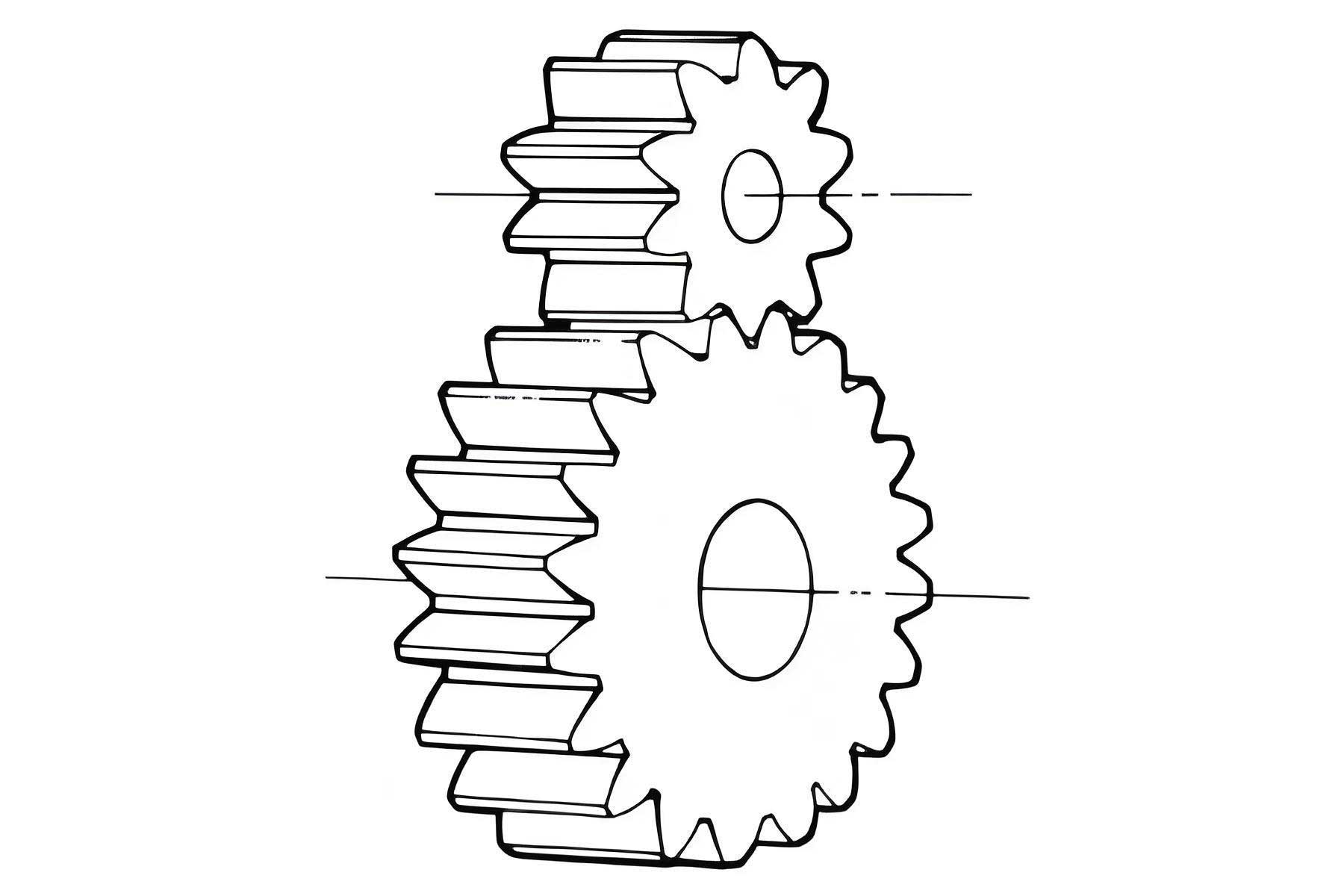
To systematically analyze this spur gear failure, I employed a multi-faceted approach combining macro- and micro-examination techniques. First, I conducted a visual inspection to document the crack morphology and distribution. The cracks were found to be spaced approximately 90 degrees apart, exhibiting a pattern characteristic of diametral-type vibration, which is often associated with resonant conditions in rotating components. Next, I selected several cracks for fractographic analysis by carefully opening them to expose the fracture surfaces. Using scanning electron microscopy (SEM), I examined the fracture features to identify the failure mechanism. Additionally, I performed metallographic analysis on cross-sections of the cracked and intact tooth regions to assess the microstructure, particularly the carburized layer, and measured the hardness profile to verify compliance with specifications. The goal was to correlate the observed defects with potential stressors introduced during the spur gear’s lifecycle.
The macro-examination revealed that all ten cracks shared similar characteristics: they originated linearly from the chamfer area, with propagation depths of 1.2 to 1.8 mm, exceeding the carburized layer thickness. The fracture surfaces displayed distinct regions: an origin and early propagation zone within the carburized layer (Region 1), a fatigue progression zone with arrest marks (Region 2), and a final rupture zone from manual opening (Region 3). In Region 1, due to the high hardness and brittleness of the carburized layer, the fracture exhibited a mixed mode of dimples and intergranular features, indicating rapid crack growth. Region 2 showed clear fatigue striations and beach marks, typical of cyclic loading, as seen in the following formula for fatigue crack growth rate:
$$ \frac{da}{dN} = C(\Delta K)^m $$
where \( da/dN \) is the crack growth per cycle, \( \Delta K \) is the stress intensity factor range, and \( C \) and \( m \) are material constants. For the spur gear material, the presence of these striations confirmed vibration-induced fatigue. Region 3 exhibited ductile dimples, consistent with overload fracture. In contrast, artificially broken intact teeth showed no such fatigue features, only a smooth transition at the carburized layer boundary. The microstructure evaluation indicated that the carburized layer contained a network of carbides along grain boundaries, rated 5-6 according to HB5492-1991, which is acceptable. Hardness tests confirmed that surface and core hardness values met requirements, as summarized in Table 1.
| Location | Surface Hardness (HRC) | Carburized Layer Depth (mm) | Core Hardness (HRC) |
|---|---|---|---|
| Tooth Chamfer | 60.5 | 0.8-1.0 | 38.2 |
| Tooth End Face | 59.8 | 0.9-1.1 | 37.9 |
| Tooth Slot Center | 60.2 | 0.85-1.05 | 38.5 |
The crack distribution and fractographic evidence pointed decisively toward vibration fatigue as the failure mode. In spur gears, two primary fatigue failure modes exist: bending fatigue, where cracks initiate at the loaded root fillet and propagate across the tooth, and vibration fatigue, where cracks start at the tooth slot bottom and spread radially. The observed pattern aligned with vibration fatigue, specifically diametral-type vibration, which involves resonant oscillations with nodal diameters. This mode is particularly dangerous because it can lead to multiple cracks propagating simultaneously, as seen in this spur gear. The mathematical representation of such vibrations can be described using the natural frequency equation for a thin disk, which approximates the spur gear’s behavior:
$$ f_n = \frac{\lambda_{mn}}{2\pi} \sqrt{\frac{D}{\rho h R^4}} $$
where \( f_n \) is the natural frequency, \( \lambda_{mn} \) is a dimensionless frequency parameter for mode shape (with m nodal circles and n nodal diameters), \( D \) is the flexural rigidity, \( \rho \) is density, \( h \) is thickness, and \( R \) is radius. For this spur gear, the crack spacing suggested a two-nodal-diameter resonance, indicating an excitation source that matched this frequency.
To identify the root cause, I evaluated potential sources of vibration throughout the spur gear’s lifecycle. Design deficiencies were ruled out because the gear was a proven design with Campbell diagram analysis showing no resonance within operational speed ranges. Assembly-related issues were dismissed since the gear had not been used, and manual assembly processes could not induce significant cyclic stresses. Thus, the focus shifted to manufacturing, specifically the grinding operation, which involved a cantilevered clamping fixture. This setup allowed the thin-walled spur gear to tilt during grinding, imposing an unintended axial force component. This force acted as an excitation source, potentially driving the spur gear into resonance when the grinding frequency coincided with its natural frequency. The relationship between forcing frequency and response can be expressed as:
$$ \text{Response Amplitude} = \frac{F_0/k}{\sqrt{(1-r^2)^2 + (2\zeta r)^2}} $$
where \( F_0 \) is the excitation force amplitude, \( k \) is stiffness, \( r = f/f_n \) is the frequency ratio, and \( \zeta \) is damping ratio. In this case, the axial force from misalignment likely created a periodic excitation, leading to large-amplitude vibrations and crack initiation at stress concentrators like the chamfer. The chamfer itself, with a sharp梯形 convex shape rather than a smooth radius, exacerbated stress concentration, as quantified by the stress concentration factor \( K_t \):
$$ K_t = 1 + 2\sqrt{\frac{a}{\rho}} $$
where \( a \) is the crack-like flaw depth and \( \rho \) is the root radius. For the spur gear’s chamfer, the small effective radius increased \( K_t \), promoting crack nucleation under vibrational loads.
The investigation concluded that the spur gear failure resulted from vibration fatigue induced during grinding due to improper clamping. To prevent recurrence, I recommended altering the fixture design to a wheel-disk clamping method that supports the gear uniformly, minimizing tilt and axial forces. This modification ensures stable machining and avoids resonant conditions. Additionally, optimizing the chamfer geometry to a smooth radius can reduce stress concentration, enhancing the spur gear’s resistance to crack initiation. These measures are crucial for thin-walled spur gears in high-reliability applications, as they mitigate hidden manufacturing-induced failures.
In summary, this analysis highlights the susceptibility of spur gears to vibration fatigue when manufacturing processes introduce unintended excitations. By integrating rigorous process controls and design optimizations, such failures can be effectively prevented, ensuring the longevity and reliability of spur gear transmissions. The insights gained underscore the need for holistic approaches in gear engineering, where every production step is scrutinized for potential impacts on dynamic behavior.
To further elaborate on the broader implications, I have compiled key parameters and comparison data in Table 2, which outlines typical vibration modes in spur gears and their characteristics. This table serves as a reference for engineers diagnosing similar issues in spur gear systems.
| Vibration Mode | Nodal Pattern | Common Excitation Sources | Typical Crack Location | Prevention Strategy |
|---|---|---|---|---|
| Diametral-Type | Nodal diameters (e.g., 2 or 4) | Axial force misalignment, grinding harmonics | Tooth slot roots, symmetrically spaced | Improved clamping, dynamic balancing |
| Bending Fatigue | Single crack per tooth | Cyclic bending loads, tooth meshing | Root fillet on loaded side | Optimized fillet radius, material hardening |
| Torsional Vibration | Circumferential waves | Torque fluctuations, drive irregularities | Tooth flank or base circle | Dampers, stiffness tuning |
| Axial Vibration | Planar oscillations | Thrust loads, mounting errors | End faces or hub regions | Precise alignment, thrust bearings |
Furthermore, the fatigue life estimation for spur gears under vibrational stress can be modeled using the Basquin equation:
$$ \sigma_a = \sigma_f’ (2N_f)^b $$
where \( \sigma_a \) is the stress amplitude, \( \sigma_f’ \) is the fatigue strength coefficient, \( N_f \) is the cycles to failure, and \( b \) is the fatigue strength exponent. For the failed spur gear, the stress amplitude from vibrational forces likely exceeded the endurance limit, leading to rapid crack propagation within the carburized layer. This emphasizes the importance of controlling operational and manufacturing stresses to ensure the spur gear’s integrity. In practice, implementing real-time vibration monitoring during grinding processes can detect resonant conditions early, allowing for immediate corrective actions. Such proactive measures are essential for high-precision spur gears used in critical applications like aerospace, where failure is not an option.
In conclusion, the failure of this spur gear serves as a stark reminder of the intricate interplay between design, manufacturing, and dynamic response. As I reflect on this case, it becomes evident that even minor deviations in production can have profound effects on component reliability. By adopting advanced analytical tools, such as finite element analysis (FEA) for vibration prediction and non-destructive testing for defect detection, engineers can better safeguard spur gear performance. The journey from failure to solution underscores the value of thorough investigation and continuous improvement in mechanical engineering. Moving forward, I advocate for standardized protocols in spur gear manufacturing that prioritize dynamic stability, ensuring that these essential components operate flawlessly throughout their service life.