
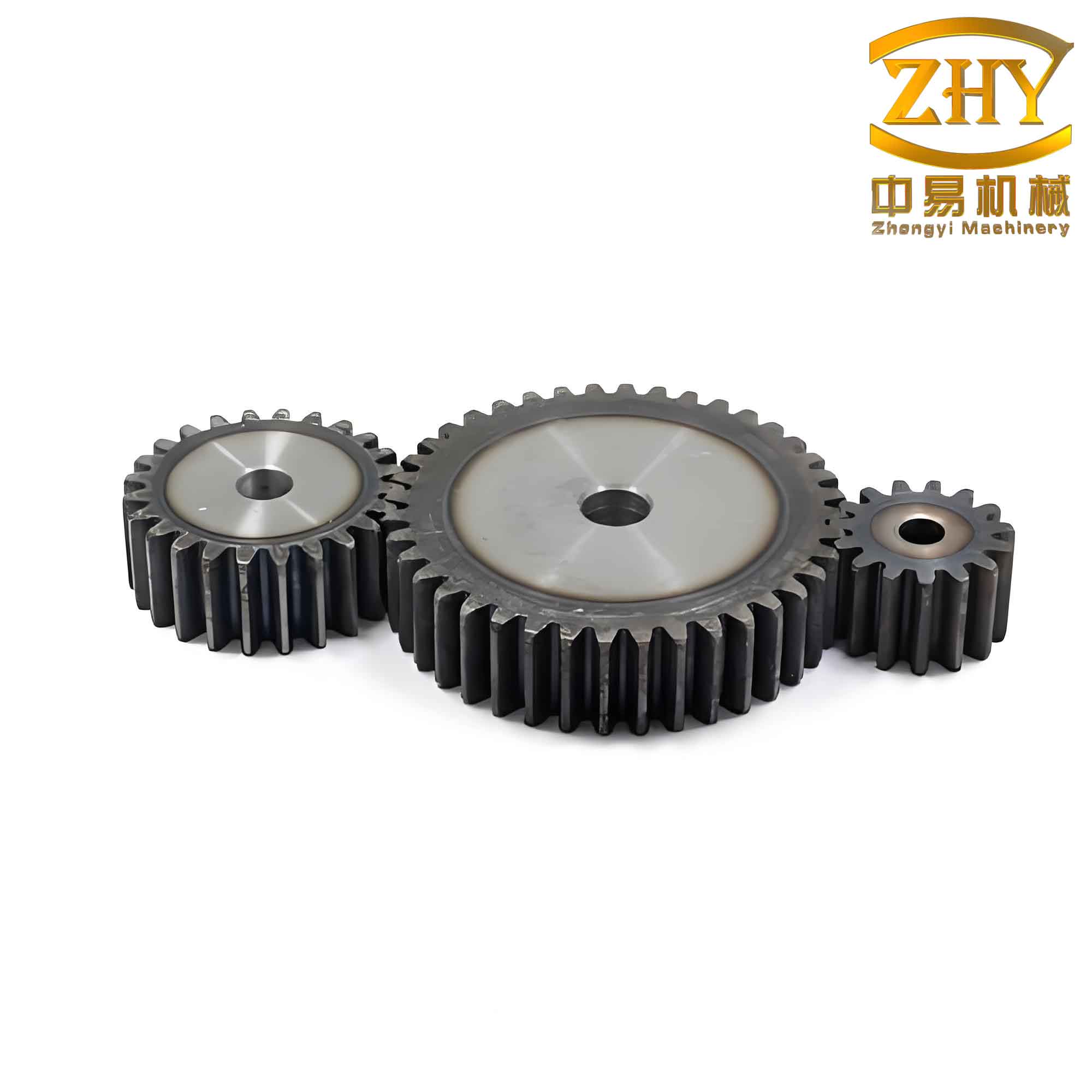
Straight spur gears are fundamental components in mechanical power transmission systems. Their design and manufacturing directly influence the overall quality, efficiency, and durability of machinery. Accurately predicting the stress distribution in straight spur gears under load is essential for optimizing gear geometry, reducing vibration and noise, and improving meshing characteristics. Traditional analytical methods, such as the Hertz contact theory, provide a baseline but often involve lengthy calculations and simplifications that may not capture local stress concentrations. Finite element analysis (FEA) offers a powerful alternative, enabling detailed stress analysis with high fidelity. In this study, we perform a quasi-static finite element analysis of straight spur gears using ABAQUS, focusing on contact and bending stresses. We establish a simplified five-tooth model, validate the results against classical Hertz theory, and investigate the effects of friction coefficient and radial extension distance on the computed stress values. Our aim is to provide theoretical support for the optimization of straight spur gears.
Model Establishment and Simplification
To reduce computational cost while maintaining accuracy, we adopt a simplified five-tooth model for the pinion. According to the literature, the circumferential influence range in finite element stress analysis of gears is approximately three teeth, and the radial influence range is about 2 to 3 times the module \(m\). Based on these guidelines, we select a five-tooth segment of the pinion and extend the region from the root circle radially inward by \(2.5m\). The geometric parameters of the straight spur gears used in this study are listed in Table 1.
| Parameter | Value |
|---|---|
| Modulus of Elasticity (GPa) | 206 |
| Poisson’s Ratio | 0.3 |
| Module (mm) | 2 |
| Number of Teeth (Pinion Z1) | 25 |
| Number of Teeth (Gear Z2) | 83 |
| Face Width (mm) | 17 |
| Pressure Angle (°) | 20 |
| Driving Torque (N·mm) | 95000 |
| Meshing Type | External |
The geometry of the five-tooth model is generated using parametric equations of the involute profile. The root fillet is approximated with a standard trochoid curve. The simplified model only includes the portion of the gear that participates in the meshing process, thus significantly reducing the number of elements while preserving accurate stress distributions in the contact region. The following figure illustrates the five-tooth meshing model used in our simulation.
Theoretical Calculation Based on Hertz Contact Theory
Classical contact stress analysis of straight spur gears is based on the Hertz contact theory, which treats the contacting surfaces as two cylinders in line contact. The maximum contact stress for gear pairs is given by the modified formula that accounts for various influence factors:
$$
\sigma_H = Z_H \, Z_E \, Z_\varepsilon \, \sqrt{\frac{K F_t}{b d_1} \cdot \frac{\mu+1}{\mu}}
$$
where:
- \(Z_H\) is the zone factor (dimensionless)
- \(Z_E\) is the elastic coefficient (MPa1/2)
- \(Z_\varepsilon\) is the contact ratio factor
- \(K\) is the load factor
- \(b\) is the face width (mm)
- \(d_1\) is the pitch circle diameter of the pinion (mm)
- \(F_t\) is the tangential force (N)
- \(\mu\) is the gear ratio (Z2/Z1)
Using the gear parameters from Table 1, we compute the tangential force from the driving torque:
$$
F_t = \frac{2T}{d_1} = \frac{2 \times 95000}{2 \times 25} = 3800 \; \text{N}
$$
The gear ratio is \(\mu = 83/25 = 3.32\). The pitch diameter of the pinion is \(d_1 = m Z_1 = 2 \times 25 = 50\; \text{mm}\). All relevant coefficients are obtained from standard design handbooks and are summarized in Table 2.
| Parameter | Value |
|---|---|
| Load Factor \(K\) | 1.2 |
| Zone Factor \(Z_H\) | 2.5 |
| Elastic Coefficient \(Z_E\) (MPa1/2) | 189.8 |
| Contact Ratio Factor \(Z_\varepsilon\) | 0.872 |
| Face Width \(b\) (mm) | 17 |
| Pitch Diameter \(d_1\) (mm) | 50 |
| Gear Ratio \(\mu\) | 3.32 |
| Tangential Force \(F_t\) (N) | 3800 |
Substituting these values into the formula yields:
$$
\sigma_H = 2.5 \times 189.8 \times 0.872 \times \sqrt{\frac{1.2 \times 3800}{17 \times 50} \times \frac{3.32+1}{3.32}} \approx 1029 \; \text{MPa}
$$
This theoretical result provides a benchmark for comparing our finite element simulations.
Finite Element Simulation Using ABAQUS
We perform a quasi-static analysis in ABAQUS/Standard. The five-tooth model is meshed with eight-node linear brick elements (C3D8R) with reduced integration and hourglass control. A refined mesh is applied in the contact region to capture the high stress gradient. The material is assumed to be isotropic linear elastic with modulus of elasticity 206 GPa and Poisson’s ratio 0.3. Boundary conditions are applied as follows: the inner surface of the pinion bore is constrained in all degrees of freedom except for the rotational degree of freedom about the gear axis. A driving torque of 95000 N·mm is applied at the reference node of the pinion. The gear is fixed entirely. Contact is defined between the two tooth surfaces using a penalty formulation with a friction coefficient (initially set to 0.1). The analysis is performed in a static step with large deformation effects considered.
The simulation results reveal a maximum contact stress of approximately 1209 MPa. The location of the maximum stress is near the root of the tooth close to the point where the involute meets the fillet. This value is higher than the theoretical Hertz result of 1029 MPa, which is expected because the simplified analytical formula does not account for the actual geometry of the tooth, the presence of the adjacent teeth, and the non-uniform load distribution. The stress contour shows a clearly defined contact patch along the tooth profile.
Influence of Friction Coefficient on Contact Stress
Friction plays a crucial role in gear contact problems because the line contact transforms into an area contact under load, generating tangential tractions that affect the stress state. To quantify the effect of friction, we perform simulations with five different friction coefficients: 0, 0.05, 0.07, 0.10, and 0.15. The maximum contact stress obtained for the same point on the tooth surface is recorded in Table 3.
| Friction Coefficient | Contact Stress (MPa) |
|---|---|
| 0 | 1040 |
| 0.05 | 1048 |
| 0.07 | 1050 |
| 0.10 | 1050 |
| 0.15 | 1055 |
From Table 3, we observe that as the friction coefficient increases, the maximum contact stress increases slightly and monotonically. The increase is most pronounced when moving from zero friction to 0.05, after which the stress tends to plateau. This behavior can be explained by the fact that friction introduces tangential stresses that combine with normal stresses, elevating the equivalent von Mises stress. However, the effect is modest in magnitude – less than 1.5% increase from the frictionless case. For practical engineering analysis of straight spur gears, the friction coefficient has a second-order effect on the peak contact stress, but it cannot be neglected when studying surface fatigue and wear.
Influence of Radial Extension Distance on Bending Stress
The radial extension distance from the root circle, denoted as \(\delta_0\), influences the bending stress at the tooth root. In our model, the region from the root circle is extended radially inward by a multiple of the module \(m\). We investigate five different values: \(1m\), \(1.5m\), \(2m\), \(2.5m\), and \(3m\). The maximum bending stress at the root fillet for each case is computed and listed in Table 4.
| Radial Extension (multiples of \(m\)) | Bending Stress (MPa) |
|---|---|
| 1.0 | 353 |
| 1.5 | 402 |
| 2.0 | 430 |
| 2.5 | 458 |
| 3.0 | 462 |
The bending stress increases with increasing \(\delta_0\). For extensions up to \(2.5m\), the stress rises significantly from 353 MPa to 458 MPa, representing a 30% increase. Beyond \(2.5m\), the growth flattens, with only a marginal increase to 462 MPa at \(3m\). This indicates that a radial extension of at least \(2.5m\) is necessary to capture the full root stress without artificially constraining the deformation. Our results align with the recommendation in mechanical design handbooks, which suggest a radial extension of \(2\) to \(3\) times the module for accurate finite element analysis of straight spur gears. Using an insufficient extension (e.g., \(1m\) or \(1.5m\)) leads to underestimation of bending stress, which could result in non-conservative designs.
Furthermore, we note that the bending stress values obtained from the finite element analysis are generally consistent with those predicted by the Lewis formula and AGMA standards when proper stress concentration factors are applied. The trends observed in Table 4 underscore the importance of choosing an appropriate model size for bending stress evaluation in straight spur gears.
Conclusion
In this study, we performed a static analysis of straight spur gears using ABAQUS. A five-tooth model was found to be efficient for capturing contact and bending stresses. The main findings are as follows:
- The Hertz theory predicted a contact stress of 1029 MPa, while the finite element simulation gave 1209 MPa, a difference of about 17.5%, highlighting the limitations of the simplified analytical approach for straight spur gears.
- The friction coefficient has a small but non-negligible effect on the maximum contact stress; an increase from 0 to 0.15 raised the stress by about 1.4%.
- The radial extension from the root circle significantly affects the bending stress. An extension of \(2.5m\) or more is required to obtain stable and accurate bending stress results for straight spur gears.
These findings provide valuable guidance for the finite element modeling of straight spur gears. Future work should extend the analysis to dynamic loading, thermal effects, and the influence of tooth modifications. By understanding the stress behavior under various conditions, engineers can optimize the design of straight spur gears to improve performance and reliability.