
In the realm of precision motion control and high-ratio power transmission, the strain wave gear, often synonymous with harmonic drive, stands out as a pivotal technology. Its unique operating principle, relying on the elastic deformation of a flexible component known as the flexspline, enables remarkable characteristics such as high torque density, near-zero backlash, and exceptional positional accuracy. These attributes have cemented its role in demanding applications ranging from aerospace actuation systems and industrial robotics to advanced optical instrumentation. As a researcher deeply involved in the mechanics of these systems, I have observed that the longevity and reliability of a strain wave gear are fundamentally governed by the fatigue strength of its flexspline. Within this component, the tooth ring—the region where the gear teeth are engaged—is subjected to a complex stress state arising from both the forced deformation imposed by the wave generator and the operational loads during power transmission. Therefore, a comprehensive understanding of how structural parameters of this tooth ring influence its peak load stress is not merely an academic exercise but a critical necessity for robust design. This article presents a detailed investigation from my perspective, developing a theoretical framework for calculating load stress and analyzing the impact of key geometric parameters, supported by numerical validation. The core aim is to provide actionable insights for optimizing the flexspline design in strain wave gear systems.
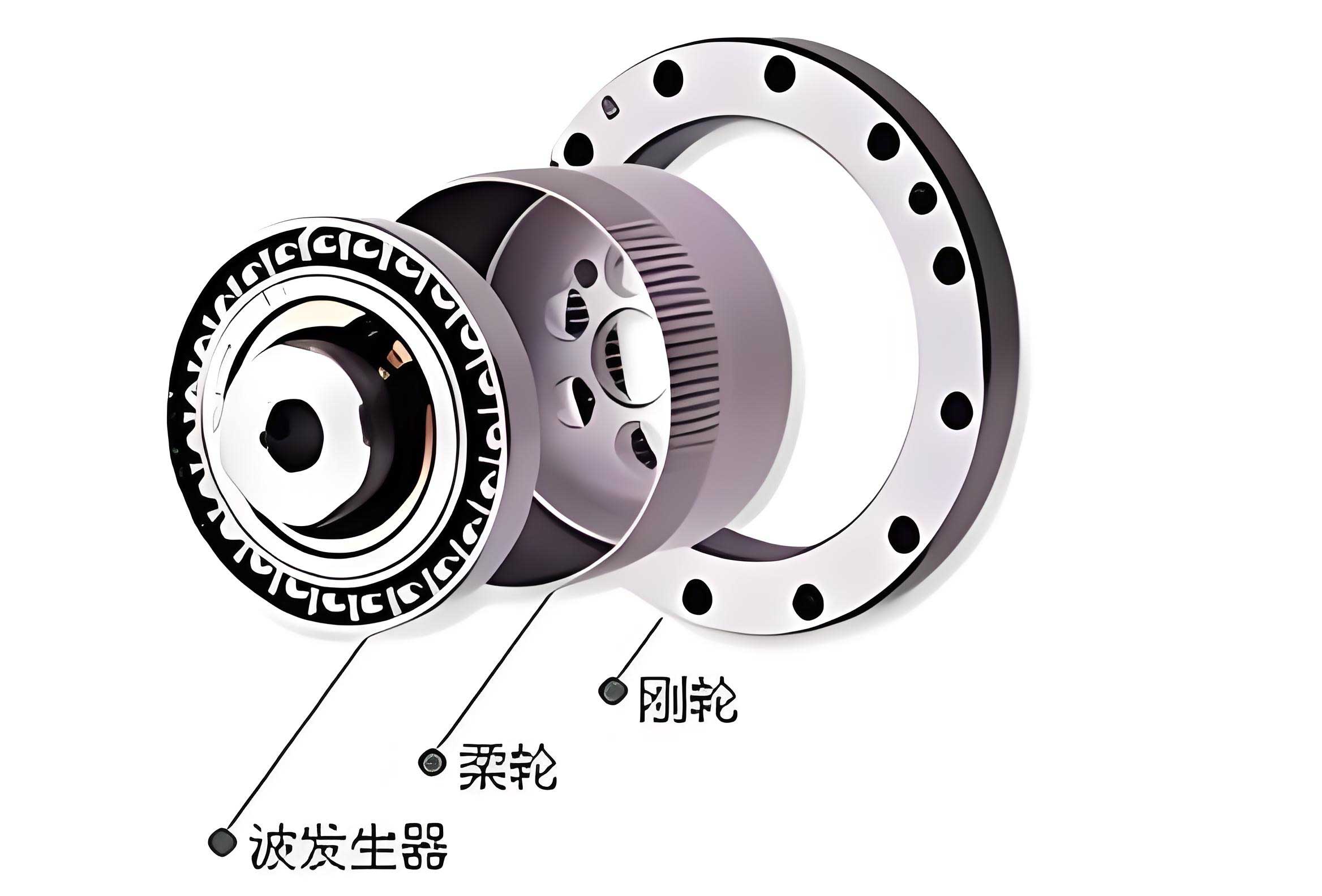
The operational principle of a strain wave gear involves three primary components: a rigid circular spline, a flexible spline (flexspline), and an elliptical wave generator. The wave generator, upon rotation, deforms the flexspline into an elliptical shape, causing its external teeth to engage with the internal teeth of the circular spline at two diametrically opposite regions. This controlled elastic deformation is the source of both the kinematic advantage and the inherent stress within the flexspline. Prior to any load application, the assembly process induces significant pre-stress, predominantly circumferential bending stress, within the flexspline tooth ring. When torque is transmitted, additional stresses arise from the meshing forces between the teeth of the flexspline and the circular spline. The superposition of these assembly (pre-load) and operational (load) stresses defines the total stress state, with the maximum value often being the limiting factor for fatigue life. Consequently, accurately predicting this maximum load stress and understanding its sensitivity to design parameters is paramount for any engineer working with strain wave gear technology.
Theoretical Foundation: Assembly Stress in the Flexspline Tooth Ring
To establish a baseline, we must first quantify the stress induced during the assembly of the strain wave gear, i.e., when the wave generator is fitted into the flexspline without external load. Under this no-load condition, the flexspline’s neutral surface conforms to the shape imposed by the wave generator, but not perfectly. A region of continuous contact, or wrap angle, forms around the major axis of the ellipse. For an elliptical cam wave generator, the deformed midline of the flexspline tooth ring can be analyzed by considering it as a thin-walled cylindrical shell. The major axis radial displacement, $w_0$, is a key parameter, and the resulting semi-axes of the deformed midline are $\rho_a = r_m + w_0$ and $\rho_b$, where $r_m$ is the radius of the neutral surface before deformation. The curvature, $\kappa(\phi)$, of the deformed midline in the contact region as a function of the initial polar angle $\phi$ is given by:
$$ \kappa(\phi) = \left| \frac{c_1}{\rho_b} \frac{(c_1^2 \cos^2 \phi – \cos^2 \phi – c_1^2)^{3/2}}{(c_1^4 \cos^2 \phi – \cos^2 \phi – c_1^4)^{3/2}} \right| $$
where $c_1 = \rho_a / \rho_b$. The change in curvature from the initial circular state ($1/r_m$) is directly related to the bending moment $M_1(\phi)$ via beam/plate theory: $\chi = M_1(\phi) / (E I_z) = \kappa(\phi) – 1/r_m$. Here, $E$ is the Young’s modulus and $I_z$ is the area moment of inertia of the tooth ring cross-section. For a rectangular cross-section of width $b_1$ and thickness $\delta$, $I_z = b_1 \delta^3 / 12$. Therefore, the circumferential bending stress due to assembly at any point in the contact zone is:
$$ \sigma_{\phi}^{ass}(\phi) = \frac{E \delta}{2} \left( \kappa(\phi) – \frac{1}{r_m} \right) $$
The maximum assembly bending stress invariably occurs at the major axis location ($\phi = 0$), simplifying the curvature expression. However, this classical shell theory stress must be adjusted to account for the discrete tooth structure. The presence of teeth significantly increases the local bending stiffness. Stress concentration occurs predominantly at the tooth dedendum (root) fillet. An empirical stress influence factor, $K_\sigma$, derived from extensive parametric finite element studies, is used to amplify the shell theory stress to reflect the actual peak stress at the tooth root. A representative form of this factor is:
$$ K_\sigma = 0.344 \exp(1.243 s_f / \delta) + 5.833 \left( \frac{r_1}{\delta} + 0.482 \frac{s_f}{\delta} – 0.693 \right)^2 + 0.886 $$
where $s_f$ is the tooth root thickness and $r_1$ is the dedendum fillet radius. Thus, the maximum assembly stress at the critical tooth root location on the major axis is:
$$ \sigma_{max}^{ass} = K_\sigma \cdot \left[ \frac{E \delta}{2} \left( \frac{\rho_a}{\rho_b^2} – \frac{1}{r_m} \right) \right] $$
This equation forms the first part of our total stress model. The parameters $\delta$, $r_1$, and the tooth geometry defining $s_f$ (which relates to the slot width ratio $\nu$) are already identified as critical influencers.
Development of a Load Stress Model via an Equivalent Beam Analogy
Under transmitted torque, meshing forces develop between the engaged teeth of the flexspline and the circular spline. Research indicates that the load distribution is not uniform; it peaks near the major axis regions and diminishes towards the minor axis. For strength calculation, it is conservative and practical to analyze the condition where the maximum meshing force per tooth, denoted as $q$, acts. To model the effect of this force on the flexspline tooth ring stress, I propose simplifying the three-dimensional tooth-and-slot structure into a two-dimensional planar model. The tooth can be treated as a variable-cross-section beam attached to the ring. The critical location for stress is the dedendum of the tooth, where the beam meets the ring. The meshing force $q$ has radial ($q_r$) and tangential ($q_t$) components. The tangential component induces bending in the tooth about the ring’s circumferential direction.
Considering equilibrium of a single tooth segment over one pitch $p$, the internal bending moment $M_y$ at the dedendum section (where the tooth joins the ring) can be derived. The force system includes the meshing force, reaction from the wave generator $F_{wg}$, and internal sectional forces (bending moment $M_y$, shear force $F_S$). After applying static equilibrium and compatibility conditions for deformation between the tooth section (with effective height $h_0$) and the thin ring section (thickness $\delta$), the moment $M_{y\sigma}$ at the root due to the tangential load component can be expressed as:
$$ M_{y\sigma} = q_t (h + \delta/2) \cdot \frac{K_s (1 – K_s/2)(1 – \delta^3 / h_p^3) – 0.5}{K_s (1 – \delta^3 / h_p^3) – 1} $$
where $h$ is the total tooth height, $h_p = \delta + h_0$ is an equivalent height for the tooth section’s moment of inertia, and $K_s = s_f / p$ is a geometric ratio relating the root thickness to the pitch. The additional bending stress at the tooth root fillet caused by this moment is then:
$$ \sigma_{y\sigma}^{load} = \frac{6 M_{y\sigma}}{\delta^2} $$
This stress is localized at the dedendum. The total maximum load stress in the flexspline tooth ring under operating conditions is the sum of the maximum assembly stress and this load-induced additional bending stress:
$$ \sigma_{y}^{total} = \sigma_{max}^{ass} + \sigma_{y\sigma}^{load} = K_\sigma \left[ \frac{E \delta}{2} \left( \frac{\rho_a}{\rho_b^2} – \frac{1}{r_m} \right) \right] + \frac{6 M_{y\sigma}}{\delta^2} $$
This equation is the cornerstone of our analytical approach. It explicitly shows the dependence of the peak stress on the tooth ring thickness $\delta$, the dedendum fillet radius $r_1$ (embedded in $K_\sigma$), and the tooth geometry defining $K_s$ and $h$, which is closely related to the slot width ratio $\nu$. To generalize the analysis, it is advantageous to define dimensionless parameters: the thickness coefficient ($\delta / r_m$), the fillet radius coefficient ($r_1 / m$, where $m$ is the module), and the slot width ratio $\nu$ itself (ratio of space width to tooth thickness on the pitch circle).
| Parameter | Symbol | Value (Example) | Dimension |
|---|---|---|---|
| Module | $m$ | 0.375 | mm |
| Neutral Layer Radius | $r_m$ | 29.119 | mm |
| Number of Teeth (Flexspline) | $z_1$ | 160 | – |
| Tooth Ring Width | $b_1$ | 10.0 | mm |
| Wave Generator Major Semi-axis | $\rho_a$ | 29.494 | mm |
| Wave Generator Minor Semi-axis | $\rho_b$ | 28.741 | mm |
| Young’s Modulus | $E$ | 210 | GPa |
Parametric Influence Analysis on Maximum Load Stress
Using the derived total stress equation, we can systematically investigate how each dimensionless parameter affects $\sigma_{y}^{total}$ under various load conditions. For this analysis, I consider a range of operational torques typical for a strain wave gear: Rated Torque (RAT), Average Maximum Torque (AVT), Peak Start-Stop Torque (STT), and Momentary Maximum Torque (MIT). The corresponding maximum meshing force $q_t$ increases proportionally with torque.
Influence of Tooth Ring Thickness (Thickness Coefficient $\delta / r_m$)
The tooth ring thickness $\delta$ has a dual and competing role. In the assembly stress term, it acts linearly ($\sigma^{ass} \propto \delta$). In the load stress term, it appears inversely squared in the denominator ($\sigma^{load} \propto 1/\delta^2$). Therefore, the relationship between total stress and thickness is non-monotonic. For the no-load case, stress increases linearly with thickness, as only the assembly term is active. However, under load, the total stress exhibits a distinct minimum. As $\delta$ increases from a very small value, the rapid decrease in the load-induced stress dominates, causing the total stress to fall sharply. Beyond a certain point, the increasing assembly stress begins to dominate, leading to a gradual rise in total stress. This behavior is summarized in the following conceptual equation derived from the model:
$$ \frac{\partial \sigma_{y}^{total}}{\partial \delta} = \frac{E}{2} \left( \frac{\rho_a}{\rho_b^2} – \frac{1}{r_m} \right) \frac{\partial (K_\sigma \delta)}{\partial \delta} – \frac{12 M_{y\sigma}}{\delta^3} + \frac{6}{\delta^2} \frac{\partial M_{y\sigma}}{\partial \delta} $$
The optimal thickness coefficient that minimizes total stress depends on the applied load. Higher torque levels (larger $M_{y\sigma}$) shift the minimum towards larger thickness values because the load stress term becomes more significant. Furthermore, the slot width ratio $\nu$ interacts with this optimum; a larger $\nu$ (wider slots) generally allows for a slightly thinner optimal ring. Based on model evaluations for a standard strain wave gear configuration, the optimal thickness coefficient typically lies between 2.9% and 3.4% for operational loads, suggesting a design rule of thumb around $\delta / r_m \approx 0.03$.
| Load Condition | Torque (N·m) | Optimal $\delta / r_m$ for $\nu=1.4$ | Optimal $\delta / r_m$ for $\nu=1.8$ | Optimal $\delta / r_m$ for $\nu=2.2$ |
|---|---|---|---|---|
| RAT | 67 | ~2.95% | ~2.85% | ~2.75% |
| AVT | 108 | ~3.10% | ~3.00% | ~2.90% |
| STT | 167 | ~3.20% | ~3.10% | ~3.00% |
| MIT | 304 | ~3.45% | ~3.35% | ~3.25% |
Influence of Dedendum Fillet Radius (Fillet Coefficient $r_1/m$)
The fillet radius at the tooth root is a critical stress concentration feature. In our model, its influence is captured primarily through the stress influence factor $K_\sigma$. A larger fillet radius reduces the stress concentration, thereby decreasing $K_\sigma$ and the assembly stress component. However, an excessively large fillet can infringe on the tooth active profile or effectively increase the local bending stiffness of the tooth-root junction, potentially affecting the load stress distribution. The analysis shows a clear optimum. For a given tooth ring thickness and slot width, increasing $r_1$ from a small value initially causes a significant drop in total stress due to the reduction in $K_\sigma$. After a certain point, the benefits diminish, and the total stress may even increase slightly. The optimal range is remarkably consistent across different load conditions but shifts with the slot width ratio $\nu$. For common strain wave gear designs, the optimal fillet radius coefficient falls within:
$$ 0.6 \leq \frac{r_1}{m} \leq 0.7 $$
This provides a clear guideline for designers. A fillet radius smaller than $0.6m$ risks high stress concentration, while one larger than $0.7m$ offers diminishing returns and may introduce other geometric constraints without substantially improving the load-bearing capacity against stress.
Influence of Slot Width Ratio ($\nu$)
The slot width ratio $\nu$ defines the proportion of space to material on the pitch circle. It directly affects the tooth root thickness $s_f$ and the geometric factor $K_s$ in the load moment calculation. A higher $\nu$ means wider slots and narrower teeth. This reduces the bending stiffness of the tooth ring assembly, which generally lowers the assembly-induced stress. However, it also affects the load-carrying capacity per tooth and the distribution of the load-induced moment. The interaction with tooth ring thickness is particularly strong. When analyzed at the respective optimal thickness for each load, the total stress as a function of $\nu$ shows a relatively shallow minimum. The primary trend is that the optimal $\nu$ decreases as the load torque increases. Under heavy loads, a slightly smaller $\nu$ (i.e., slightly stronger, wider teeth) is beneficial to handle the higher meshing forces, even though it increases assembly stress slightly. For most practical load ranges in a strain wave gear, the optimal slot width ratio centers around:
$$ \nu_{opt} \approx 2.0 $$
This value represents a balance, ensuring sufficient material for load transmission while allowing enough compliance to keep assembly stresses manageable.
| Design Priority | Tooth Ring Thickness Coefficient ($\delta/r_m$) | Dedendum Fillet Coefficient ($r_1/m$) | Slot Width Ratio ($\nu$) | Remarks |
|---|---|---|---|---|
| Minimum Stress (General) | ~0.030 (3.0%) | 0.65 | ~2.0 | Balanced design for typical operating loads. |
| High Torque / Shock Loads | 0.033 – 0.035 | 0.65 – 0.70 | 1.8 – 2.0 | Sacrifices some weight for higher load capacity. |
| Weight-Sensitive / Low Load | 0.028 – 0.030 | 0.60 – 0.65 | 2.0 – 2.2 | Optimized for assembly stress dominance. |
Numerical Validation via Finite Element Analysis
To verify the accuracy and practical utility of the analytical model, a comprehensive finite element analysis (FEA) was conducted. A parameterized three-dimensional solid model of a cup-type flexspline from an SHF-25-80 strain wave gear set was created. The model included accurate double-arc tooth profiles. Key parameters–tooth ring thickness $\delta$, dedendum fillet radius $r_1$, and slot width ratio $\nu$–were defined as variables. The wave generator was modeled as a rigid elliptical cam. Contact pairs were established between the cam and the flexspline’s inner surface, and between the flexspline teeth and a simulated rigid circular spline section in the major axis engagement zone. Material properties were assigned (Elastic Modulus $E$ = 210 GPa, Poisson’s ratio = 0.3). The bottom of the flexspline cup was fixed, and the wave generator was constrained to prevent rigid body motion. The analysis was performed in two steps: first, an assembly step to simulate the press-fit of the wave generator and obtain the assembly stress; second, a load step where distributed forces equivalent to the maximum meshing force for a given torque were applied to the engaged tooth flanks in the major axis region.
The FEA results for the no-load condition showed a maximum stress location at the dedendum fillet on the major axis, near the front opening of the cup, which aligns with known failure origins in strain wave gears. The magnitude of this stress was compared to the theoretical $\sigma_{max}^{ass}$. For a base configuration, the theoretical value was 242.7 MPa, while the FEA result was 250.9 MPa, a discrepancy of only 3.4%. Under the rated torque (RAT = 67 N·m), the FEA-predicted maximum total stress was 374.4 MPa, compared to the theoretical prediction of 371.1 MPa—a difference of less than 0.9%. This close agreement validates the superposition principle and the equivalent beam model for load stress.
A series of FEA simulations were then run across the parameter space. The trends observed perfectly corroborated the analytical findings. The stress vs. thickness curves exhibited the predicted U-shape under load. The existence of an optimal fillet radius and its specified range were confirmed. The interaction between slot width ratio and thickness was also evident in the FEA results. For instance, at the MIT load level (304 N·m), using the analytically suggested optimal parameters ($\delta/r_m=3.375\%$, $r_1/m=0.7$, $\nu=1.8$) yielded a theoretical stress of 496.1 MPa. The corresponding FEA result was 528.5 MPa, showing a slightly higher but consistent value with a 6.5% difference, which is acceptable given the complexities of 3D contact and material non-linearity not captured in the simple analytical model. This comprehensive numerical validation underscores the robustness of the proposed analytical framework as a design tool for strain wave gear engineers.
Extended Discussion and Design Implications for Strain Wave Gears
The findings from this integrated analytical and numerical study have profound implications for the design and application of strain wave gears. Firstly, the non-monotonic relationship between tooth ring thickness and total stress challenges the intuitive “thicker is stronger” notion. Over-designing the flexspline wall thickness can be detrimental, increasing weight and, counterintuitively, the peak stress under certain conditions. The identified optimal thickness coefficient range provides a quantitative starting point for designers. Secondly, the optimal fillet radius range of $0.6m$ to $0.7m$ is a specific, actionable guideline that can be directly implemented in tooth profile generation software. This optimization directly tackles fatigue life by minimizing stress concentration. Thirdly, the recommended slot width ratio of around 2.0 helps balance the often-conflicting requirements of high tooth strength and low assembly stress. These guidelines collectively contribute to a more reliable and longer-lasting strain wave gear.
Furthermore, this research highlights the importance of considering the combined stress state. Design approaches that consider only assembly stress or only tooth bending strength in isolation are incomplete. The superposition model, while simplified, captures the essential physics. For advanced applications, such as strain wave gears in space robotics or surgical instruments, where weight and reliability are paramount, this parametric optimization becomes even more critical. Future work could extend this model to consider factors like the axial variation of stress (coning effect), the impact of different wave generator profiles (e.g., three-lobe cam), and the influence of material plasticity or fatigue crack initiation. However, the current framework establishes a solid foundation for rational, performance-driven design of the flexspline, the very heart of the strain wave gear mechanism.
Conclusion
In this detailed investigation, I have developed and validated a methodology for analyzing the maximum load stress in the flexspline tooth ring of a strain wave gear. By modeling the tooth as an equivalent variable-section beam under combined assembly deformation and operational meshing forces, an analytical expression for total stress was derived. This expression clearly delineates the influence of three key structural parameters: tooth ring thickness, dedendum fillet radius, and slot width ratio. Parametric analysis revealed that the maximum load stress versus thickness exhibits a minimum point, with the optimal thickness coefficient increasing with applied torque. The dedendum fillet radius has a distinct optimal range between 0.6 and 0.7 times the module, which effectively minimizes stress concentration. The optimal slot width ratio is approximately 2.0, though it tends to decrease slightly under very high loads. These findings were strongly corroborated by three-dimensional nonlinear finite element analysis, with discrepancies typically under 5-7%. This work provides strain wave gear designers with a practical theoretical tool and clear parametric guidelines to optimize flexspline geometry for enhanced strength and durability, ultimately contributing to more reliable and efficient motion control systems across countless high-tech industries.