
As a technical expert in the field of gear manufacturing, I have dedicated years to advancing precision forging techniques, particularly for miter gears. Miter gears, which are bevel gears with a 1:1 ratio, are critical components in various mechanical systems, requiring high accuracy and durability. In this article, I will share insights based on extensive实践经验, focusing on hot precision forging, cold precision forging, and composite forging processes, along with optimal equipment layout principles. These methods are essential for producing high-quality miter gears efficiently, and I will illustrate key points using tables and formulas to summarize complex concepts. Throughout this discussion, the term “miter gears” will be frequently emphasized to highlight their specific applications.
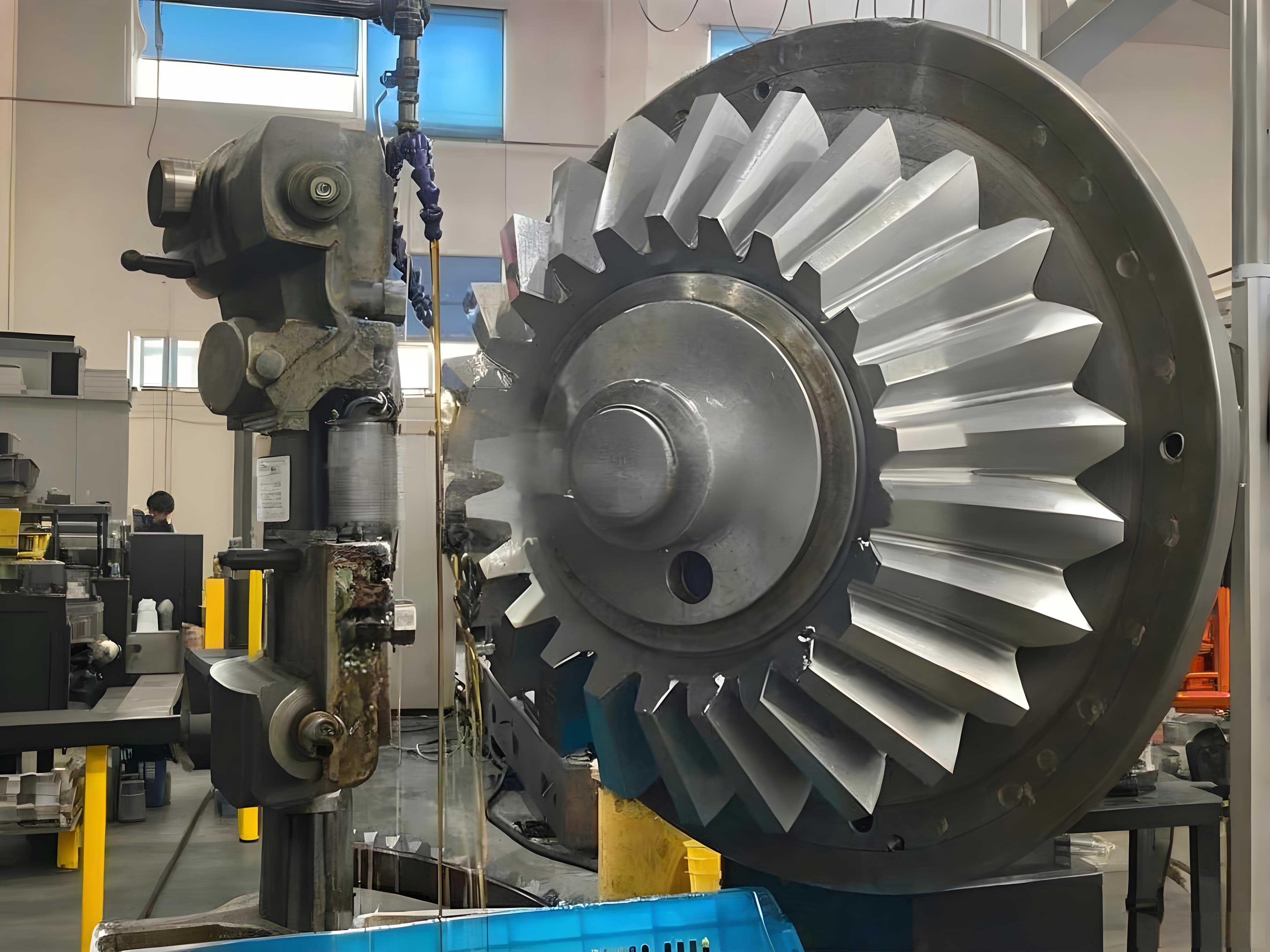
Precision forging has revolutionized the production of miter gears, enabling near-net-shape manufacturing that reduces material waste and post-processing. Miter gears, due to their angular transmission requirements, demand tight tolerances and excellent surface finish, which can be achieved through advanced forging techniques. In my experience, the evolution from traditional machining to precision forging has significantly enhanced the performance and cost-effectiveness of miter gears in industries such as automotive, aerospace, and machinery. This article delves into the nuances of different forging processes, all tailored for miter gears, and provides guidelines for setting up production lines to maximize efficiency.
Hot Precision Forging Process for Miter Gears
Hot precision forging involves deforming metal at elevated temperatures, typically above the recrystallization point, to reduce deformation resistance and improve plasticity. This process is ideal for miter gears with complex geometries, as it allows for easier成形 of intricate tooth profiles. A common efficient method is the “one-heat three-forge” technique, where the workpiece is heated once and undergoes连续镦粗, rough forging, and finish forging. This minimizes oxidation and maintains the final forging temperature, crucial for the dimensional accuracy of miter gears.
The key advantages of hot precision forging for miter gears include reduced flow stress and enhanced formability. The deformation force can be estimated using the following formula, which relates to the material’s behavior at high temperatures:
$$ F_h = k_h \cdot \sigma_y(T) \cdot A_c $$
Where \( F_h \) is the hot forging force, \( k_h \) is a correction factor accounting for friction and geometry (typically ranging from 1.5 to 2.5 for miter gears), \( \sigma_y(T) \) is the yield stress as a function of temperature, and \( A_c \) is the contact area during forging. For miter gears, the temperature dependency is critical; for example, for steel alloys commonly used in miter gears, the yield stress decreases exponentially with temperature:
$$ \sigma_y(T) = \sigma_{y0} \cdot e^{-\alpha (T – T_0)} $$
Here, \( \sigma_{y0} \) is the yield stress at reference temperature \( T_0 \), and \( \alpha \) is a material constant. This highlights the importance of temperature control in hot forging of miter gears.
To optimize the hot forging process for miter gears, several parameters must be carefully controlled. The table below summarizes key工艺 parameters for hot precision forging of miter gears, based on my实践经验:
| Parameter | Typical Range for Miter Gears | Influence on Gear Quality |
|---|---|---|
| Forging Temperature | 1000°C to 1200°C | Higher temperatures reduce force but increase oxidation; critical for tooth profile accuracy. |
| Strain Rate | 0.1 s⁻¹ to 10 s⁻¹ | Affects grain structure; lower rates improve formability for complex miter gear shapes. |
| Heating Time | 5 to 15 minutes | Ensures uniform heating, minimizing thermal gradients that could distort miter gears. |
| Cooling Rate After Forging | Controlled to 10°C/s to 50°C/s | Determines final microstructure and hardness of miter gears. |
In practice, the hot precision forging line for miter gears should be arranged to minimize工件 transfer between stations, reducing exposure to air and preventing excessive oxidation. This is vital for maintaining the surface quality of miter gears, as oxidation can lead to defects in the gear teeth. The layout principles will be discussed in detail later, but it’s worth noting that for miter gears, the “one-heat three-forge” approach often requires closely spaced presses to ensure rapid processing.
Cold Precision Forging Process for Miter Gears
Cold precision forging is performed at room temperature, offering several advantages for miter gears, including excellent dimensional control, improved mechanical properties, and smooth surfaces. Since no heating is involved, there is no oxidation, making it suitable for high-precision miter gears used in sensitive applications. The process relies on high pressures to deform the material, requiring robust equipment and precise tooling.
The characteristics of cold precision forging for miter gears include high accuracy and enhanced strength due to work hardening. The forging force in cold forging can be modeled using a similar formula but with adjustments for room-temperature properties:
$$ F_c = k_c \cdot \sigma_{yc} \cdot A_c $$
Where \( F_c \) is the cold forging force, \( k_c \) is a factor typically higher than in hot forging (around 2.0 to 3.0 for miter gears due to increased friction), and \( \sigma_{yc} \) is the yield stress at room temperature. For miter gears, the work hardening effect is significant, described by the Hollomon equation:
$$ \sigma = K \cdot \varepsilon^n $$
Here, \( \sigma \) is the flow stress, \( \varepsilon \) is the true strain, \( K \) is the strength coefficient, and \( n \) is the strain-hardening exponent. This relationship is crucial for predicting the deformation behavior of miter gears during cold forging, as it affects the final gear tooth strength.
The table below compares cold forging parameters for miter gears with those of hot forging, emphasizing the trade-offs:
| Aspect | Cold Forging of Miter Gears | Hot Forging of Miter Gears |
|---|---|---|
| Temperature | Room temperature (20°C to 25°C) | 1000°C to 1200°C |
| Deformation Force | Higher due to no thermal softening | Lower due to reduced yield stress |
| Surface Finish | Excellent, no oxidation | Good, but may require cleaning |
| Dimensional Accuracy | Very high, suitable for precision miter gears | High, but may have thermal shrinkage |
| Mechanical Properties | Improved via work hardening | Controlled by cooling rate |
For cold precision forging of miter gears, the equipment layout must accommodate the use of guided die sets (with导柱导套模架) to ensure accuracy. The生产线排布 principles include maintaining横向间距 of at least a certain distance to facilitate workpiece handling, as miter gears often require careful搬运 to avoid damage. Additionally,纵向间距 should be sufficient for模具模架装卸, and for multiple rows, a back-to-back arrangement is preferred to share换模设施, enhancing efficiency for high-volume production of miter gears.
Composite Precision Forging Process for Miter Gears
Composite forging combines hot, warm, and cold forging stages to leverage the benefits of each while mitigating their drawbacks, making it ideal for advanced miter gears with stringent requirements. For instance, a miter gear might undergo hot forging for initial shaping, warm forging for intermediate accuracy, and cold forging for final finishing. This hybrid approach optimizes material flow, reduces forces, and enhances the final properties of miter gears.
The composite process for miter gears can be mathematically represented by integrating the forging forces across different temperature regimes. The total energy required for forging a miter gear in a composite process is:
$$ E_{total} = \int_{T_h}^{T_c} F(T) \, d\varepsilon $$
Where \( E_{total} \) is the total deformation energy, \( T_h \) and \( T_c \) are the hot and cold temperature limits, and \( F(T) \) is the forging force as a function of temperature. For miter gears, this energy minimization is key to efficient production. The warm forging stage, typically at temperatures between 500°C and 800°C, offers a balance, reducing force compared to cold forging while maintaining better accuracy than hot forging for miter gears.
The following table outlines the stages in composite forging for miter gears, along with typical parameters:
| Stage | Temperature Range | Purpose for Miter Gears | Key Considerations |
|---|---|---|---|
| Hot Forging | 1000°C to 1200°C | Rough成形 of gear blank and tooth profile | Minimize oxidation; maintain high ductility. |
| Warm Forging | 500°C to 800°C | Intermediate shaping to improve accuracy | Control cooling to prevent cracking in miter gears. |
| Cold Forging | Room temperature | Final sizing and surface finishing | Use high-precision dies for miter gear teeth. |
In my experience, composite forging is particularly effective for high-performance miter gears used in automotive differentials, where both strength and precision are paramount. The equipment layout for composite forging lines should integrate principles from both hot and cold forging sections, ensuring smooth transitions between stages to maintain the quality of miter gears.
Equipment Layout Principles for Forging Miter Gears
The arrangement of forging equipment plays a crucial role in the efficiency and quality of miter gear production. Based on多年实践, I have developed guidelines for layout设计 that cater to the specific needs of hot, cold, and composite forging processes for miter gears. These principles focus on minimizing handling, optimizing space, and facilitating maintenance.
For hot precision forging lines producing miter gears, the layout should follow the工艺流程 closely. The distance between forging presses should be minimized to reduce工件 transfer time, preventing excessive temperature drop and oxidation. This is critical for miter gears, as their complex shapes are sensitive to thermal variations. The operating space for workers must be adequate, and allowance should be made for equipment搬运 and repairs. A schematic formula for optimal间距 in hot forging lines can be expressed as:
$$ D_h = \max(d_{min}, v \cdot t_t) $$
Where \( D_h \) is the horizontal spacing between devices, \( d_{min} \) is the minimum safety distance (e.g., 1.5 meters), \( v \) is the average transfer speed of miter gear workpieces, and \( t_t \) is the target transfer time to maintain temperature. For miter gears, \( t_t \) is often less than 10 seconds to ensure终锻温度 above 800°C.
For cold precision forging lines dedicated to miter gears, the layout differs due to the use of guided die sets and the need for precision. The横向间距 should be set to allow easy placement and搬运 of workpieces, typically at least 2 meters for miter gears. The纵向间距 must be larger to enable模具模架装卸, and for multiple rows, a back-to-back arrangement is recommended to share换模设施, improving换模效率. This can be summarized in the table below for cold forging lines producing miter gears:
| Layout Type | Spacing Requirement | Rationale for Miter Gears |
|---|---|---|
| Single-Row Cold Forging Line | Horizontal: ≥ 2 m; Vertical: ≥ 3 m | Ensures smooth workpiece flow and access for precision tooling. |
| Multiple-Row Cold Forging Line | Back-to-back rows with shared换模 area | Reduces downtime and enhances efficiency for high-volume miter gear production. |
In composite forging lines for miter gears, the layout should combine elements from both hot and cold sections. The hot forging stages might be arranged in a compact cluster, while the cold forging stages require more space for precision operations. Allocating预留空间 for future equipment upgrades is essential, as technology evolves for manufacturing miter gears. The overall goal is to create a seamless flow from raw material to finished miter gears, minimizing bottlenecks and maximizing output quality.
Advanced Considerations in Forging Miter Gears
Beyond the basic processes and layout, several advanced factors influence the forging of miter gears. These include material selection, die design, and quality control measures, all of which are integral to producing superior miter gears. For instance, the choice of alloy steel for miter gears affects forgeability and final properties; common grades include AISI 8620 for its balance of strength and toughness.
The die design for miter gears must account for tooth geometry and stress concentrations. The contact pressure on dies during forging of miter gears can be estimated using the formula:
$$ P_d = \frac{F}{A_d} $$
Where \( P_d \) is the die pressure, \( F \) is the forging force (from earlier formulas), and \( A_d \) is the die接触面积. For miter gears, this pressure is often high due to the intricate tooth shapes, necessitating hardened die materials like H13 tool steel. Additionally, the die life for miter gear forging can be predicted using empirical models, such as:
$$ N_d = C \cdot \left( \frac{\sigma_d}{P_d} \right)^m $$
Here, \( N_d \) is the number of forging cycles before die failure, \( C \) is a constant, \( \sigma_d \) is the die material strength, and \( m \) is an exponent typically around 3 for miter gear dies. This highlights the importance of die maintenance in prolonged production runs of miter gears.
Quality control in forging miter gears involves dimensional checks and non-destructive testing. The table below lists key quality parameters for forged miter gears, based on industry standards:
| Quality Parameter | Target for Miter Gears | Measurement Method |
|---|---|---|
| Tooth Profile Accuracy | Within ±0.05 mm | Coordinate Measuring Machine (CMM) |
| Surface Roughness | Ra ≤ 1.6 µm for cold-forged miter gears | Profilometer |
| Hardness Uniformity | HRC 30-35 with variation < 3 points | Rockwell hardness tester |
| Microstructure | Fine-grained, no inclusions | Metallographic analysis |
These parameters ensure that miter gears meet the demanding requirements of their applications, such as in power transmission systems where smooth operation and longevity are critical.
Future Trends in Forging Miter Gears
The forging industry for miter gears is continuously evolving, driven by advancements in automation, simulation, and sustainable manufacturing. Numerical simulation tools, like finite element analysis (FEA), are now used to optimize forging processes for miter gears, reducing trial-and-error and improving yield. The governing equations for simulating miter gear forging include the plasticity models discussed earlier, solved iteratively to predict material flow and defects.
Automation in forging lines for miter gears involves robotics for workpiece handling and real-time monitoring. This enhances consistency and reduces labor costs, especially for high-precision miter gears. The integration of IoT sensors allows for predictive maintenance of equipment, minimizing downtime in miter gear production. Additionally, the shift toward green manufacturing encourages energy-efficient processes, such as using induction heating for hot forging of miter gears, which reduces energy consumption compared to furnace heating.
In summary, the precision forging of miter gears is a multifaceted field that combines metallurgy, mechanics, and engineering design. Through hot, cold, and composite forging processes, along with strategic equipment layout, manufacturers can produce high-quality miter gears that meet modern industry standards. As technology progresses, further innovations will continue to enhance the efficiency and accuracy of forging miter gears, solidifying their role in mechanical systems worldwide.
Reflecting on my experiences, I emphasize that attention to detail in every aspect—from process parameters to layout planning—is key to success in forging miter gears. By adhering to the principles outlined here and embracing continuous improvement, manufacturers can stay at the forefront of this specialized领域, delivering reliable miter gears for diverse applications. The journey of perfecting miter gear forging is ongoing, and I look forward to contributing to its future advancements.