
We investigate the dynamic and load-sharing behaviors of a power six-branch coaxial herringbone gear transmission system, which is a critical component in high-power marine propulsion applications. To assess vibration, noise, and dynamic loads, we develop a torsional vibration model considering time-varying mesh stiffness and transmission errors. The governing equations are solved analytically. Based on the relative vibration response along the line of action, we derive formulas for dynamic load coefficient and load-sharing coefficient. We analyze the influence of torsional stiffness of the input shaft, double-gear shafts, and output shaft on the dynamic and load-sharing characteristics. Results indicate that input shaft torsional stiffness significantly affects load sharing; double-gear shaft torsional stiffness influences both split-torque and combining stages, and higher stiffness leads to larger dynamic load coefficients; output shaft stiffness has negligible effect on branch dynamic load coefficients.
1. Introduction
Power multi-branch gear transmission systems are widely used in aerospace, marine, and wind energy applications due to their compact size, light weight, large transmission ratio, and high reliability. The power six-branch coaxial herringbone gear transmission system is of particular interest for high-power marine drivetrains because of its superior torque-to-mass ratio and efficiency. Understanding the dynamic characteristics and load-sharing performance of such systems is essential for safe and quiet operation.
Many researchers have studied load sharing and dynamics of power-split gears using finite element models, experimental modal analysis, lumped-parameter models, and equivalent torsional vibration methods. However, most studies focus on simple two-branch or straight/spur gear systems. Work on complex six-branch coaxial herringbone gear systems is scarce. In this paper, we present a pure torsional dynamic model for this system, accounting for shaft stiffness between multiple gear pairs, and investigate the effect of stiffness parameters on load sharing and dynamic loads.
2. Dynamic Model of the Power Six-Branch Coaxial Herringbone Gear Transmission System
Figure 1 (not shown) illustrates the system layout. The input gear 1 meshes with three split-torque pinions 2i (i=1,2,3), forming three power paths. Each pinion 2i meshes with a large gear 3i, which is connected through an intermediate shaft to a combining pinion 4i. Each combining pinion 4i meshes with two gears 5ip and 5iq (p,q for left/right herringbone halves), resulting in six parallel paths that drive the output gear 6. The input and output gears are coaxial.
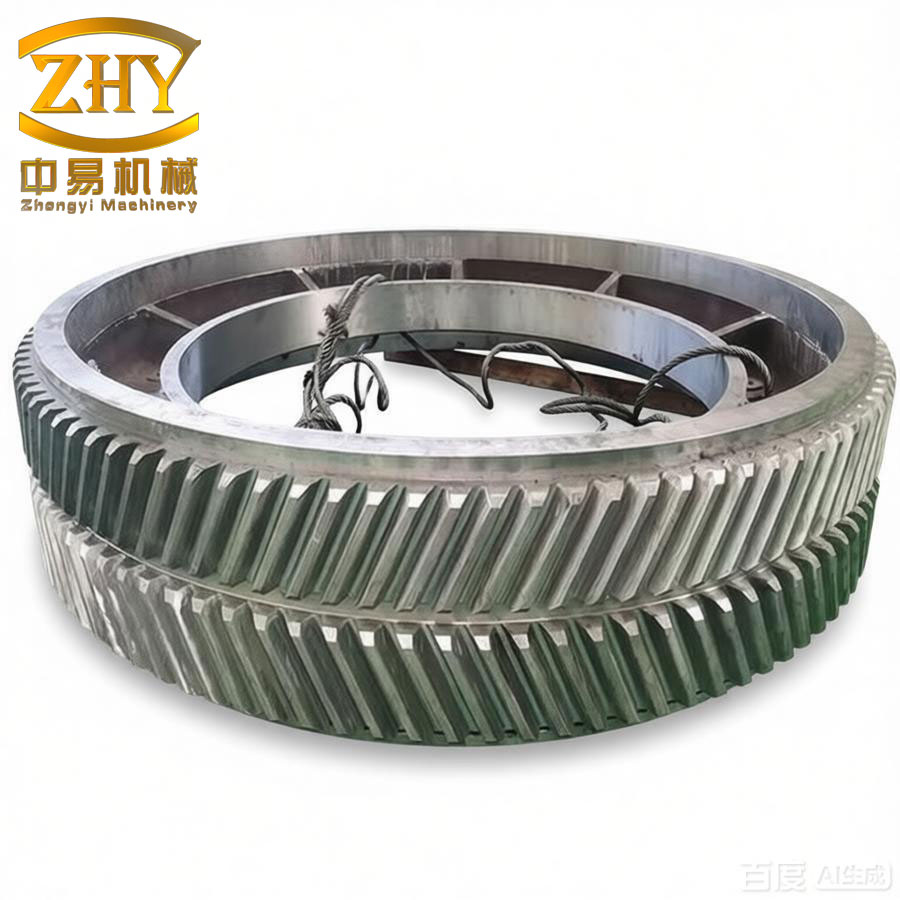
Each herringbone gear is modeled as two helical gears with opposite helix angles connected by a spring. Each helical gear is a lumped rotational inertia, and meshing pairs are connected by mesh stiffness and damping. The system has 36 rotational degrees of freedom. The torsional vibration equations for the input disk I and output disk O are:
$$J_I \ddot{\theta}_I + c_{I1}(\dot{\theta}_I – \dot{\theta}_{1L}) + k_{I1}(\theta_I – \theta_{1L}) = T_I$$
$$J_O \ddot{\theta}_O – c_{6O}(\dot{\theta}_{6R} – \dot{\theta}_O) – k_{6O}(\theta_{6R} – \theta_O) = -T_O$$
Assembling all equations in matrix form:
$$[J]\{\ddot{\Theta}\} + [C]\{\dot{\Theta}\} + [K]\{\Theta\} = \{T\}$$
where $[J]$, $[C]$, $[K]$ are the inertia, damping, and stiffness matrices, $\{\Theta\}$ is the displacement vector, and $\{T\}$ is the torque vector.
3. Calculation of Dynamic Load Coefficient and Load-Sharing Coefficient
Solving the dynamic equation yields the torsional vibration displacements $\theta_{uj}$, $\theta_{vj}$. The relative displacement along the line of action for a meshing pair (u,v) is:
$$\delta_{uvj} = (r_{bu}\theta_{uj} – r_{bv}\theta_{vj})\cos\beta_{uj} – e_{uvj}(t)$$
where $r_{bu}$, $r_{bv}$ are base radii, $\beta_{uj}$ is helix angle, and $e_{uvj}(t)$ is the composite error (including manufacturing and mounting errors).
The dynamic mesh force is:
$$F_{uvj} = k_{uvj}\delta_{uvj} + c_{uvj}\dot{\delta}_{uvj}$$
The dynamic load coefficient $k_{ij}$ is defined as the maximum ratio of dynamic force to nominal force over one mesh cycle:
$$k_{ij} = \max\left( \frac{\bar{F}_{uvj}}{T_{ij}/r_{bij}} \right)$$
For a branch, the branch dynamic load coefficient $K_{ij}$ is the maximum of all $k_{ij}$ in that branch.
The load-sharing coefficient $k_{bi}$ for branch $i$ over one mesh cycle is:
$$k_{bi} = N k_{vi} \Big/ \sum_{j=1}^{N} k_{vj}$$
where $N$ is the total number of branches and $k_{vi}$ is the branch dynamic load coefficient of branch $i$.
4. Numerical Example
We implement the model in MATLAB. Basic parameters of the system are listed in Table 1.
| Gear label | Moment of inertia (kg·m²) |
|---|---|
| 1 | 1.458371×10¹⁷ |
| 21,22,23 | 1.606832×10¹⁷ |
| 31,32,33 | 7.441041×10¹² |
| 41,42,43 | 3.558740×10¹² |
| 51p,51q,52p,52q,53p,53q | 2.920311×10¹⁷ |
| 6 | 4.273057×10¹⁷ |
| In/out disks | 1.065242×10¹⁷ |
Intermediate shaft stiffness: $K_1=K_2=K_3=3.863\times10^{10}$ N·m/rad. Mean mesh stiffnesses (N·m/rad): $K_{121}=K_{122}=K_{123}=1.843\times10^{10}$, $K_{2131}=K_{2232}=K_{2333}=1.94\times10^{10}$, $K_{4151}=K_{4152}=K_{4253}=K_{4254}=K_{4355}=K_{4356}=2.80\times10^{10}$, $K_{516}=K_{526}=K_{536}=K_{546}=K_{556}=K_{566}=2.96\times10^{10}$. Input speed: 4000 r/min, input power: 40000 kW. Manufacturing and mounting errors are set to 5 μm.
Branch dynamic load coefficients are obtained and shown in Table 2.
| Branch dynamic load coefficient | Value |
|---|---|
| $K_{v121}$ | 1.2456 |
| $K_{v122}$ | 1.2913 |
| $K_{v123}$ | 1.3247 |
| $K_{v2131}$ | 1.3847 |
| $K_{v2232}$ | 1.3345 |
| $K_{v2333}$ | 1.4478 |
| $K_{v4151p}$ | 1.1547 |
| $K_{v4151q}$ | 1.1586 |
| $K_{v4252p}$ | 1.2078 |
| $K_{v4252q}$ | 1.2132 |
| $K_{v4353p}$ | 1.1599 |
| $K_{v4353q}$ | 1.1523 |
| $K_{v51p6}$ | 1.2501 |
| $K_{v51q6}$ | 1.3342 |
| $K_{v52p6}$ | 1.2834 |
| $K_{v52q6}$ | 1.2502 |
| $K_{v53p6}$ | 1.2471 |
| $K_{v53q6}$ | 1.1904 |
Load-sharing coefficients are calculated and listed in Table 3.
| Branch load-sharing coefficient | Value |
|---|---|
| $K_{b121}$ | 0.8974 |
| $K_{b122}$ | 0.8824 |
| $K_{b123}$ | 0.9782 |
| $K_{b2131}$ | 1.1026 |
| $K_{b2232}$ | 1.0375 |
| $K_{b2333}$ | 0.9984 |
| $K_{b4151p}$ | 0.9686 |
| $K_{b4151q}$ | 0.9565 |
| $K_{b4252p}$ | 1.1078 |
| $K_{b4252q}$ | 1.1252 |
| $K_{b4353p}$ | 1.0399 |
| $K_{b4353q}$ | 0.9923 |
| $K_{b51p6}$ | 0.9756 |
| $K_{b51q6}$ | 1.2342 |
| $K_{b52p6}$ | 0.9834 |
| $K_{b52q6}$ | 1.0250 |
| $K_{b53p6}$ | 1.0475 |
| $K_{b53q6}$ | 0.9965 |
5. Influence of Torsional Stiffness on Dynamic Performance
We study the effect of varying torsional stiffness of the input shaft, double-gear shafts, and output shaft on the branch dynamic load coefficients.
5.1 Input Shaft Torsional Stiffness
As input shaft torsional stiffness increases, the dynamic load coefficients of the split-torque stage branches (e.g., $K_{v121}$, $K_{v2131}$) vary significantly, while those of the combining stage branches ($K_{v4151p}$, $K_{v51p6}$) change only slightly. This indicates that input shaft stiffness primarily affects the split-torque stage. Therefore, adjusting input shaft stiffness can be an effective way to improve load sharing in the system.
5.2 Double-gear Shaft Torsional Stiffness
With increasing double-gear shaft stiffness, dynamic load coefficients of the split-torque stage decrease, while those of the combining stage increase. In other words, higher double-gear shaft stiffness worsens the dynamic behavior of the combining stage. This parameter influences both stages but in opposite directions. Thus, a compromise must be made when selecting double-gear shaft stiffness in herringbone gears.
5.3 Output Shaft Torsional Stiffness
Varying output shaft torsional stiffness has almost no effect on the branch dynamic load coefficients of any stage. Hence, output shaft stiffness does not need to be a tuning parameter for dynamic performance of herringbone gears.
6. Influence of Torsional Stiffness on Load Sharing
We further examine the impact of the same stiffness parameters on load-sharing coefficients.
6.1 Input Shaft Stiffness
As input shaft stiffness increases, the load-sharing coefficient $K_{b121}$ changes significantly, and its variation is symmetric with respect to $K_b=1$ relative to $K_{b2131}$. The combining stage load-sharing coefficients vary only slightly. Hence, input shaft stiffness is a powerful lever for controlling load sharing in the split-torque stage of herringbone gears.
6.2 Double-gear Shaft Stiffness
Increasing double-gear shaft stiffness causes the load-sharing coefficients of the split-torque stage to vary symmetrically about $K_b=1$, while those of the combining stage also vary symmetrically but with greater amplitude. The double-gear shaft stiffness therefore has a stronger influence on the combining stage load sharing. Excessive stiffness does not further improve dynamic load sharing.
6.3 Output Shaft Stiffness
Output shaft stiffness has negligible effect on all load-sharing coefficients. Therefore, it does not need to be considered for load-sharing optimization of herringbone gears.
7. Conclusion
We have developed a torsional vibration model for a power six-branch coaxial herringbone gear transmission system and derived formulas for dynamic load coefficient and load-sharing coefficient. Through numerical analysis, we draw the following conclusions:
- The input shaft torsional stiffness greatly affects the dynamic load and load sharing of the split-torque stage, but has little influence on the combining stage.
- The double-gear shaft torsional stiffness influences both stages: higher stiffness increases dynamic load coefficients in the combining stage and decreases them in the split-torque stage. Load sharing in the combining stage is more sensitive to this parameter.
- The output shaft torsional stiffness has negligible impact on both dynamic and load-sharing characteristics. Therefore, it is not a critical parameter for optimizing the performance of herringbone gears.
These findings provide guidance for the design and tuning of herringbone gear systems in high-power marine transmissions, enabling better vibration control and more uniform load distribution among multiple power paths.