
In modern aero-engine development, the trend toward higher rotational speeds and heavier loads places stringent demands on transmission gears. Helical gears are widely used in such applications due to their smooth meshing, low noise, high contact ratio, and reduced single-tooth load. However, the lubrication performance of high-speed helical gears is significantly affected by surface roughness, especially when the oil film thickness becomes comparable to the roughness amplitude. In this study, we systematically investigate the influence of roughness parameters—wavelength, amplitude, and dimensionless parameters (material parameter G, speed parameter U, and load parameter W)—on the lubrication characteristics of a typical high-speed helical gear in an aero-engine. We employ a finite line contact thermal elastohydrodynamic lubrication (TEHL) model that accounts for the surface roughness distribution on the gear tooth flanks. By introducing the standard deviation of oil film characteristic parameters (pressure, film thickness, temperature rise) to quantify the degree of fluctuation induced by roughness, we evaluate the stability of the lubricating film under various operating conditions. The results provide theoretical guidance for the lubrication design and surface finishing of high-speed helical gears.
Model and Governing Equations
Our analysis is based on the equivalent contact model for helical gears. The helical gear meshing can be represented as a pair of conical rollers with varying radii along the contact line. At each meshing instant, the local geometry is further simplified to two cylindrical rollers in finite line contact. The equivalent curvature radius at a point K along the contact line is given by:
$$ r_K = \frac{R_1 R_2}{R_1 + R_2} $$
where \( R_1 = r_1 / \cos\beta_b \) and \( R_2 = r_2 / \cos\beta_b \) are the radii perpendicular to the contact line, with \( \beta_b \) being the base helix angle. The geometric gap between the two equivalent cylinders is approximated as:
$$ h = h_0 + \frac{x^2}{2 r_K} $$
We solve the Reynolds equation for finite line contact under thermal conditions. The film thickness equation includes the contribution of surface roughness:
$$ h = h_0 + \frac{x^2}{2r_K} – \frac{2}{\pi E’} \iint_{\Omega} \frac{p'(x’,y’)}{\sqrt{(x-x’)^2 + (y-y’)^2}} \, dx’ dy’ – s_{12}(x,y,t) $$
where \( s_{12} \) is the composite surface roughness of the two gear flanks. The roughness is modeled as a cosine distribution with amplitude \( A_{xy} \) and wavelengths \( \lambda_x \) and \( \lambda_y \) in the rolling and transverse directions, respectively. To avoid edge effects, we apply a linear modification at both ends of the contact line. The roughness function is:
$$
s_{12}(x,y,t) =
\begin{cases}
A_{xy} – A_{xy} \cos\left[\frac{2\pi}{\lambda_x}(x – u_e t)\right], & |y| > \frac{l}{2} – l_x \\[4pt]
A_{xy} – A_{xy} \cos\left(\frac{2\pi x}{\lambda_x}\right) \cos\left[\frac{2\pi}{\lambda_y}(y + l_x)\right], & |y| \le \frac{l}{2} – l_x
\end{cases}
$$
The Reynolds equation for the steady-state (or quasi-steady) thermal elastohydrodynamic lubrication is:
$$ \frac{\partial}{\partial x} \left( \frac{\rho h^3}{12\eta} \frac{\partial p}{\partial x} \right) + \frac{\partial}{\partial y} \left( \frac{\rho h^3}{12\eta} \frac{\partial p}{\partial y} \right) = \frac{\partial (\rho^* u_e h)}{\partial x} + \frac{\partial (\rho_e h)}{\partial t} $$
Boundary conditions are: pressure zero at inlet, outlet, and at the two ends of the finite line contact. The viscosity is governed by the Roelands equation considering both pressure and temperature:
$$ \eta = \eta_0 \exp\left\{ A_1 \left[ (1 + A_2 p)^{Z (A_3 T – A_4)^{-S}} – 1 \right] \right\} $$
The density follows the Dowson-Higginson relation:
$$ \rho = \rho_0 \left(1 + \frac{A p}{1 + B p} + D (T – T_0) \right) $$
The load balance equation ensures that the integral of pressure over the contact area equals the applied load:
$$ w – \iint_{\Omega} p(x,y) \, dx dy = 0 $$
The energy equation for the oil film, neglecting conduction in x and y directions, is:
$$ \rho c_p \left( u \frac{\partial T}{\partial x} + v \frac{\partial T}{\partial y} + w \frac{\partial T}{\partial z} \right) = \frac{\partial}{\partial z} \left( k \frac{\partial T}{\partial z} \right) – \frac{T}{\rho} \frac{\partial \rho}{\partial T} \left( u \frac{\partial p}{\partial x} + v \frac{\partial p}{\partial y} \right) + \eta \left[ \left( \frac{\partial u}{\partial z} \right)^2 + \left( \frac{\partial v}{\partial z} \right)^2 \right] $$
The solid surfaces are treated by the moving heat source method. The temperature at the solid-oil interfaces is given by:
$$ T_1 = \frac{1}{\sqrt{\pi \rho_{s,1} c_{s,1} k_{s,1} u_1}} \int_{-\infty}^{x} \frac{k \partial T / \partial z|_{z=0}}{\sqrt{x – s}} \, ds + T_{1,0} $$
$$ T_2 = \frac{1}{\sqrt{\pi \rho_{s,2} c_{s,2} k_{s,2} u_2}} \int_{-\infty}^{x} \frac{k \partial T / \partial z|_{z=h}}{\sqrt{x – s}} \, ds + T_{2,0} $$
All equations are nondimensionalized using the Hertzian contact parameters at the end point of the contact line. The solution domain is −4 ≤ X ≤ 2.4 and −L/2 ≤ Y ≤ L/2. Convergence criteria are 1×10⁻³ for pressure and load, and 1×10⁻⁴ for temperature.
Numerical Results and Analysis
We apply our model to a typical aero-engine helical gear operating at the design point (speed 24 000 rpm, power 300 kW, oil supply temperature 120 °C). The gear geometric parameters are listed in Table 1, material properties in Table 2, and lubricant properties in Table 3.
| Parameter | Value |
|---|---|
| z₁ / z₂ | 40 / 57 |
| mₙ / mm | 2.0 |
| αₙ / ° | 20 |
| β / ° | 18 |
| B / mm | 30 |
| lₓ / mm | 1.5 |
| Parameter | Value |
|---|---|
| Material | 16Cr3NiWMoVNbE |
| λ / (W·m⁻¹·K) | 29.82 |
| cₚ / (J·kg⁻¹·K) | 726.3 |
| ρ / (kg·m⁻³) | 7980 |
| E / GPa | 209 |
| Parameter | Value |
|---|---|
| λ / (W·m⁻¹·K) | 0.143 |
| cₚ / (J·kg⁻¹·K) | 2108 |
| ρ₀ / (kg·m⁻³) | 896.9 |
| η₀ / (mPa·s) | 3.191 |
| α / (GPa⁻¹) | 13.6 |
| β_T / (K⁻¹) | 0.0169 |
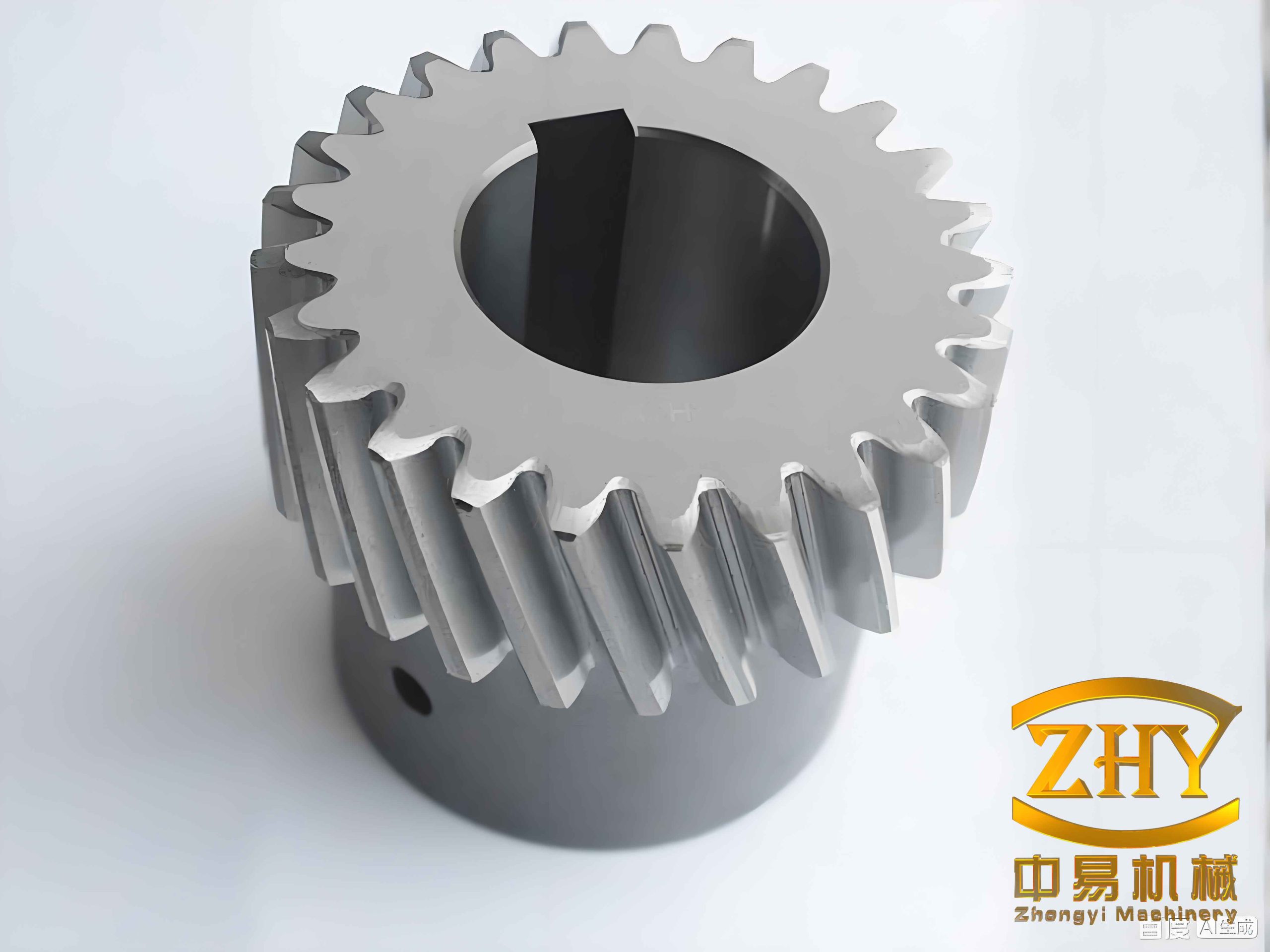
For the baseline roughness, we set amplitude Aₓᵧ = 0.05 μm, longitudinal wavelength λₓ = 22.5 μm, and transverse wavelength λᵧ = 2.0 mm. Figure (Insert the helical gear image here) illustrates the physical geometry of the helical gear pair analyzed in our study.
The three-dimensional distributions of oil film pressure, temperature rise, and film thickness at the pitch point are obtained. Compared with the smooth surface case, the rough surface induces periodic fluctuations in all film parameters. The pressure peaks and temperature rise can exceed the smooth solution by more than 50% in local regions. The minimum film thickness near the outlet and at the ends of the contact line becomes significantly lower than the central region, increasing the risk of dry friction.
To quantify the influence of roughness parameters, we extract the two characteristic cross‑sections: y = 0 (along the rolling direction) and x = 0 (along the contact line). We compute the standard deviation of the deviations between the rough and smooth solutions using:
$$ \sigma = \sqrt{ \frac{1}{n} \sum_{i=1}^{n} (m_i – l_i)^2 } $$
where \( m_i \) and \( l_i \) are the rough and smooth values at the same grid point, respectively, and n is the number of points in the domain of interest.
Effect of x‑Direction Roughness Wavelength λₓ
We vary λₓ from 15.0 μm to 30.0 μm while keeping other parameters fixed. The film pressure, temperature rise, and thickness profiles along y = 0 (rolling direction) show that increasing λₓ reduces the fluctuation amplitude and frequency. The pressure and temperature peaks decrease, and the local film thickness increases. The standard deviations are summarized in Table 4.
| λₓ / μm | σₓ(p) / GPa | σₓ(ΔT) / °C | σₓ(h) / μm |
|---|---|---|---|
| 15.0 | 0.0682 | 3.37 | 0.0374 |
| 22.5 | 0.0578 | 2.66 | 0.0361 |
| 30.0 | 0.0428 | 2.37 | 0.0352 |
As λₓ increases, the standard deviation of pressure drops by 37.2%, temperature rise by 29.4%, and film thickness by 5.9%. This indicates that longer roughness wavelengths produce a smoother lubricant flow and more stable film.
Effect of y‑Direction Roughness Wavelength λᵧ
We vary λᵧ from 1.5 mm to 2.5 mm while keeping other parameters fixed. The profiles along x = 0 (transverse direction) show that increasing λᵧ also reduces fluctuations and weakens the end‑effect necking. Table 5 lists the standard deviations.
| λᵧ / mm | σᵧ(p) / GPa | σᵧ(ΔT) / °C | σᵧ(h) / μm |
|---|---|---|---|
| 1.5 | 0.0574 | 2.31 | 0.0341 |
| 2.0 | 0.0370 | 1.84 | 0.0270 |
| 2.5 | 0.0361 | 1.69 | 0.0262 |
The pressure standard deviation decreases by 37.1%, temperature rise by 26.8%, and film thickness by 23.2% when λᵧ increases from 1.5 mm to 2.5 mm. The effect is significant but slightly weaker than that of λₓ, because the main flow and shear direction is along x.
Effect of Two‑Dimensional Roughness Amplitude Aₓᵧ
We study four amplitude levels: 0 (smooth), 0.025 μm, 0.05 μm, and 0.10 μm, with λₓ = 22.5 μm and λᵧ = 2.0 mm. Increasing amplitude strongly magnifies the fluctuations. Table 6 lists the standard deviations for both the x and y cross‑sections.
| Aₓᵧ / μm | σₓ(p) / GPa | σᵧ(p) / GPa | σₓ(ΔT) / °C | σᵧ(ΔT) / °C | σₓ(h) / μm | σᵧ(h) / μm |
|---|---|---|---|---|---|---|
| 0.025 | 0.0337 | 0.0483 | 1.590 | 2.600 | 0.0173 | 0.0258 |
| 0.050 | 0.0625 | 0.0735 | 3.120 | 4.360 | 0.0348 | 0.0370 |
| 0.100 | 0.104 | 0.118 | 6.710 | 8.090 | 0.070 | 0.067 |
When amplitude increases from 0.025 μm to 0.10 μm, the x‑direction pressure standard deviation rises by 209%, y‑direction by 144%; temperature rise standard deviation increases by 322% and 211% respectively; film thickness standard deviation increases by 305% and 160%. The x‑direction is more sensitive because the rolling velocity is along x, enhancing the interaction between roughness asperities and the lubricant flow.
Effect of Dimensionless Parameter G (Material Parameter)
The dimensionless material parameter G = αE’ is varied by changing the lubricant pressure‑viscosity coefficient α or the elastic modulus. We keep W and U constant. As G increases from 2000 to 3600, the oil film pressure and temperature rise increase overall, and the fluctuations become more severe. The film thickness shows only a slight decrease. Table 7 summarizes the standard deviations.
| G | σ_G(p) / GPa | σ_G(ΔT) / °C | σ_G(h) / μm |
|---|---|---|---|
| 2000 | 0.0195 | 1.19 | 0.0354 |
| 2800 | 0.0469 | 3.56 | 0.0351 |
| 3600 | 0.0893 | 6.58 | 0.0349 |
The pressure standard deviation rises by 358% and temperature rise by 453% from the lowest to highest G. This indicates that higher G amplifies the roughness‑induced fluctuations because the higher viscosity increases shear stresses and local temperature variations.
Effect of Dimensionless Parameter U (Speed Parameter)
The speed parameter U is varied around a reference value U* = 8.111×10⁻¹¹. As U increases from 0.6U* to 1.4U*, the film thickness and temperature rise increase, and the pressure fluctuations are partially suppressed. Table 8 shows the standard deviations.
| U | σ_U(p) / GPa | σ_U(ΔT) / °C | σ_U(h) / μm |
|---|---|---|---|
| 0.6U* | 0.0517 | 3.39 | 0.0349 |
| 1.0U* | 0.0352 | 2.76 | 0.0340 |
| 1.4U* | 0.0253 | 2.14 | 0.0331 |
Higher U reduces pressure standard deviation by 51.1% and temperature rise standard deviation by 36.9%. The thicker oil film at higher speeds helps to smooth out the asperity effects, mitigating the local pressure peaks.
Effect of Dimensionless Parameter W (Load Parameter)
The load parameter W is varied around a reference value W* = 2.301×10⁻⁵. As W increases from 0.5W* to 1.5W*, the film pressure and temperature rise increase markedly, and the fluctuations are greatly amplified. The film thickness decreases slightly. Table 9 presents the standard deviations.
| W | σ_W(p) / GPa | σ_W(ΔT) / °C | σ_W(h) / μm |
|---|---|---|---|
| 0.5W* | 0.0083 | 0.66 | 0.0383 |
| 1.0W* | 0.0240 | 2.02 | 0.0352 |
| 1.5W* | 0.0480 | 4.17 | 0.0354 |
The pressure standard deviation increases by 478% and temperature rise by 532% from the lowest to highest load. Higher loads reduce film thickness, making the asperities more likely to penetrate the film and cause severe pressure and temperature fluctuations.
Discussion and Conclusions
From our comprehensive numerical study on the TEHL of high‑speed helical gears, we draw the following conclusions:
- When the gear surface roughness amplitude is of the same order as the oil film thickness (typically sub‑micrometer), roughness significantly degrades lubrication stability. The film pressure, temperature, and thickness exhibit periodic fluctuations around the smooth solution, with local pressure peaks rising by up to 50% and intensified necking at the outlet and contact line ends.
- Increasing the roughness amplitude or decreasing the roughness wavelength (in either direction) exacerbates the fluctuations. The x‑direction (rolling direction) roughness has a greater impact than the y‑direction (transverse) roughness because the lubricant flow is mainly along the rolling direction.
- Among the dimensionless parameters, the material parameter G strongly amplifies pressure and temperature fluctuations, while the speed parameter U suppresses them. The load parameter W significantly amplifies fluctuations. Therefore, although increasing lubricant viscosity (higher G) can produce a thicker film, it also intensifies the detrimental effect of roughness on pressure and temperature stability.
- To improve the lubrication condition of high‑speed helical gears, we recommend minimizing the peak roughness amplitude and avoiding closely spaced asperity peaks. This can be achieved through superfinishing processes. Additionally, increasing the equivalent radius of curvature (reducing W) can help reduce the severity of roughness effects.
Our findings provide quantitative guidelines for the design and manufacturing of high‑speed helical gears in aero‑engines, emphasizing the importance of surface finish quality and the selection of proper operating parameters to ensure a stable lubricating film.