
In the demanding world of aerospace propulsion, where power ratings soar and rotational speeds reach dizzying heights, the humble gear is thrust into an arena of extreme performance. The transmission of thousands of horsepower at speeds exceeding ten thousand revolutions per minute places unparalleled stress on gear teeth. Conventional, theoretically perfect involute profiles are often inadequate here. Under such heavy loads, teeth deflect elastically, disrupting the ideal line of contact and leading to premature wear, excessive noise, vibration, and catastrophic failure. To combat this, a sophisticated solution is employed: the crowned, or “barrel-shaped,” tooth profile. My experience in manufacturing these critical components has centered on mastering two interconnected processes: precision grinding to generate the complex crowned form, and subsequent gear honing to achieve the superlative surface finish required for reliable, long-term operation.
The crowned profile is a deliberate and subtle deviation from the true involute. Imagine a gear tooth where the flanks are not straight in the profile view but are gently convex, like the surface of a barrel. This “crowning” is strategically applied to compensate for anticipated elastic deformation under load, ensuring that contact is maintained across the active profile in a controlled and uniform manner, even when the gears are heavily loaded. Analysis of the specified design reveals that this crown is not a simple, symmetrical curve. Rather, it is a composite form. The segment from the root to the pitch point features a “root relief” or undercut, effectively created by generating the flank from an enlarged base circle. Conversely, the segment from the pitch point to the tip features a “tip relief,” generated from a reduced base circle. Therefore, the crowned tooth profile is, in essence, a seamless blend of two involute curves originating from two distinct base diameters. This fundamental understanding is the cornerstone of both the grinding and the subsequent gear honing strategy.
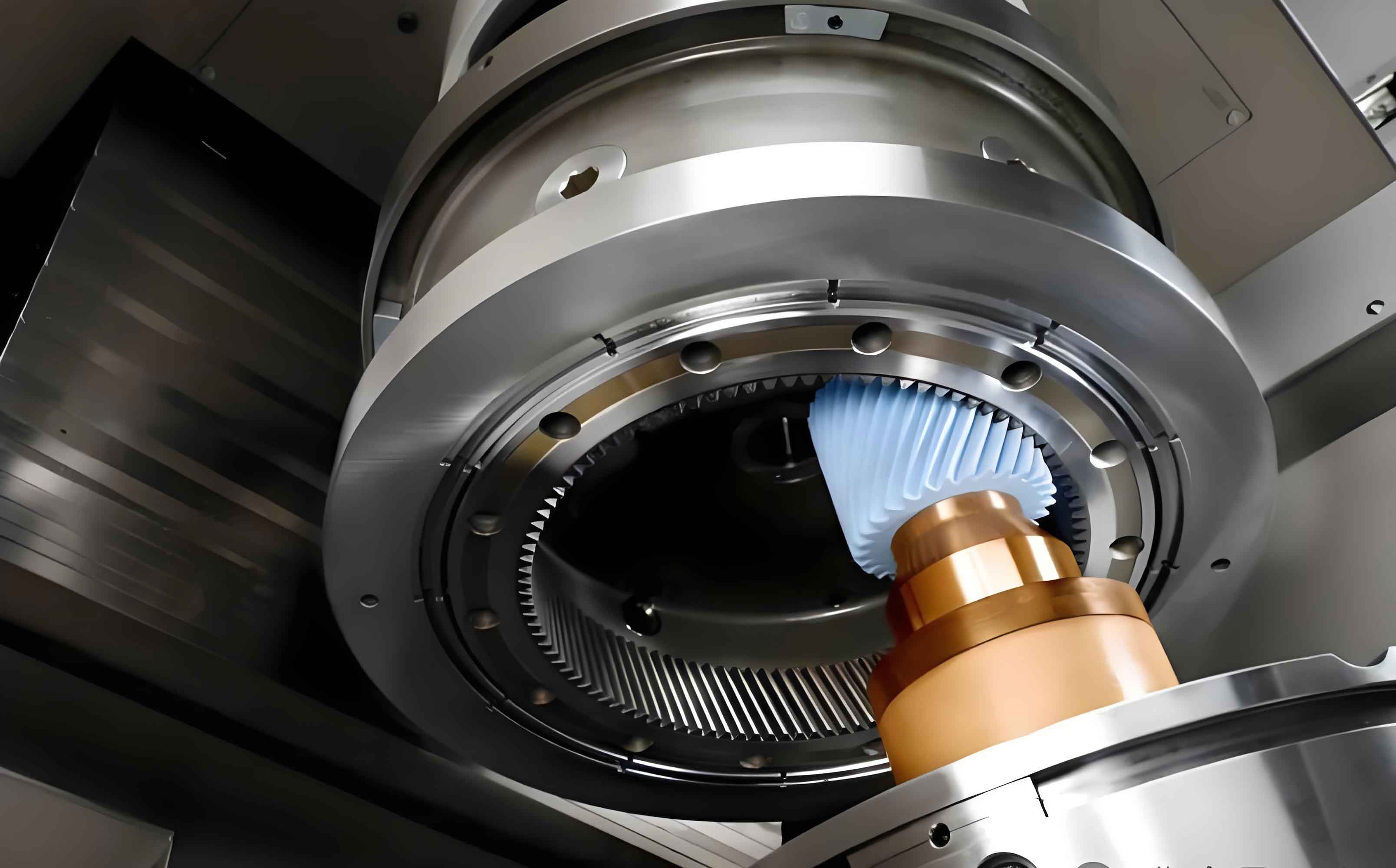
The generation of this precise crowned profile is achieved on precision gear grinding machines equipped with specialized modification attachments. The process employs the “0° grinding” method, where the axis of the grinding wheel is horizontal, and the wheel itself represents a rack with a 0° pressure angle. Contact with the workpiece is a single point, analogous to measurement with a span micrometer. The critical modification is controlled by a cam-driven “B” mechanism. This system provides an axial reciprocation to the grinding wheel, superimposed on its primary motion. A signal cam, synchronized with the workpiece’s generating roll, is fitted with adjustable templates. These templates are set to command the axial movement of the wheel precisely when the grinding point traverses the zones requiring modification—the root and the tip. For the crowned profile, the root relief (enlarged base circle effect) and the tip relief (reduced base circle effect) are programmed sequentially via this cam system.
The mathematical relationship between the required profile modification (crown amount, $\Delta J$) and the necessary adjustment to the machine’s kinematic chain (like the effective base circle) is key. The profile modification $\Delta J$ at a specific roll length is related to a change in the base circle radius $\Delta R_b$ by the formula:
$$ \Delta R_b = R_b \cdot \frac{\Delta J}{\rho} $$
where $R_b$ is the nominal base circle radius and $\rho$ is the length of the active profile (the difference in radii of curvature between the tip and the start of active profile). For a gear requiring a symmetrical crown with a mean value $\Delta J_{mean}$, the calculations for the “relieved” segments are derived from this principle. The target profile is defined within a tight tolerance band, often only a few microns. The setup parameters for grinding different crowned gears can be summarized as follows:
| Gear Component | Module (mm) | Crown Amount (mm) | Grinding Strategy |
|---|---|---|---|
| Primary Drive Gear | ~4.2 | 0.012 – 0.021 | 0° grind with B-cam for root & tip relief |
| Planet Gear | ~3.88 | 0.004 – 0.022 | 0° grind with B-cam; root relief via base circle adjustment |
| Secondary Drive Gear | ~4.5 | 0.015 – 0.024 | 0° grind with B-cam for root & tip relief |
While grinding achieves the exact geometric form, the resulting surface finish, typically around Ra 0.8 µm (32 µin), is insufficient for the ultra-smooth operation demanded by high-speed gears. The final surface integrity is achieved through gear honing. This is a finishing process where a geared honing tool, impregnated with abrasive, meshes with the workpiece under light pressure and crossed axes. The abrasive action removes minute amounts of material, primarily the peaks of the surface roughness, to achieve a mirror-like finish of Ra 0.1 µm (4 µin) or better. However, the challenge in gear honing a crowned profile is profound: the honing tool must not only improve finish but must do so without altering the meticulously ground crown geometry. The honing stone’s contact pattern must conform to the crowned flank; otherwise, it will preferentially wear the high point of the crown, flattening the profile and destroying its functional benefit.
This necessitates the design of a specially modified honing tool. The principle mirrors the analysis of the crown itself. The honing tool’s tooth profile must be a conjugate match to the workpiece’s crowned profile. For an external gear honing tool, this means creating a tooth with a slightly “concave” or “hollow” flank. In practice, this is achieved by designing the honing tool with asymmetric flanks. One flank (e.g., the left) is generated from an enlarged base circle to correctly hone the root-relief segment of the workpiece. The opposing flank (the right) is generated from a reduced base circle to hone the tip-relief segment. The honing operation is then performed in two passes: one with the tool rotating in a direction that brings the “enlarged base circle” flank into contact, and another (often with the workpiece reversed) using the “reduced base circle” flank. The calculations for designing such a tool are critical. Given the workpiece’s nominal base diameter $D_b$, the modified base diameters for the honing tool $D_{b,hone}$ are calculated based on the desired crown compensation $\Delta J_{comp}$:
$$ D_{b,hone\_left} = D_b + 2 \cdot \left( R_b \cdot \frac{\Delta J_{comp}}{\rho} \right) $$
$$ D_{b,hone\_right} = D_b – 2 \cdot \left( R_b \cdot \frac{\Delta J_{comp}}{\rho} \right) $$
For internal gear honing tools, the approach is different but follows the same logic. The master model (a positive external gear) used to cast the internal hone is itself manufactured with a crowned profile. Consequently, the internal hone cavity receives a conjugate, “concave” profile that perfectly matches the workpiece’s crowned tooth. The design of this master requires additional considerations, such as increased addendum to maintain radial clearance during gear honing and increased dedendum to ensure the honed profile includes the full active length. The comparison between external and internal honing methods reveals distinct trade-offs:
| Aspect | External Gear Honing Tool | Internal Gear Honing Tool |
|---|---|---|
| Profile Conformity | Requires precise asymmetric grinding of tool. | Inherently matches crown from master model. |
| Process Efficiency | Generally higher material removal rate. | Typically slower cutting action. |
| Surface Finish | Can achieve excellent finish. | Finish may be slightly less refined. |
| Tool Life & Stability | Lower tool life; profile may degrade. | Higher tool life; profile stability is excellent. |
| Application Flexibility | Suitable for a range of gears. | Ideal for complex, stable production of crowned profiles. |
The symbiotic relationship between grinding and gear honing defines the manufacturing success of high-performance gears. The grinder is the sculptor, creating the macro-geometry with micron-level precision. The hone is the polisher, refining the micro-geometry to a state that minimizes friction, wear, and heat generation. The parameters for the gear honing process itself must be meticulously controlled. The honing allowance, the amount of stock left after grinding for the hone to remove, is a critical variable. It must be sufficient to clean up the grind marks and achieve the target finish, yet small enough to prevent any significant alteration of the crown geometry. This allowance is typically in the range of 0.005 to 0.02 mm per flank. The cross-axis angle between the tool and workpiece, the honing speed, and the applied pressure are all tuned to create an optimal cutting action that is gentle on the geometry but effective on the surface. A summary of key honing parameters and their effects is useful:
| Honing Parameter | Typical Range/Value | Primary Influence |
|---|---|---|
| Honing Allowance (per flank) | 0.005 – 0.02 mm | Final surface finish; risk of profile alteration. |
| Cross-Axis Angle | 3° – 10° | Generates sliding motion for cutting; affects pattern. |
| Honing Speed (Surface) | 1 – 3 m/s | Material removal rate; heat generation. |
| Honing Pressure | Low, controlled force | Determines cutting aggression and tool wear. |
| Honing Oil | Specialty cleaning/cooling oil | Cools, cleans chips, and prevents loading. |
The culmination of this rigorous process is a gear capable of surviving its brutal operational environment. The crowned profile ensures that under full load, the contact ellipse spreads optimally across the tooth flank, distributing stress and preventing edge loading. The superb finish from gear honing minimizes micropitting, reduces friction losses, and contributes to quiet operation. Every step, from the calculation of the base circle modifications for the grind to the design of the conjugate honing tool, is underpinned by a deep understanding of involute geometry and tribology. It is a testament to precision engineering where the functional requirement of compensating for elastic deflection is translated first into a complex geometric definition, then into a set of machine tool instructions, and finally into a physical reality through the abrasive harmony of grinding and gear honing. The continuous development of gear honing technology, including CNC-controlled honing tools that can adapt their profile, promises even greater capabilities for manufacturing the advanced crowned profiles required by next-generation, high-speed, heavy-duty transmissions.