
In my years of experience working with power transmission systems, I have consistently found worm gear reducers to be among the most fascinating and widely applicable components. Their unique principle of operation, offering a compact right-angle drive with high reduction ratios and inherent self-locking capability, makes them indispensable in countless industrial and mechanical applications. From conveyor systems and packaging machinery to elevators and material handling equipment, the presence of worm gears is ubiquitous. This guide aims to provide a comprehensive, in-depth exploration of worm gear reducers, delving into their fundamental principles, advantages, common failure modes, and best practices for maintenance, all from a practical engineering perspective.
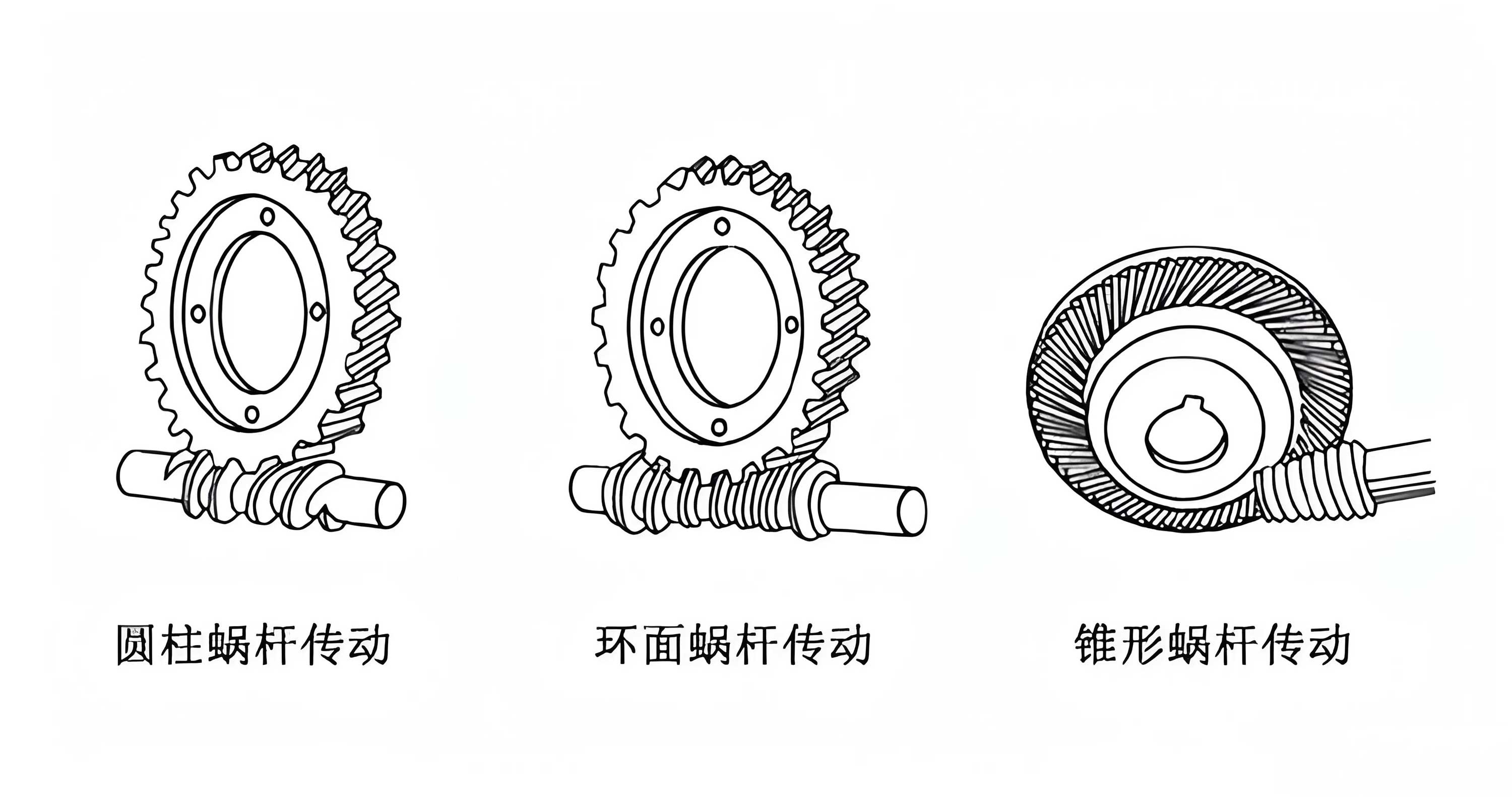
The core of a worm gear reducer lies in the meshing of two primary components: the worm (a threaded screw) and the worm wheel (a gear). This configuration is fundamentally different from parallel-shaft gear systems. The worm, typically made from hardened steel, is the driving element. Its threads engage with the specially profiled teeth of the worm wheel, which is often cast from a softer, bearing-grade bronze or a polymeric material. This material combination is crucial for managing the significant sliding friction inherent in the operation of worm gears. The primary kinematic relationship is defined by the number of threads (or “starts”) on the worm ($$Z_1$$) and the number of teeth on the worm wheel ($$Z_2$$). The single-stage reduction ratio ($$i$$) is elegantly simple:
$$ i = \frac{Z_2}{Z_1} $$
For instance, a single-start worm ($$Z_1 = 1$$) driving a worm wheel with 40 teeth ($$Z_2 = 40$$) yields a reduction ratio of 40:1. This ability to achieve high ratios in a single, compact stage is a defining characteristic that sets worm gears apart from many other gear types.
Fundamental Characteristics and Operational Advantages
The design of worm gear drives confers several distinct operational advantages, which I will detail below, supported by quantitative relationships where applicable.
1. High Reduction Ratio and Compactness: As indicated by the formula above, very high reduction ratios can be achieved in a minimal space. This contrasts sharply with multi-stage spur or helical gear trains, which would require significantly more stages and axial length to accomplish the same ratio.
2. Smooth and Quiet Operation: The engagement between the worm and wheel teeth involves a progressive, sliding contact rather than the abrupt impact of meshing spur gear teeth. This results in remarkably quiet and vibration-free power transmission, a critical factor in applications like theater stage machinery or hospital equipment.
3. Self-Locking Capability: This is perhaps the most renowned feature of many worm gear sets. Self-locking occurs when the lead angle of the worm ($$\gamma$$) is less than the arctangent of the coefficient of friction ($$\mu$$) between the mating surfaces:
$$ \gamma < \arctan(\mu) $$
Under this condition, the system cannot be back-driven; that is, torque applied to the output worm wheel cannot cause the input worm to rotate. This provides a built-in braking or holding force, essential for applications like hoists, inclined conveyors, or lifting platforms where safety is paramount. It is vital to note that not all worm gears are self-locking; high-efficiency, multi-start designs with a larger lead angle may permit back-driving.
4. Right-Angle Power Transmission: The perpendicular orientation of the input and output shafts simplifies mechanical layout, often eliminating the need for additional bevel gears or belt drives to change the direction of power flow.
The following table summarizes the key characteristics and typical value ranges for standard worm gear drives:
| Characteristic | Description | Typical Range / Notes |
|---|---|---|
| Reduction Ratio (Single-Stage) | Ratio of output speed to input speed. | 5:1 to 100:1 (Common), up to 300:1+ (Special) |
| Efficiency (η) | Output power / Input power. Highly dependent on ratio and lubrication. | ~40% (High-ratio) to ~90% (Low-ratio, multi-start) |
| Self-Locking Tendency | Ability to prevent back-driving. | Common in single-start, low lead angle designs. |
| Primary Motion | Dominant contact type between teeth. | Sliding action (vs. rolling in some other gears). |
Core Functions and Performance Analysis
In practical application, worm gear reducers perform three critical functions that justify their selection over alternative drive systems.
1. Torque Multiplication and Speed Reduction: This is the fundamental purpose of any reducer. By reducing the output rotational speed ($$n_{out}$$) relative to the input speed ($$n_{in}$$), the output torque ($$T_{out}$$) is increased proportionally, neglecting losses. The ideal relationship is governed by power conservation:
$$ P_{in} = T_{in} \cdot \omega_{in} = T_{out} \cdot \omega_{out} = P_{out} $$
$$ \text{Since } \omega = \frac{2\pi n}{60}, \text{ then } T_{out} \approx T_{in} \cdot i \cdot \eta $$
Where $$ \eta $$ is the mechanical efficiency. This allows a relatively small, high-speed motor to deliver very high torque at a low, usable speed to the driven machine.
2. Load Inertia Matching and System Protection: A frequently overlooked but vital role of the worm gear reducer is inertial reflection. The inertia of the load ($$J_{load}$$) as seen by the motor is reduced by the square of the reduction ratio:
$$ J_{reflected} = \frac{J_{load}}{i^2} $$
This has profound implications. It drastically reduces the torque required from the motor for acceleration/deceleration, allowing for smaller motor sizing and more responsive control. It also mechanically protects the motor from sudden shock loads on the output side, as these are attenuated through the reducer.
3. Directional Change of Power Flow: The 90-degree shaft orientation provides design flexibility, simplifying machine layout. The self-locking characteristic, when present, adds a critical safety function by holding the load stationary when the motor is de-energized.
Common Failure Modes and Systematic Solution Strategies
Despite their robust design, worm gears are susceptible to specific failure modes, primarily stemming from their sliding-action nature. A systematic approach to diagnosis and resolution is essential. The table below outlines the primary failures, their root causes, and mitigation strategies.
| Failure Mode | Primary Symptoms & Root Causes | Corrective & Preventive Strategies |
|---|---|---|
| Overheating & Oil Leakage | Symptom: High housing temperature, oil seepage at seals/casing. Causes: Excessive sliding friction generates heat, causing thermal expansion and seal degradation. Inadequate lubrication, overloading, or improper viscosity oil worsen the issue. |
1. Ensure correct lubricant type/viscosity (e.g., EP-rated synthetic). 2. Verify unit is not operating above rated thermal capacity. 3. Improve external cooling (fans, cooling fins) if ambient temperature is high. 4. Use high-temperature seals and ensure proper installation. |
| Premature Worm Wheel Wear | Symptom: Bronze particles in oil, increased backlash, noise. Causes: Abrasive wear from contamination (dust, grit). Adhesive wear (scuffing) from oil film breakdown, poor surface finish, or overload. |
1. Implement superior filtration and sealing to exclude contaminants. 2. Use lubricants with extreme-pressure (EP) and anti-wear additives. 3. Ensure correct initial run-in procedure to establish proper contact pattern. 4. Verify applied load is within design specifications. |
| Scoring/Galling of Worm Thread | Symptom: Severe adhesive material transfer between surfaces, leading to rapid failure. Causes: Critical lubrication failure, misalignment, excessive load, or incompatible material pairing. |
1. Immediate attention to lubrication system (level, flow, cooler). 2. Check and realign the reducer to the driven/driving units. 3. Specify high-quality worm gears with proper surface hardening (worm) and phosphor bronze (wheel). |
| Bearing Failure | Symptom: Grinding noise, increased vibration, shaft seizure. Causes: Contaminated lubricant, improper preload, misalignment, corrosion from moisture ingress, or fatigue from overloading. |
1. Maintain lubricant cleanliness and change intervals. 2. Follow manufacturer’s specifications for bearing adjustment/preload. 3. Ensure proper sealing to prevent water/condensation entry. 4. Check for excessive axial or radial loads from connected equipment. |
| Fatigue Pitting on Tooth Flanks | Symptom: Small pits or craters on the loaded flank of worm wheel teeth. Cause: Cyclic Hertzian contact stresses exceed the material’s endurance limit, often after many operating hours. |
1. This is often a normal wear-out mode. Use higher-grade materials. 2. Ensure lubricant film thickness is sufficient to separate surfaces (adequate viscosity). 3. Reduce dynamic shock loads in the system. |
From my experience, overheating is a primary accelerator of almost all other failures. The heat generated ($$Q_{gen}$$) is primarily a function of lost power, which is input power multiplied by inefficiency (1-η). A simplified thermal equilibrium model must be considered:
$$ Q_{gen} = P_{in} \cdot (1 – \eta) $$
$$ Q_{dissipated} = h \cdot A \cdot (T_{housing} – T_{ambient}) $$
For stable operation, $$ Q_{dissipated} \geq Q_{gen} $$. If the generated heat exceeds the housing’s ability to dissipate it (dictated by surface area $$A$$ and heat transfer coefficient $$h$$), the temperature rises uncontrollably, leading to the cascade of issues described.
Comprehensive Maintenance and Proactive Care Regimen
Proactive and disciplined maintenance is the single most effective way to maximize the service life and reliability of worm gear reducers. This regimen should be multi-tiered, encompassing daily checks, periodic services, and major overhauls.
1. Daily/Operational Monitoring:
* Temperature: Use an infrared thermometer or housing-mounted sensor. Compare against baseline readings. A sudden or steady rise often indicates developing trouble.
* Noise & Vibration: Listen for changes in sound—increasing whine, grinding, or irregular knocking. Simple vibration analysis tools can detect bearing or misalignment issues early.
* Leak Inspection: Visually check all sealing surfaces (shaft seals, casing joints, breathers) for oil seepage or drips.
* Lubricant Level: Check sight glasses or dipsticks with the unit stopped and leveled.
2. Scheduled Periodic Maintenance: Adherence to a time- or operation-based schedule is non-negotiable. The following table provides a generalized framework, which must be adapted to the specific manufacturer’s recommendations and operating severity.
| Activity | Frequency | Key Actions |
|---|---|---|
| Oil Analysis & Change | First: 500 hrs. Then: 2,500-5,000 hrs or annually. | Drain oil while warm. Analyze used oil for wear metals (Fe, Cu, Sn), viscosity, and moisture. Refill with exact specified grade and quantity. |
| External Cleaning & Inspection | Weekly/Monthly | Clean housing to promote heat dissipation. Inspect for corrosion, loose mounting bolts, and coupling condition. |
| Seal & Breather Check | Every 6 months | Ensure breathers are unclogged to prevent pressure build-up. Inspect shaft seals for lip damage. |
| Alignment Verification | After installation; after any adjacent component work | Check and correct angular and parallel misalignment between reducer and motor/load shafts using laser or dial indicators. |
3. Major Overhaul & Rebuild: Typically scheduled every 25,000 to 50,000 operating hours, or as indicated by condition monitoring. This involves complete disassembly, thorough cleaning, detailed inspection of all components (worms, wheels, bearings, shafts, seals), replacement of worn parts, reassembly with precise clearances, and testing. Key dimensional checks include backlash measurement, which can be assessed with a dial indicator fixed to the housing, measuring the rotational movement of the output wheel when the input is locked. Excessive backlash signals significant wear.
Furthermore, proper storage of spare worm gear units is critical. They should be stored in a clean, dry environment with all exposed shafts and flanges coated in preservative oil and protected. The housing should be filled with the correct lubricant, or if stored dry, filled with preservative oil which must be thoroughly flushed before commissioning.
Conclusion
The worm gear reducer stands as a testament to elegant mechanical design, solving complex problems of torque multiplication, speed reduction, and directional change with a remarkably simple and robust configuration. Its advantages—high single-stage ratios, compact right-angle output, smooth operation, and potential self-locking—ensure its continued prevalence across industries. However, understanding its Achilles’ heel, namely the sliding friction that defines its operation, is key to successful application. By respecting its thermal limitations, ensuring impeccable lubrication, implementing a rigorous condition monitoring and maintenance schedule, and responding proactively to early warning signs, engineers and maintenance professionals can reliably extract decades of service from these versatile power transmission components. The longevity and performance of worm gears are not merely a matter of chance but a direct result of informed application and diligent care.