
In modern mechanical transmission systems, helical gears are widely used due to their high load capacity, smooth operation, and reduced noise compared to spur gears. However, under high-speed and heavy-duty conditions, the temperature rise caused by friction and sliding at the meshing interfaces can significantly affect the gear’s structural integrity and dynamic behavior. Specifically, the thermal deformation of tooth profiles alters the mesh stiffness, which is a critical parameter in gear dynamics analysis. Accurate calculation of time-varying mesh stiffness for helical gears, while accounting for temperature effects, is essential for reliable design and optimization. In this article, I present a comprehensive analytic algorithm for determining the time-varying mesh stiffness of helical gears considering temperature effects. The algorithm integrates thermal deformation into the potential energy method, using slicing and integral approaches, and is validated through finite element analysis. I will discuss the methodology, results, and implications for gear system design, with emphasis on the influence of operational parameters such as friction coefficient, input torque, and input speed.
The importance of helical gears in power transmission cannot be overstated. Their helical teeth allow for gradual engagement, reducing impact loads and vibration. However, this advantage comes with increased complexity in stiffness calculation due to the varying contact line length along the tooth width. Traditional methods often neglect temperature effects, but in high-performance applications, the heat generated from sliding friction can cause substantial thermal expansion, leading to changes in tooth geometry and stiffness. This oversight may result in inaccurate dynamic predictions, potentially causing premature failure or suboptimal performance. Therefore, developing an efficient analytic algorithm that incorporates temperature effects is crucial for advancing gear technology.
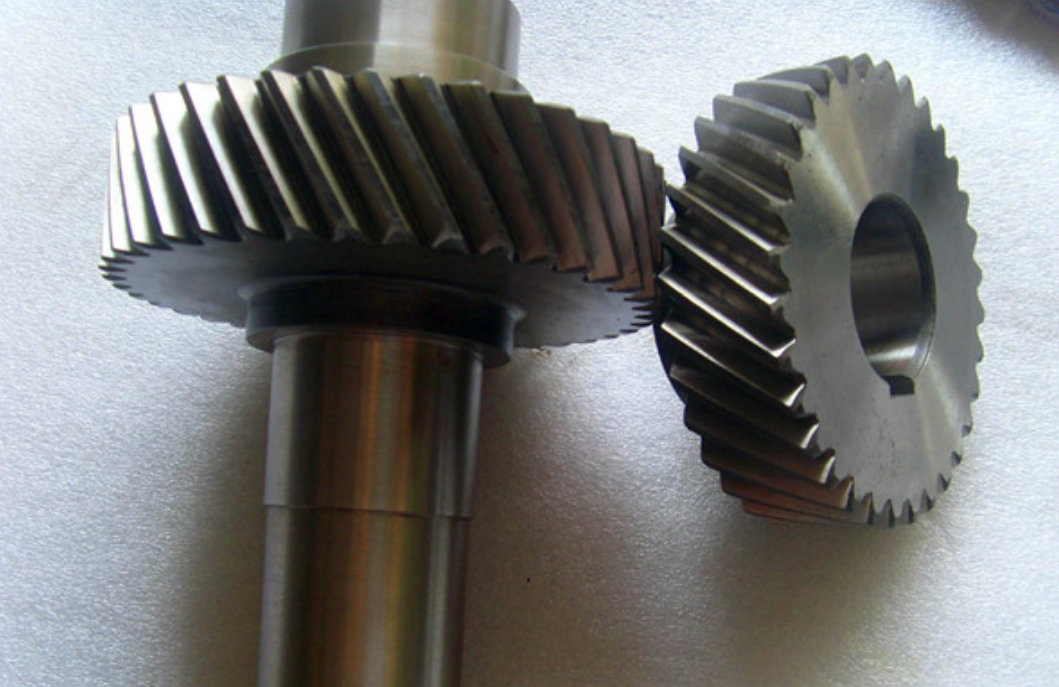
My approach begins with modeling the thermal deformation of helical gear tooth profiles. When helical gears operate under thermal equilibrium, the bulk temperature field stabilizes, but it is non-uniform across the gear body. The temperature distribution can be described using a steady-state heat conduction equation in cylindrical coordinates. Assuming a one-dimensional steady temperature field where temperature varies only radially, the governing equation simplifies to:
$$ \frac{d}{dr} \left( r \frac{dT}{dr} \right) = 0 $$
The general solution is:
$$ T(r) = C_1 \ln r + C_2 $$
Applying boundary conditions at the inner radius \( R_i \) (shaft hole) and outer radius \( R_0 \) (taken as the larger of base circle radius \( R_b \) or root circle radius \( R_f \)), the temperature distribution becomes:
$$ T(r) = T(R_i) + [T(R_0) – T(R_i)] \frac{\ln r – \ln R_i}{\ln R_0 – \ln R_i} $$
The radial displacement due to thermal expansion, derived from displacement methods, is given by:
$$ u = \frac{(1+\nu)\alpha}{r} \int_{R_i}^{r} T r \, dr + \frac{r \alpha (1-\nu)}{R_0^2 – R_i^2} \int_{R_i}^{R_0} T r \, dr + \frac{\alpha (1+\nu) R_i^2}{r(R_0^2 – R_i^2)} \int_{R_i}^{R_0} T r \, dr $$
where \( \alpha \) is the thermal expansion coefficient, \( \nu \) is Poisson’s ratio, and \( u \) represents radial displacement. For helical gears, this displacement affects both the base circle and root circle, altering the tooth profile geometry. The actual radius of any point on the transverse tooth profile after thermal deformation is:
$$ R’_K = R_K + \Delta R_K = R_K + u_b + \Delta T \alpha (R_b / \cos \alpha_K – R_b) $$
Here, \( u_b \) is the thermal deformation at the base circle, \( \Delta T \) is the instantaneous flash temperature at the meshing interface, and \( \alpha_K \) is the pressure angle at point K. The flash temperature is calculated as:
$$ \Delta T = \psi_T f_m f_e \frac{|v_1 – v_2|}{(\sqrt{g_1 \rho_1 c_1 v_1} + \sqrt{g_2 \rho_2 c_2 v_2}) \sqrt{B_c}} $$
where \( \psi_T \) is a temperature rise coefficient for helical gears, \( f_m \) is the average friction coefficient, \( f_e \) is the normal load per unit width, \( v_i \) are tangential velocities, \( g_i \) are thermal conductivities, \( \rho_i \) are densities, \( c_i \) are specific heats, and \( B_c \) is the half-width of the contact band. The modified transverse tooth profile in polar coordinates becomes:
$$ R’_K(\alpha_K) = \frac{R_b + u_b}{\cos \alpha_K} + \Delta T \alpha R_b \left( \frac{1 – \cos \alpha_K}{\cos \alpha_K} \right) $$
$$ \theta’_K(\alpha_K) = \text{inv} \alpha_K – \frac{\Delta T \alpha s_K}{2 R’_K(\alpha_K)} $$
This formulation accounts for thermal expansion in both tooth thickness and height, providing a realistic representation of helical gear teeth under thermal loads.
Next, I derive the time-varying mesh stiffness for helical gears using the potential energy method. The total mesh stiffness \( k_t \) is a combination of various stiffness components: bending stiffness \( k_b \), shear stiffness \( k_s \), axial compression stiffness \( k_a \), fillet foundation stiffness \( k_f \), and Hertzian contact stiffness \( k_h \). The reciprocal sum gives:
$$ k_t = \frac{1}{\frac{1}{k_{b1}} + \frac{1}{k_{s1}} + \frac{1}{k_{a1}} + \frac{1}{k_{f1}} + \frac{1}{k_{b2}} + \frac{1}{k_{s2}} + \frac{1}{k_{a2}} + \frac{1}{k_{f2}} + \frac{1}{k_h}} $$
For helical gears, the slicing method is employed. The tooth is divided into numerous thin slices along the face width, each treated as a spur gear slice. The stiffness contributions are integrated over the contact line length. Considering thermal deformation, the bending stiffness for a slice is expressed as:
$$ dk_b = \left[ \int_{0}^{d'(y)} \frac{[(d'(y) – x’) \cos \alpha’_1(y) – h'(y) \sin \alpha’_1(y)]^2}{E dI’_x} \, dx’ \right]^{-1} $$
where \( E \) is Young’s modulus, \( d'(y) \) is the distance from the meshing point to the base circle in the tooth height direction, \( h'(y) \) is the distance from the meshing point to the gear centerline, and \( dI’_x \) is the area moment of inertia at section \( x’ \). The variables depend on whether the base circle radius is larger or smaller than the root circle radius. For helical gears, the integration is performed numerically by summing over \( N \) slices:
$$ k_b = \sum_{i=1}^{N} \left[ \int_{\alpha_f}^{\alpha_m} \frac{3A^2 x'(\alpha_K)}{2E z^3(\alpha_K) \Delta y} \, d\alpha_K \right]^{-1} $$
with \( \Delta y = l / N \), where \( l = L \cos \beta_b \), \( L \) is the time-varying contact line length, and \( \beta_b \) is the base helix angle. The terms \( A \), \( x'(\alpha_K) \), and \( z(\alpha_K) \) are derived from the transformed tooth profile coordinates. Similarly, shear stiffness and axial compression stiffness are given by:
$$ k_s = \sum_{i=1}^{N} \left[ \int_{\alpha_f}^{\alpha_m} \frac{1.2(1+\nu) \cos^2 \alpha’_1 x'(\alpha_K)}{E z(\alpha_K) \Delta y} \, d\alpha_K \right]^{-1} $$
$$ k_a = \sum_{i=1}^{N} \left[ \int_{\alpha_f}^{\alpha_m} \frac{\sin^2 \alpha’_1 x'(\alpha_K)}{2E z(\alpha_K) \Delta y} \, d\alpha_K \right]^{-1} $$
The fillet foundation stiffness for a slice, considering thermal effects, is:
$$ k_f = \sum_{i=1}^{N} \frac{1}{\cos^2 \alpha’_1} \left[ \frac{E \Delta y}{L^* \left( \frac{u_r}{S_r} \right)^2 + M^* \left( \frac{u_r}{S_r} \right) + P^* (1 + Q^* \tan^2 \alpha’_1)} \right] $$
where \( L^*, M^*, P^*, Q^* \) are geometric coefficients, \( u_r = x[\alpha_m(y)] – (R_f + u_f) \), and \( S_r = 2(R_f + u_f) \alpha_3 \). Finally, the Hertzian contact stiffness is:
$$ k_h = \frac{\pi E L}{4(1 – \nu^2)} $$
These equations collectively form the analytic algorithm for time-varying mesh stiffness of helical gears with temperature inclusion. The algorithm efficiently computes stiffness over a meshing cycle, capturing the effects of thermal expansion on tooth geometry.
To validate the algorithm, I compared its results with finite element analysis (FEA) for a helical gear pair with parameters listed in Table 1. The gears operate under high-speed conditions, and temperature effects are significant. The FEA model incorporated frictional heat flux and convective cooling to simulate the thermal field, followed by static contact analysis to extract deformations and stiffness.
| Parameter | Value | Parameter | Value |
|---|---|---|---|
| Number of teeth, \( z_1 / z_2 \) | 40 / 162 | Center distance, \( a \) (mm) | 1250 |
| Normal module, \( m_n \) (mm) | 12 | Power, \( P \) (kW) | 3060 |
| Normal pressure angle, \( \alpha_n \) (°) | 20 | Rotational speed, \( n \) (r/min) | 1200 |
| Helix angle, \( \beta \) (°) | 12 | Density, \( \rho \) (kg/m³) | 7850 |
| Face width, \( b \) (mm) | 180 | Young’s modulus, \( E \) (Pa) | 2.1 × 10¹¹ |
The single-tooth mesh stiffness and total mesh stiffness were computed using both methods. Figure 1 shows the comparison of single-tooth mesh stiffness over a normalized meshing period \( \tau \) (from engagement to disengagement). The analytic results align closely with FEA, especially near the pitch point. The average error in single-tooth stiffness is about 11.59%, which is acceptable for engineering applications. The inclusion of temperature effects increases stiffness throughout the meshing cycle due to thermal expansion reducing tooth clearance and increasing contact area. Specifically, the maximum single-tooth stiffness rose from \( 2.592 \times 10^9 \, \text{N/m} \) to \( 2.878 \times 10^9 \, \text{N/m} \), and the mean total stiffness increased from \( 3.726 \times 10^9 \, \text{N/m} \) to \( 4.117 \times 10^9 \, \text{N/m} \).
To further analyze the impact of operational parameters, I varied friction coefficient, input torque, and input speed. The results are summarized in Table 2 and discussed below.
| Parameter | Range | Effect on Mean Total Stiffness | Percentage Increase |
|---|---|---|---|
| Friction coefficient, \( f_m \) | 0.03 to 0.07 | Increases from \( 3.858 \times 10^9 \, \text{N/m} \) to \( 4.311 \times 10^9 \, \text{N/m} \) | 11.74% |
| Input torque, \( T \) (kN·m) | 12 to 36 | Increases from \( 3.586 \times 10^9 \, \text{N/m} \) to \( 4.454 \times 10^9 \, \text{N/m} \) | 24.21% |
| Input speed, \( n \) (r/min) | 1200 to 6000 | Increases from \( 4.118 \times 10^9 \, \text{N/m} \) to \( 4.554 \times 10^9 \, \text{N/m} \) | 10.59% |
Increasing the friction coefficient elevates frictional heating, raising bulk and flash temperatures. This leads to greater thermal expansion, enhancing mesh stiffness. The stiffness increase is gradual across the meshing cycle, as shown in Figure 2a for single-tooth stiffness. The mean total stiffness grows by 11.74% over the friction range, indicating that friction management is crucial for stiffness control in helical gears.
Higher input torque increases contact pressure and frictional heat flux, similarly boosting temperatures and stiffness. Additionally, torque rise extends the contact line length, reducing unit load and further increasing stiffness. The mean total stiffness surges by 24.21%, the largest among parameters, highlighting torque’s dominant role. Figure 2b illustrates the near-linear growth of mean stiffness with torque, emphasizing the need for accurate torque considerations in design.
Elevated input speed amplifies sliding velocities, intensifying frictional heating. However, the stiffness increase diminishes at higher speeds due to enhanced cooling effects and nonlinear thermal dynamics. The mean total stiffness rises by 10.59%, with curves showing saturation trends (Figure 2c). This suggests that speed effects may plateau in extreme conditions, warranting careful analysis for high-speed helical gears.
The algorithm’s efficiency stems from its analytic nature, avoiding time-consuming FEA simulations. By integrating thermal deformation directly into stiffness formulas, it provides rapid predictions suitable for iterative design and optimization. Moreover, the slicing method accurately captures the helical geometry, making it applicable to a wide range of helical gear configurations. The inclusion of temperature effects addresses a critical gap in traditional methods, ensuring reliability in high-performance applications.
In practice, this algorithm can be embedded into gear design software for dynamic analysis. For instance, in wind turbine gearboxes or automotive transmissions, where helical gears are prevalent, temperature-induced stiffness variations can affect vibration and noise. By incorporating this algorithm, designers can better predict dynamic responses, optimize tooth modifications, and prevent resonance issues. Future work could extend the method to include non-uniform load distribution, lubrication effects, or composite materials for helical gears.
In conclusion, I have developed an analytic algorithm for time-varying mesh stiffness of helical gears that considers temperature effects. The algorithm combines thermal deformation modeling with the potential energy method, validated through FEA. Results show that temperature inclusion increases mesh stiffness, with operational parameters like friction, torque, and speed significantly influencing stiffness values. This research provides a theoretical foundation for accurate dynamic analysis of high-speed, heavy-duty helical gear systems, enabling improved design and performance. The use of helical gears in advanced machinery will benefit from this enhanced stiffness calculation approach, fostering innovation in mechanical transmission technology.
To further illustrate the mathematical framework, key equations are summarized below:
1. Thermal deformation of base circle:
$$ u_b = \text{Equation (6) or (8) depending on } R_b \text{ and } R_f $$
2. Modified tooth profile:
$$ R’_K(\alpha_K) = \frac{R_b + u_b}{\cos \alpha_K} + \Delta T \alpha R_b \left( \frac{1 – \cos \alpha_K}{\cos \alpha_K} \right) $$
3. Single-tooth bending stiffness (for \( R_b > R_f \)):
$$ k_b = \sum_{i=1}^{N} \left[ \int_{0}^{\alpha_m} \frac{3A^2 x'(\alpha_K)}{2E z^3(\alpha_K) \Delta y} \, d\alpha_K + \frac{B^3 – C^2}{2E \cos \alpha_m(y) z^3(0) \Delta y} \right]^{-1} $$
4. Total mesh stiffness:
$$ k_t = \frac{1}{\sum_{j=1}^{2} \left( \frac{1}{k_{b j}} + \frac{1}{k_{s j}} + \frac{1}{k_{a j}} + \frac{1}{k_{f j}} \right) + \frac{1}{k_h}} $$
These formulas, along with the discussed tables, provide a comprehensive toolset for analyzing helical gears under thermal loads. The algorithm’s robustness and efficiency make it a valuable contribution to gear engineering, particularly for advancing helical gear applications in demanding environments.