
In the realm of mechanical transmission systems, miter gears hold a pivotal position due to their ability to transmit power between intersecting shafts at a right angle. The performance and longevity of these miter gears are profoundly influenced by their material properties and manufacturing processes. Among various manufacturing parameters, forging temperature—specifically the initial forging temperature and final forging temperature—stands out as a critical factor that dictates the microstructural evolution and, consequently, the tribological behavior of the gear. In this comprehensive investigation, I delve into the intricate relationship between forging temperature regimes and the wear resistance of miter gears fabricated from 40Cr steel. The objective is to establish a data-driven foundation for optimizing forging practices, moving beyond empirical guesswork to enhance the durability of miter gears operating under diverse thermal conditions.
The significance of miter gears in automotive differentials, industrial machinery, and aerospace applications cannot be overstated. Their failure often initiates from surface degradation due to wear, leading to noise, vibration, and eventual system breakdown. Wear resistance, therefore, is a paramount property. Forging, as a primary shaping process, imparts significant microstructural characteristics to the gear blank. The thermal history during forging, defined by the initial and final temperatures, controls grain size, phase distribution, dislocation density, and the presence of defects—all of which are direct contributors to wear performance. Historically, the selection of forging temperatures for miter gears has relied heavily on operator experience, lacking systematic experimental validation. This study aims to fill that gap by methodically varying forging temperatures and evaluating the wear response at both ambient and elevated temperatures, thereby providing actionable insights for industrial production.
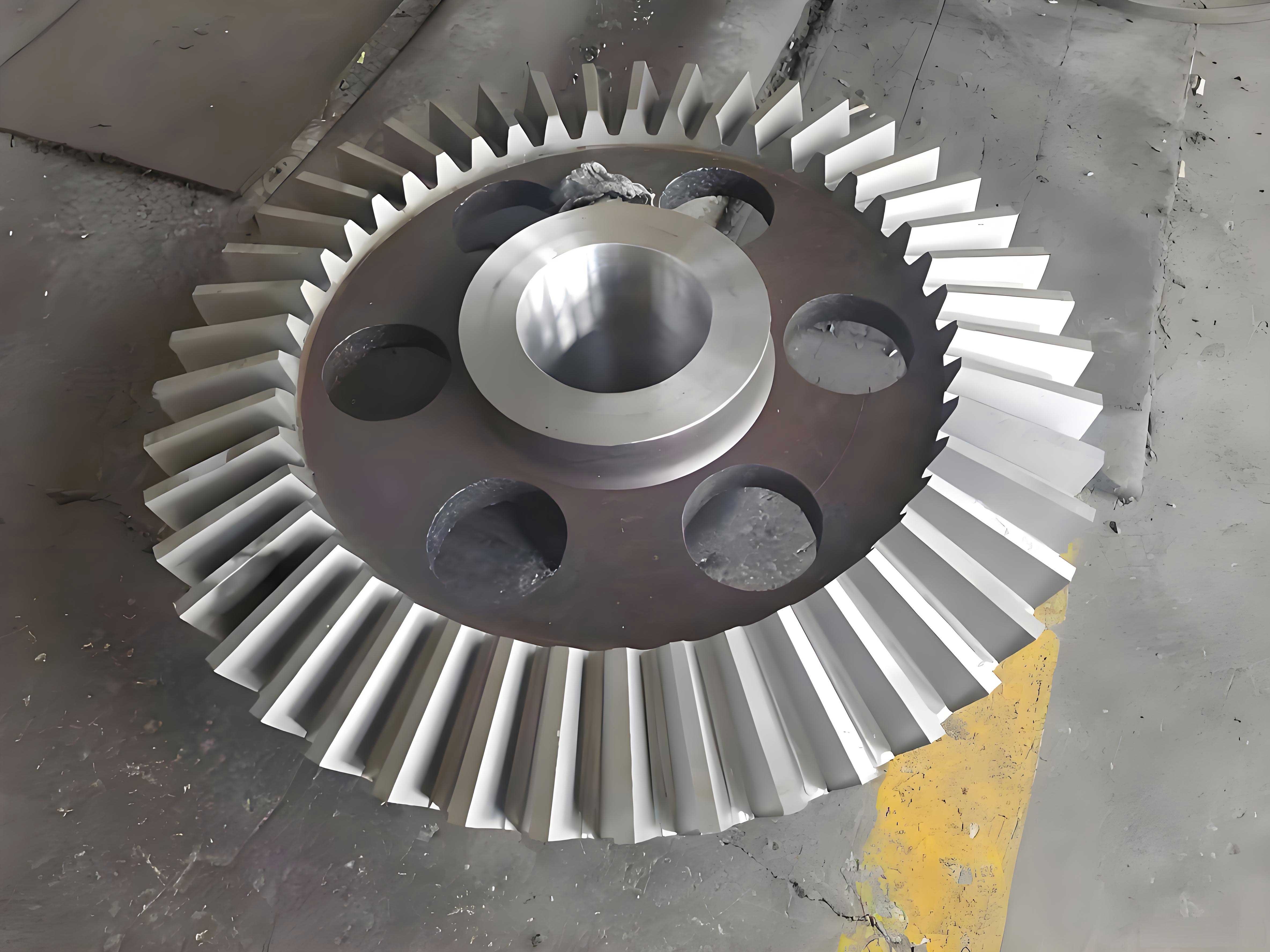
The material of choice for this study is 40Cr medium-carbon low-alloy steel, a widely used grade for high-strength components like miter gears due to its good hardenability and toughness. The nominal chemical composition (in weight percent) is: 0.37-0.44% C, 0.17-0.37% Si, 0.50-0.80% Mn, 0.80-1.10% Cr, with maximum limits for Ni, S, P, and Cu. The miter gear specimens were designed with the following key parameters: number of teeth (z) = 20, module (m) = 4 mm, pressure angle (α) = 20°, addendum coefficient (h_a*) = 1, and dedendum clearance coefficient (c*) = 0.3. All gears underwent identical post-forging heat treatment to isolate the effect of forging temperature: oil quenching at 850°C for 3 minutes followed by tempering at 520°C for 4 hours.
The core of the experimental design involved systematically varying the initial forging temperature (T_i) and the final forging temperature (T_f). A total of eight distinct forging batches were prepared, as summarized in Table 1. The forging ratio was kept constant at 7 for all specimens to ensure consistent deformation severity. The wear resistance was evaluated using a high-temperature friction and wear testing machine. The test conditions were standardized: a grinding wheel speed of 250 rpm, total revolutions of 2500, a relative sliding speed of 100 mm/min, and an applied load of 100 N. Crucially, tests were conducted at two distinct environmental temperatures: 25°C (ambient) and 300°C (elevated), simulating different operational environments for miter gears. The primary metric for wear resistance was the wear volume (V_w), measured in cubic millimeters. A lower V_w indicates superior wear resistance. The worn surfaces of selected miter gear samples were subsequently examined using scanning electron microscopy (SEM) to correlate macroscopic wear data with microscopic failure modes.
| Specimen ID | Initial Forging Temperature, T_i (°C) | Final Forging Temperature, T_f (°C) | Forging Ratio |
|---|---|---|---|
| M1 | 1130 | 860 | 7 |
| M2 | 1150 | 860 | 7 |
| M3 | 1170 | 860 | 7 |
| M4 | 1190 | 860 | 7 |
| M5 | 1210 | 860 | 7 |
| M6 | 1170 | 820 | 7 |
| M7 | 1170 | 840 | 7 |
| M8 | 1170 | 880 | 7 |
The wear test results for miter gears forged at different initial temperatures are consolidated in Table 2. The data reveals a consistent and non-linear trend across both testing temperatures. As T_i increases from 1130°C to 1210°C, the wear volume initially decreases, then stabilizes within a range, before undergoing a sharp increase. The optimal point is distinctly at T_i = 1170°C, where the wear volume is minimized. For instance, at 25°C, V_w drops to 21 × 10^{-3} mm³, and at 300°C, it is 48 × 10^{-3} mm³. This suggests that for the 40Cr miter gear, an initial forging temperature of approximately 1170°C facilitates the most favorable microstructure for resisting wear, whether in cold or moderately hot service environments.
| T_i (°C) | V_w at 25°C (×10⁻³ mm³) | V_w at 300°C (×10⁻³ mm³) | Relative Wear Resistance Index* |
|---|---|---|---|
| 1130 | 38 | 72 | 0.56 |
| 1150 | 25 | 55 | 0.85 |
| 1170 | 21 | 48 | 1.00 |
| 1190 | 22 | 50 | 0.95 |
| 1210 | 35 | 68 | 0.60 |
*Index normalized to the best performance (T_i=1170°C). Higher index indicates better wear resistance.
The influence of the final forging temperature on the miter gear’s wear performance is equally significant, as detailed in Table 3. Holding T_i constant at the optimal 1170°C, varying T_f from 820°C to 880°C produces a clear parabolic response. The wear resistance first improves, peaks at T_f = 860°C, and then deteriorates with further temperature increase. The minimum wear volumes coincide with this temperature: 21 × 10^{-3} mm³ at 25°C and 48 × 10^{-3} mm³ at 300°C. This establishes 860°C as the optimal final forging temperature for maximizing the wear life of 40Cr miter gears.
| T_f (°C) | V_w at 25°C (×10⁻³ mm³) | V_w at 300°C (×10⁻³ mm³) | Relative Wear Resistance Index |
|---|---|---|---|
| 820 | 32 | 62 | 0.66 |
| 840 | 24 | 53 | 0.88 |
| 860 | 21 | 48 | 1.00 |
| 880 | 28 | 58 | 0.75 |
To understand the underlying mechanisms, we must consider the tribological process and the metallurgical impact of forging temperature. The wear of a miter gear typically progresses through three stages, which can be modeled conceptually. The initial stage involves asperity contact and plastic deformation. The contact pressure (p) at the surface can be related to the applied load (F) and the real area of contact (A_r), often described by models such as the Archard’s wear equation in its differential form:
$$ \frac{dV}{ds} = K \frac{F}{H} $$
where \( dV/ds \) is the wear volume per unit sliding distance, \( K \) is a dimensionless wear coefficient, \( F \) is the normal load, and \( H \) is the hardness of the softer material (the miter gear surface in this case). The hardness \( H \) is itself a strong function of the microstructure developed during forging and subsequent heat treatment.
The initial forging temperature fundamentally governs the starting condition for plastic deformation. If T_i is too low (e.g., 1130°C), the steel’s yield strength remains relatively high, and its ductility is insufficient for homogeneous deformation. This can lead to incomplete recrystallization, residual stresses, and a non-uniform grain structure. Such a microstructure possesses inherent weaknesses—regions of high dislocation density adjacent to less deformed zones—which act as nucleation sites for cracks during wear. The SEM observations of miter gears forged at low T_i confirm this, showing extensive surface peeling and spalling, indicative of severe adhesive and abrasive wear mechanisms.
Conversely, an excessively high initial forging temperature (e.g., 1210°C) pushes the material toward the over-heating region. This promotes rapid grain growth kinetics. The average grain diameter (D) after forging and heat treatment can be approximated by the Beck equation for grain growth:
$$ D^n – D_0^n = k t \exp\left(-\frac{Q}{RT}\right) $$
where \( D_0 \) is the initial grain size, \( n \) is the grain growth exponent, \( k \) is a constant, \( t \) is time, \( Q \) is the activation energy for grain boundary migration, \( R \) is the gas constant, and \( T \) is the absolute temperature. A coarse-grained microstructure, resulting from high T_i, has fewer grain boundaries per unit volume. Grain boundaries are potent barriers to dislocation motion; thus, a coarser structure softens the material, reducing its yield strength and hardness. During wear, this translates to easier plastic flow at the surface, larger wear debris formation, and accelerated material removal. The wear volume, therefore, increases sharply.
The optimal initial forging temperature of 1170°C for our miter gear strikes a balance. It is high enough to ensure full austenitization, low flow stress for energy-efficient forging, and adequate time for diffusion processes that homogenize the composition. Yet, it is low enough to restrain excessive grain growth. This results in a fine, uniform prior-austenite grain size that, after quenching and tempering, transforms into a fine dispersion of tempered martensite with high strength and toughness—a microstructure exceptionally resistant to wear initiation and propagation.
The final forging temperature, T_f, dictates the condition at which plastic deformation ceases and cooling begins. Its effect is primarily on the work-hardening state and the prevention of defect formation. If T_f is too low (e.g., 820°C), the steel’s temperature approaches or falls below the recrystallization stop temperature. Deformation occurs in a regime of low plasticity, leading to significant work hardening. The flow stress (\( \sigma_f \)) can be modeled for hot working:
$$ \sigma_f = C \dot{\epsilon}^m \exp\left(\frac{Q_w}{RT}\right) $$
where \( C \) is a strength coefficient, \( \dot{\epsilon} \) is the strain rate, \( m \) is the strain rate sensitivity, and \( Q_w \) is the activation energy for deformation. At low T_f, \( \exp(Q_w/RT) \) is large, meaning deformation resistance is high. This high resistance, combined with insufficient thermal energy for dynamic recovery/recrystallization, leads to accumulated dislocation tangles and internal stresses. These internal stresses can surpass the material’s cohesive strength upon cooling, manifesting as micro-cracks or cold shuts. These defects become potent stress concentrators during gear meshing, drastically reducing wear resistance by promoting subsurface crack initiation and surface material removal.
On the other hand, an excessively high final forging temperature (e.g., 880°C) allows full recrystallization but also provides the thermal driving force for static grain growth during the post-forging cooling period before quenching. Furthermore, if T_f is too high, it may approach or exceed the grain coarsening temperature for the steel, leading to the same detrimental coarse microstructure as with an overly high T_i. The result is a softened material with reduced resistance to plastic deformation during wear. The optimal T_f of 860°C ensures that deformation finishes while the material is still fully austenitic and sufficiently hot for complete static recrystallization (refining the grains deformed during forging) but cool enough to inhibit significant grain growth before quenching. This produces a fine, recrystallized austenite grain structure that transforms into an optimal martensitic matrix upon subsequent heat treatment.
The synergy between T_i and T_f is crucial for the final quality of the miter gear. The thermal path defines the thermo-mechanical processing window. We can conceptualize an optimal forging domain for wear resistance on a plot of T_i vs. T_f. For the 40Cr miter gear, this domain centers around the coordinates (1170°C, 860°C). Operating within this window ensures a fine, homogeneous, and defect-free microstructure that maximizes hardness, toughness, and fatigue strength—all prerequisites for superior wear resistance.
The wear behavior at 300°C introduces an additional layer of complexity related to thermally activated processes. At elevated temperatures, mechanisms like oxidation wear and thermal softening become relevant. The wear coefficient \( K \) in Archard’s equation often becomes temperature-dependent:
$$ K(T) = K_0 \exp\left(-\frac{E_a}{k_B T}\right) $$
where \( K_0 \) is a pre-exponential factor, \( E_a \) is an activation energy for the dominant wear mechanism, \( k_B \) is Boltzmann’s constant, and \( T \) is the absolute surface temperature. A well-forged miter gear with a fine, stable microstructure (from optimal T_i and T_f) exhibits a higher activation energy \( E_a \) for processes like adhesive junction growth or abrasive groove formation. This means its wear rate remains relatively lower as temperature increases compared to a poorly forged gear. The data supports this: while absolute wear volumes are higher at 300°C due to material softening, the ranking of specimens based on forging temperature remains consistent with the 25°C tests. The miter gear forged at (1170°C, 860°C) still shows the best performance, proving the robustness of this forging parameter set.
Beyond the basic parameters, the forging ratio (kept constant here) and cooling rate post-forging also interact with temperature. Future studies on miter gears could explore multi-variable optimization using response surface methodology. Furthermore, advanced characterization techniques like electron backscatter diffraction (EBSD) could quantitatively link the forging temperature to crystallographic texture and grain boundary character distribution, providing deeper insights into wear anisotropy in miter gears.
In conclusion, this systematic investigation unequivocally demonstrates that forging temperature is a master variable controlling the wear resistance of 40Cr steel miter gears. The trends are robust across both ambient and elevated temperature service conditions. The initial forging temperature should be carefully selected—neither too low nor too high—with an optimum identified at 1170°C for this specific alloy and miter gear geometry. Similarly, the final forging temperature must be controlled precisely, with 860°C yielding the best wear performance. Adopting these optimized parameters in the industrial forging of miter gears will lead to components with extended service life, reduced maintenance costs, and enhanced reliability in demanding mechanical systems. This work underscores the importance of replacing tradition with data-driven process optimization in the manufacturing of critical components like miter gears.