
In my experience designing and overseeing the production of heavy industrial machinery, the manufacturing of worm gear sets, or screw gears, represents one of the most demanding challenges in mechanical transmission systems. The unique geometry, involving a sliding contact between the worm (screw) and the wheel, demands exceptional precision in every component, from the raw material to the final assembly. The failure of a single element can compromise the entire system’s efficiency, load capacity, and service life. This detailed account delves into the comprehensive manufacturing process of a high-load screw gear assembly used for adjustment mechanisms, highlighting the solutions developed to overcome significant technical hurdles.
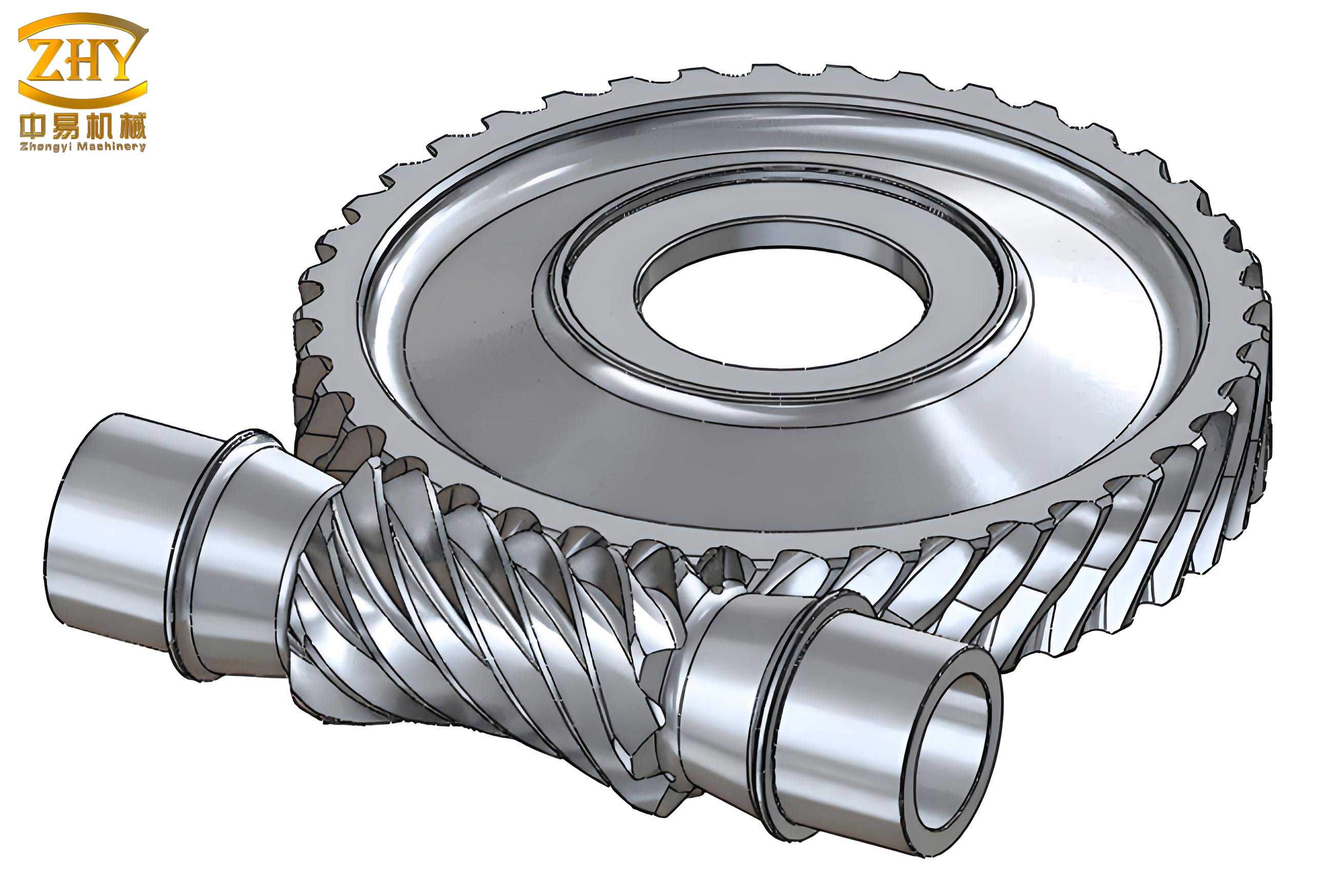
The core function of this particular screw gear assembly is to convert rotary input into precise linear motion for position adjustment under substantial load. This is achieved through a dual-thread system: the primary worm and wheel provide the speed reduction and torque multiplication, while a secondary trapezoidal thread on the wheel and a matching screw translate the rotation into linear displacement. This dual functionality inherently compounds the manufacturing complexity, as both the gear mesh accuracy and the thread engagement must be perfectly controlled simultaneously.
Critical Component Analysis and Manufacturing Strategies
The Tie Rod: Foundation of Load Transfer
The tie rod is the central load-bearing member, connecting the screw gear output to the external mechanism. Its manufacturing is paramount. Made from a Grade 45 steel, Class IV forging, its integrity is non-negotiable. The process begins with rigorous material certification and non-destructive testing (NDT). A key step is the heat treatment: quenching and tempering to achieve a uniform hardness of 242-287 HB, which provides an optimal balance of strength and toughness. The machining sequence is carefully staged: rough turning, stress-relieving semi-finishing, and final precision grinding. The most critical feature is the trapezoidal thread (e.g., Tr180×20-9c). To machine this accurately, the journal adjacent to the thread is first ground to a precise h9 tolerance, serving as the datum for subsequent threading operations. The thread profile is then cut, with its dimensions verified using a custom gauge and a thread micrometer, ensuring the pitch diameter and flank angles are within specification. A final hard chrome plating on the wear surfaces enhances durability, validated by hardness tests on witness coupons processed alongside the rod.
| Process Stage | Key Control Parameters | Inspection Method |
|---|---|---|
| Material & Forging | Grade 45 Steel, Class IV Forging | Ultrasonic Testing (UT) per DIN EN 10228-3 |
| Heat Treatment | Quench & Temper to 242-287 HB | Hardness test, Mechanical test on witness bar |
| Precision Machining | Sequential roughing, semi-finishing, finishing | Dimensional check, surface finish (Ra) |
| Trapezoidal Threading | Thread form, pitch diameter, lead accuracy | Custom profile gauge, thread micrometer over pin |
| Surface Enhancement | Hard Chrome Plating (~950-1050 HV) | Hardness test on coupon, thickness measurement |
The Housing: Precision Framework
The housing, a ZG230-450 steel casting, is the foundational structure that maintains the critical spatial relationships between all moving parts. Its primary challenge lies in machining the precise bearing and bushing bores that must maintain strict perpendicularity and center distance tolerances. The most critical dimension is the center distance between the worm shaft bore and the wheel shaft bore, often specified as $$C = 200 \pm 0.036 \text{ mm}$$. Achieving this requires a meticulous machining strategy. Operations are performed on a precision boring mill, with the workpiece carefully positioned using machined datums. A significant step is the installation of the bronze bushing for the wheel shaft. To ensure a perfect, stress-free interference fit, the bushing is shrink-fitted using liquid nitrogen at approximately -70°C. This prevents deformation and guarantees long-term stability of the bearing alignment critical for the screw gears’ performance.
The Worm and Wheel: The Heart of the Screw Gears
The manufacturing of the mating worm and wheel pair defines the performance envelope of the entire screw gear drive. Their processes are deeply interconnected.
The Worm (Screw): Fabricated from case-hardening steel 20CrMnTi, the worm undergoes a multi-stage process. After initial turning and grinding of the reference diameters, the helical thread is hobbed, leaving a consistent stock allowance for final grinding. The part is then carburized and hardened to achieve a surface hardness of approximately 60 HRC with a controlled case depth. The final and most critical operation is profile grinding of the thread flanks. This must achieve not only the correct geometry (pressure angle, module, lead) but also the precise lead variation and surface finish to minimize friction and wear. The quality is validated by mating it with its wheel and checking the contact pattern and backlash. The desired contact pattern should be centralized, covering >55% of the tooth height and >50% of the tooth length, biased slightly towards the exit side.
The Wheel: Cast from aluminum bronze ZCuAl10Fe3, the wheel’s machining focuses on the bore, faces, and the external worm wheel teeth. After precision boring and facing, the gear teeth are generated by hobbing. The hobbing machine must be meticulously set up to account for the unique geometry dictated by the worm’s parameters. The final operation is cutting the internal trapezoidal thread. This is often done as a matching operation to the tie rod or using a precision gauge to ensure perfect thread engagement without binding. The wheel’s geometry, particularly its throat diameter and face width, must perfectly match the worm’s characteristics to ensure full contact and proper load distribution.
The fundamental kinematic relationship for a single-start worm gear is given by the gear ratio:
$$ i = \frac{N_{\text{gear}}}{N_{\text{worm}}} = \frac{Z_{\text{gear}}}{1} $$
where $Z_{\text{gear}}$ is the number of teeth on the wheel. The lead of the worm is $L = p \cdot N_{\text{worm}}$, where $p$ is the axial pitch. For multi-start worms, $N_{\text{worm}}$ is the number of starts. The center distance $C$ is critical:
$$ C = \frac{d_{\text{worm}} + d_{\text{gear}}}{2} $$
where $d_{\text{worm}}$ is the pitch diameter of the worm and $d_{\text{gear}}$ is the pitch diameter of the gear. Manufacturing must hold $C$ within microns to ensure proper meshing of the screw gears.
| Component | Material | Key Processes | Critical Quality Check |
|---|---|---|---|
| Worm (Screw) | 20CrMnTi (Case-Hardening Steel) | Turning, Hobbing, Case Hardening, Profile Grinding | Surface hardness (60 HRC), Profile accuracy, Contact pattern with wheel |
| Wheel (Gear) | ZCuAl10Fe3 (Aluminum Bronze) | Boring, Facing, Hobbing, Internal Threading | Tooth profile accuracy, Bore concentricity, Thread match with tie rod |
The Threaded Sleeve and Ancillary Parts
The threaded sleeve acts as the interface between the rotating trapezoidal thread of the wheel and the stationary housing, allowing the linear motion to be transmitted while taking up thrust loads. Its external splines must engage smoothly with a locking plate, and its internal trapezoidal thread must be a perfect match for the tie rod. Machining is sequenced so that the internal thread is cut relative to the precision-finished pilot diameter, ensuring concentricity. A custom thread gauge, referenced from the pilot bore, is used for final inspection.
The Culminating Challenge: Precision Assembly
Assembling screw gears of this complexity is an exercise in precision adjustment. The challenge is two-fold: achieving the correct worm-wheel mesh (backlash, contact pattern) AND setting the correct preload and alignment for the thrust bearings and threaded engagements. These adjustments are interdependent, making a sequential, controlled procedure essential.
The developed assembly protocol is as follows:
- Bearing and Worm Installation: The worm shaft is installed with its tapered roller bearings. Axial play is adjusted via shims behind the end caps to a specified preload (e.g., 0.05-0.1mm).
- Primary Mesh Adjustment: The wheel is installed. The thrust bearing assembly under the wheel is shimmed to vertically position the wheel, aligning its pitch cylinder perfectly with the worm’s pitch line. This is verified by manually rotating the assembly and checking the contact pattern using Prussian blue. The pattern must conform to the specified area and location on the tooth flanks.
- Integration of the Linear Mechanism: With the gear mesh optimized and temporarily locked, the housing is inverted. The threaded sleeve and its associated locking plate are installed. Here, a critical adjustment is made to define the end float of the entire rotating wheel/sleeve assembly. Using hydraulic jacks to apply a consistent load and dial indicators to measure displacement, the exact thickness of the final adjustment shim pack is calculated. The formula derived is:
$$ H = B + \bar{a} – T $$
where $H$ is the required shim thickness, $B$ is the thickness of the trial shim pack used during setup, $\bar{a}$ is the average measured axial play, and $T$ is the ideal target axial play (e.g., 0.13 mm). - Final System Verification: After installing the calculated shim pack and reassembling, the tie rod is screwed in. The locking mechanism for the threaded sleeve is tightened to a specified torque, and then backed off a precise amount to create a defined clearance (e.g., 0.17mm), which is verified with feeler gauges. Finally, the entire assembly’s integrated performance is checked by measuring the composite axial movement under a test load, ensuring consistency across multiple units.
The efficiency of a worm gear drive is notably lower than that of other gear types, largely due to sliding friction. The theoretical efficiency can be estimated by:
$$ \eta \approx \frac{\cos \alpha_n – \mu \tan \lambda}{\cos \alpha_n + \mu \cot \lambda} $$
where $\alpha_n$ is the normal pressure angle, $\mu$ is the coefficient of friction, and $\lambda$ is the lead angle of the worm. This formula highlights why precision manufacturing—minimizing surface roughness and ensuring perfect profile alignment—is crucial for reducing $\mu$ and maximizing the performance of screw gears.
| Adjustment Stage | Parameter Controlled | Target Value / Method | Verification Tool |
|---|---|---|---|
| Worm Bearing Preload | Axial play of worm shaft | 0.05 – 0.1 mm | Dial indicator, Feeler gauge on end cap |
| Worm-Wheel Mesh | Contact Pattern | >55% height, >50% length, centered | Prussian blue, Visual inspection |
| Wheel Thrust Bearing | Axial shim pack thickness (H) | Calculated: $H = B + \bar{a} – T$ | Dial indicators, hydraulic jack, calculation |
| Threaded Sleeve Lock | Clearance after torquing | 0.17 mm | Feeler gauge |
| Final System Check | Composite axial movement | 0.1-0.17 mm, variation < 0.03 mm | Dial indicators at three points |
Conclusion
The successful manufacture of high-performance screw gears is a testament to systematic process engineering. It requires viewing the unit not as a collection of individual parts, but as an integrated system where the quality of each component and each interface—from the metallurgy of the forging to the final torque on a locking plate—directly impacts the whole. The challenges presented by the dual-function gearbox, involving both rotary power transmission and linear motion conversion, were met through a rigorous approach: strict material and热处理 controls, precision machining using datums and custom gauges, and a meticulously developed, multi-stage assembly procedure that isolates and controls each critical adjustment. The methodologies outlined, particularly for controlling center distance, achieving optimal tooth contact, and managing the interplay between gear mesh and thread engagement, provide a reliable framework. This framework ensures that the final screw gear assembly delivers the required transmission accuracy, load capacity, and operational longevity, proving that even the most complex mechanical puzzles can be solved with detailed planning and precision execution.