
The gear manufacturing industry represents the largest sector within mechanical fundamental components. With the rapid advancement of China’s equipment manufacturing capabilities, the demands on gear processing have become increasingly stringent. The continuous application of advanced CNC equipment has precipitated significant transformations in cutting processes and technologies. Gear shaving, serving as the most critical segment of the gear finishing process, is now extensively employed for the precision machining of various gears. Its application spans from small gears used in automobiles, reducers, and agricultural machinery to large reduction gears for marine turbines. The progression of advanced gear shaving technology is intrinsically linked to the development of cutting fluid technology, making the judicious selection of cutting fluid in production and processing exceedingly important.
This paper commences with an examination of cutting fluids, using the gear shaving process as the research subject, and proposes a transition from oil-based to water-based cutting fluids in gear shaving. The objective is to green the manufacturing process and mitigate environmental pollution. Initially, based on the characteristics of gear shaving and the functions and classifications of cutting fluids, laboratory tests were conducted on the physicochemical properties of pre-selected fluids. Subsequently, machining comparison experiments for gear shaving were performed using different types of cutting fluids. A comparative analysis was undertaken from the perspectives of workpiece quality, tool life, cost, and resource/environmental impact. Finally, considering the experimental outcomes, a fuzzy comprehensive evaluation method was employed to assess the machining results. A decision-making model for cutting fluid optimization oriented towards green manufacturing was proposed, encompassing five decision-making objectives: processing time, quality, cost, resources, and environmental impact. This model provides a theoretical foundation for the green selection of cutting fluids in gear shaving.
Gear Shaving Process and Its Characteristics
Gear shaving is a high-efficiency gear finishing method widely adopted in the mass production of gears for automobiles, tractors, and machine tools. It offers several distinct advantages over gear grinding, including higher efficiency, lower cost, and the absence of burns or cracks on the tooth surface. The primary goal of the gear shaving process is to refine the tooth profile, helix, and surface of a gear after initial machining operations like hobbing or shaping, typically before heat treatment.
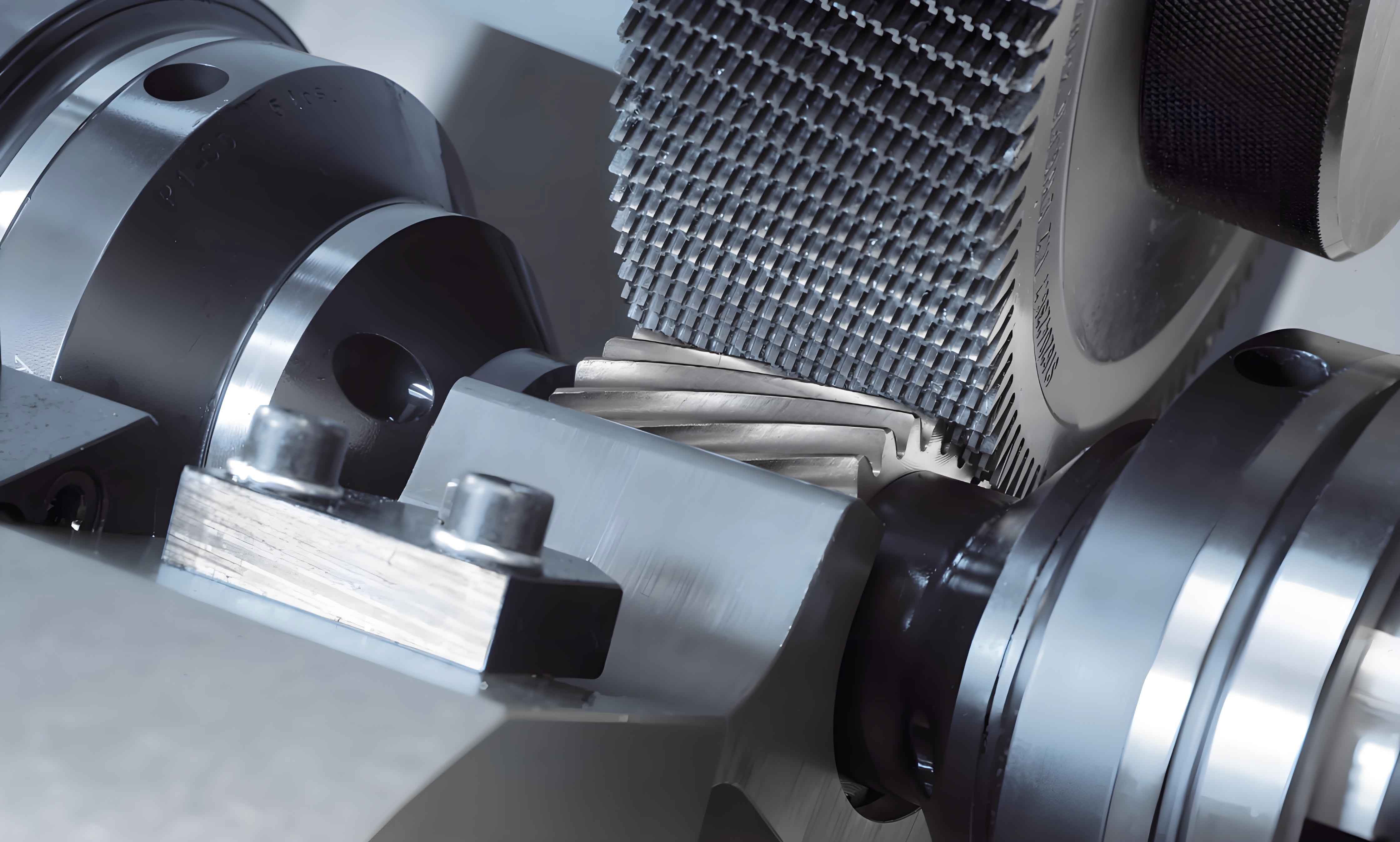
The fundamental principle of gear shaving involves the meshing of a high-precision, hardened gear shaving cutter (essentially a helical gear with numerous small grooves forming cutting edges along the involute direction) with the workpiece gear. They are set at a crossed-axis angle (Σ). This configuration generates a relative sliding velocity at the tooth interface, which acts as the cutting speed. The necessary motions include the high-speed rotation (main motion) of the cutter, the free rotation of the workpiece induced by the cutter, and the radial feed motion to achieve the full tooth depth.
The relative sliding speed, $V_w$, which is the effective cutting speed in gear shaving, can be expressed as:
$$V_w = V_1 \frac{\sin \Sigma}{\cos \beta_2} = V_{2t} – V_{1t}$$
where $V_1$ is the peripheral speed of the shaving cutter, $V_{2t}$ and $V_{1t}$ are the tangential speeds of the workpiece and cutter respectively, $\Sigma$ is the crossed-axis angle, and $\beta_2$ is the helix angle of the workpiece. This relationship highlights that increasing the crossed-axis angle increases the cutting speed and efficiency.
Common gear shaving methods include axial, diagonal, tangential, and radial shaving. Among these, radial gear shaving has gained prominence due to its significant benefits in processing efficiency, accuracy, tool life, and economic performance. It involves only radial feed without axial traverse, making it particularly suitable for machining gears with shoulders or multiple gear clusters.
The selection of cutting parameters such as cutting speed, longitudinal feed, and radial feed is crucial. For instance, while a higher cutting speed improves surface finish, it can adversely affect tool life. An appropriate radial feed is essential; if too small, it cannot correct pre-shaving errors, and if too large, it overloads the tool and machine, degrading accuracy. The machining allowance is another critical factor, typically kept as minimal as possible while sufficient to correct prior errors.
Cutting Fluids: Functions, Classification, and Green Selection
In the gear shaving process, a significant portion of energy is consumed by friction occurring at the tool-chip and tool-workpiece interfaces. Therefore, a metal cutting fluid must possess excellent lubrication, anti-rust, cleaning, and cooling properties. Its primary functions are:
- Cooling: Removing heat from the cutting zone to prevent thermal deformation of the workpiece and tool.
- Lubrication: Reducing friction between the tool, chip, and workpiece, thereby improving surface finish and reducing tool wear.
- Cleaning: Flushing away chips and abrasive particles to prevent damage to the workpiece surface and machine components.
- Rust Prevention: Protecting the machine tool, workpiece, and tool from corrosion.
Cutting fluids are broadly categorized into two main types:
| Type | Sub-categories & Composition |
|---|---|
| Oil-Based | Mineral oils, fatty oils, compounded oils, non-active extreme pressure (EP) oils, active EP oils. |
| Water-Based | Emulsions (soluble oils), Semi-synthetic fluids (micro-emulsions), Synthetic fluids, Chemical solutions. |
Traditional oil-based cutting fluids generally offer superior lubrication but have poorer cooling performance. During high-speed operations like gear shaving, the generated heat can cause the oil to smoke, pose fire hazards, and lead to workpiece thermal distortion. In contrast, water-based cutting fluids provide excellent cooling and cleaning capabilities, are safer (non-flammable), more economical due to water dilution, and contribute to a healthier workshop environment. From the perspective of green manufacturing and the conservation of non-renewable petroleum resources, the transition “from oil to water” is a significant trend. The performance comparison is summarized below:
| Property | Oil-Based Cutting Fluid | Water-Based Cutting Fluid |
|---|---|---|
| Cooling Performance | Poorer | Better |
| Lubrication Performance | Better | Poorer (but improvable with additives) |
| Cleaning Performance | Poorer | Better |
| Rust Prevention | Better | Poorer (but improvable with additives) |
The selection of a cutting fluid for gear shaving must be a holistic decision. The面向绿色制造 (Green Manufacturing-Oriented) selection model expands the traditional decision-making objectives of Time (T), Quality (Q), and Cost (C) to include Resource consumption (R) and Environmental impact (E). This forms the five-objective decision-making system for green cutting fluid selection.
T: Processing time (minimized).
Q: Workpiece quality and cutting fluid stability (maximized).
C: Comprehensive cost, including procurement, use, disposal (minimized).
R: Resource consumption, e.g., tool wear, energy (minimized).
E: Environmental impact, e.g., toxicity, waste treatment difficulty, safety (minimized).
Experimental Analysis of Cutting Fluids in Gear Shaving
To evaluate the practical performance, gear shaving experiments were conducted on a YDA4232CNC数控剃齿机. The workpiece material was 20CrMo steel. Three different cutting fluids were tested under identical process parameters (cutter speed: 180 rpm, radial feed rate: 0.8 mm/min, feed: 0.08 mm):
- Oil-Based Cutting Fluid (OB): A traditional active EP oil.
- Domestic Semi-Synthetic Fluid (Micro-emulsion, SS).
- Imported Full Synthetic Fluid (FS).
Key physicochemical properties of the water-based fluids were tested beforehand, including emulsion stability, salt tolerance, foam resistance, maximum non-seizure load (PB value), surface tension, rust prevention, and compatibility with machine tool paint. Both water-based fluids showed satisfactory results, qualifying them for the machining test.
The experimental results focused on three main aspects:
1. Workpiece Quality:
Surface roughness ($R_a$) and tooth profile slope deviation ($f_{H\alpha}$) were monitored. As the number of machined gears increased, the surface roughness deteriorated for all fluids, but the rate of increase was most pronounced for the OB fluid and least for the FS fluid. The tooth profile deviation showed a trend of initial decrease followed by an increase. The SS fluid caused the most rapid growth in profile deviation, exceeding the tolerance limit after about 5500 pieces, while OB and FS remained more stable. This indicates that the synthetic fluid better maintained workpiece geometric accuracy over time.
2. Tool Life:
Tool life was measured by the number of workpieces machined before tool re-grinding was necessary. The results were:
– OB Fluid: ~6,530 pieces
– SS Fluid: ~5,560 pieces
– FS Fluid: ~6,110 pieces
The oil-based fluid provided the best tool protection under these specific conditions, while the semi-synthetic fluid resulted in the fastest tool wear. The full synthetic fluid performed better than the semi-synthetic but slightly worse than the oil.
3. Cost and Environmental Impact:
A simplified cost analysis per workpiece was performed, considering the purchase price and typical consumption rate.
| Cutting Fluid Type | Use Conc. | Diluted Price per Liter | Consumption per Piece | Fluid Cost per Piece |
|---|---|---|---|---|
| Oil-Based (OB) | 100% | $18.9 | 0.0047 L | $0.09 |
| Semi-Synthetic (SS) | 15% | $5.6 | 0.0051 L | $0.028 |
| Full Synthetic (FS) | 15% | $13.3 | 0.0053 L | $0.07 |
From a purely fluid-cost perspective, the domestic semi-synthetic fluid is the most economical. Regarding environmental impact (E), water-based fluids are inherently safer (non-flammable), generally have lower toxicity profiles when formulated without harmful additives like nitrites, and their waste is often easier to treat compared to oily waste, which aligns with the goals of green manufacturing in gear shaving.
Fuzzy Comprehensive Evaluation for Green Decision-Making
Given the multiple, often conflicting objectives (T, Q, C, R, E) and the presence of qualitative factors, a fuzzy comprehensive evaluation model is apt for selecting the optimal cutting fluid for green gear shaving. The model construction involves:
- Defining the Evaluation Factor Set (U): This is the hierarchy of criteria, decomposed from the five main objectives. For example, Quality (Q) can be broken down into “Machining Quality” (further into dimensional accuracy, surface finish) and “Cutting Fluid Quality.”
- Defining the Evaluation Grade Set (V): e.g., V = {Good, Fair, Poor}.
- Constructing the Fuzzy Relation Matrix (R): For each alternative (OB, SS, FS), a matrix R is built where each element $r_{ij}$ represents the membership degree of a lower-level factor to evaluation grade $j$. These values are determined from experimental data and expert scoring.
- Assigning Weight Vectors (A): Weights are assigned to each factor in the hierarchy, reflecting their relative importance. For instance, the primary weights for the five objectives might be A = (0.05, 0.35, 0.20, 0.20, 0.20) for T, Q, C, R, E respectively, emphasizing Quality and Green factors.
- Performing Comprehensive Evaluation: The evaluation result vector B for an alternative is calculated through fuzzy composition: $B = A \cdot R$. The result is a vector like (b_Good, b_Fair, b_Poor). A final score can be computed by assigning numerical values to the grades (e.g., Good=0.9, Fair=0.6, Poor=0.3) and calculating: $Score = 100 \times \sum (b_i \cdot v_i)$.
Applying this model to the three gear shaving cutting fluid alternatives based on the experimental and analytical data yields the following comprehensive scores:
| Cutting Fluid Alternative | Fuzzy Comprehensive Evaluation Result Vector (B) | Composite Score |
|---|---|---|
| Oil-Based (OB) | (0.6458, 0.2220, 0.1324) | 75.41 |
| Semi-Synthetic (SS) | (0.6534, 0.2305, 0.1189) | 76.20 |
| Full Synthetic (FS) | (0.7296, 0.1876, 0.1098) | 80.21 |
The evaluation indicates that both water-based fluids outperform the traditional oil-based fluid from a comprehensive green manufacturing perspective. The imported full synthetic fluid achieves the highest score, balancing good machining quality, acceptable tool life, moderate cost, and lower environmental impact. However, the domestic semi-synthetic fluid presents a compelling option where minimizing direct cost is a higher priority, as it scores marginally better than oil and is significantly cheaper than the full synthetic fluid.
Optimization and Future Perspectives for Gear Shaving
Beyond fluid selection, the greening of the gear shaving process can be further enhanced through system and parameter optimization.
1. Cutting Fluid Supply System Optimization: Transitioning from individual machine sumps to a Centralized Circulation and Treatment System offers multiple benefits for large-scale gear shaving production. Such a system features multi-stage filtration (e.g., settling, magnetic, vacuum), temperature control, and automated concentration monitoring. It reduces overall fluid consumption, improves cleanliness and stability of the fluid, extends its service life, and simplifies waste management, thereby positively impacting the ‘C’, ‘R’, and ‘E’ objectives.
2. Process Parameter Optimization: The cutting parameters in gear shaving (speed $n$, feed rate $f_r$, feed $f$) interact complexly with the outcomes (T, Q, Tool Wear-R). An orthogonal experimental design can be employed to find the optimal parameter combination that satisfies the multi-objective requirements of green manufacturing. For example, a $L_9(3^3)$ orthogonal array can test three levels for each of the three parameters with only 9 experiments instead of 27 full combinations. The optimal levels are those that jointly maximize quality and tool life while minimizing time and energy consumption, forming an optimal parameter set for the specific gear shaving task and selected cutting fluid.
Conclusion
The research demonstrates the viability and advantages of transitioning to water-based cutting fluids in the gear shaving process from a green manufacturing standpoint. While traditional oil-based fluids may offer marginally better tool lubrication in some cases, modern water-based semi-synthetic and full synthetic fluids can provide adequate lubrication coupled with superior cooling, cleaning, safety, and environmental profiles. A comprehensive evaluation using a fuzzy logic model that incorporates time, quality, cost, resource, and environmental objectives provides a more holistic decision-making framework than traditional cost-only or performance-only approaches. For gear shaving operations, this model confirms that properly selected water-based fluids can offer a better overall performance when green metrics are valued. Future work should integrate this fluid selection model with optimized process parameters and advanced fluid delivery systems to fully realize the potential of efficient and eco-friendly gear shaving production.