
In the field of power transmission, particularly within agricultural machinery and automotive differentials, the precise manufacture of bevel gears is paramount for ensuring quiet operation, efficiency, and longevity. Among these, straight bevel gears and their specific subtype, miter gear pairs (where the shaft angle is 90° and the gear ratio is 1:1), are widely employed due to their simpler design and manufacturing process compared to spiral bevel gears. However, as performance demands increase, controlling the geometric accuracy of the tooth flank has become a critical quality metric, surpassing the traditional method of relying solely on contact pattern observation. Gear measuring centers (GMCs) are the standard instruments for this high-precision inspection, functioning by comparing the actual gear surface against a theoretical digital master.
The conventional approach for generating this theoretical master data relies on mathematical models derived from gear generation principles or approximated geometry. This presents a significant, often overlooked, problem. In modern production, especially in precision forging which is a dominant process for miter gear and straight bevel gear manufacturing, tooth flanks are almost always modified from their theoretical conjugate form. Modifications such as crown, bias, or profile relief are intentionally introduced to compensate for deflections under load, misalignments, and to optimize noise-vibration-harshness (NVH) characteristics. If the measurement program on the GMC uses a theoretical model that does not incorporate these specific modifications, the reported deviation map becomes a convoluted mix of the intentional modification error and the unwanted machining error. This conflation makes it impossible to accurately assess the quality of the manufacturing process itself, as one cannot distinguish a well-made modified flank from a poorly made theoretical one.
This article addresses this fundamental inconsistency by proposing a novel methodology. Instead of deriving measurement coordinates from an idealized equation, we extract the necessary theoretical data—the coordinates and surface normal vectors for predefined grid points—directly from the precise 3D solid model of the gear. This solid model is the definitive digital representation, already incorporating all design modifications, and serves as the basis for manufacturing the forging dies or cutting tools. Therefore, measurement against this model ensures that the reported errors purely reflect the manufacturing process’s ability to replicate the *intended* design, including its modifications. This method provides a direct and truthful link between design, manufacturing, and metrology. The principles discussed are universally applicable to straight bevel gears and are particularly relevant for precision miter gear applications where exact conjugate action is often sacrificed for better real-world performance.
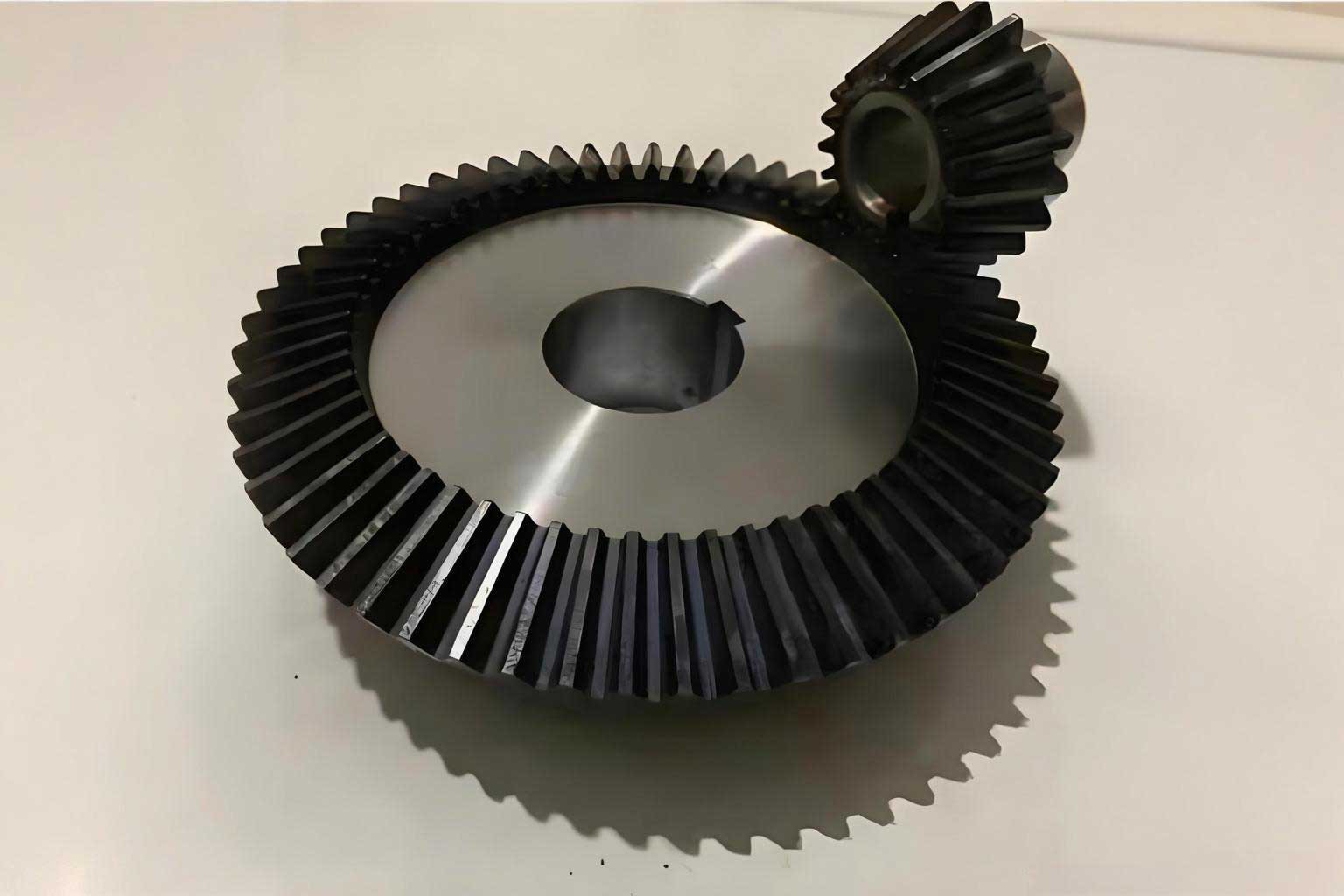
Fundamental Principles and the Limitation of Conventional Modeling
Theoretically, the tooth flank of a straight bevel gear is a spherical involute. However, due to the complexity of modeling on a sphere, an approximation using a “back-cone” is universally adopted in engineering. The back-cone unwraps the gear geometry onto a plane, creating an equivalent spur gear whose properties guide the design. The coordinate system for this model is typically defined with the origin at the gear’s crossing point. The flank surface \( \mathbf{r}_i \) and its unit normal vector \( \mathbf{n}_i \) for pinion (i=1) and gear (i=2) can be derived through a series of coordinate transformations from this back-cone development, resulting in parametric equations:
$$
\mathbf{r}_i = \mathbf{r}_i(\theta_i, u_i), \quad \mathbf{n}_i = \mathbf{n}_i(\theta_i, u_i)
$$
where \( u_i \) and \( \theta_i \) are the surface parameters related to the face width and profile evolution, respectively.
For measurement, a grid of points is planned on the flank. A common scheme uses a polar grid in the gear’s axis plane (see Figure 3 in the original text). The grid is defined by a radial distance \( R_x \) from the axis and an angular coordinate \( \alpha_x \) (pressure angle). Typically, 5 lines of constant pressure angle (along the profile height) and 9 lines of constant radius (along the face width) create 45 measurement points. The coordinates \( M(x, y) \) for these 45 nodes in the axis plane are first calculated based on gear geometry.
The core task of the conventional method is to find the corresponding 3D point \( M^*(x^*, y^*, z^*) \) on the theoretical flank surface for each axis-plane node \( M(x, y) \). They are related by a rotational projection, where \( M \) is the projection of \( M^* \) onto the axis plane (Y-Z plane in the original coordinate system):
$$
x = x^*, \quad y = \sqrt{(y^*)^2 + (z^*)^2}
$$
This creates a system of nonlinear equations. Solving it iteratively for the surface parameters \( (\theta_i, u_i) \) and substituting back into Eq. (1) yields the required 3D coordinates and normals. The fundamental issue is that the function \( \mathbf{r}_i(\theta_i, u_i) \) in Eq. (1) is a *generic* model. It does not contain any information about the unique, application-specific modifications applied to the flank. When a GMC uses data from this unmodified model, its measurements are inherently biased.
| Data Source | Description | Pros | Cons | Impact on Measurement Result |
|---|---|---|---|---|
| Conventional Mathematical Model | Derived from gear theory (e.g., Gleason, Klingelnberg formulae). Represents perfect, conjugate tooth form. | Standardized, easy to program. | Does not account for design-specific flank modifications (crown, bias, tip/root relief). | Reported error includes both manufacturing error AND design modification, providing a distorted view of production quality. |
| Proposed Solid Model Data | Extracted directly from the 3D CAD model used for tooling (e.g., forging die or cutter path generation). | Represents the *exact intended design*, including all modifications. Provides a true benchmark for manufacturing. | Requires a robust method to accurately extract data from the CAD model in the correct measurement coordinate system. | Reported error reflects *only* the manufacturing process’s deviation from the intended design, enabling precise quality control. |
Proposed Methodology: Extraction from Solid Models
The proposed workflow bypasses the need for an analytical flank equation. It starts from the finalized 3D solid model (in formats like STEP, IGES, or Parasolid) and the same set of 45 axis-plane grid points \( M(x, y) \). The goal is to find their 3D counterparts \( M^* \) on the solid model’s surface and extract the associated normal vectors. The key steps involve precise coordinate system alignment and geometric construction within the CAD environment, often automated via Application Programming Interface (API) tools like UG/Open or similar.
1. Coordinate System Alignment and Datum Establishment
The first and most critical step is to establish the measurement coordinate system on the solid model that is congruent with the GMC’s setup. The origin is defined at the theoretical crossing point of the gear and pinion axes. A crucial design parameter, the mounting distance (the distance from this crossing point to a defined locating face on the gear), is used to position the gear blank correctly along its axis. This ensures the extracted 3D coordinates are in the same frame of reference as the physical part will be on the GMC. The axis plane and other datums (e.g., the pitch cone apex) are then established based on this origin and the gear’s basic geometric parameters like pitch angle.
2. Geometric Construction for Point Mapping
For each of the 45 axis-plane points \( M(x, y, 0) \), we employ a visual implementation of the rotational projection principle. Instead of solving equations, we construct the circle (the “rotational projection line”) on which both \( M \) and the desired flank point \( M^* \) must lie. This circle lies in a plane perpendicular to the gear axis (X-axis) and has its center on that axis.
Given point \( M \), we find two other points \( M_1 \) and \( M_2 \) that share the same X-coordinate but have different Y/Z coordinates, all lying on the same desired circle. Using the CAD API’s curve creation function (e.g., UF_CURVE_create_arc_3point()), we construct this circle. This geometric construction is expressed as finding a circle with center \( C = (x, 0, 0) \) and radius \( R = y \), satisfying the condition that any point \( P \) on it fulfills \( P_x = x \) and \( \sqrt{P_y^2 + P_z^2} = y \).
$$
\text{Circle } C: \{ (X, Y, Z) \ |\ X = x,\ Y^2 + Z^2 = y^2 \}
$$
3. Intersection and Data Extraction
The constructed circle is then intersected with the tooth flank surface of the solid model. Using an API function for curve-surface intersection (e.g., UF_CURVE_intersect()), we obtain the unique 3D intersection point \( M^*(x^*, y^*, z^*) \). This point is, by construction, the precise counterpart to the axis-plane node \( M \), adhering to the rotational projection relationship and lying exactly on the modified flank geometry.
Finally, with the 3D point \( M^* \) identified on the CAD face, its unit normal vector \( \mathbf{n} = (n_x, n_y, n_z) \) is extracted. CAD kernels store surface parameterization data, allowing the API (e.g., via UF_MODL_ask_face_props()) to compute the true surface normal at that specific UV location, which accounts for local curvature changes induced by modifications. The complete data for all 45 points is then compiled into a file format compatible with the GMC’s software.
| Step | Action | Purpose | Key API/Tool (Example) | Output |
|---|---|---|---|---|
| 1. Setup & Alignment | Import solid model. Define coordinate origin at crossing point using mounting distance. Establish axis plane. | To align the digital extraction space with the physical measurement space on the GMC. | Coordinate transformation functions, datum plane creation. | Correctly positioned gear model in the measurement reference frame. |
| 2. Grid Definition | Calculate or load the 2D coordinates of the 45 measurement nodes \( M(x, y) \) in the axis plane. | To define the locations where data must be extracted, following standardized measurement plans. | Text file I/O, point creation. | Set of 2D points in the axis plane. |
| 3. Projection Circle Creation | For each \( M(x, y) \), construct a circle in the plane \( X=x \) with radius \( R=y \). | To geometrically define the locus of all points that project onto \( M \) in the axis plane. | UF_CURVE_create_arc_3point() |
A 3D circle for each measurement node. |
| 4. Surface Intersection | Compute the intersection point between each circle and the target tooth flank face. | To find the unique 3D point \( M^* \) on the actual (modified) flank corresponding to node \( M \). | UF_CURVE_intersect() |
3D coordinates \( (x^*, y^*, z^*) \) for all 45 points. |
| 5. Normal Vector Extraction | Query the CAD face properties at each intersection point \( M^* \). | To obtain the unit normal vector required for probe compensation during measurement. | UF_MODL_ask_face_props() |
Unit normal vector \( (n_x, n_y, n_z) \) for all 45 points. |
| 6. Data Export | Format the extracted coordinates and normals into a GMC-compatible file (e.g., XML, TXT). | To create the final theoretical data set for loading into the gear measuring center. | Custom formatting and file writing routines. | The final measurement program theoretical data file. |
Implementation and Comparative Verification
The methodology was implemented using UG/Open API to create a dedicated software tool within the NX environment. The tool features a graphical interface for selecting the solid model file, inputting gear parameters (mounting distance, etc.), and executing the extraction process for left and right flanks independently.
For validation, a straight bevel pinion solid model (without modification, for a direct comparison) was used. The basic parameters are listed below:
| Parameter | Value |
|---|---|
| Number of Teeth (Pinion) | 10 |
| Module | 5.4000 mm |
| Face Width | 17.000 mm |
| Pressure Angle | 22.5000° |
| Mounting Distance | 57.0000 mm |
The axis-plane grid coordinates were calculated first. The following table shows a subset of these 2D nodes, along with the corresponding 3D coordinates and normal vectors extracted via the conventional mathematical model (Eq. 1) and the proposed solid model method.
| Node Seq. | Axis Plane Coord. M(x, y) | Conventional Model (Calculated) | Proposed Method (Extracted from Solid) | ΔX | ΔY | ΔZ | ||||
|---|---|---|---|---|---|---|---|---|---|---|
| Coordinates M* (x*, y*, z*) | Normal (nx, ny, nz) | Coordinates M* (x*, y*, z*) | Normal (nx, ny, nz) | |||||||
| 1 | (31.8329, 22.2136) | (31.8329, -1.2976, -22.1756) | (-0.28422, -0.81085, -0.51161) | (31.8329, -1.2976, -22.1756) | (-0.2842, -0.8108, -0.5116) | 0.00000 | 0.00000 | 0.00000 | ||
| 5 | (34.6829, 17.4003) | (34.6829, -3.4953, -17.0456) | (0.08569, -0.98431, 0.15423) | (34.6829, -3.4953, -17.0456) | (0.0857, -0.9843, 0.1542) | 0.00000 | 0.00000 | 0.00000 | ||
| 41 | (45.8539, 31.9977) | (45.8539, -1.8691, -31.9430) | (-0.28422, -0.81085, -0.51161) | (45.8539, -1.8691, -31.9430) | (-0.2842, -0.8108, -0.5116) | 0.00000 | 0.00000 | 0.00000 | ||
| 45 | (49.9592, 25.0643) | (49.9592, -5.0348, -24.5534) | (0.08569, -0.98431, 0.15423) | (49.9592, -5.0348, -24.5534) | (0.0857, -0.9843, 0.1542) | 0.00000 | 0.00000 | 0.00000 | ||
The differences (Δ) between the calculated and extracted coordinates are on the order of 1e-5 mm or less, which is within the precision tolerance of high-end gear measuring centers. This validates the accuracy of the extraction algorithm for a standard, unmodified flank. The true power of the method, however, is unlocked when the solid model contains modifications. In that case, the conventional model’s data would diverge significantly from the extracted data, and only the extracted data would provide the correct benchmark for measuring the manufactured part.
Discussion, Applications, and Future Potential
The proposed methodology effectively bridges the gap between digital design and physical metrology. By using the manufacturing master model (the solid CAD model) as the direct source for inspection data, it ensures that quality control is performed against the true design intent. This is particularly critical for components like a high-precision miter gear used in a sensitive indexing mechanism or a differential, where tailored flank modifications are essential for performance.
The advantages of this approach are multifold:
- Elimination of Measurement Bias: The reported surface deviation is purely the manufacturing error, cleanly separated from design modification.
- Design Flexibility: It accommodates any flank topology—whether based on traditional generation, optimized for loaded tooth contact analysis (LTCA), or even free-form—as long as it is represented in the solid model.
- Process Integration: It seamlessly integrates with modern digital manufacturing workflows (CAD > CAM > CMM).
- Standardization Potential: It provides a model-based definition (MBD) approach to gear metrology, where the 3D model becomes the single source of truth.
The method is not limited to straight bevel gears. It is equally applicable, and potentially even more valuable, for complex flank geometries such as those of spiral bevel gears, hypoid gears, and non-generated (Formate) gears. For these, deriving an accurate universal theoretical equation that includes modifications like ease-off topography is exceptionally difficult, making direct extraction from the design model the most reliable and straightforward path.
Future work involves expanding the tool’s capability to automatically handle different gear types, extract full flank point clouds for scanning probe evaluation, and integrate directly with GMC software platforms to create a fully automated, closed-loop digital thread from design to inspection report. For the manufacturing of critical power transmission components like a custom miter gear set, adopting such a model-based measurement strategy is a definitive step towards achieving higher quality, reduced validation time, and more consistent performance in the field.