
The pursuit of optimal performance in power transmission systems is a core objective in mechanical engineering. Among these systems, the spur and pinion gear arrangement is one of the most fundamental and widely used. Its simplicity, ease of manufacture, and reliability make it indispensable. However, under demanding operational conditions involving high speeds and heavy loads, inherent design characteristics can lead to dynamic issues such as vibration, noise, and premature failure modes like scuffing. A primary contributor to these problems is the non-uniform nature of the load distribution and the resulting transmission error fluctuation during the meshing cycle. This article delves into the comprehensive methodology for determining the optimal tooth profile modification parameters for spur and pinion gear pairs. The analysis is based on time-varying mesh stiffness and Blok’s flash temperature theory, employing fuzzy comprehensive decision theory to balance multiple, often competing, performance objectives.
1. Meshing Characteristics and Challenges in Spur and Pinion Gears
For a standard spur and pinion gear pair with a contact ratio between 1 and 2, the meshing process involves an alternating pattern between single-tooth-pair contact (STC) and double-tooth-pair contact (DTC) zones. The transition points between these zones, typically labeled as points B and D along the line of action, are critical. In an ideal, perfectly rigid, and unmodified spur and pinion gear system, the total load is shared between two tooth pairs in the DTC zone and carried by a single pair in the STC zone. However, real gears exhibit elasticity. The mesh stiffness, which represents the resistance to deflection under load, is not constant but varies with the position of the contact point along the tooth flank. This is known as time-varying mesh stiffness.
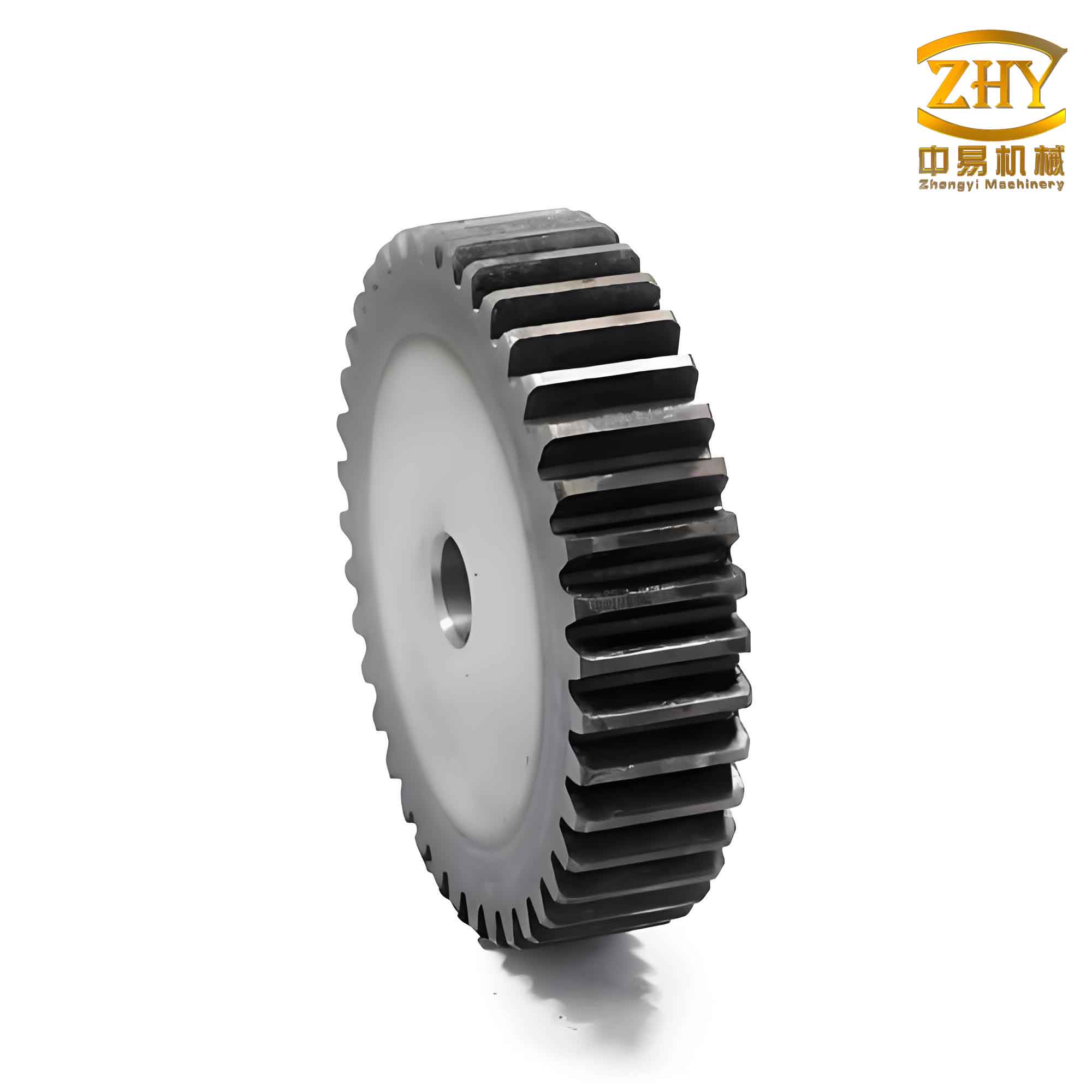
When an external torque is applied, the teeth deflect. At the instant of transition from DTC to STC (e.g., at point D), one tooth pair exits contact. If the next pair has not yet deflected enough to carry its share, the remaining single tooth must abruptly accept the full load. This causes a sudden jump in load per tooth, known as “mesh stiffness excitation,” leading to impact and vibration. Conversely, when entering the DTC zone (e.g., at point B), the load must be suddenly shared, also causing discontinuity. This load discontinuity directly translates into fluctuations in transmission error (TE), defined as the deviation of the angular position of the driven gear from its theoretical position. Minimizing TE fluctuation is paramount for reducing vibration and noise. Furthermore, the localized high loads at the tooth tips (entrance A and exit E) combined with high sliding velocities can lead to excessive flash temperatures on the tooth surface, increasing the risk of scuffing failure.
Tooth profile modification is a proactive design technique used to mitigate these issues. By intentionally and slightly removing material from the ideal involute profile, typically near the tip and/or root, the effective length of the involute is altered. This controlled deviation allows the gear teeth to engage more smoothly, compensating for deflections and manufacturing errors, thereby reducing load shocks, smoothing transmission error, and often lowering peak contact stresses and temperatures.
2. Mechanism and Formulation of Tooth Profile Modification
The modification is applied symmetrically to both the pinion and the gear. The amount of material removed, or the “relief,” varies along the path of contact. The most common forms are linear or parabolic modifications. For the purpose of this analysis, we consider a parabolic modification profile defined along the line of action. The modification amount $$ \Delta $$ at any point in the double-contact region is given by:
$$ \Delta = \Delta_{\text{max}} \left( \frac{x}{L} \right)^{\beta_c} $$
where:
- $$ \Delta_{\text{max}} $$ is the maximum modification amount, usually applied at the tooth tip (and/or root).
- $$ x $$ is the distance from the start of the modification zone (e.g., the boundary point B or D) to the point of interest K on the line of action within the double-contact zone.
- $$ L $$ is the active length of the modification, which can be the entire length of the double-contact zone (termed “long modification”) or a portion of it, such as half (“short modification”).
- $$ \beta_c $$ is the modification index. A value of 1 represents linear modification, while values greater than 1 represent progressively more concave parabolic profiles.
The determination of $$ \Delta_{\text{max}} $$ is crucial. A common starting point is to set it equal to the total static deflection at the transition points B and D under the design load, sometimes adjusted for base pitch error $$ \Delta_{fb} $$: $$ \Delta_{\text{max}} = \delta_{B,D} \pm \Delta_{fb} $$.
3. Influence of Modification on Load Sharing and Transmission Error
The core benefit of profile modification for a spur and pinion gear system is its ability to reshape the load distribution. In the double-tooth-contact zone, the system can be modeled as two springs (representing the mesh stiffnesses of the two engaged pairs) in parallel. The load sharing ratio $$ \zeta_i $$ for pair i is governed by its stiffness and the relative modification applied to each pair.
$$ \zeta_1 = \frac{k_1}{k_1 + k_2} \left[ 1 + \frac{k_2 (\Delta_2 – \Delta_1)}{w} \right], \quad \zeta_2 = \frac{k_2}{k_1 + k_2} \left[ 1 + \frac{k_1 (\Delta_1 – \Delta_2)}{w} \right] $$
where $$ k_1, k_2 $$ are the time-varying mesh stiffnesses of the two pairs, $$ \Delta_1, \Delta_2 $$ are their respective profile modifications at the contact point, and $$ w $$ is the applied load per unit face width. The condition for double-tooth contact is $$ |\Delta_1 – \Delta_2| \leq \min(w/k_1, w/k_2) $$.
Transmission Error (TE) is calculated considering deflection and modification:
$$
TE = \begin{cases}
\frac{w + k_1\Delta_1 + k_2\Delta_2}{k_1 + k_2}, & |\Delta_1 – \Delta_2| \leq \min(w/k_1, w/k_2) \\
\Delta_1 + w/k_1, & \Delta_2 – \Delta_1 > w/k_1 \\
\Delta_2 + w/k_2, & \Delta_1 – \Delta_2 > w/k_2
\end{cases}
$$
The impact of modification parameters ($$ \Delta_{\text{max}}, \beta_c $$, and long vs. short) on load sharing and TE is systematic:
- $$ \Delta_{\text{max}} $$: Primarily determines the continuity of load transition. If too small, load jumps persist. If too large, it can artificially shorten the double-contact zone, potentially causing other dynamic issues.
- $$ \beta_c $$ and Modification Form: Influence the nonlinearity of the load transition and the shape of the TE curve within the modified zone. A well-chosen combination can make TE nearly constant.
Table 1: Basic Parameters of the Exemplary Spur and Pinion Gear System
| Category | Parameter | Value |
|---|---|---|
| Geometry | Number of Teeth, $$ z_1 / z_2 $$ | 27 / 35 |
| Module, $$ m $$ (mm) | 3 | |
| Pressure Angle, $$ \alpha $$ (°) | 20 | |
| Face Width, $$ b $$ (mm) | 25 | |
| Load | Power, $$ P $$ (kW) | 80 |
| Pinion Speed, $$ n_1 $$ (rpm) | 2000 | |
| Material (Steel) | Young’s Modulus, $$ E $$ (GPa) | 206 |
| Poisson’s Ratio, $$ \nu $$ | 0.3 | |
| Density, $$ \rho $$ (kg/m³) | 7850 |
For the spur and pinion gear defined in Table 1, analysis shows that a long modification with $$ \Delta_{\text{max}} $$ equal to the deflection at points B/D (≈26.5 µm) and $$ \beta_c = 1.43 $$ yields an optimally flat TE curve and a smooth load transition. These can be termed the single-objective optimal parameters for load/error minimization.
4. Influence of Modification on Tooth Surface Flash Temperature
For high-speed spur and pinion gear applications, preventing scuffing is critical. Scuffing is a sudden surface damage often initiated when the localized flash temperature at the contacting asperities exceeds a critical value. The flash temperature $$ \theta_{fla} $$ can be estimated using Blok’s formula:
$$ \theta_{fla} = 0.785 \cdot \frac{f w_b |v_{\rho1} – v_{\rho2}|}{(\sqrt{\lambda_1 \gamma_1 c_1 v_{\rho1}} + \sqrt{\lambda_2 \gamma_2 c_2 v_{\rho2}}) \sqrt{b_1}} $$
where $$ f $$ is the friction coefficient, $$ w_b $$ is the load per unit face width (directly related to $$ \zeta_i $$), $$ v_{\rho i} $$ are the rolling/sliding velocities, $$ \lambda, \gamma, c $$ are thermal properties, and $$ b_1 $$ is the semi-width of the Hertzian contact band.
In an unmodified spur and pinion gear, the highest flash temperature typically occurs at the points of single-pair contact near the tip/root (points A and E) due to the combination of high sliding velocity and full load. Profile modification directly affects the $$ w_b $$ term by altering the load sharing ratio $$ \zeta_i $$. By reducing the load on the entering and exiting tooth pairs, modification can significantly lower the peak flash temperature and shift its location.
Key Findings for the Spur and Pinion Gear System:
- Modification changes the flash temperature distribution from a “V” shape to an “M” shape.
- The peak temperature is no longer at the tip but moves inward to the mid-region of the double-contact zone.
- The optimal modification for minimizing peak flash temperature is not the same as for minimizing TE fluctuation. For the example system, the optimal $$ \Delta_{\text{max}} $$ for flash temperature is found to be the deflection at the midpoint of the approach path double-contact zone (≈16.2 µm), with $$ \beta_c = 1.43 $$ and long modification.
Table 2: Summary of Single-Objective Optimal Modification Parameters
| Performance Objective | Optimal Max Modification ($$ \Delta_{\text{max}} $$) | Optimal Modification Index ($$ \beta_c $$) | Optimal Modification Form |
|---|---|---|---|
| Load Sharing / Transmission Error Smoothing | Deflection at transition points B/D | 1.43 | Long |
| Flash Temperature Minimization | Deflection at midpoint of approach DTC zone | 1.43 | Long |
5. Multi-Objective Optimization Using Fuzzy Comprehensive Decision Theory
In practical spur and pinion gear design, engineers must balance multiple objectives: smooth load transfer, low vibration (low TE fluctuation), and high scuffing resistance (low flash temperature). The single-objective optima conflict, particularly in the value of $$ \Delta_{\text{max}} $$. Fuzzy comprehensive decision theory is an excellent tool to handle this multi-criteria optimization under uncertainty.
The procedure for our spur and pinion gear case is as follows:
1. Define the Alternative Set ($$ \tilde{B} $$): This is the discrete set of candidate $$ \Delta_{\text{max}} $$ values, bounded by the two single-objective optima (16.2 µm and 26.5 µm). We create a set of six alternatives: $$ \tilde{B} = \{26.5, 24.5, 22.5, 20.5, 18.5, 16.2\} $$ µm.
2. Define the Evaluation Factor Set ($$ \tilde{A} $$): These are the performance criteria we care about. $$ \tilde{A} = \{\text{Load Distribution}, \text{Transmission Error}, \text{Flash Temperature}\} $$.
3. Determine the Weight Vector ($$ \tilde{a} $$): This reflects the relative importance of each factor. The weights can be assigned based on the sensitivity of each factor to changes in $$ \Delta_{\text{max}} $$ or based on design priorities. For the example gear, an analysis of sensitivity led to a weight distribution of (0.5, 0.4, 0.1), prioritizing dynamic performance over pure thermal performance, which is common in many applications.
$$ \tilde{a} = (0.5, 0.4, 0.1) $$
4. Establish the Fuzzy Relation Matrix ($$ \tilde{R} $$): This matrix quantifies the degree to which each alternative $$ \tilde{B}_j $$ satisfies each evaluation factor $$ \tilde{A}_i $$. The membership values (between 0 and 1) are derived from normalized performance analysis. For instance, a high $$ \Delta_{\text{max}} $$ (26.5 µm) scores well for Load/Error but poorly for Flash Temperature.
$$
\tilde{R} = \begin{bmatrix}
0.6 & 0.5 & 0.4 & 0.3 & 0.2 & 0.1 \\
0.5 & 0.45 & 0.4 & 0.35 & 0.3 & 0.2 \\
0.2 & 0.25 & 0.3 & 0.35 & 0.4 & 0.5
\end{bmatrix}
$$
5. Compute the Comprehensive Decision Vector ($$ \tilde{C} $$): This is obtained by the fuzzy transformation $$ \tilde{C} = \tilde{a} \circ \tilde{R} $$. Using the weighted average model for a more balanced result:
$$ \tilde{C} = (0.5, 0.4, 0.1) \circ \tilde{R} = (0.5, 0.5, 0.4, 0.35, 0.3, 0.2) $$
6. Determine the Best Alternative: Applying the weighted average method to the decision vector $$ \tilde{C} $$ and the alternative set $$ \tilde{B} $$ yields the optimal compromise value.
$$ B^* = \frac{\sum_{j=1}^{m} C_j B_j}{\sum_{j=1}^{m} C_j} \approx 22.4 \text{ µm} $$
Thus, the multi-objective optimal $$ \Delta_{\text{max}} $$ is selected as 22.5 µm from the alternative set.
6. Generalized Multi-Objective Optimal Parameters and Correction Factor
Extending this fuzzy decision analysis across multiple spur and pinion gear designs with different geometries and loads reveals a consistent pattern. The multi-objective optimal maximum modification $$ \Delta_{\text{max}}^{multi} $$ can be related to the single-objective optimal value for load/error $$ \Delta_{\text{max}}^{load/error} $$ (the deflection at points B/D) via a correction factor $$ X_c $$.
$$ \Delta_{\text{max}}^{multi} = X_c \cdot \Delta_{\text{max}}^{load/error} $$
Statistical analysis from several case studies, as summarized below, shows that the factor $$ X_c $$ averages around 0.845.
Table 3: Statistical Analysis of Optimal Modification Across Different Spur and Pinion Gear Designs
| Gear Pair ($$ z_1/z_2 $$) | Single-Objective $$ \Delta_{\text{max}} $$ (Load/Error) (µm) | Single-Objective $$ \Delta_{\text{max}} $$ (Flash Temp) (µm) | Multi-Objective $$ \Delta_{\text{max}} $$ (µm) | Calculated $$ X_c $$ |
|---|---|---|---|---|
| 17/25 | 38.0 | 23.2 | 32.0 | 0.842 |
| 23/30 | 51.5 | 31.5 | 43.5 | 0.845 |
| 27/35 | 26.5 | 16.2 | 22.5 | 0.849 |
| 33/45 | 18.9 | 11.5 | 15.9 | 0.841 |
| 43/92 | 17.1 | 10.4 | 14.5 | 0.848 |
| Average | 0.845 | |||
7. Conclusions
This comprehensive analysis provides a systematic framework for optimizing tooth profile modification in spur and pinion gear systems. The key conclusions are:
- Tooth profile modification is essential for managing the inherent dynamic excitations in spur and pinion gears caused by time-varying mesh stiffness and load sharing discontinuities.
- The modification parameters—maximum amount ($$ \Delta_{\text{max}} $$), index ($$ \beta_c $$), and form (long/short)—have distinct and significant effects on load distribution, transmission error fluctuation, and tooth surface flash temperature.
- Single-objective optimization yields distinct optimal parameters: For load/error smoothing, $$ \Delta_{\text{max}} $$ should equal the deflection at the STC/DTC transition points. For flash temperature minimization, $$ \Delta_{\text{max}} $$ should equal the deflection at the midpoint of the approach DTC zone. In both cases, a long modification form with $$ \beta_c \approx 1.43 $$ is favorable.
- For practical spur and pinion gear design, a multi-objective approach is necessary. Fuzzy comprehensive decision theory provides a robust mathematical tool to find the best compromise between competing dynamic and thermal performance goals.
- The multi-objective optimal maximum modification can be efficiently calculated using a correction factor $$ X_c \approx 0.845 $$ applied to the single-objective (load/error) optimal value. The comprehensive optimal modification profile is therefore given by:
$$ \Delta = X_c \cdot \Delta_{\text{max}}^{load/error} \cdot \left( \frac{x}{L} \right)^{\beta_c} $$
with $$ \beta_c = 1.43 $$ and using the long modification form.
Applying these parameters to the exemplary spur and pinion gear system results in a load shock reduction to 5.4%, a transmission error fluctuation of 5.7%, and a peak flash temperature reduction of 28.3% compared to the unmodified gear, demonstrating a balanced and significant improvement in overall system performance.