
We present a comprehensive study on the tooth surface contact temperature of a straight spur gear based on Blok’s flash temperature theory. Our work derives calculation formulas for four distinct lubrication regimes: elastohydrodynamic lubrication (EHL), mixed lubrication, boundary lubrication, and dry friction. Through numerical simulation and experimental measurement, we investigate the effects of rotational speed, torque, lubricant viscosity, and backlash on the contact temperature distribution along the meshing line. The results show that the highest temperatures occur at the entry meshing point and the tooth tip, while the temperature near the pitch point remains close to ambient. Under EHL, the contact temperature increases with lubricant viscosity, while under mixed lubrication the trend reverses. Boundary lubrication shows no significant dependence on viscosity. Higher speed, torque, and backlash all raise the contact temperature. Our findings provide a reliable basis for both theoretical prediction and practical measurement of tooth surface contact temperature in straight spur gears.
Introduction
Gears are essential mechanical components widely used in power transmission. Under high load and high speed conditions, the friction between tooth surfaces generates significant heat, elevating the tooth surface contact temperature. This elevated temperature is a primary cause of scuffing failure, which severely affects gear performance and lifespan. Understanding the temperature distribution and its influencing factors is therefore critical. The flash temperature theory proposed by Blok in 1937 has been a cornerstone for estimating instantaneous contact temperatures. Later researchers like Mao used finite difference methods for more realistic predictions. Li et al. studied the effects of torque, viscosity, and surface roughness. Taburdagitan developed finite element models for thermo-elastic analysis. Experimental work by Chen et al. employed infrared thermography. Despite these advances, a unified formulation covering multiple lubrication regimes and systematic parametric analysis with experimental validation remains limited. Our study addresses this gap by focusing on a straight spur gear system, developing calculation formulas for four lubrication states, conducting measurements with a custom test rig, and analyzing the coupled influence of key system parameters.
1. Theoretical Model for Tooth Surface Contact Temperature of Straight Spur Gear
The total contact temperature TC is the sum of the bulk temperature TB and the flash temperature Tf:
$$T_{C} = T_{B} + T_{f}$$
1.1 Flash Temperature Calculation
According to Blok’s theory, the flash temperature for a straight spur gear is given by:
$$T_{f} = \frac{\xi \mu p_{e} \lvert v_{1} – v_{2} \rvert}{\left( \sqrt{g_{1} \rho_{1} c_{1} v_{1}} + \sqrt{g_{2} \rho_{2} c_{2} v_{2}} \right) \sqrt{B}}$$
where ξ = 0.83 for spur gears, μ is the friction coefficient, pe is the normal load per unit width, g, ρ, c are thermal conductivity, density, and specific heat of the wheel (1: driving, 2: driven), B is half Hertzian contact width, and v are tangential velocities at the meshing point.
The tangential velocities are expressed as functions of time t:
$$v_{i}(t) = \omega_{i} r_{ci}(t) \sin\left[ \arccos\left( \frac{r_{bi}}{r_{ci}(t)} \right) \right]$$
with ω = 2πn, and rci given by the gear geometry. The half contact width B is:
$$B_{i}(t) = \psi \sqrt{ \left( \frac{1-\mu_{1}^{2}}{E_{1}} + \frac{1-\mu_{2}^{2}}{E_{2}} \right) \frac{4 p_{e i}(t)}{\pi} \frac{R_{1}(t)R_{2}(t)}{R_{1}(t)+R_{2}(t)} }$$
where ψ = 1.128, μ is Poisson’s ratio, E is Young’s modulus, and R are radii of curvature.
1.2 Friction Coefficient Under Different Lubrication States
We consider four lubrication regimes affecting μ:
Elastohydrodynamic Lubrication (EHL)
The friction coefficient for EHL is:
$$\mu_{Ei}(t) = e^{f(s, F_{hz}, \eta_{0}, S_{av})} \, F_{hz i}^{b_{2}}(t) \, |s(t)|^{b_{3}} \, v_{e}^{b_{6}}(t) \, \eta_{0}^{b_{7}} \, R^{b_{8}}(t)$$
where f contains regression coefficients b1 to b9, η0 is dynamic viscosity, Sav is average surface roughness, s is slide-to-roll ratio, ve is entrainment velocity, R is combined curvature radius, and Fhz is Hertzian contact stress.
Mixed Lubrication
The mixed lubrication friction coefficient is:
$$\mu_{mi}(t) = 0.0127 \times \frac{1.13}{1.13 – S_{av}} \lg\left( \frac{29700 p_{e i}(t)}{\eta_{0} v_{s}(t) v_{e}^{2}(t)} \right)$$
Boundary Lubrication
For boundary lubrication:
$$\mu_{bi}(t) = \frac{2\mu_{av}}{\pi} \arctan[\Phi x_{i}(t)] + \frac{2\mu_{av} \sigma x_{i}(t)}{\pi [1+\Phi^{2} x_{i}^{2}(t)]}$$
with μav average friction, Φ = 50, σ transmission ratio, and x periodic displacement.
Dry Friction
For dry contact we adopt a constant value μd = 0.4 based on typical experimental data.
1.3 Contact Temperature Expression
Substituting the appropriate friction coefficient into the flash temperature formula yields the time-dependent surface temperature for each lubrication state:
$$T_{f i}(t) = \frac{\xi \mu_{i}(t) p_{e i}(t) \lvert v_{1}(t)-v_{2}(t) \rvert}{\left( \sqrt{g_{1} \rho_{1} c_{1} v_{1}(t)} + \sqrt{g_{2} \rho_{2} c_{2} v_{2}(t)} \right) \sqrt{B_{i}(t)}}$$
$$T_{C i}(t) = T_{B} + T_{f i}(t)$$
The basic gear parameters used in our study are summarized in the table below.
| Parameter | Driving gear (pinion) | Driven gear |
|---|---|---|
| Module m (mm) | 5 | 5 |
| Number of teeth z | 21 | 26 |
| Pressure angle α (°) | 20 | 20 |
| Face width b (mm) | 25 | 20 |
| Young’s modulus E (GPa) | 163 | 211 |
| Poisson’s ratio μ | 0.277 | 0.33 |
| Material | Constantan | 40Cr steel |
| Density ρ (kg/m³) | 8900 | 7820 |
| Thermal conductivity g (J/(s·K)) | 22 | 32 |
| Linear expansion coefficient λ | 1.52×10⁻⁵ | 1.3×10⁻⁵ |
| Specific heat c (J/(kg·K)) | 420 | 550 |
2. Experimental Verification of the Straight Spur Gear Contact Temperature
To validate our numerical model, we constructed a purpose-built test rig for measuring the tooth surface contact temperature of a straight spur gear under single-tooth meshing. The rig uses a three-phase variable frequency motor for speed adjustment from 1080 to 2400 r/min. The driven gear is a special three-tooth missing-gear assembly to ensure single-tooth contact. Embedded thermocouples beneath the tooth surface directly measure the transient temperature at the contact point. Experiments were conducted under several operating conditions: torque T = 6, 8, 15 N·m; speed n = 1200, 1500 r/min; bulk temperature TB = 19 or 25 °C.
The measured temperature traces show excellent qualitative agreement with our numerical predictions. For instance, under T = 15 N·m, n = 1500 r/min, the experimental peak temperature reaches about 45 °C while our model predicts 42 °C. The distribution along the meshing line shows the characteristic U-shape: highest at entry and exit (tooth tip), lowest near the pitch circle. Some minor fluctuations near the pitch point are attributed to impact and oil churning in the real gearbox, which are not captured in the ideal theoretical model. Nonetheless, the overall trend validates our approach.
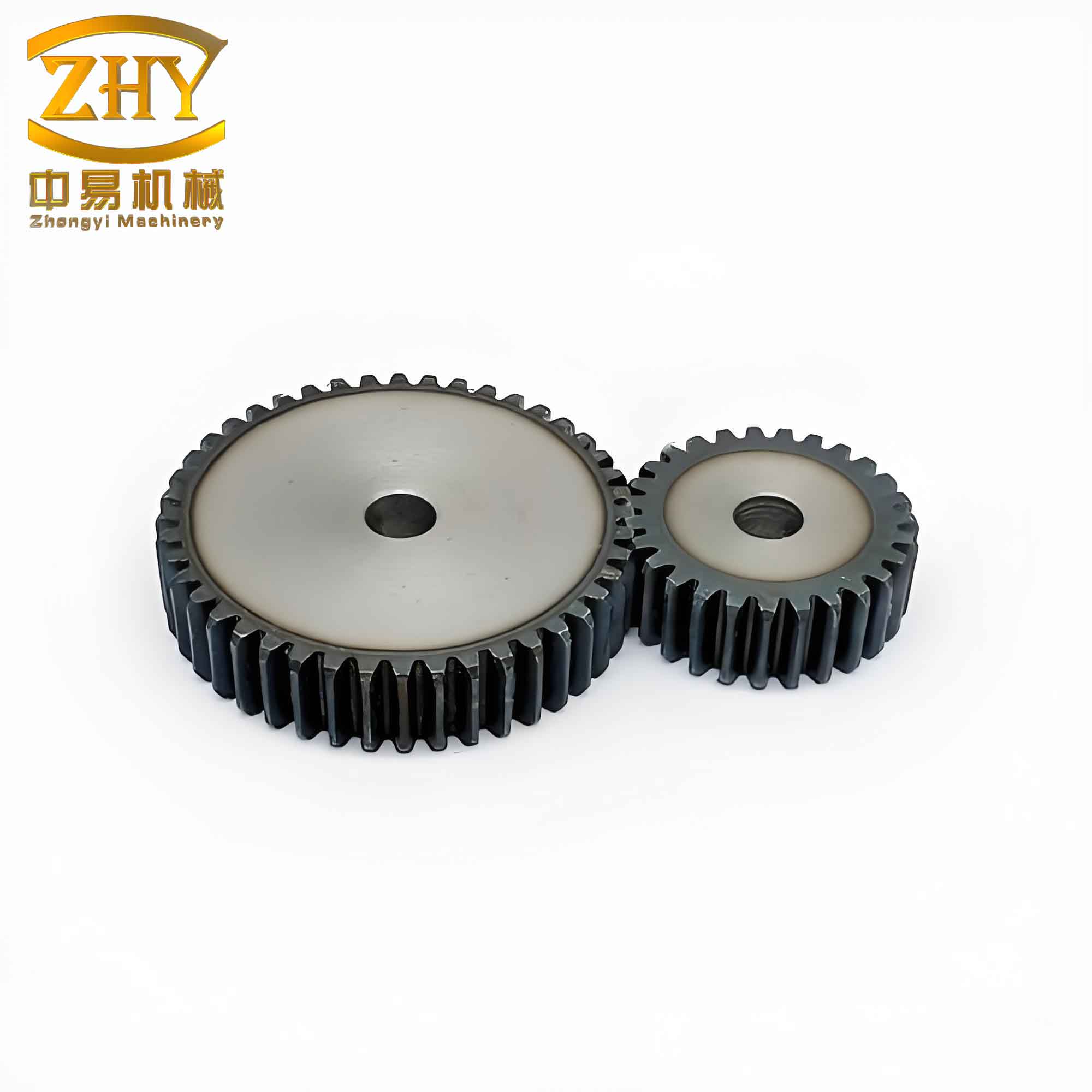
The following images illustrate the set-up and comparison between predicted and measured temperatures for a typical case.
3. Parametric Study on Tooth Surface Contact Temperature of Straight Spur Gear
Using the validated numerical code, we systematically investigated the influence of rotational speed, torque, lubricant viscosity, and backlash on the maximum contact temperature along the meshing line. Contour plots are generated over two-parameter planes to reveal coupling effects.
3.1 Coupled Effect of Speed and Torque
Under EHL (η₀ = 0.033 Pa·s, zero backlash), the contact temperature increases monotonically with both speed and torque. At low torque the temperature rises slowly with speed; at high torque the increase becomes steeper. The highest temperatures occur at the maximum speed and torque. This pattern is similar for mixed, boundary, and dry lubrication, but dry friction yields the highest absolute values due to the larger friction coefficient. The results emphasize that for safe operation of a straight spur gear, both speed and torque must be limited to avoid scuffing.
3.2 Coupled Effect of Speed and Lubricant Viscosity
We compare EHL and mixed lubrication at T = 10 N·m and zero backlash. Under EHL, at low viscosity the temperature rises modestly with speed; at high viscosity the rise becomes dramatic once speed exceeds about 500 r/min. This is because higher viscosity increases internal fluid friction and impedes heat dissipation. In contrast, under mixed lubrication, higher viscosity reduces the metal-to-metal contact, thus lowering the temperature, especially above 1800 r/min. Therefore, for a straight spur gear operating in the EHL regime, lower viscosity oil is beneficial, while in mixed lubrication, higher viscosity is preferred.
3.3 Coupled Effect of Torque and Lubricant Viscosity
At n = 1800 r/min and zero backlash, EHL again shows a strong positive correlation with viscosity when torque exceeds 6 N·m. Mixed lubrication exhibits a weak negative correlation with viscosity; temperature drops only slightly as viscosity rises. This reinforces the point that the optimal lubricant selection depends on the prevailing lubrication regime of the straight spur gear.
3.4 Coupled Effect of Speed and Backlash
Backlash Jn was varied from 0 to 0.25 mm. Under all four lubrication states, the temperature increases with both speed and backlash, but the influence of backlash is much weaker than that of speed. For example, increasing backlash from 0 to 0.25 mm raises the temperature by only 2–3 °C at a given speed. However, excessive backlash leads to impact noise and gear vibration, so a moderate value is recommended for straight spur gear applications.
3.5 Coupled Effect of Torque and Backlash
Similar trends are observed: temperature rises with torque and slightly with backlash. The dry friction condition produces the highest temperatures, followed by boundary, mixed, and EHL. The influence of backlash remains secondary compared to torque.
3.6 Coupled Effect of Backlash and Lubricant Viscosity
At n = 1800 r/min and T = 10 N·m, under EHL the temperature increases strongly with viscosity and slightly with backlash. Under mixed lubrication, temperature decreases weakly with viscosity and increases slightly with backlash. The overall effect of backlash on contact temperature is minor, but its impact on dynamics and noise must be considered in practical design of straight spur gear systems.
A summary of the parametric trends is provided in the table below.
| Parameter | Trend | Lubrication regime sensitivity |
|---|---|---|
| Rotational speed (n) | Positive (strong) | All regimes; strongest in dry and EHL at high viscosity |
| Torque (T) | Positive (strong) | All regimes; similar sensitivity |
| Lubricant viscosity (η₀) | Positive (EHL); Negative (Mixed); Negligible (Boundary, Dry) | Strong coupling with speed and torque |
| Backlash (Jn) | Positive (weak) | Similar across regimes; secondary effect |
4. Conclusion
We have developed a complete theoretical framework for calculating the tooth surface contact temperature of a straight spur gear under four lubrication regimes, based on Blok’s flash temperature theory. The model was experimentally verified using a single-tooth meshing test rig, showing good agreement in both magnitude and distribution pattern. Our parametric study, summarized in the contour plots and tables, reveals the following key findings:
- The contact temperature reaches its maximum at the entry meshing point and the tooth tip, while the near-pitch area remains close to ambient temperature. This distribution is consistent across all lubrication states.
- For Elastohydrodynamic Lubrication, higher lubricant viscosity leads to higher temperatures due to increased internal shear and reduced heat dissipation. Lower viscosity is recommended for EHL-dominated straight spur gear operation.
- For Mixed Lubrication, the trend reverses: higher viscosity reduces metal-to-metal contact and thus lowers the temperature. Higher viscosity is beneficial in this case.
- Boundary lubrication and dry friction show negligible dependence on lubricant viscosity; the temperature is primarily governed by speed and torque.
- Increasing speed and torque always raises the contact temperature. The effect is particularly severe when both are high, increasing the risk of scuffing.
- Backlash has a minor positive effect on temperature but significantly affects impact loads and noise; a moderate backlash (e.g., 0.1–0.15 mm) is advisable for straight spur gear applications.
- The dry friction state produces the highest temperatures, while EHL yields the lowest, confirming the importance of proper lubrication in controlling thermal behavior.
Our work provides a reliable foundation for engineers to predict and control tooth surface contact temperature in straight spur gears, aiding in the prevention of scuffing failure and the optimization of gear system performance. Future work should extend the experimental validation to mixed and boundary lubrication regimes, and incorporate the effect of bearing heat generation for more accurate bulk temperature prediction.