
In this study, I investigate the vibration characteristics of straight spur gear pairs under the combined influence of random transmission error and random tooth surface friction parameters. By integrating statistical methods with a lumped-parameter approach, I numerically characterize the randomness of gear errors and friction parameters, establish a bending-torsional coupled vibration model for straight spur gear transmission, and analyze the dynamic responses. The results demonstrate that the randomness in both error and friction leads to more complex stochastic behaviors in the frequency domain and phase portraits, with error randomness exerting a stronger destabilizing effect on system dynamics. This work provides theoretical references for the dynamic design of straight spur gear drives.
1. Introduction
The development of gear transmission systems toward higher speeds and power densities demands effective vibration and noise reduction. In practical engineering, manufacturing and assembly tolerances, along with varying operational conditions, introduce randomness in the composite transmission error and tooth surface micro‑topography of straight spur gears. Such randomness influences tooth surface friction, which in turn affects the overall dynamic behavior. The interplay between random error and friction parameters makes the vibration characteristics of straight spur gear pairs unclear. Therefore, a comprehensive study accounting for both random error and random friction is essential for reliability analysis and optimization of straight spur gear transmissions.
Previous research has extensively investigated gear dynamics under deterministic excitations. Some scholars considered random profile errors but neglected friction effects; others studied friction under deterministic assumptions. Few works simultaneously addressed the randomness of error and friction. To fill this gap, I propose a probabilistic framework that treats both the composite error and the friction parameters (friction coefficient and instantaneous meshing radius) as random variables. A three‑degree‑of‑freedom bending‑torsional coupled dynamic model for a straight spur gear pair is developed, and the fourth‑order Runge‑Kutta method is employed to solve the equations. The influence of each random factor on the vibration responses is examined.
2. Dynamic Model of Straight Spur Gear Pair Considering Random Error and Friction
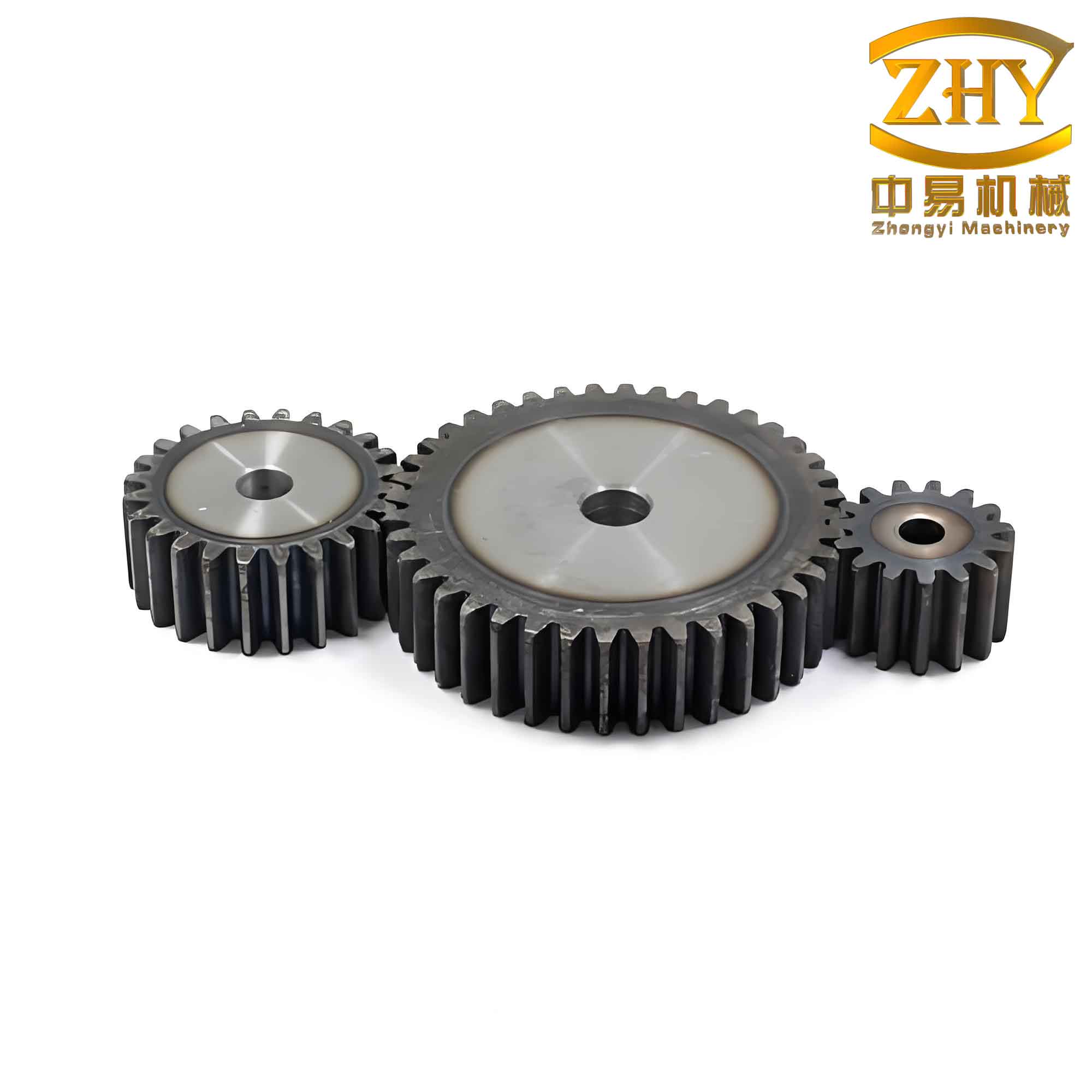
I adopt a lumped‑mass method to establish the bending‑torsional coupled model of a straight spur gear pair with three degrees of freedom, as illustrated conceptually. The displacement vector of the mass points is
$$ \mathbf{q} = [x_p,\; y_p,\; \theta_p,\; x_g,\; y_g,\; \theta_g]^{\mathrm{T}} $$
where subscripts p and g denote the driving and driven straight spur gears, respectively; \(x_i\) and \(y_i\) are the translational displacements in the x and y directions, and \(\theta_i\) is the rotational displacement.
Considering time‑varying mesh stiffness, random error, and tooth surface friction, the bending‑torsional vibration equations are written as
$$
\begin{cases}
m_p\ddot{x}_p + k_{xp}x_p + \sin\alpha\, k_m(t)\,\delta(t) = F_f(t)\sin\alpha \\[4pt]
m_p\ddot{y}_p + k_{yp}y_p + \cos\alpha\, k_m(t)\,\delta(t) = -F_f(t)\cos\alpha \\[4pt]
I_p\ddot{\theta}_p + R_p(t)\,k_m(t)\,\delta(t) = T_p(t) \\[4pt]
m_g\ddot{x}_g + k_{xg}x_g – \sin\alpha\, k_m(t)\,\delta(t) = -F_f(t)\sin\alpha \\[4pt]
m_g\ddot{y}_g + k_{yg}y_g – \cos\alpha\, k_m(t)\,\delta(t) = F_f(t)\cos\alpha \\[4pt]
I_g\ddot{\theta}_g – R_g(t)\,k_m(t)\,\delta(t) = -T_g(t)
\end{cases}
$$
where \(\delta(t)\) is the relative displacement along the line of action:
$$ \delta(t) = \sin\alpha\,(x_p – x_g) + \cos\alpha\,(y_p – y_g) + R_p(t)\theta_p – R_g(t)\theta_g + e(t) $$
Here, \(k_{xi},k_{yi}\) are the equivalent support stiffnesses; \(k_m(t)\) is the time‑varying mesh stiffness; \(T_i(t)\) are the torques; \(R_i(t)\) are the instantaneous curvature radii along the contact line; \(m_i,I_i\) are the mass and moment of inertia; \(F_f(t)\) is the time‑varying friction force under random tooth surface roughness; \(\alpha\) is the pressure angle; and \(e(t)\) is the gear transmission error.
The parameters of the straight spur gear pair used in this study are listed in Table 1.
| Parameter | Driving Gear | Driven Gear |
|---|---|---|
| Number of teeth | 33 | 26 |
| Accuracy grade | 6GJ | 6GJ |
| Mass (kg) | 10.6 | 7.43 |
| Modulus (mm) | 7 | 7 |
| Moment of inertia (kg·mm²) | 147670 | 61426 |
| Pressure angle (°) | 20 | 20 |
| Face width (mm) | 69 | 69 |
| Input speed (r/min) | 2000 | – |
| Input torque (N·m) | 2340.7 | – |
The time‑varying mesh stiffness curve is obtained using the Weber energy method. The mean mesh stiffness and its harmonics generate the fundamental mesh frequency of 1100 Hz.
3. Randomness Analysis of Error and Tooth Surface Friction Parameters
3.1 Random Transmission Error
The gear transmission error consists of deterministic periodic components and random fluctuations. Following deterministic methods, the base pitch error and tooth profile error are combined into a sinusoidal function over one mesh cycle:
$$ e_i(t) = e_m + E_i \sin(\omega t + \varphi_i) $$
where \(e_m\) is the mean error, \(E_i\) the amplitude, \(\omega\) the mesh angular frequency, and \(\varphi_i\) the initial phase. The stochastic part is represented by a Gaussian white noise \(\xi(t)\) with zero mean and variance 0.0005. Thus, the total random error is
$$ e(t) = e_i(t) + \xi(t) $$
The white noise sequence and the resulting random transmission error for a 6‑grade precision straight spur gear are shown conceptually.
3.2 Tooth Surface Friction Parameters Affected by Random Error
The time‑varying friction force on the meshing line is given by
$$ F_f(t) = \mu(t)\, k_m(t)\, \delta(t) $$
where \(\mu(t)\) is the coefficient of friction. The friction moment on each gear is
$$ T_i(t) = F_f(t)\, R_i(t) $$
The randomness of tooth surface micro‑topography causes the friction coefficient to be a random process. I assume
$$ \mu(t) = \mu_0 + \sigma_\mu\,\xi(t) $$
with mean \(\mu_0 = 0.109\) and standard deviation \(\sigma_\mu = 0.05\). The instantaneous meshing radius \(R_i(t)\) also becomes random due to the varying distance from the pitch point to the instantaneous contact point. The distance \(s(t)\) along the line of action is modeled as
$$ s(t) = s_\mu + \xi(t) $$
where \(s_\mu\) is the mean value computed from gear geometry. Then
$$ R_p(t) = r_1\sin\alpha_p + s(t), \qquad R_g(t) = r_2\sin\alpha_g + s(t) $$
Using the geometric model of the involute straight spur gear, \(s_\mu\) is determined. The resulting random friction coefficient and curvature radius curves illustrate the stochastic nature.
4. Dynamic Response Characteristics
I solve the governing equations using the fourth‑order Runge‑Kutta method with a fixed step of 0.00015 s. The vibration responses of the straight spur gear pair under combined random error and random friction are obtained. Figure (not shown) presents the time‑domain acceleration of both gears.
Statistical characteristics are summarized in Table 2.
| Parameter | Direction | Mean Square (mm/s² or rad/s²) |
|---|---|---|
| Driving gear | x | 5.5127 |
| y | 15.1342 | |
| Torsional | 0.1254 | |
| Driven gear | x | 7.8657 |
| y | 21.5914 | |
| Torsional | 0.2375 |
The power spectral density (PSD) of the torsional acceleration of both gears shows prominent peaks at 1100 Hz (mesh frequency) and 2200 Hz (second harmonic). Sidebands appear near these frequencies due to the convolution of mesh stiffness, friction, and random error.
5. Influence of Randomness on Vibration
5.1 Effect of Random Error
I compare the responses of the driving straight spur gear with and without random error (friction parameters kept at their deterministic means). Figure 2 (conceptual) shows that random error significantly increases the fluctuation amplitude. Table 3 quantifies the time‑domain statistics.
| Direction | With Random Error (mean square) | Without Random Error (mean square) | Increase (%) |
|---|---|---|---|
| x (mm/s²) | 5.5127 | 3.3406 | 65.02 |
| y (mm/s²) | 15.1342 | 9.1597 | 65.23 |
| Torsional (rad/s²) | 0.1254 | 0.0759 | 65.21 |
In the frequency domain, the response spectrum becomes broader and more continuous in the presence of random error. The amplitude at mesh frequency increases by approximately 227% compared to the deterministic case. Phase portraits transform from smooth closed curves into irregular, chaotic‑like trajectories, indicating a loss of periodic motion stability.
5.2 Effect of Random Friction Parameters
Now I keep the random error present and compare two cases: (a) friction parameters (coefficient and curvature radius) treated as deterministic constants, and (b) friction parameters treated as random variables. Figure 3 (conceptual) shows that random friction further amplifies the vibration. Statistical data are given in Table 4.
| Direction | Random friction (mean square) | Deterministic friction (mean square) | Increase (%) |
|---|---|---|---|
| x (mm/s²) | 6.9896 | 5.5127 | 26.79 |
| y (mm/s²) | 19.2008 | 15.1342 | 26.87 |
| Torsional (rad/s²) | 0.1591 | 0.1254 | 26.84 |
In the frequency domain, the peak amplitudes at 1100 Hz and 2200 Hz increase by about 40% – 53% when friction randomness is considered. The sidebands also become more pronounced. This demonstrates that the stochastic nature of tooth surface friction contributes to additional vibration energy, especially at the mesh harmonics.
6. Conclusions
- I have applied probabilistic methods to mathematically characterize the random features of transmission error and tooth surface friction in straight spur gear pairs. A modified geometric model establishes the mapping between random error and time‑varying meshing curvature radius and friction coefficient.
- A three‑degree‑of‑freedom bending‑torsional coupled dynamic model for straight spur gear transmission that incorporates both random error and random friction parameters has been developed and solved numerically.
- The simulation results reveal that random error significantly increases the vibration amplitude and introduces strong stochastic fluctuations; random friction parameters further amplify the response, especially at the mesh frequency and its harmonics. The combined effect creates more complex frequency spectra and chaotic‑like phase trajectories, destabilizing the gear dynamics. This work provides a theoretical basis for the dynamic design and optimization of straight spur gear transmissions under realistic random excitations.