
Spiral bevel gears are critical components in power transmission systems, prized for their high efficiency, substantial load-bearing capacity, smooth operation, and low noise. Among various designs, the equal-height tooth form offers distinct manufacturing and performance advantages. The machining of these complex gears, particularly the spiral bevel gear, is a sophisticated process. Traditional methods rely heavily on costly and time-consuming trial-and-error cutting to establish suitable machining parameters. This study presents a comprehensive methodology integrating theoretical modeling, finite element simulation, and experimental validation to optimize the cutting process for spiral bevel gear manufacturing, thereby reducing development time and cost.
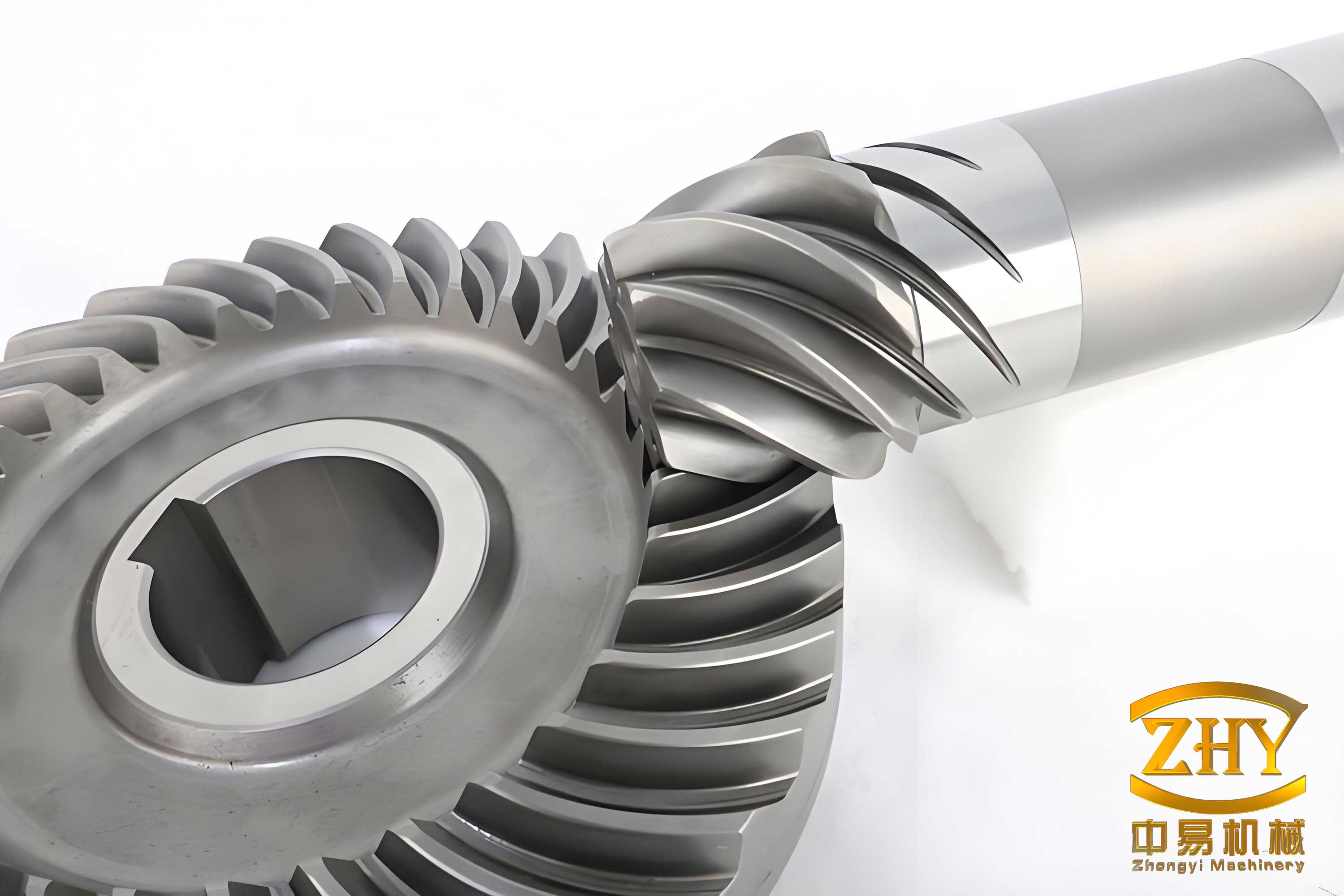
The core challenge in machining spiral bevel gear teeth lies in generating the precise curvilinear tooth flank. The face-hobbing process with a continuous indexing cycle is commonly employed. In this method, the cutter head, equipped with multiple tool inserts (blades), rotates on its own axis while simultaneously performing a relative rolling motion with the gear blank, tracing an extended epicycloidal path to form the tooth slot. Accurately defining the cutting trajectory is fundamental to any subsequent analysis.
Theoretical Foundation: Cutting Trajectory Modeling
The geometric model for generating the tooth flank of an spiral bevel gear is based on the kinematics of the face-hobbing process. The coordinate systems and key parameters are established with respect to the machine plane and the cutter head. The primary goal is to derive the equation for the cutting edge’s path relative to the gear blank.
Let the machine coordinate system be denoted as \( O(i, j) \), with the origin \(O\) at the machine center. The cutter head center is located at \(O_C\). The radial distance \(S\) (radial setting) and the angular orientation \(q\) (angular setting) define the position of \(O_C\). The cutter head has a nominal radius \(r_C\). For an individual cutting blade, the distance from the cutter head center to the blade tip (point \(M_0\)) is \(r_0\), which differs for inside and outside blades and is given by:
$$
r_0 = r_C \pm 0.5W_G
$$
where \(W_G\) is the gear blank width, and the positive sign is used for inside blades, the negative for outside blades.
If the phase angle of the blade is \(\theta\), the position vector of the blade tip \(M_0\) in the machine coordinate system is:
$$
\vec{r_{M_0}} = [S \cos q + r_0 \sin(q – \theta)]\vec{i} + [S \sin q + r_0 \cos(q – \theta)]\vec{j}
$$
The orientation of the cutting edge is defined by its unit tangent vector \(\vec{t}\) and the unit normal vector \(\vec{n}\) to the cutting surface. These are expressed as:
$$
\begin{aligned}
\vec{n} &= \cos\phi \sin(q-\theta)\vec{i} + \cos\phi \cos(q-\theta)\vec{j} – \sin\phi\vec{k} \\
\vec{t} &= \sin\phi \sin(q-\theta)\vec{i} + \sin\phi \cos(q-\theta)\vec{j} + \cos\phi\vec{k}
\end{aligned}
$$
where \(\phi\) is the blade pressure angle. Consequently, any point \(M\) along the cutting edge, located at a distance \(s\) from the tip \(M_0\), can be described by the vector equation of the cutting surface:
$$
\vec{r_M} = \vec{r_{M_0}} – s\vec{t}
$$
This parametric equation, coupled with the kinematic relationship between cutter rotation and work roll, defines the complete cutting trajectory for generating the spiral bevel gear tooth flank. The derivation of the full kinematic transformation, accounting for the machine root angle and tilt settings, allows for the precise calculation of cutter location data necessary for CNC machining and simulation setup.
Finite Element Simulation Methodology
To analyze the influence of machining parameters without physical trials, a finite element (FE) based simulation approach is adopted. The commercially available software AdvantEdge FEM, specialized for metal cutting processes, is utilized to model the single-tooth cutting operation of an spiral bevel gear.
Geometric Model Simplification
To maintain computational efficiency while preserving the essential physics, the model is significantly simplified. A single tool insert (blade) is extracted from the full cutter head assembly to act as the cutting tool. The complex gear blank is simplified to a representative workpiece geometry that corresponds to the section being cut during one indexing step of the spiral bevel gear generation. The 3D models are created in CAD software and imported into AdvantEdge.
Material Properties and Meshing
The tool material is defined as a standard carbide (Carbide-General). The workpiece material is AISI-4120 (20CrMnMo), an alloy steel commonly used for gears, with a Brinell hardness of 248 HB. Adaptive remeshing is employed, with a minimum element size of 0.2 mm for the tool and 0.1 mm for the workpiece to ensure accuracy in the high-strain shear zones.
Process Kinematics and Approximation
Simulating the exact epicycloidal tool path within the constraints of the FE software requires an approximation. The software typically handles linear or circular tool motions. The actual tool path for one cutting pass, derived from the full kinematics, can be expressed as:
$$
\begin{aligned}
x_{actual} &= 88\cos\alpha + 138.68\cos(50.85^\circ – 0.35\alpha) \\
y_{actual} &= 88\sin\alpha + 138.68\sin(50.85^\circ – 0.35\alpha)
\end{aligned}
$$
for \( \alpha \) from \(0\) to \(50^\circ\).
This path is approximated in AdvantEdge as a combination of the cutter’s primary rotary motion and a linear feed motion, effectively simulating a “slope milling” operation. The approximated path used in the simulation is:
$$
\begin{aligned}
x_{sim} &= 88\cos\alpha + \frac{105.48\alpha}{\pi} + 86.31 \\
y_{sim} &= 88\sin\alpha + \frac{109.692\alpha}{\pi} + 106.43
\end{aligned}
$$
for \( \alpha \) from \(0\) to \( \frac{5}{18}\pi \). This linearization is valid for the small segment of the epicycloid generated during the cutting of a single tooth flank.
Simulation Matrix and Outputs
A series of simulations are designed to investigate the effects of key variables. The baseline parameters are set, and then each factor is varied independently. The primary outputs of interest are the three orthogonal cutting force components (Fx, Fy, Fz) and the tool-chip interface temperature. For the spiral bevel gear cutting orientation, the force component Fy is identified as the dominant main cutting force.
| Factor | Symbol | Levels Investigated |
|---|---|---|
| Cutting Speed | \(v_c\) | 150, 180, 210 m/min |
| Feed per Tooth | \(f_z\) | 0.01, 0.015, 0.02 mm/tooth |
| Blade Rake Face Angle | \(\gamma\) | 8.5°, 12.0°, 15.5° |
Simulation Results and Parametric Analysis
The simulation results provide clear trends regarding the impact of machining and tool geometry parameters on the cutting process of the spiral bevel gear.
Effect of Cutting Speed
Increasing the cutting speed generally reduces the specific cutting force due to thermal softening of the workpiece material in the shear zone. However, it also increases the rate of heat generation. The simulation data confirms this. The table below summarizes the average main cutting force (Fy_avg) and peak cutting temperature (T_max) for different cutting speeds at a constant feed of 0.01 mm/tooth and a blade angle of 12°.
| Cutting Speed, \(v_c\) (m/min) | Avg. Main Cutting Force, Fy_avg (N) | Peak Cutting Temperature, T_max (°C) |
|---|---|---|
| 150 | 485 | 612 |
| 180 | 462 | 648 |
| 210 | 438 | 695 |
The data shows a consistent decrease in cutting force (approximately 5% reduction from 150 to 210 m/min) and a consistent increase in temperature (about 13.6% increase over the same range). A speed of 180 m/min offers a reasonable compromise, providing force reduction without an excessively high temperature.
Effect of Feed per Tooth
Feed rate directly influences the uncut chip thickness, which has a dominant effect on cutting force. Higher feed increases the force significantly. The effect on temperature is more complex, as a larger chip carries away more heat, but the power input is higher. The simulation results are as follows (at \(v_c = 180\) m/min, \(\gamma = 12°\)):
| Feed per Tooth, \(f_z\) (mm/tooth) | Avg. Main Cutting Force, Fy_avg (N) | Peak Cutting Temperature, T_max (°C) |
|---|---|---|
| 0.010 | 462 | 648 |
| 0.015 | 598 | 661 |
| 0.020 | 725 | 677 |
The cutting force increases nearly linearly with feed, rising by about 57% when the feed is doubled. The temperature rise is more modest, increasing by only about 4.5% over the same range. A lower feed (0.01 mm/tooth) is preferred to minimize cutting forces and potential deflection, which is critical for achieving accurate tooth geometry in spiral bevel gear machining.
Effect of Blade Rake Face Angle
The blade’s rake face angle (\(\gamma\)) is a crucial geometric parameter. Increasing this angle effectively increases the positive rake, reducing cutting forces, but it may weaken the cutting edge. It also alters the effective inclination angle. The simulation results reveal a non-linear relationship (at \(v_c = 180\) m/min, \(f_z = 0.01\) mm/tooth):
| Blade Rake Angle, \(\gamma\) (°) | Avg. Main Cutting Force, Fy_avg (N) | Peak Cutting Temperature, T_max (°C) |
|---|---|---|
| 8.5 | 478 | 665 |
| 12.0 | 462 | 648 |
| 15.5 | 455 | 658 |
The cutting force gradually decreases as the angle increases, with a more noticeable drop from 8.5° to 12.0°. Interestingly, the temperature reaches a minimum at the 12.0° angle, suggesting an optimal balance between reduced shear energy and heat conduction. Increasing to 15.5° slightly increases temperature again, possibly due to changes in chip flow and contact. Therefore, a blade rake angle of 12.0° is selected as optimal for this spiral bevel gear application.
Consolidated Process Windows
Based on the simulation analysis, the following optimized parameters are recommended for the finish cutting of the case-hardened spiral bevel gear material to balance force, temperature, surface integrity, and geometric accuracy.
| Parameter | Optimized Value | Justification |
|---|---|---|
| Cutting Speed (\(v_c\)) | 180 m/min | Good force reduction without excessive temperature. |
| Feed per Tooth (\(f_z\)) | 0.01 mm/tooth | Minimizes cutting force and deflection for precision. |
| Blade Rake Angle (\(\gamma\)) | 12.0° | Provides lowest cutting temperature and reduced force. |
Experimental Validation and Gear Inspection
To validate the simulation-based optimization, actual cutting trials were performed on a Gleason Phoenix 175HC CNC hypoid gear generator. The workpiece was an spiral bevel gear with 10 teeth, a normal module of 5.6 mm, and a spiral angle of 50°. A Tri-AC type 88 mm diameter left-hand cutter head was used, equipped with blades having the optimized 12.0° rake face angle.
The machining parameters were set according to the simulation recommendations: \(v_c = 180\) m/min and \(f_z = 0.01\) mm/tooth. The gear was successfully cut without any observable issues such as chatter or excessive wear.
The quality of the manufactured spiral bevel gear was assessed through a multi-step inspection process. First, visual inspection confirmed acceptable surface roughness. Second, contact pattern testing via rolling with a master gear showed correct localization, shape, and alignment of the bearing contact. Finally, quantitative geometric accuracy was measured on a Klingelnberg P40 precision gear measuring center. Key error metrics were evaluated against the DIN 3965 standard for bevel gears.
| Error Metric | Symbol | Measured Value (µm) | DIN 3965 Grade 7 Tolerance (µm) | Assessment |
|---|---|---|---|---|
| Single Pitch Deviation | \(f_p\) | 8 | 12 | Pass |
| Adjacent Pitch Error | \(f_u\) | 10 | 14 | Pass |
| Cumulative Pitch Error | \(F_p\) | 22 | 28 | Pass |
| Runout Error | \(F_r\) | 25 | 32 | Pass |
The inspection results confirm that all critical error measures are within the limits for a precision Grade 7 gear according to DIN 3965. This successful outcome validates the parameters derived from the finite element simulation as being not only physically sound in the model but also effective and suitable for producing a high-quality spiral bevel gear in practice.
Conclusion
This study demonstrates a robust and effective framework for optimizing the machining parameters for equal-height spiral bevel gears. The methodology successfully bridges theoretical kinematics, computational simulation, and practical manufacturing.
- Theoretical Modeling: The cutting trajectory for the face-hobbing process was mathematically derived, providing the essential link between machine settings and the generated spiral bevel gear tooth geometry.
- Simulation-Based Analysis: A practical FE simulation strategy was implemented using AdvantEdge software. By approximating the complex epicycloidal path, the model effectively predicted cutting forces and temperatures. Parametric studies quantified the effects of cutting speed, feed rate, and tool geometry. The analysis identified an optimal set: cutting speed of 180 m/min, feed per tooth of 0.01 mm, and a blade rake angle of 12.0°, which minimized cutting forces and temperature for the given spiral bevel gear application.
- Experimental Validation: Machining trials conducted with the optimized parameters produced a gear with excellent surface quality and geometric accuracy, measuring within Grade 7 per DIN 3965 standards. This confirms the practical validity and effectiveness of the simulation-based optimization approach.
This integrated approach significantly reduces the reliance on empirical trial-and-error in the process development for spiral bevel gear manufacturing. It provides a predictive tool for selecting machining parameters, potentially leading to reduced costs, shorter lead times, and consistently high gear quality. Future work could expand the simulation to include wear modeling, residual stress prediction, and the optimization of roughing cycles for complete spiral bevel gear process design.