
In modern mechanical transmission systems, spiral bevel gears are critical components for transmitting motion and power between intersecting shafts. Due to their high overlap ratio, smooth operation, and superior load-bearing capacity, spiral bevel gears are extensively used in automotive, aerospace, marine, and industrial machinery. However, the manufacturing of spiral bevel gears is complex, as the tooth surfaces are not theoretically conjugate but are generated based on machine settings and cutting parameters. Traditional methods rely on trial-and-error adjustments using Gleason settings, which demand skilled operators and prolonged production cycles. To address these challenges, we propose a novel modeling approach that simulates the actual cutting process of spiral bevel gears, enabling virtual prototyping, parameter optimization, and dynamic interference detection before physical manufacturing. This method leverages generative cutting principles to derive a mathematical model of spiral bevel gears, implements a parameter adjustment program, and constructs three-dimensional solid models for simulation. Our work aims to enhance the design and manufacturing efficiency of spiral bevel gears, reduce costs, and improve gear performance through computational tools.
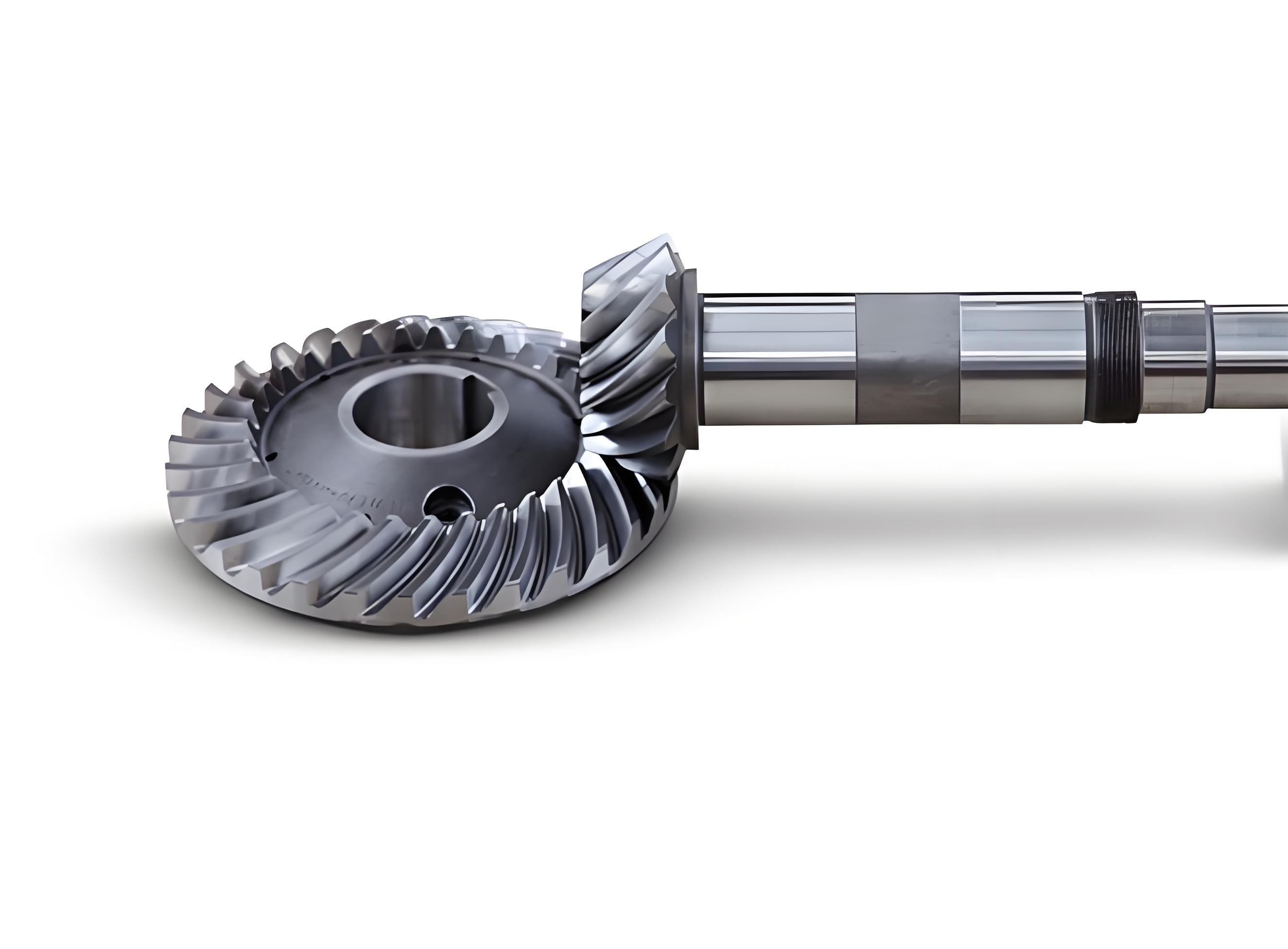
The core of our methodology is emulating the actual cutting process of spiral bevel gears on specialized machines, such as Gleason-type equipment. In production, spiral bevel gears are formed through an enveloping process where cutter blades sequentially sweep across the gear blank, generating tooth surfaces via line contact between the cutter edge and workpiece. We replicate this by considering the intersection points of successive cutter blade positions as discrete points on the tooth surface. By reducing the time interval between cuts, the error between the approximated surface and the theoretical envelope can be minimized to an acceptable level. This approach directly links cutting parameters to the gear geometry, facilitating easier adjustment and analysis compared to theoretical啮合 equations. Our focus is on spiral bevel gears, which exhibit curved teeth for smoother engagement, and we emphasize the importance of accurate modeling for these components.
To establish the mathematical model, we define coordinate systems based on the machine tool structure. For a Gleason machine, we set a static global coordinate system \(S_0\) at the machine center, with \(Z_0\) perpendicular to the cradle plane. Dynamic coordinate systems are attached to the cradle \(S_1\), cutter head \(S_2\), tilt body \(S_3\), and cutter \(S_4\). The workpiece coordinate system \(S_1’\) is derived by translating and rotating \(S_0\) to align with the gear blank axis. Transformations between these systems involve parameters such as cradle rotation angle \(q\), cutter rotation angle \(\theta\), machine tilt angle \(i\), and workpiece rotation angle \(\omega_1\). The transformation matrix from cutter coordinates \(S_4\) to workpiece coordinates \(S_1’\) is denoted as \(M_{41′}\), which incorporates all machine settings: radial distance, angular position, tilt, and kinematic motions. For spiral bevel gears, these matrices are crucial for mapping cutter paths onto the gear surface.
The cutter blade edge is represented as a straight line in the cutter coordinate system \(S_4\). At time \(t\), for a blade lying in the \(X_4O_4Z_4\) plane, the edge equation is:
$$ \begin{cases} X_4 = r_a u + r_a \\ Y_4 = 0 \\ Z_4 = -r_a u \cot \alpha \end{cases} $$
where \(r_a\) is the cutter tip radius, \(\alpha\) is the pressure angle, and \(u\) is a parameter. This line is transformed into the workpiece system using \(M_{41′}\) to describe the cutting trace. At time \(t + \Delta t\), the next blade engages, and its edge equation is similarly transformed. The intersection of these two traces in the workpiece system yields a point on the tooth surface of the spiral bevel gear. If the lines are skew, we use the midpoint of their common perpendicular segment. The coordinates of a surface point \(P(X_p, Y_p, Z_p)\) are derived as follows, based on the transformation matrices and kinematic parameters:
$$ \begin{aligned} X_p &= r_a t_{11} \cos(\omega_1 \Delta t) + r_a t_{12} \sin(\omega_1 \Delta t) – a \left( \frac{(r_a t_{11} \cos(\omega_1 \Delta t) + r_a t_{12} \sin(\omega_1 \Delta t) – r_a \cos(2\pi/n) t_{11}(\Delta t) + r_a \sin(2\pi/n) t_{12}(\Delta t))c’ + a'(r_a \cos(2\pi/n) t_{13}(\Delta t) + r_a \sin(2\pi/n) t_{23}(\Delta t))}{a c’ – a’ c} \right) \\ Y_p &= r_a t_{12} \cos(\omega_1 \Delta t) – r_a t_{11} \sin(\omega_1 \Delta t) – b \left( \frac{(r_a t_{11} \cos(\omega_1 \Delta t) + r_a t_{12} \sin(\omega_1 \Delta t) – r_a \cos(2\pi/n) t_{11}(\Delta t) + r_a \sin(2\pi/n) t_{12}(\Delta t))c’ + a'(r_a \cos(2\pi/n) t_{13}(\Delta t) + r_a \sin(2\pi/n) t_{23}(\Delta t))}{a c’ – a’ c} \right) \\ Z_p &= r_a t_{13} + c \left( \frac{(r_a t_{11} \cos(\omega_1 \Delta t) + r_a t_{12} \sin(\omega_1 \Delta t) – r_a \cos(2\pi/n) t_{11}(\Delta t) + r_a \sin(2\pi/n) t_{12}(\Delta t))c’ + a'(r_a \cos(2\pi/n) t_{13}(\Delta t) + r_a \sin(2\pi/n) t_{23}(\Delta t))}{a c’ – a’ c} \right) \end{aligned} $$
where \(n\) is the number of cutter blades, \(\omega_1\) is workpiece angular velocity, and coefficients \(a, b, c, a’, b’, c’\) are derived from matrix elements. By varying time and blade positions, we generate a point cloud representing the entire tooth surface of the spiral bevel gear. This mathematical foundation allows us to simulate the cutting process accurately for spiral bevel gears.
To implement this model, we developed a cutting parameter program using Visual Basic (VB). The program facilitates the calculation and adjustment of machine settings for spiral bevel gears. It consists of four main dialog boxes: initial parameter input, basic parameter calculation, large gear cutting parameter adjustment, and small gear cutting parameter adjustment. Users input fundamental gear data, such as number of teeth, module, shaft angle, spiral angle, pressure angle, and face width. The program then computes derived parameters and cutting settings, which can be modified interactively to optimize the gear design. The workflow of the program is summarized in the table below, which outlines key steps and parameters for spiral bevel gears.
| Step | Action | Parameters for Spiral Bevel Gears |
|---|---|---|
| 1 | Input initial gear data | Number of teeth (Z1, Z2), module (m), shaft angle (Σ), spiral angle (β), pressure angle (α), face width (b) |
| 2 | Compute basic parameters | Pitch cone angles, root cone angles, face cone angles, working depth, whole depth, addendum |
| 3 | Adjust large gear settings | Cutter tip radius (inner/outer), radial distance, angular position, installation angle, machine center distance, ratio of roll |
| 4 | Adjust small gear settings | Cutting radius, radial distance, angular position, cutter rotation angle, tilt angle, machine center distance, ratio of roll, vertical workpiece distance, installation angle |
| 5 | Generate point cloud | Tooth surface points exported as data files for 3D modeling |
The program dynamically updates parameters based on user inputs, enabling virtual trial-and-error for spiral bevel gears. For instance, adjusting the radial distance or tilt angle directly affects the tooth surface geometry, allowing designers to visualize changes before actual cutting. This capability is particularly valuable for spiral bevel gears, where minor parameter variations can significantly impact performance. The output is a set of coordinates that define the tooth surface, which are then used for three-dimensional modeling.
Using the point cloud data, we construct three-dimensional solid models of spiral bevel gears in Pro/ENGINEER (Pro/E). The process involves several steps: point processing to generate skeleton curves, surface reconstruction via boundary blending, tooth slot formation, and solid modeling. For example, consider a spiral bevel gear pair with parameters as shown in the table below. These parameters are typical for industrial applications of spiral bevel gears.
| Parameter | Value | Description |
|---|---|---|
| Pinion teeth (Z1) | 11 | Number of teeth on small gear |
| Gear teeth (Z2) | 25 | Number of teeth on large gear |
| Module (m_s) | 9 mm | Module at large end |
| Pressure angle (α) | 20° | Standard pressure angle |
| Spiral angle (β_m) | 35° | Mean spiral angle |
| Shaft angle (Σ) | 90° | Right angle between shafts |
| Face width (b) | 41 mm | Width of tooth along pitch cone |
| Hand of spiral | Right-hand for gear | Direction of tooth curvature |
The modeling steps in Pro/E are as follows. First, import the point data and create spline curves through these points to form the tooth profile骨架. Then, use the boundary blend command to generate surfaces for both sides of a tooth. Next, create a tooth slot surface by blending boundaries at the root area, and solidify it to cut the gear blank. Finally, pattern the tooth slot around the gear axis to complete the spiral bevel gear model. This process is repeated for both pinion and gear, resulting in accurate three-dimensional representations. The models can be rendered and analyzed for further study, such as stress analysis or noise prediction for spiral bevel gears.
Once the spiral bevel gear models are created, we perform assembly and dynamic interference detection in Pro/E. This step simulates the meshing of the gear pair under operating conditions, allowing us to identify contact patterns, transmission errors, and potential collisions. By adjusting cutting parameters in the VB program, we can iteratively refine the gear designs to minimize interference and optimize performance. The dynamic simulation involves defining kinematic pairs, applying rotational motions, and running interference checks over a range of rotation angles. For spiral bevel gears, this is crucial because improper tooth contact can lead to noise, vibration, and premature failure. The table below summarizes key aspects of the interference detection process for spiral bevel gears.
| Aspect | Description | Impact on Spiral Bevel Gears |
|---|---|---|
| Assembly constraints | Align gear axes at specified shaft angle, mate pitch cones | Ensures correct relative positioning for spiral bevel gears |
| Motion definition | Apply rotational velocities to pinion and gear | Simulates operational conditions of spiral bevel gears |
| Interference check | Analyze collisions during rotation | Identifies areas of excessive contact or gaps in spiral bevel gears |
| Parameter adjustment | Modify cutting settings based on results | Optimizes tooth surface geometry of spiral bevel gears |
| Output evaluation | Assess contact pattern and transmission error | Determines performance metrics for spiral bevel gears |
Through this simulation, we can visualize the meshing behavior of spiral bevel gears and make informed adjustments to cutting parameters. For example, if interference is detected at the tooth tips, we might increase the cutter tilt angle or adjust the radial distance. This virtual trial-and-error process reduces the need for physical prototypes, saving time and resources in the manufacturing of spiral bevel gears. The ability to dynamically test and refine designs is a significant advantage of our modeling approach for spiral bevel gears.
Our methodology offers several benefits for the design and production of spiral bevel gears. First, it bridges the gap between theoretical analysis and practical manufacturing by emulating actual cutting processes. Second, the integration of mathematical modeling, parameter programming, and 3D simulation enables comprehensive virtual prototyping. Third, the dynamic interference detection facilitates optimization of gear pairs for specific applications. To illustrate the mathematical depth, we can express key transformations using matrices. The transformation from cutter system \(S_4\) to workpiece system \(S_1’\) is given by:
$$ M_{41′} = M_{01′} \cdot M_{40} $$
where \(M_{40}\) is the matrix from \(S_4\) to \(S_0\), and \(M_{01′}\) from \(S_0\) to \(S_1’\). These matrices involve rotations and translations based on machine settings. For instance, \(M_{40}\) includes rotations for cradle angle \(q\), cutter rotation \(\theta\), and tilt angle \(i\). The elements of these matrices are functions of these parameters, and their derivatives relate to the kinematics of the cutting process for spiral bevel gears.
In conclusion, our approach to modeling and simulating spiral bevel gears based on actual cutting processes provides a robust framework for virtual design and testing. By deriving tooth surface points from successive cutter positions, we create accurate mathematical models that reflect real manufacturing conditions. The VB program allows flexible parameter adjustment, and the Pro/E integration enables detailed 3D modeling and dynamic analysis. This method not only enhances the efficiency of designing spiral bevel gears but also improves quality by enabling pre-production optimization. Future work could extend this to other gear types, incorporate finite element analysis for stress evaluation, or integrate with CNC machine tools for direct manufacturing. Overall, the emphasis on spiral bevel gears underscores their importance in mechanical systems, and our contributions aim to advance their design and manufacturing through computational tools.
To further elaborate on the mathematical model, consider the transformation matrices in detail. The matrix \(M_{40}\) can be decomposed as:
$$ M_{40} = R_z(q) \cdot T(E, X_B) \cdot R_y(90^\circ – \delta) \cdot R_x(i) \cdot R_z(j) \cdot R_z(\theta) $$
where \(R\) denotes rotation matrices, \(T\) translation, \(E\) vertical distance, \(X_B\) machine center distance, \(\delta\) installation angle, \(i\) tilt angle, \(j\) cutter rotation angle, and \(\theta\) cutter blade angle. These parameters are critical for defining the cutter path relative to the workpiece for spiral bevel gears. Similarly, the workpiece matrix \(M_{01′}\) accounts for the gear blank orientation. By combining these, we can express the cutter edge in workpiece coordinates as:
$$ \begin{bmatrix} X_1′ \\ Y_1′ \\ Z_1′ \\ 1 \end{bmatrix} = M_{41′} \cdot \begin{bmatrix} X_4 \\ Y_4 \\ Z_4 \\ 1 \end{bmatrix} $$
This equation forms the basis for generating tooth surface points for spiral bevel gears. The time-dependent variations introduce kinematic effects, such as the rotation of the workpiece and cradle, which are essential for simulating the cutting motion.
In terms of program implementation, the VB code structure includes modules for parameter input, matrix computation, point generation, and data export. The user interface is designed to be intuitive, with sliders and input boxes for real-time adjustment. For spiral bevel gears, this interactivity allows designers to explore the effects of parameter changes on tooth geometry quickly. The program outputs point clouds in standard formats (e.g., CSV files) that are compatible with CAD software like Pro/E, SolidWorks, or CATIA. This interoperability is key for integrating our modeling approach into existing design workflows for spiral bevel gears.
The 3D modeling phase in Pro/E involves advanced surfacing techniques. After importing points, we create datum curves and use them to construct surfaces via boundary blends. For spiral bevel gears, the tooth surfaces are complex doubly-curved shapes, so accurate surface fitting is crucial. We employ techniques like lofting and sweeping to ensure continuity and smoothness. The solid model is then generated by extruding the gear blank and subtracting tooth slots using the surfaced data. This process is automated via Pro/E’s API for batch processing of multiple gear designs. The resulting models can be used for further analysis, such as contact pattern simulation or finite element meshing for spiral bevel gears.
Dynamic interference detection is performed using Pro/E’s mechanism module. We define gear pairs as rigid bodies with rotational joints, apply motors to simulate rotation, and run analyses over full cycles. The software detects collisions and reports interference volumes, which we use to adjust cutting parameters iteratively. For spiral bevel gears, this helps optimize tooth contact for minimal noise and maximum durability. We can also export motion data to other tools for更深入的分析, such as vibration analysis or lubrication studies for spiral bevel gears.
Our work demonstrates that virtual modeling based on actual cutting processes is a powerful tool for spiral bevel gear design. By simulating the entire manufacturing chain, from machine settings to final assembly, we reduce reliance on physical prototypes and accelerate development cycles. The methods described here are applicable to various types of spiral bevel gears, including those with non-standard parameters or customized profiles. As computational power increases, we anticipate even more detailed simulations, such as incorporating cutter wear or thermal effects into the model for spiral bevel gears.
In summary, the integration of mathematical modeling, parameter programming, and 3D simulation offers a comprehensive solution for spiral bevel gear design. Our approach emphasizes practical applicability, enabling engineers to visualize and optimize gear pairs before manufacturing. The frequent mention of spiral bevel gears throughout this discussion highlights their centrality to our research. We believe that this methodology will contribute to advancing the state-of-the-art in gear technology, particularly for high-performance applications where spiral bevel gears are essential. Future enhancements may include machine learning for parameter optimization or cloud-based simulation platforms for collaborative design of spiral bevel gears.