
In modern mechanical design, the use of virtual prototyping and dynamic simulation has become an indispensable methodology for predicting system performance, optimizing designs, and reducing reliance on costly physical prototypes. This approach is particularly valuable in the analysis of complex gear transmission systems, such as those found in heavy machinery. My focus here is on the comprehensive dynamic simulation of a three-stage helical gear reducer designed for a concrete mixer application. The helical gear design was chosen for its superior load-carrying capacity and smoother, quieter operation compared to spur gears, which is critical for the demanding and variable loads encountered in mixing operations. The primary objective was to construct a accurate virtual model, subject it to real-world operational constraints and loads, and analyze its dynamic behavior to validate the design and extract meaningful load data for subsequent engineering analysis, such as finite element studies.
1. Design and 3D Parametric Modeling
The design process commenced with defining the operational requirements. The concrete mixer’s agitator requires an output speed of 23 rpm under a significant load torque of $$T_{load} = 5.310 \times 10^6 \text{ N·mm}$$. With an assumed input motor speed of 600 rpm (or 3600 °/s), the necessary total reduction ratio was calculated. A three-stage helical gear configuration was adopted to achieve this high ratio while maintaining a compact and efficient layout. The preliminary theoretical calculations yielded the fundamental geometric parameters for each helical gear pair, which are summarized in the table below.
| Gear Pair & Component | Number of Teeth, z | Normal Module, mn (mm) | Helix Angle, β (°) / Hand | Normal Pressure Angle, αn (°) | Face Width, b (mm) | Theoretical Speed, n (°/s) |
|---|---|---|---|---|---|---|
| Input / Pinion 1 | 21 | 12 | 12 / Left | 20 | 190 | 3600 |
| Gear 2 | 51 | 12 / Right | 180 | 1492 | ||
| Pinion 3 | 17 | 18 | 11 / Right | 250 | 1492 | |
| Gear 4 | 50 | 11 / Left | 240 | 504 | ||
| Pinion 5 | 17 | 25 | 9 / Left | 320 | 504 | |
| Output / Gear 6 | 53 | 9 / Right | 310 | 162 |
From the parameters in Table 1, the stagewise and total transmission ratios were determined as follows:
$$i_{12} = \frac{z_2}{z_1} = \frac{51}{21} = 2.429, \quad i_{34} = \frac{z_4}{z_3} = \frac{50}{17} = 2.941, \quad i_{56} = \frac{z_6}{z_5} = \frac{53}{17} = 3.118$$
$$i_{total} = i_{12} \times i_{34} \times i_{56} = 2.429 \times 2.941 \times 3.118 \approx 22.269$$
This total ratio reduces the input speed of 3600 °/s to an output speed of approximately 161.7 °/s (or 26.95 rpm), meeting the design target closely.
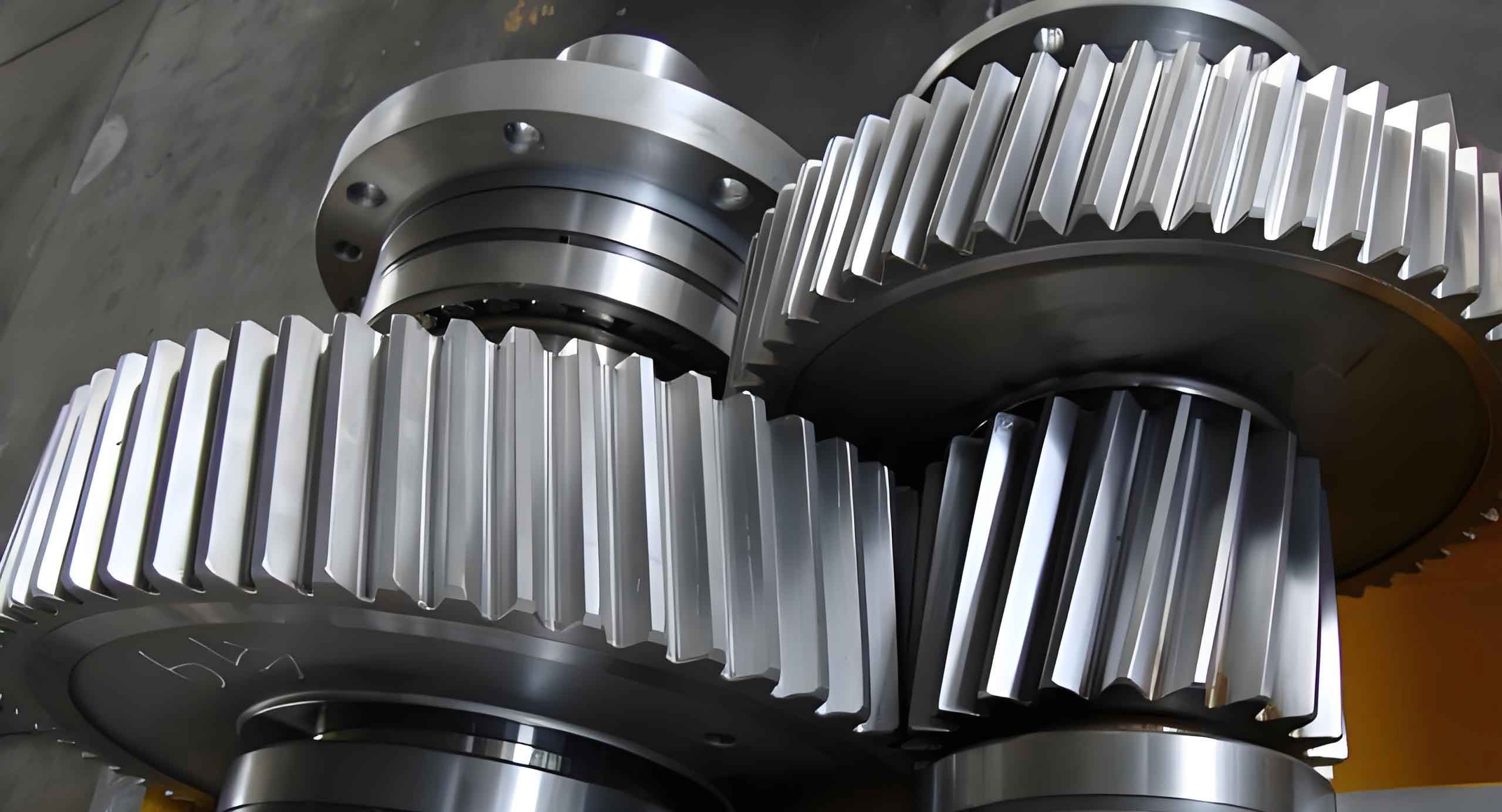
Using these parameters, a fully parametric three-dimensional solid model of the entire reducer was developed. Each component, starting with the individual helical gears, shafts, and housing, was modeled. Special attention was paid to the accurate generation of the helical gear teeth profiles. Subsequently, a virtual assembly was created, ensuring all components were mated according to their functional relationships. A critical step in this phase was performing interference checks, particularly at the meshing interfaces of the helical gear teeth, to guarantee a physically feasible assembly without geometric collisions in the initial position. The final assembled 3D CAD model served as the foundation for the dynamic simulation.
2. Data Transfer and Virtual Prototype Assembly
To perform a multi-body dynamic analysis, the 3D CAD model was transferred into a dedicated simulation environment. The process involved exporting the assembly model in the Parasolid (*.x_t) format, ensuring the file path contained no non-ASCII characters. The file extension was then changed to *.xmt_txt to facilitate a clean import. Within the multibody dynamics software, the “Import” function was used, selecting the appropriate file type and creating a new model to receive the geometry. This process translated the precise geometric data into a set of rigid bodies within the simulation workspace, accurately representing the physical components of the helical gear reducer. The imported virtual prototype model retained all the geometric relationships, forming the basis for applying physical properties and interactions.
3. Applying Physics and Defining Interactions for Dynamics Simulation
With the geometric model established, the next step was to imbue it with physical properties and kinematic constraints to create a functioning dynamic simulation.
3.1 Material Property Assignment
Each component was assigned material properties to define its mass and inertial characteristics. For the helical gears and other steel components, standard structural steel properties were applied: a density of $$\rho = 7800 \text{ kg/m}^3$$, a Young’s Modulus of $$E = 2.07 \times 10^{11} \text{ Pa}$$, and a Poisson’s ratio of $$\mu = 0.29$$. The software automatically calculated the mass, center of mass, and inertia tensor for each body based on its geometry and assigned material.
3.2 Defining Kinematic Joints and Motion Drivers
To correctly constrain the model, kinematic joints were applied. Revolute joints were placed between each gear shaft and the ground (representing the housing), allowing only rotational degrees of freedom about their respective axes. A rotational motion driver was applied to the input shaft (connected to Pinion 1). To avoid numerical instability associated with instantaneous starts, a smooth step function was used to ramp the input speed from 0 to the full operational speed of 3600 °/s (62.832 rad/s) over a short period of 0.18 seconds. The function is defined as:
$$\text{Motion}(t) = \text{STEP}(t, 0, 0, 0.18, 62.832)$$
Similarly, the load torque was applied to the output shaft (connected to Gear 6) using a step function to ensure a smooth application of the $$5.310 \times 10^6 \text{ N·mm}$$ load:
$$\text{Torque}(t) = \text{STEP}(t, 0, 0, 0.18, 5.31 \times 10^6)$$
3.3 Modeling Helical Gear Meshing with Contact Forces
The most critical aspect of the simulation was defining the interaction between meshing helical gear teeth. This was achieved by applying a contact force model between each gear pair. The contact between gear teeth was treated as a collision between two bodies with time-varying curvature, approximated using a Hertzian contact model augmented with a damping term. The generalized contact force $$F$$ is calculated as:
$$ F = K \cdot h^e + C \cdot \dot{h} $$
where:
- $$K$$ is the contact stiffness coefficient (N/mm)
- $$h$$ is the penetration depth between the contacting geometries (mm)
- $$e$$ is the force exponent (typically >1, often 1.5 for metals)
- $$C$$ is the damping coefficient (N·s/mm)
- $$\dot{h}$$ is the penetration velocity (mm/s)
The stiffness coefficient $$K$$ is derived from the Hertzian contact theory for two cylinders and depends on the material properties and the geometry at the contact point:
$$ K = \frac{4}{3} \cdot R^{\frac{1}{2}} \cdot E^* $$
where the equivalent radius $$R$$ and equivalent Young’s modulus $$E^*$$ are given by:
$$ \frac{1}{R} = \frac{1}{R_1} + \frac{1}{R_2} $$
$$ \frac{1}{E^*} = \frac{1 – \mu_1^2}{E_1} + \frac{1 – \mu_2^2}{E_2} $$
For the first stage helical gear pair (Gear 1 and 2), using the pitch radii as approximations for $$R_1$$ and $$R_2$$:
$$ R_1 = \frac{m_n \cdot z_1}{2 \cos \beta} = \frac{12 \times 21}{2 \cos 12^\circ} \approx 128.9 \text{ mm}, \quad R_2 = \frac{12 \times 51}{2 \cos 12^\circ} \approx 313.0 \text{ mm} $$
Substituting the values $$E_1 = E_2 = 2.07 \times 10^5 \text{ MPa}$$ and $$\mu_1 = \mu_2 = 0.29$$:
$$ \frac{1}{R} = \frac{1}{128.9} + \frac{1}{313.0} \approx 0.01095 \text{ mm}^{-1} \Rightarrow R \approx 91.36 \text{ mm} $$
$$ \frac{1}{E^*} = 2 \times \frac{1 – 0.29^2}{2.07 \times 10^5} \approx 8.743 \times 10^{-6} \text{ MPa}^{-1} \Rightarrow E^* \approx 1.144 \times 10^5 \text{ MPa} $$
Therefore, the contact stiffness is:
$$ K = \frac{4}{3} \times (91.36)^{\frac{1}{2}} \times (1.144 \times 10^5) \approx 2.87 \times 10^6 \text{ N/mm} $$
For the simulation, standard parameters for steel were used: a force exponent $$e = 1.5$$, a damping coefficient $$C = 50 \text{ N·s/mm}$$, and a maximum allowable penetration $$h_{max} = 0.1 \text{ mm}$$. This contact force definition was applied between each of the three helical gear pairs in the system.
4. Simulation Execution and Results Analysis
The fully constrained and loaded virtual prototype model of the helical gear reducer was simulated for a duration of 0.5 seconds with a high resolution of 2000 steps to capture dynamic transients accurately. The analysis focused on two key outputs: the rotational speeds of the shafts and the dynamic contact forces at the helical gear meshes.
4.1 Speed Analysis and Transmission Ratio Validation
The rotational speed of each shaft was measured throughout the simulation. As expected, the input speed (Pinion 1) followed the defined step function, ramping up smoothly and stabilizing at approximately 3598.2 °/s after 0.18 seconds. The speeds of the intermediate shafts (Gear2/Pinion3 and Gear4/Pinion5) and the output shaft (Gear 6) exhibited corresponding increases, eventually reaching their steady-state operational speeds.
The steady-state speeds were used to calculate the actual dynamic transmission ratios. The output shaft speed stabilized around 161.5 °/s. The achieved total transmission ratio from the simulation is:
$$ i_{sim} = \frac{\omega_{input}}{\omega_{output}} = \frac{3598.2 \text{ °/s}}{161.5 \text{ °/s}} \approx 22.280 $$
This value is in excellent agreement with the theoretical design ratio of 22.269, with a discrepancy of less than 0.05%. This close match validates the accuracy of the geometric model and the basic kinematic constraints applied to the helical gear reducer virtual prototype. The output speed showed minor oscillations around the mean value, a characteristic dynamic behavior caused by the cyclical variation of mesh stiffness and contact forces as different gear tooth pairs engage and disengage.
4.2 Dynamic Gear Mesh Force Analysis
The core of the dynamic analysis lies in understanding the forces transmitted through the helical gear teeth. The contact force algorithm computed the three-dimensional force vector at the mesh point for each gear pair. For analysis, these forces are typically resolved into three orthogonal components relative to the gear: the tangential force (Ft, responsible for transmitting torque), the radial force (Fr), and the axial force (Fa, a direct consequence of the helix angle in a helical gear).
To provide a benchmark, the theoretical static forces for the first helical gear pair were calculated. Assuming no power loss, the input torque required to overcome the output load is:
$$ T_{input} = \frac{T_{load}}{i_{total}} = \frac{5.310 \times 10^6}{22.269} \approx 2.384 \times 10^5 \text{ N·mm} $$
The tangential force on the pinion pitch circle is:
$$ F_t^{theory} = \frac{2 T_{input}}{d_1} = \frac{2 \times 2.384 \times 10^5}{m_n \cdot z_1 / \cos \beta} = \frac{4.768 \times 10^5}{12 \times 21 / \cos 12^\circ} \approx 1851 \text{ N} $$
The radial and axial forces are derived from the geometry:
$$ F_r^{theory} = F_t^{theory} \cdot \frac{\tan \alpha_n}{\cos \beta} = 1851 \cdot \frac{\tan 20^\circ}{\cos 12^\circ} \approx 689 \text{ N} $$
$$ F_a^{theory} = F_t^{theory} \cdot \tan \beta = 1851 \cdot \tan 12^\circ \approx 393 \text{ N} $$
The simulation results provided dynamic force histories. After the initial transient period (post 0.18s), the forces reached a steady-state condition characterized by a mean value with periodic fluctuations. For the first helical gear pair, the simulated mean forces were:
- Tangential Force, $$F_t^{sim} \approx 1796 \text{ N}$$
- Radial Force, $$F_r^{sim} \approx 764 \text{ N}$$
- Axial Force, $$F_a^{sim} \approx 392 \text{ N}$$
The comparison between simulation means and theoretical static calculations reveals a high degree of correlation. The relative errors are:
$$ \text{Error}(F_t) = \frac{|1796 – 1851|}{1851} \approx 3.0\% $$
$$ \text{Error}(F_r) = \frac{|764 – 689|}{689} \approx 10.9\% $$
$$ \text{Error}(F_a) = \frac{|392 – 393|}{393} \approx 0.3\% $$
The tangential and axial force matches are exceptionally good. The slightly higher discrepancy in the radial force can be attributed to the dynamic effects and the simplifying assumptions in the theoretical calculation (e.g., perfect load sharing, ignoring shaft deflections). More importantly, the simulation captured the dynamic nature of the helical gear mesh: the forces are not constant but oscillate with a frequency corresponding to the gear mesh frequency. This dynamic variation, which is impossible to obtain from a simple static analysis, represents the vibratory excitation inherent in the system and is crucial for noise, vibration, and durability assessments.
5. Conclusion and Engineering Value
The successful execution of this virtual prototyping and dynamics simulation study for a three-stage helical gear reducer demonstrates the powerful synergy between modern CAD and MBD software. The process began with a parametrically defined 3D model, which was seamlessly transferred to a dynamic analysis environment to create a fully functional virtual prototype. By applying realistic constraints, motion inputs, and—most critically—a physics-based contact force model to the helical gear meshes, the operational dynamics of the reducer were accurately replicated.
The results served a dual purpose. First, they validated the fundamental kinematic design. The achieved transmission ratio matched the theoretical value almost exactly, confirming the correctness of the gear geometry and assembly. Second, and more significantly, the simulation provided detailed, time-varying load data that is far more representative of real-world conditions than static calculations. The extraction of mean and fluctuating components of the helical gear mesh forces is invaluable. This data provides highly effective boundary load conditions for subsequent, more granular analyses, such as finite element analysis (FEA) of individual gears, shafts, or bearings for stress and fatigue life prediction. By identifying dynamic load peaks and variations, the design can be optimized for strength and durability before any metal is cut.
In summary, this virtual prototyping methodology moves beyond traditional design checks. It allows engineers to probe the dynamic performance of complex systems like multi-stage helical gear reducers under realistic operating conditions. This not only de-risks the design process and reduces dependency on physical prototypes but also enables a deeper understanding of system behavior, leading to more robust, reliable, and optimized mechanical designs.