
This study explores advanced precision forging techniques for spur gears to reduce forming loads, enhance mold lifespan, and improve material utilization. Through DEFORM-3D simulations and experimental validation, we analyze the effectiveness of floating die and hole split methods compared to conventional closed-die forging.
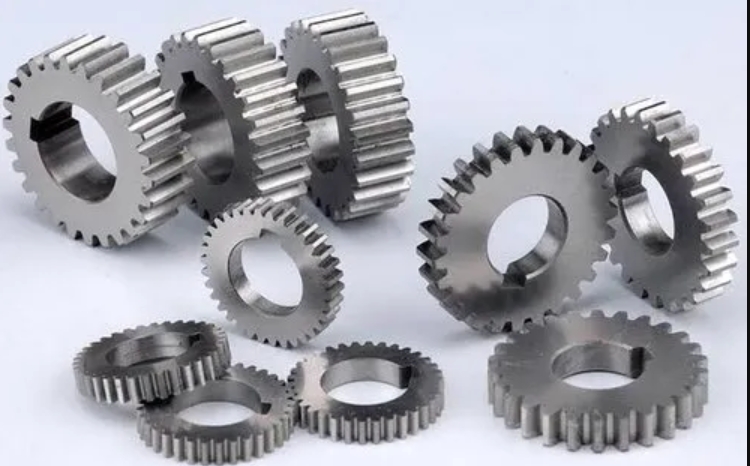
1. Process Design and Numerical Modeling
The spur gear (modulus: 3, teeth: 20, pressure angle: 20°) was modeled using a 1/5 symmetric segment to optimize computational efficiency. Three process configurations were investigated:
| Process | Characteristics | Workpiece Geometry |
|---|---|---|
| Conventional Closed-Die | Fixed die structure | Cylindrical billet (Φ60×30 mm) |
| Floating Die | Spring-assisted movable die | Cylindrical billet (Φ60×30 mm) |
| Hole Split | Central material diversion | Annular billet (Φ60/Φ19×30 mm) |
The material properties of 20CrMnMo steel are critical for accurate simulation:
$$ \sigma_y = 958\ \text{MPa},\ \sigma_{UTS} = 1250\ \text{MPa},\ E = 207\ \text{GPa} $$
| Parameter | Value |
|---|---|
| Yield Strength | 958 MPa |
| Elastic Modulus | 207 GPa |
| Poisson’s Ratio | 0.27 |
| Friction Factor (m) | 0.1 |
2. Formulation of Key Parameters
The equivalent stress distribution during spur gear forging follows the Hollomon power law:
$$ \bar{\sigma} = K\bar{\epsilon}^n $$
where \( K = 1250\ \text{MPa} \) (strength coefficient) and \( n = 0.15 \) (strain hardening exponent) for 20CrMnMo at forging temperatures. The forming load progression can be modeled as:
$$ F(t) = F_0 + \alpha A(t)\bar{\sigma}(t) $$
where \( \alpha \) represents the geometric constraint factor varying from 2.5 to 4.0 during different forming stages.
3. Simulation Results Analysis
The stress evolution and load characteristics reveal distinct advantages of the improved processes:
| Process | Peak Load (kN) | Max Equivalent Stress (MPa) | Die Life Improvement |
|---|---|---|---|
| Conventional | 778 | 921 | Baseline |
| Floating Die | 705 | 890 | +10% |
| Hole Split | 589 | 840 | +25% |
The floating die mechanism converts counterproductive friction into beneficial material flow through controlled die movement:
$$ F_{friction} = \begin{cases}
-\mu p & \text{(Conventional)} \\
+\mu p & \text{(Floating Die)}
\end{cases} $$
where \( \mu \) is the friction coefficient and \( p \) represents interface pressure. This reversal reduces required forming energy by 10-12%.
4. Process Optimization Strategies
For hole split designs, the central aperture diameter (\( d \)) must satisfy:
$$ 0.32D \leq d \leq 0.37D $$
$$ (19\ \text{mm} \leq d \leq 22\ \text{mm}\ \text{for}\ D=60\ \text{mm}) $$
Material flow partitioning between radial tooth filling and axial hole expansion follows:
$$ \frac{V_{tooth}}{V_{hole}} = \frac{\pi h(R^2 – r^2)}{\pi r_h^2 h} = \frac{R^2 – r^2}{r_h^2} $$
where \( R \) = gear radius, \( r \) = hole radius, and \( h \) = gear height. Optimal balance occurs when 65-70% of material flows radially for tooth formation.
5. Experimental Validation
Physical trials confirmed simulation accuracy with <10% deviation in forming loads. The floating die process demonstrated superior surface finish due to enhanced material flow patterns, while the hole split method achieved 22.8% energy reduction compared to conventional spur gear forging.
| Performance Metric | Floating Die | Hole Split |
|---|---|---|
| Tooth Fill Completeness | 98.7% | 97.2% |
| Surface Roughness Ra (μm) | 3.2 | 4.1 |
| Tool Wear Rate | 0.12 mm/1000pcs | 0.09 mm/1000pcs |
These advancements in spur gear manufacturing enable higher production rates while maintaining dimensional accuracy within ISO 1328 Class 7 specifications. The combination of numerical simulation and process innovation provides a robust framework for complex gear forging optimization.