
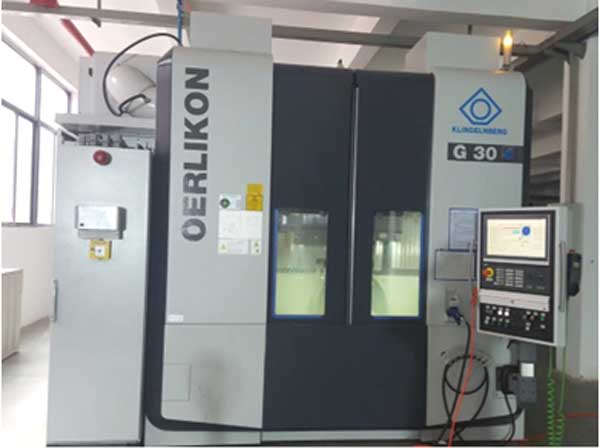
Spiral bevel gears are critical for high-precision power transmission in aerospace, automotive, and industrial machinery. Traditional horizontal gear milling machines face rigidity and chip evacuation limitations during high-speed dry cutting. The vertical configuration—where the tool spindle mounts perpendicularly on a column and the workpiece spindle remains horizontal—offers enhanced structural stiffness and improved chip flow. This research establishes a mathematical foundation for tool-workpiece motion control in vertical gear milling, develops in-machine measurement protocols, and implements a dedicated CNC software suite for Siemens 840Dsl, enabling closed-loop manufacturing.
Coordinate Control Method for Gear Milling
The kinematic transformation from mechanical to CNC vertical gear milling requires modeling relative tool-workpiece motion. For face hobbing or face milling, the cutter axis \(\mathbf{V}_c\) and workpiece axis \(\mathbf{V}_p\) in the machine coordinate system \(\Sigma_s\) are defined as:
$$ \mathbf{V}_c = \mathbf{M}(-\theta_t) \mathbf{M}(j_0) \mathbf{M}(i_0) \mathbf{k}, \quad \mathbf{V}_p = [\cos\Gamma, 0, \sin\Gamma]^T $$
where \(\theta_t\) is the cradle angle, \(i_0\) and \(j_0\) are basic blade inclination and direction angles, and \(\Gamma\) is the root angle. The vector from the workpiece apex to the cutter center \(\mathbf{V}_{ls}\) is:
$$ \mathbf{V}_{ls} = \mathbf{V}_p X_p – \mathbf{k} X_b + \mathbf{j} E_m + \mathbf{V}_{qt} S $$
Here, \(X_p\), \(X_b\), \(E_m\), and \(S\) denote horizontal offset, machine center to back, vertical offset, and radial distance, respectively. To align \(\mathbf{V}_c\) with the vertical Z-axis of the CNC machine, rotation angles \(dA\) and \(dB\) are computed:
$$ dA = \tan^{-1}\left(\frac{V_{cj}}{V_{ct}}\right), \quad dB = \frac{\pi}{2} – \varphi – \Gamma $$
where \(\varphi = \cos^{-1}(\mathbf{V}_c \cdot \mathbf{V}_p)\). The transformed axis coordinates \((X, Y, Z, A, B)\) for vertical gear milling are:
$$
\begin{cases}
X = – \mathbf{V}_{ls} \cdot \mathbf{i}_s \\
Y = \mathbf{V}_{ls} \cdot \mathbf{j}_s \\
Z = – \mathbf{V}_{ls} \cdot \mathbf{k}_s + R_d + C_t \\
A = -\theta_t – \theta_s – dA \\
B = \Gamma + dB
\end{cases}
$$
Conjugate contact points are derived using the meshing equation \(\mathbf{v}_{12} \cdot \mathbf{n} = 0\), where \(\mathbf{v}_{12}\) is relative velocity and \(\mathbf{n}\) is the surface normal. The tooth surface \(\mathbf{R}\) is parameterized as:
$$ \mathbf{R} = f(r_b, X_b, X_p, E_m, S, R_a, i_0, j_0, \theta_t) $$
Measurement Method for Gear Milling Machine
In-machine measurement uses a touch-trigger probe (e.g., Renishaw LP2) mounted near the tool spindle. Probe center coordinates \(\mathbf{V}_m\) in machine frame \(\Sigma_H\) are calibrated using a master ring:
| Axis | Calibration Equations |
|---|---|
| X | \(L_x = X_1 + x_{cm} = X_2 + x_{cm}, \quad x_{cm} = \frac{X_1 + X_2}{2}\) |
| Y | \(L_y = Y_1 + y_{cm} = Y_2 + y_{cm}, \quad y_{cm} = \frac{Y_1 + Y_2}{2}\) |
| Z | \(z_{cm} = D + F + r_m – Z_c\) |
Gear errors are evaluated per ISO 17485. Pitch deviation \(\Delta f_{pt}\) and cumulative pitch error \(F_p\) are calculated from angular positions \(\theta_A\) recorded during probing:
$$ \Delta f_{pt}(i) = \theta_A(i) \cdot r_p – \frac{360^\circ}{n}, \quad F_p = \max[\Delta F_{p}(i)] – \min[\Delta F_{p}(i)] $$
Profile deviation \(\delta\) is computed by projecting measured points \(\mathbf{R}_g\) onto the theoretical tooth normal \(\mathbf{n}\):
$$ \delta = (\mathbf{R}_g – \mathbf{R}_0) \cdot \mathbf{n}, \quad \mathbf{n} = \frac{\partial \mathbf{R}}{\partial u} \times \frac{\partial \mathbf{R}}{\partial v} $$
For error compensation, \(\delta\) is parameterized via a cubic polynomial in a local coordinate system \((X,Y)\) at the contact reference point:
$$ \delta(X,Y) = c_1 + c_2X + c_3Y + c_4X^2 + c_5XY + c_6Y^2 + \cdots $$
Machine setting corrections \(\Delta \mathbf{x} = [\Delta X_b, \Delta X_p, \Delta S, \ldots]^T\) are optimized by minimizing the objective function:
$$ \min_{\Delta \mathbf{x}} F = \frac{1}{2} \sum_{j=1}^{m+k} \omega_j \left( c_j(\Delta \mathbf{x}) – c_j^* \right)^2 $$
where \(c_j^*\) are target coefficients from the measured deviation surface.
Software Development
The CNC software architecture integrates motion control, measurement, and error compensation. Key modules include:
| Module | Function | Implementation |
|---|---|---|
| Motion Control | Generates NC code for cutting/measurement | C++ DLL with Siemens CPP-API |
| Measurement | Probe path planning & data acquisition | R-parameter monitoring via DataSvc |
| Error Compensation | Adjusts machine settings using \(\Delta \mathbf{x}\) | Levenberg-Marquardt optimization |
| HMI | Real-time monitoring & parameter input | MFC with BCGControlBar |
Siemens 840Dsl communication uses:
- DataSvc: Reads/writes R-parameters (e.g., axis positions).
- AlarmSvc: Monitors system alarms.
- FileSvc: Exports measurement data.
NC code generation for face hobbing involves linear interpolation of cradle angles. For profile measurement, probe paths follow offset surfaces \(\mathbf{R}_I\) and \(\mathbf{R}_J\):
$$ \mathbf{R}_I = \mathbf{R} + \mathbf{n} \cdot r_m, \quad \mathbf{R}_J = \mathbf{R} – \mathbf{n} \cdot r_m $$
Simulation and Experiment
A virtual gear milling platform validated the algorithms. A spiral bevel gear set (7×43 teeth) was machined in simulation using calculated NC code. Post-machining measurement errors were under 2.5 µm, confirming path accuracy. Physical validation used a YKH2235 horizontal machine and a 3906 gear measuring center. Initial profile errors reached -26.6 µm (pinion) and -20.8 µm (gear). After compensation, errors reduced to 8.2 µm and 12.5 µm, respectively. Contact patterns aligned with theoretical predictions:
| Parameter | Initial (µm) | Compensated (µm) |
|---|---|---|
| Max Profile Error (Pinion) | -20.8 | 8.2 |
| Max Profile Error (Gear) | 26.6 | 12.5 |
| Cumulative Pitch Error | 38.4 | 14.7 |
This demonstrates the efficacy of closed-loop vertical gear milling for precision manufacturing.