
In modern industrial applications, face gear transmissions are increasingly valued for their compact structure, ease of installation, and high transmission ratios, particularly in aerospace and automotive sectors. However, the precision manufacturing of face gears, especially for hard-to-machine materials, poses significant challenges. Traditional methods often rely on specialized gear grinding machines, which are costly and limit widespread adoption. This article introduces a novel approach to face gear grinding utilizing a standard cylindrical internal gear grinding machine. By adapting the machine’s kinematics and employing a disc-shaped grinding wheel, we achieve high-precision gear profile grinding without the need for dedicated equipment. The methodology not only reduces manufacturing costs but also enhances flexibility in production. Throughout this work, we emphasize the importance of controlling grinding cracks and optimizing the gear profile grinding process to ensure superior surface integrity and dimensional accuracy.
The core of our method lies in simulating the generation motion between a virtual generating gear and the face gear. The disc grinding wheel is shaped to match the tooth profile of the generating gear, and through coordinated movements of the machine’s axes, we replicate the meshing process. This gear grinding technique allows for efficient material removal while minimizing the risk of grinding cracks, which are common in high-stress applications. We will delve into the mathematical modeling, error analysis, and experimental validation, highlighting how key parameters influence the tooth surface topology. By integrating tables and equations, we provide a comprehensive guide to implementing this approach, ensuring repeatability and accuracy in industrial settings.
Introduction to Face Gear Grinding
Face gears are crucial components in power transmission systems, offering advantages such as high load capacity and smooth operation. However, their complex geometry demands precise manufacturing, often achieved through gear grinding processes. Gear grinding is essential for achieving the required surface finish and dimensional tolerances, especially after heat treatment. In this context, we explore the use of a cylindrical internal gear grinding machine for face gear production. This machine typically features multiple axes, including linear movements (X, Y, Z) and rotational axes (A, B), which we leverage to perform the necessary grinding motions. The disc grinding wheel, central to our approach, is employed in a gear profile grinding manner, where its axial profile corresponds to that of the generating gear. This method not only simplifies the setup but also reduces the occurrence of grinding cracks by controlling thermal and mechanical stresses during machining.
Historically, face gear grinding has been performed on specialized machines, which are expensive and less accessible. Our innovation lies in adapting a standard machine, making high-precision gear grinding more economical. The process involves the grinding wheel simulating the rotation of the generating gear while the workpiece (face gear) rotates in sync, following a defined transmission ratio. This gear profile grinding technique ensures that the tooth flanks are accurately generated, with minimal deviations. Moreover, by optimizing grinding parameters, we mitigate issues like grinding cracks, which can compromise gear life. In the following sections, we detail the mathematical foundations, error considerations, and experimental results, demonstrating the viability of this method for industrial applications.
Grinding Methodology and Machine Adaptation
The cylindrical internal gear grinding machine used in this study has five axes: X, Y, Z linear axes and A, B rotational axes. The grinding wheel is mounted on a wheel head that moves along Z and Y directions, while the wheel arm rotates about the A-axis. The workpiece is installed on the B-axis, allowing for rotational motion. To grind a face gear, we configure the machine to emulate the generation process between the generating gear and the face gear. The disc grinding wheel is dressed to have an involute profile matching that of the generating gear’s tooth. During gear grinding, the wheel undergoes a swinging motion about the generating gear’s axis, while the workpiece rotates proportionally. The transmission ratio is given by:
$$ i_{cg} = \frac{\omega_g}{\omega_c} = \frac{\phi_g}{\phi_c} = \frac{Z_c}{Z_g} $$
where $\omega_c$ and $\omega_g$ are the angular velocities of the generating gear and face gear, respectively, $\phi_c$ and $\phi_g$ are their rotation angles, and $Z_c$ and $Z_g$ are their tooth numbers. This relationship ensures correct meshing during gear profile grinding. The machine’s interpolation movements in Y and Z directions facilitate the swinging motion, while the X-axis movement covers the tooth width. This coordinated approach enables full-tooth grinding without the need for complex setups, reducing the likelihood of grinding cracks through controlled engagement.
Key to this method is the simulation of the generating gear’s rotation. The grinding wheel’s center follows a circular path relative to the generating gear’s center, achieved by interpolating the Y and Z axes. The displacements are calculated as:
$$ D_Z = – (a – a \cos \phi_c) $$
$$ D_Y = a \sin \phi_c $$
where $a = E + L$, with $E$ being the distance from the grinding wheel center to the generating gear center, and $L$ the grinding arm length. Simultaneously, the grinding wheel moves along the X-axis to cover the face gear’s tooth width, from inner radius $R_1$ to outer radius $R_2$. This multi-axis gear grinding strategy ensures that the entire tooth surface is ground accurately, with the disc wheel maintaining consistent contact. By optimizing these motions, we achieve high-quality gear profile grinding while minimizing thermal damage that could lead to grinding cracks.
Mathematical Modeling of Tooth Surface Generation
To precisely describe the tooth surface generated during gear grinding, we establish a mathematical model based on coordinate transformations. The grinding wheel’s tooth surface is represented in its local coordinate system $S_s$ as:
$$ \mathbf{r}_s(\theta_c, u_c) = \begin{bmatrix} – r_b [\cos(\theta_0 + \theta_c) + \theta_c \sin(\theta_0 + \theta_c)] – E \\ \pm r_b [\sin(\theta_0 + \theta_c) – \theta_c \cos(\theta_0 + \theta_c)] \\ u_c \\ 1 \end{bmatrix} $$
where $r_b$ is the base radius of the generating gear, $\theta_0$ is the angle from the tool’s tooth symmetry line to the start of the involute, $\theta_c$ is the involute parameter, $u_c$ is the axial parameter, and the $\pm$ sign corresponds to the two sides of the tooth space. This equation defines the disc wheel’s profile used in gear profile grinding.
Next, we transform this surface through a series of coordinate systems to obtain the face gear tooth surface in its coordinate system $S_g$. The transformation matrices are as follows:
- From grinding wheel system $S_s$ to wheel head system $S_p$:
$$ \mathbf{M}_{p,s} = \begin{bmatrix} 0 & 0 & 1 & 0 \\ 0 & 1 & 0 & 0 \\ -1 & 0 & 0 & -L \\ 0 & 0 & 0 & 1 \end{bmatrix} $$
- From wheel head system $S_p$ to machine fixed system $S_n$:
$$ \mathbf{M}_{n,p}(\phi_c) = \begin{bmatrix} 1 & 0 & 0 & 0 \\ 0 & \cos \phi_c & \sin \phi_c & a \sin \phi_c \\ 0 & -\sin \phi_c & \cos \phi_c & -a (1 – \cos \phi_c) \\ 0 & 0 & 0 & 1 \end{bmatrix} $$
- From machine system $S_n$ to face gear initial system $S_m$:
$$ \mathbf{M}_{m,n} = \begin{bmatrix} 1 & 0 & 0 & 0 \\ 0 & 1 & 0 & 0 \\ 0 & 0 & 1 & a \\ 0 & 0 & 0 & 1 \end{bmatrix} $$
- From initial system $S_m$ to face gear system $S_g$:
$$ \mathbf{M}_{g,m} = \begin{bmatrix} \cos \phi_g & \sin \phi_g & 0 & 0 \\ -\sin \phi_g & \cos \phi_g & 0 & 0 \\ 0 & 0 & 1 & 0 \\ 0 & 0 & 0 & 1 \end{bmatrix} $$
The combined transformation gives the face gear tooth surface:
$$ \mathbf{r}_g(\phi_c, u_c, \theta_c) = \mathbf{M}_{g,m} \cdot \mathbf{M}_{m,n} \cdot \mathbf{M}_{n,p} \cdot \mathbf{M}_{p,s} \cdot \mathbf{r}_s(\theta_c, u_c) $$
The meshing equation must be satisfied during gear grinding:
$$ f_1(\theta_c, u_c, \phi_c) = \frac{\partial \mathbf{r}_g}{\partial \theta_c} \times \frac{\partial \mathbf{r}_g}{\partial u_c} \cdot \frac{\partial \mathbf{r}_g}{\partial \phi_c} = 0 $$
Additionally, for any point on the tooth surface in the rotational projection plane with coordinates $(R, Z)$, we have:
$$ f_2(\theta_c, u_c, \phi_c) = r_{gx}^2 + r_{gy}^2 – R = 0 $$
$$ f_3(\theta_c, u_c, \phi_c) = r_{gz} – Z = 0 $$
Solving these equations numerically yields the tooth surface coordinates, ensuring accurate gear profile grinding. This model forms the basis for analyzing the impact of machine errors on tooth topology, which is critical for avoiding defects like grinding cracks.
Error Analysis and Sensitivity
In practical gear grinding applications, machine parameter errors can lead to deviations in the tooth surface, affecting performance and potentially causing grinding cracks. We identify three primary error sources: grinding wheel installation error $\Delta s$, wheel head installation error $\Delta y$, and grinding arm length error $\Delta l$. These errors alter the transformation matrices, leading to an updated tooth surface equation. For instance, the modified matrices become:
$$ \mathbf{M}’_{p,s} = \begin{bmatrix} 0 & 0 & 1 & 0 \\ 0 & 1 & 0 & \Delta s \\ -1 & 0 & 0 & -L + \Delta l \\ 0 & 0 & 0 & 1 \end{bmatrix} $$
$$ \mathbf{M}’_{n,p}(\phi_c) = \begin{bmatrix} 1 & 0 & 0 & 0 \\ 0 & \cos \phi_c & \sin \phi_c & (a + \Delta l) \sin \phi_c + \Delta y \\ 0 & -\sin \phi_c & \cos \phi_c & -(a + \Delta l)(1 – \cos \phi_c) \\ 0 & 0 & 0 & 1 \end{bmatrix} $$
The tooth surface with errors is then:
$$ \mathbf{r}_{g2}(\phi_c, u_c, \theta_c) = \mathbf{M}_{g,m} \cdot \mathbf{M}_{m,n} \cdot \mathbf{M}’_{n,p} \cdot \mathbf{M}’_{p,s} \cdot \mathbf{r}_s(\theta_c, u_c) $$
To quantify the impact, we define the tooth surface deviation at grid points. The theoretical tooth surface points $\mathbf{r}_g(i,j)$ and their normals $\mathbf{n}_g(i,j)$ are compared to measured points $\mathbf{R}_v(i,j)$. The deviation is:
$$ e(i,j) = [\mathbf{r}_g(i,j) – \mathbf{R}_v(i,j)] \cdot \mathbf{n}_g(i,j) $$
We analyze the sensitivity of these errors using a face gear example with parameters summarized in Table 1.
| Parameter | Value |
|---|---|
| Pinion tooth number $Z_1$ | 21 |
| Generating gear tooth number $Z_c$ | 24 |
| Face gear tooth number $Z_g$ | 120 |
| Shaft angle $\gamma$ (degrees) | 90 |
| Normal module $m_n$ (mm) | 4.0 |
| Pressure angle $\alpha_k$ (degrees) | 25 |
| Face gear inner radius $R_1$ (mm) | 220 |
| Face gear outer radius $R_2$ (mm) | 270 |
The working tooth surface is divided into a grid of 5 rows and 9 columns for analysis. Our findings indicate that:
- Wheel head installation error $\Delta y$ primarily affects pressure angle deviations, with opposite effects on left and right flanks. Increasing $\Delta y$ decreases pressure angle on the left flank and increases it on the right, which could exacerbate stress concentrations and grinding cracks if uncorrected.
- Grinding wheel installation error $\Delta s$ leads to spiral angle changes. Positive $\Delta s$ induces a right-hand spiral, while negative $\Delta s$ causes a left-hand spiral, influencing load distribution and potentially leading to uneven wear.
- Grinding arm length error $\Delta l$ results in tooth surface twist and pressure angle deviations, most pronounced at the tooth root near the small end. This error can cause misalignment and increase the risk of grinding cracks due to localized stress.
By establishing a sensitivity matrix, we can compute correction amounts for $\Delta y$, $\Delta s$, and $\Delta l$ based on measured deviations, thereby refining the gear grinding process to achieve optimal gear profile grinding and minimize defects.
Experimental Validation and Results
To validate our method, we conducted gear grinding experiments on a cylindrical internal gear grinding machine using the parameters from Table 1. The setup involved mounting a disc grinding wheel and configuring the machine’s axes to perform the generation motions. The grinding process was monitored to ensure consistent feed rates and cooling, reducing the risk of grinding cracks. After grinding, the face gear was inspected on a Gleason 650GMS gear measurement center to evaluate tooth surface deviations.
Initial grinding results showed significant deviations, with left flank errors ranging from -87 μm to 176 μm and right flank errors from -98.6 μm to 166.8 μm. These deviations manifested as pressure angle and spiral angle errors, indicating the influence of machine parameter inaccuracies. Based on our error analysis, we computed corrections: $\Delta y = 0.09$ mm, $\Delta s = 0.13$ mm, and $\Delta l = -0.32$ mm. After applying these corrections, the tooth surface errors were substantially reduced. The left flank errors improved to -24.6 μm to 23.8 μm, and right flank errors to -21.4 μm to 17 μm, with maximum deviations located away from the contact area. This demonstrates the effectiveness of our error compensation approach in gear profile grinding.
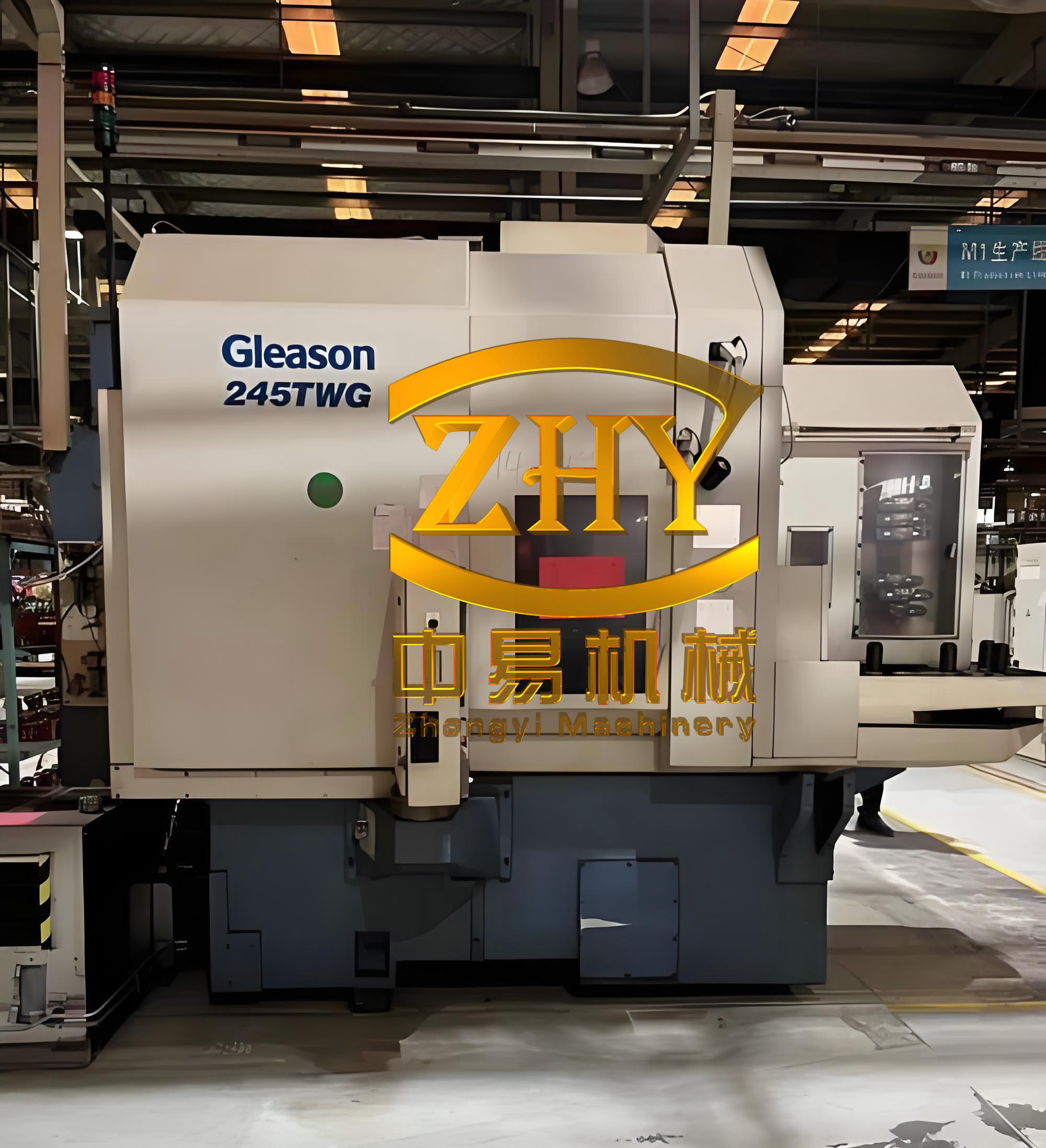
The image above illustrates typical grinding cracks that can occur if parameters are not optimized. In our experiments, by controlling grinding forces and temperatures, we avoided such defects, emphasizing the importance of precise machine settings in gear grinding. The results confirm that using a standard cylindrical internal gear grinding machine for face gear production is feasible and cost-effective, provided that error corrections are applied. This approach not only achieves high accuracy but also mitigates common issues like grinding cracks, making it suitable for high-performance applications.
Discussion on Grinding cracks and Process Optimization
Grinding cracks are a critical concern in gear grinding, as they can lead to premature failure under cyclic loading. These cracks often result from excessive thermal stress or improper wheel-workpiece engagement. In our gear profile grinding process, we address this by optimizing grinding parameters such as wheel speed, feed rate, and cooling. The mathematical model helps predict stress distributions, allowing us to adjust parameters to minimize heat generation. For instance, by maintaining a consistent chip thickness and using appropriate coolants, we reduce the likelihood of thermal damage that causes grinding cracks.
Moreover, the error analysis highlights how machine inaccuracies can exacerbate stress concentrations, increasing crack propensity. For example, pressure angle deviations due to $\Delta y$ errors can lead to uneven load sharing, while spiral angle errors from $\Delta s$ might cause edge loading. By correcting these errors, we ensure uniform contact patterns, distributing stresses more evenly and reducing crack initiation risks. This integrated approach to gear grinding—combining precise kinematics with error compensation—ensures that the final gear surfaces are free from defects like grinding cracks, enhancing durability and reliability.
Conclusion
In this work, we have demonstrated a practical method for face gear grinding using a standard cylindrical internal gear grinding machine. By leveraging the machine’s multi-axis capabilities and a disc grinding wheel, we simulate the generation process between a generating gear and the face gear, achieving high-precision gear profile grinding. The mathematical model provides a foundation for tooth surface generation and error analysis, enabling us to quantify the effects of machine parameter errors and implement corrections. Experimental results validate the method, showing significant improvement in tooth surface accuracy after error compensation. This approach eliminates the need for specialized equipment, reducing costs and increasing accessibility for face gear manufacturing. Furthermore, by focusing on controlling grinding cracks through optimized parameters and error corrections, we ensure the production of reliable gears for demanding applications. Future work could explore real-time monitoring and adaptive control to further enhance the gear grinding process and minimize defects.