
In the production of automotive transmission systems, the output shaft plays a critical role in transmitting power from the gearbox to the drive wheels. As a key component, its precision directly impacts the overall performance, noise levels, and longevity of the transmission. One of the most critical manufacturing steps for these shafts is the gear grinding process, which ensures high accuracy and surface quality of the gear teeth. However, during the initial trial production of a specific output shaft with 22 teeth, we encountered significant challenges related to dimensional deviations. The original gear grinding process, which involved clamping one end on the outer diameter and supporting the other end with a center, led to excessive tooth profile inclination deviation (fHα), helix inclination deviation (fHβ), and radial runout (Fr). These issues not only affected the product quality but also raised concerns about the reliability of the grinding process in mass production. This article details our comprehensive approach to optimizing the gear grinding process by redesigning the clamping method to a two-center support system, thereby addressing these deviations and ensuring consistent batch production.
The importance of gear grinding in modern automotive manufacturing cannot be overstated. It is a precision machining technique used to achieve tight tolerances and superior surface finishes on gear teeth after heat treatment. Processes such as gear profile grinding are essential for enhancing wear resistance, reducing friction losses, and increasing the load-bearing capacity of tooth surfaces and roots. In our case, the output shaft is made from high-quality low-carbon alloy steel, specifically 22CrMoH, with a module of 3.5, a reference diameter of approximately 81.942 mm, and a tooth width of 45 mm. The required accuracy level is Grade 6, with additional customer-specific internal controls: the difference between the maximum and minimum values of fHα (denoted as fsα) should not exceed 5 μm, the difference for fHβ (fsβ) should be within 6 μm, and the radial runout Fr must be less than or equal to 0.012 mm. These stringent requirements highlight the need for a robust and precise gear grinding process to prevent issues like grinding cracks, which can compromise the integrity of the gear teeth under operational stresses.
Initially, we adopted a clamping method where one end of the shaft was held by an elastic collet on the ϕ40 mm outer diameter, and the other end was supported by a center. This approach was chosen based on the functional requirements of the shaft, as the ϕ35 mm outer diameter is used for bearing installation and support within the transmission housing. However, during trial production, this method resulted in inconsistent quality. For instance, the fsα values ranged from 3.2 to 7.3 μm, with a batch variation Δfsα of 4.1 μm, exceeding the internal control limit of 5 μm. Similarly, fsβ values varied between 3.3 and 6.8 μm (Δfsβ = 3.5 μm), and Fr values were between 10.7 and 16 μm (ΔFr = 5.3 μm), indicating significant deviations. These problems were primarily attributed to a misalignment in the machining datum. The finishing process for the ϕ35 mm outer diameter used a two-center clamping method, whereas the gear grinding employed a one-clamp-one-center approach, leading to datum inconsistency and accumulated errors. This inconsistency can exacerbate issues like grinding cracks due to uneven stress distribution during the grinding process.
To address these challenges, we focused on optimizing the gear grinding process by redesigning the clamping system to a two-center support method. This change aimed to unify the machining datum with the previous operations, thereby minimizing errors. The new fixture design consists of an upper center installed in the machine’s tailstock, a positioning base mounted on the worktable, a centering expansion sleeve, a lower center, a connecting sleeve, a guide tube, and a pull rod. The working principle involves the upper center engaging with the shaft’s center hole, while the centering expansion sleeve, connected via the pull rod to the machine’s hydraulic system, provides radial positioning. The lower center and positioning base ensure axial and radial alignment, with the entire assembly facilitating precise and stable clamping during the gear grinding operation. This setup enhances the rigidity of the system, reducing vibrations that could lead to grinding cracks and improving the overall accuracy of the gear profile grinding process.
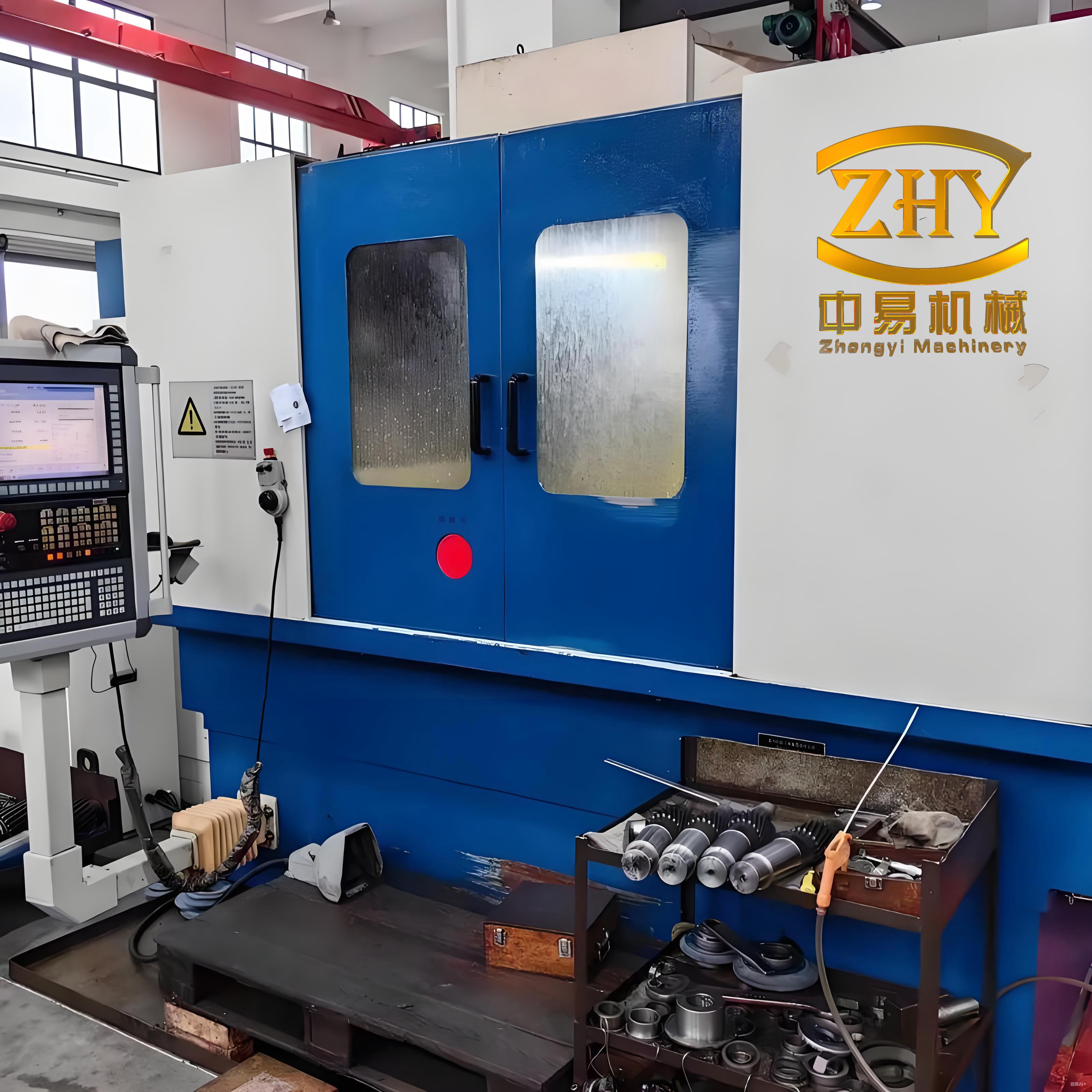
The gear grinding was performed on a Liebherr LGG280 CNC gear grinding machine, which supports both generating and form grinding methods. For the grinding wheel, we selected a TYROLIT 12KS901G8VM1 model, chosen for its optimal abrasive properties, grain size, and linear speed compatibility with the material. The automatic loading and unloading system was designed to handle the shaft by the gear tip circle (ϕ88.68 mm), the ϕ42 mm outer diameter, and the small end face of the gear, ensuring efficient and accurate positioning. The mathematical representation of the deviations can be expressed using the following equations to quantify the tooth profile and helix errors:
$$ f_{H\alpha} = \frac{1}{n} \sum_{i=1}^{n} |\alpha_i – \bar{\alpha}| $$
$$ f_{H\beta} = \frac{1}{n} \sum_{i=1}^{n} |\beta_i – \bar{\beta}| $$
where αi and βi represent the individual profile and helix angle measurements, and $\bar{\alpha}$ and $\bar{\beta}$ are their respective mean values. The radial runout Fr is defined as the maximum deviation of the tooth space from the theoretical position relative to the axis of rotation. By optimizing the clamping method, we aimed to reduce these deviations significantly.
After implementing the two-center clamping system, we conducted a series of tests on five sample shafts to evaluate the effectiveness of the optimization. The results were measured using a gear testing center, and the data is summarized in the table below. This table compares the key parameters between the original one-clamp-one-center method and the optimized two-center method, highlighting the improvements in consistency and accuracy.
| Parameter | Original Method (One-Clamp-One-Center) | Optimized Method (Two-Center) | Reduction | Reduction Percentage |
|---|---|---|---|---|
| Max fsα (μm) | 7.3 | 2.4 | 4.9 | 56.10% |
| Max fsβ (μm) | 6.8 | 2.5 | 4.3 | 80% |
| Max Fr (μm) | 16 | 7.4 | 8.6 | 28.30% |
| Batch Δfsα (μm) | 4.1 | 1.8 | 2.3 | 56.10% |
| Batch Δfsβ (μm) | 3.5 | 0.7 | 2.8 | 80% |
| Batch ΔFr (μm) | 5.3 | 3.8 | 1.5 | 28.30% |
The data clearly demonstrates the superiority of the optimized gear grinding process. For instance, the maximum fsα decreased from 7.3 μm to 2.4 μm, a reduction of 56.10%, while the maximum fsβ dropped from 6.8 μm to 2.5 μm, an 80% improvement. Similarly, the maximum Fr was reduced from 16 μm to 7.4 μm, a 28.30% enhancement. These improvements not only meet the internal control requirements but also ensure the stability of the gear grinding process in mass production. The reduction in deviations minimizes the risk of grinding cracks, which are often caused by thermal and mechanical stresses during improper grinding operations. By maintaining a consistent datum and enhancing clamping rigidity, the optimized process mitigates such defects, leading to higher product reliability.
Further analysis of the gear grinding process involves understanding the relationship between clamping forces and resultant errors. The tooth profile errors can be modeled using a linear regression approach, where the total error E is a function of clamping force F, grinding wheel speed S, and feed rate R:
$$ E = k_1 \cdot F + k_2 \cdot S + k_3 \cdot R + C $$
where k1, k2, and k3 are coefficients determined experimentally, and C is a constant. In our case, by switching to the two-center method, the effective clamping force is distributed more evenly, reducing the coefficient k1 associated with force-induced errors. This aligns with the principles of gear profile grinding, where uniform support is crucial for achieving accurate tooth geometries. Additionally, the optimization reduces the cumulative effect of errors, as expressed by the standard deviation σ of the deviations across multiple teeth:
$$ \sigma = \sqrt{\frac{1}{N} \sum_{j=1}^{N} (x_j – \mu)^2} $$
where xj represents individual measurements (e.g., fHα or fHβ), μ is the mean, and N is the number of samples. The lower σ values in the optimized process indicate better consistency, which is vital for preventing localized stress concentrations that could lead to grinding cracks.
In practice, the gear grinding process parameters were fine-tuned to complement the new clamping system. The grinding wheel speed was maintained at an optimal range to balance material removal rate and surface integrity, while the feed rate was adjusted to minimize heat generation—a common cause of grinding cracks. The following table summarizes the key grinding parameters used in the optimized process, illustrating how they contribute to the improved outcomes.
| Parameter | Value | Description |
|---|---|---|
| Grinding Wheel Type | TYROLIT 12KS901G8VM1 | Selected for high abrasion resistance and fine grain size |
| Wheel Speed (m/s) | 35-40 | Optimized to reduce thermal damage and grinding cracks |
| Feed Rate (mm/min) | 50-100 | Controlled to ensure precise material removal in gear profile grinding |
| Clamping Force (N) | 500-700 | Evenly distributed in two-center system to minimize deformations |
| Coolant Flow Rate (L/min) | 20-30 | Maintained to dissipate heat and prevent grinding cracks |
The implementation of this optimized gear grinding process has enabled us to achieve a 100% qualification rate in batch production, with all samples meeting the internal control standards. The two-center clamping method not only resolves the initial deviation issues but also enhances the overall efficiency of the grinding operation. For example, the automatic loading system, integrated with the new fixture, reduces setup time and improves repeatability. This is particularly important in high-volume production environments, where consistency and speed are paramount. Moreover, the reduction in deviations contributes to lower noise levels and higher durability of the transmission system, as the gear teeth engage more smoothly without excessive stress concentrations.
In conclusion, the optimization of the gear grinding process for the automotive transmission output shaft through the adoption of a two-center clamping system has proven highly effective. By addressing the root cause of datum inconsistency, we have significantly reduced tooth profile and helix inclination deviations, as well as radial runout, thereby eliminating the quality issues observed in the initial trials. This approach not only ensures the reliability of the product but also serves as a valuable reference for similar applications in gear manufacturing. The continuous focus on precision in processes like gear profile grinding is essential for advancing automotive technology and meeting evolving customer demands for performance and longevity. Future work could explore further refinements, such as adaptive control systems in gear grinding to dynamically adjust parameters based on real-time feedback, potentially reducing the risk of grinding cracks even further.