
In heavy industrial applications such as hot plate leveling mills, the reliable operation of screw-down mechanisms is paramount. A critical component within these mechanisms is the worm gear speed reducer, responsible for translating motor rotation into precise vertical movement of the leveling rolls. The operating environment for a hot leveler is exceptionally demanding, characterized by high ambient temperatures from the processed steel plate and intermittent, high-torque operational cycles. This paper, based on first-hand engineering experience, details a comprehensive failure analysis of the electric screw-down worm gear reducers installed on an eleven-roll wide and thick plate hot leveler. The prevalent failure modes observed include severe pitting, adhesive wear (scuffing), and accelerated abrasive wear on the teeth of the bronze worm wheel. Through systematic calculation of transmission efficiency and thermal equilibrium, the root causes are identified. Subsequently, a multi-faceted optimization strategy is proposed and evaluated to enhance reliability, longevity, and operational performance.
Operational Context and System Configuration
The subject machine is an 11-roll leveler with work rolls measuring 285 mm in diameter and 4300 mm in length. The screw-down system is electrically driven, designed for both global roll gap adjustment and tilting (entry/exit side independent adjustment) to control plate flatness.
Key Technical Parameters:
- Screw-down speed: 0 – 0.5 mm/s
- Screw-down Motors: Two units, AC variable-frequency drive, 11 kW, 1500 rpm.
- Maximum Roll Gap: 300 mm
- Duty Cycle: Intermittent operation with a rated duty factor (Jc) of 25%.
Drive Train Architecture: Each of the two motors drives a primary helical gear reducer with a ratio of 11.2. The output from these gearboxes serves as the input for a dual-input, single-output worm gear speed reducer. This specialized reducer houses two independent worm shafts driving a common large worm wheel. The worm wheel features an internal spline that connects to four screw-down spindles. These spindles have upper splined sections for guidance, middle trapezoidal threads engaging with fixed nuts on the machine frame, and lower spherical seats. The rotation of the worm wheel thus converts into the linear lift of the entire top roll assembly.
The choice of worm gears for this final reduction stage was driven by the need for a high single-stage reduction ratio (i=49), compactness, smooth operation, and high shock load tolerance within a confined space in the machine crosshead. However, the inherent drawbacks of worm gear sets—namely, relatively low transmission efficiency and significant heat generation—became the focal point of the failure analysis.
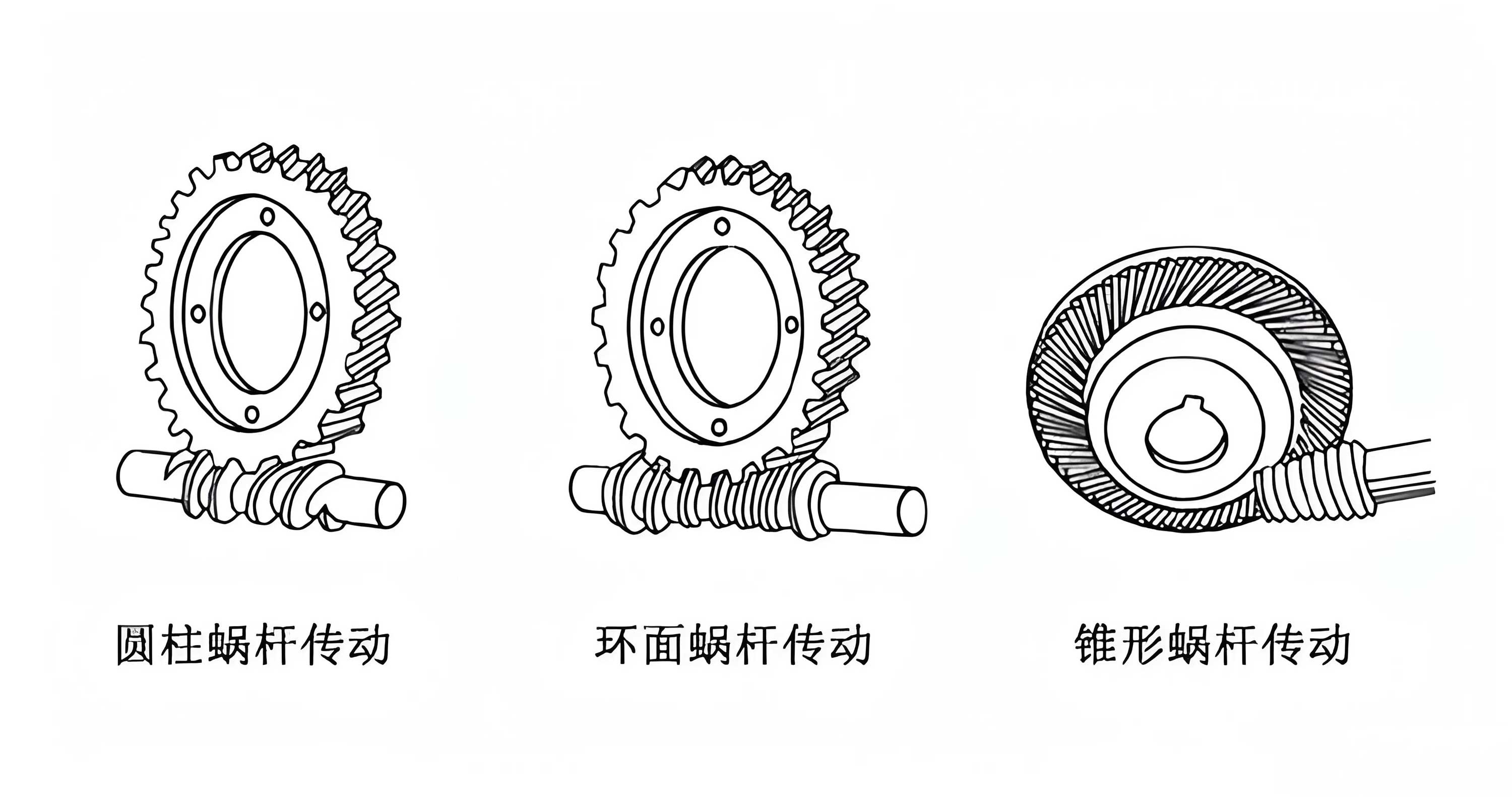
Initial Worm Gear Reducer Design and Performance Analysis
The original reducer was a custom, non-standard unit with side-mounted worms. The worm and wheel were designed as a non-self-locking, single-start Archimedes type.
| Parameter | Worm | Worm Wheel |
|---|---|---|
| Module, m | 12 mm | |
| Diameter Factor, q | 10 | – |
| Number of Starts/Teeth, z | 1 | 49 |
| Pressure Angle, α | 20° | |
| Center Distance, a | 355 mm | |
| Pitch Diameter, d | 120 mm | 588 mm |
| Lead Angle, γ | 5°42’38” (5.71°) | – |
| Material | 45 Steel, case-hardened to 45-55 HRC | ZQAl9-4 (Cast Al-Bronze) |
| Input Power per Worm, P1 | 11 kW | – |
| Worm Speed, n1 | 133.9 rpm | – |
Efficiency Analysis: The primary source of energy loss in worm gears is sliding friction. The first step is to calculate the mesh efficiency.
Worm pitch line velocity:
$$ v_1 = \frac{\pi d_1 n_1}{60 \times 1000} = \frac{\pi \times 120 \times 133.9}{60000} \approx 0.841 \text{ m/s} $$
Sliding velocity at the mesh:
$$ v_s = \frac{v_1}{\cos \gamma} = \frac{0.841}{\cos 5.71^\circ} \approx 0.85 \text{ m/s} $$
For a sliding velocity of 0.85 m/s and a bronze-on-steel pair, the equivalent friction angle ρv is approximately 3.17° (3°10′). The mesh efficiency η1 is given by:
$$ \eta_1 = \frac{\tan \gamma}{\tan(\gamma + \rho_v)} = \frac{\tan 5.71^\circ}{\tan(5.71^\circ + 3.17^\circ)} \approx 0.62 $$
The overall transmission efficiency η of the reducer must account for bearing losses (η2 ≈ 0.96) and churning/pumping losses (η3 ≈ 0.85 for periodic grease lubrication).
$$ \eta = \eta_1 \times \eta_2 \times \eta_3 = 0.62 \times 0.96 \times 0.85 \approx 0.51 $$
This calculated efficiency of 51% is critically low. For a single-start worm gear, efficiencies in the range of 70-75% are typical for non-self-locking designs. The “lost” 49% of the input power is converted directly into heat at the worm and wheel interface.
Thermal Balance Analysis: The heat generated must be dissipated to prevent lubricant breakdown and component damage. The heat generated per worm drive, H1, accounting for the 25% duty cycle is:
$$ H_1 = 1000 \times P_1 \times (1 – \eta) \times Jc = 1000 \times 11 \times (1 – 0.51) \times 0.25 = 1347.5 \text{ W} $$
With two identical worm drives in the same housing, total heat generation H2 is:
$$ H_2 = 2 \times H_1 = 2695 \text{ W} $$
The steady-state oil temperature t inside the housing is determined by the heat balance equation:
$$ t = t_0 + \frac{H_2}{K_s A} $$
Where:
- t0 = Ambient temperature. Due to radiant heat from the hot plate, t0 is estimated at 50°C.
- Ks = Heat transfer coefficient. For a static, painted metal surface in air, Ks ≈ 13 W/(m²·°C).
- A = Effective surface area of the reducer housing for heat dissipation. Original design: A ≈ 4.1 m².
$$ t = 50 + \frac{2695}{13 \times 4.1} \approx 50 + 50.56 \approx 100.56^\circ \text{C} $$
This calculated temperature (100.6°C) far exceeds the recommended maximum operating temperature for many mineral-based lubricants and the bronze wheel material (typically 80-90°C). At such elevated temperatures, the initial grease lubrication would thin excessively, losing its load-carrying capacity. This leads to a vicious cycle: poor lubrication increases friction and wear, which generates more heat, further degrading the lubricant. This condition directly explains the observed failure modes: pitting from high contact stress under boundary lubrication, adhesive wear (scuffing) from localized welding of asperities, and rapid abrasive wear from broken-down lubricant and wear debris.
Proposed Optimization Strategies for the Worm Gear Reducer
To solve the core issues of low efficiency and inadequate heat dissipation, a multi-pronged improvement plan was developed, focusing on materials, lubrication, cooling, and gear geometry.
1. Material Upgrade for Enhanced Durability
The worm experiences more sliding cycles than any single tooth on the wheel. Upgrading from 45 steel to 20Cr steel, followed by carburizing, quenching, and grinding, raises the surface hardness to 52-62 HRC. This significantly improves resistance to abrasive wear.
The worm wheel material was changed from sand-cast ZQAl9-4 aluminum bronze to metal-mold cast ZCuSn10P1 tin phosphor bronze. The tin bronze has superior embeddability (accommodating wear particles) and far better anti-scuffing properties under boundary lubrication, though at a higher material cost.
2. Enhanced Cooling System Design
Passive and active cooling measures are essential. The housing should be redesigned with external cooling fins, increasing the effective surface area A from 4.1 m² to approximately 5.6 m². Furthermore, a fan should be mounted on the protruding end of the worm shaft to force air over the housing. This active cooling dramatically increases the heat transfer coefficient Ks to a range of 18 – 35 W/(m²·°C).
3. Lubrication System Overhaul
The original periodic grease lubrication is wholly inadequate. It should be replaced with a bath (splash) lubrication system. The oil level should be high enough to immerse the worm to one tooth depth, but not above the center of the lowest bearing rolling element. This ensures constant lubrication of the mesh and assists in heat transfer from the worm. A high-viscosity, extreme-pressure (EP) mineral oil with good thermal stability is required. For the low sliding speed (vs ≈ 0.85 m/s) and heavy load, an ISO VG 460 or similar oil with a viscosity of approximately 444 cSt at 40°C is recommended. While this improves churning efficiency (η3 ≈ 0.95) and cooling, it necessitates the use of high-quality, robust shaft seals to prevent leakage.
4. Adoption of High-Efficiency Worm Gear Geometry
The most impactful change involves moving from the standard Archimedes worm to a double-enveloping or, more suitably, a cylindrical worm with concave tooth profile (often referred to as a “Hindley” or “hourglass” worm). The key comparison is summarized below:
| Aspect | Archimedes (Original) | Concave Profile (Proposed) |
|---|---|---|
| Tooth Profile | Straight-sided in axial plane. | Concave in worm, convex in wheel; optimized contact geometry. |
| Meshing Condition | Line contact with poor lubricant entrainment angle. | Area contact with favorable lubricant entrainment; 2-3 teeth in contact. |
| Load Capacity | Base reference (1x). | 1.25 to 2.4 times higher for same center distance. |
| Transmission Efficiency | ~62% (mesh), ~51% (system). | Mesh efficiency 5-11% higher for i=8-50. |
| Thermal Behavior | High friction, high heat generation. | Lower friction, reduced operating temperature. |
| Manufacturing | Relatively simple. | Requires specialized hobbing/cutting tools. |
| Assembly Sensitivity | Moderate. | High; requires precise center distance alignment. |
The concave profile allows for a larger radius of curvature at the contact zone, reducing contact stress. More importantly, it promotes the formation of a protective elastohydrodynamic (EHD) lubricant film by providing a more favorable contact geometry relative to the sliding direction. This directly increases mesh efficiency η1 and reduces heat generation at the source.
Projected Performance After Optimization
Implementing the full suite of improvements—particularly the concave profile worm gears, bath lubrication, and enhanced cooling—yields a significant performance uplift.
Improved Efficiency: Assuming a conservative 9% increase in mesh efficiency from the new gear geometry:
$$ \eta_{1(new)} \approx 0.62 + (0.62 \times 0.09) \approx 0.676 $$
$$ \eta_{new} = \eta_{1(new)} \times \eta_2 \times \eta_{3(new)} = 0.676 \times 0.96 \times 0.95 \approx 0.616 $$
System efficiency improves from 51% to approximately 62%.
Reduced Heat Generation:
$$ H_{1(new)} = 1000 \times 11 \times (1 – 0.616) \times 0.25 = 1056 \text{ W} $$
$$ H_{2(new)} = 2 \times 1056 = 2112 \text{ W} $$
Thermal Balance with Cooling: Using the improved parameters (A=5.6 m², Ks=25 W/(m²·°C) with fan):
$$ t_{new} = 50 + \frac{2112}{25 \times 5.6} \approx 50 + 15.09 \approx 65.09^\circ \text{C} $$
This new equilibrium temperature of 65°C is well within the safe operating limit for the lubricant and wheel material, effectively breaking the thermal failure cycle.
Conclusion
The failure of the original worm gear reducers in the hot plate leveler was systemic, rooted in a design that did not adequately account for the severe thermal loading imposed by low transmission efficiency. The analysis confirmed that the primary culprits were unacceptably low mesh efficiency (~62%) leading to excessive heat generation, compounded by an inadequate cooling system that resulted in operational temperatures exceeding 100°C. This thermally degraded the lubricant, causing boundary lubrication conditions that precipitated pitting, scuffing, and rapid wear of the bronze worm wheel.
The proposed optimization package addresses these root causes comprehensively. Upgrading materials increases inherent wear resistance. Switching to forced-air cooling and bath lubrication dramatically improves heat rejection. Most crucially, adopting concave profile worm gears attacks the problem at its source by improving mesh efficiency, thereby reducing the heat generated per cycle. The collective impact of these measures is a projected increase in system efficiency from 51% to 62% and a drop in operating temperature from over 100°C to a safe 65°C.
In practical application, a cost-benefit analysis may dictate implementing a subset of these improvements. However, for critical applications in harsh environments like hot plate leveling, investing in high-efficiency gear geometry and robust thermal management is not merely an optimization but a necessity for achieving reliable, long-term service life from worm gear drive systems.