
Precisely predicting the meshing behavior of a strain wave gear under transmission load is fundamental for optimizing its design for high precision and load capacity. While geometric parameters like initial backlash are key for motion accuracy under no-load conditions, the actual distribution of meshing forces and the resultant load-dependent side clearance—what we term loading backlash—under operational torque critically influence transmission accuracy, dynamic stability, and component fatigue life. This work presents a comprehensive theoretical and numerical framework to investigate these critical load-dependent characteristics.
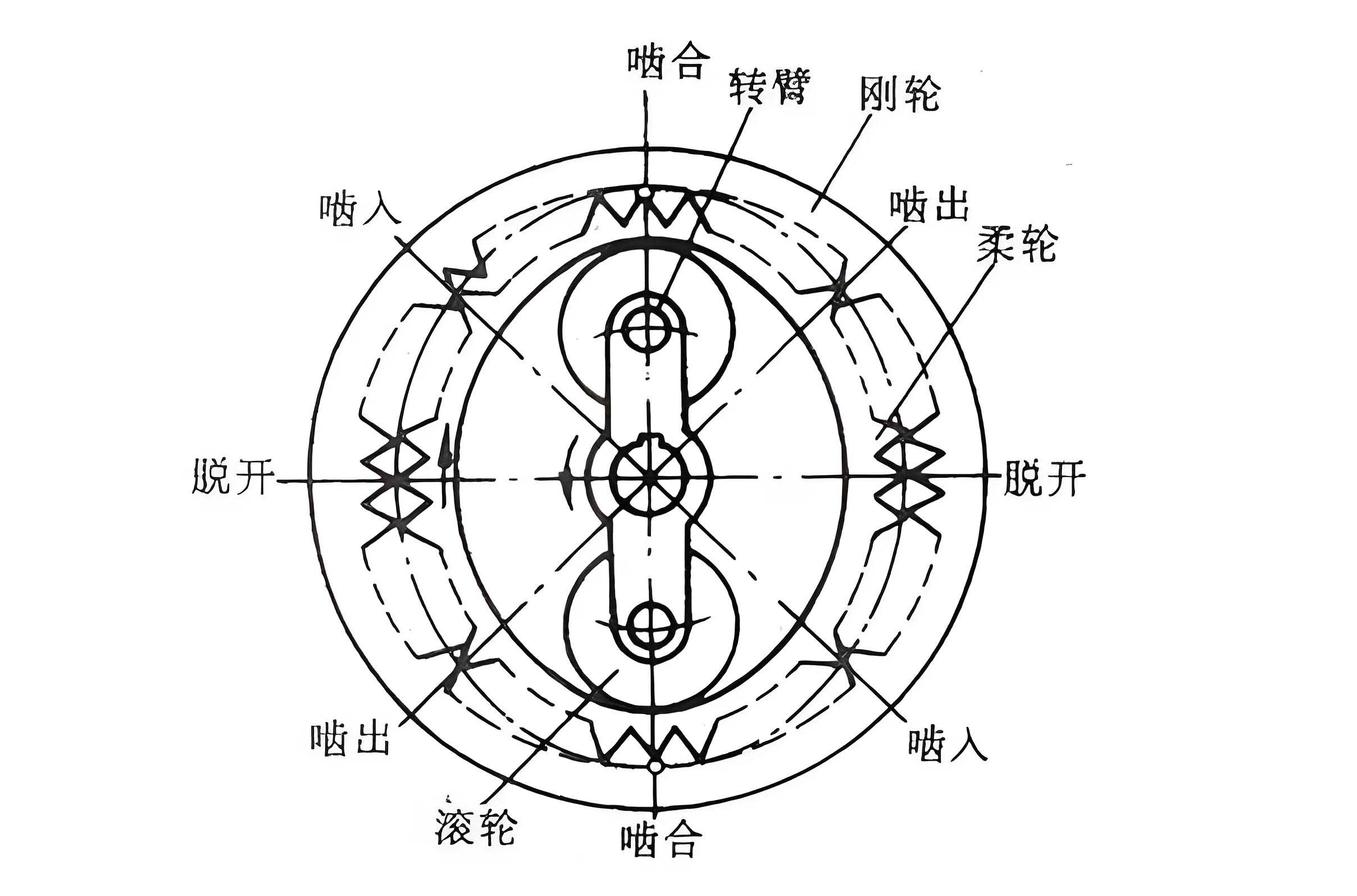
The core of our methodology is an iterative algorithm that calculates the evolving distribution of meshing forces and loading backlash as a function of increasing output torque. This algorithm is built upon two foundational pillars: the initial (no-load) backlash in the assembled state and a circumferential meshing stiffness matrix that characterizes the linear elastic response of the flexible spline’s teeth. The initial backlash, which defines the starting geometric clearance between tooth profiles, is first calculated using an exact kinematic model that accounts for the deformation imposed by the wave generator. Subsequently, a detailed 3D finite element model of the flexible spline, subjected to the wave generator’s action, is used to compute the meshing stiffness matrix by applying unit forces at individual tooth contact points. Finally, the iterative algorithm uses this stiffness matrix and the initial backlash to solve for force distribution and side clearance under progressively applied rotational displacement of the circular spline.
Initial Backlash Calculation in the Assembled Strain Wave Gear
The initial geometric condition for load analysis is the side clearance between the flexible spline and circular spline teeth after assembly with the wave generator, prior to any load application. For a two-disk wave generator, the neutral curve of the flexible spline cup deforms from a perfect circle. The radial displacement \( u(\phi) \) of a point on the neutral curve at an angular position \( \phi \) (with \( \phi = 0^\circ \) at the major axis) is given by piecewise functions depending on the wrap angle \( \gamma \).
For \( 0 \leq \phi \leq \gamma \):
$$ u_1(\phi) = A_1 \cos\phi – B_1 $$
For \( \gamma < \phi \leq \pi/2 \):
$$ u_2(\phi) = \frac{u_0}{A_1 – B_1} \left[ (1+\sin^2\gamma)\sin\phi + \left(\frac{\pi}{2} – \phi\right)\cos\phi – 2\sin\gamma \right] – B_1 $$
where \( u_0 \) is the maximum radial deformation, \( A_1 = \pi/2 – \gamma – \sin\gamma\cos\gamma \), and \( B_1 = 4[\cos\gamma – (\pi/2 – \gamma)\sin\gamma]/\pi \). The circumferential displacement \( v(\phi) \) and the rotation of the tooth centerline \( \theta_{uz}(\phi) \) are derived from the condition of inextensibility of the neutral layer and the geometry of deformation:
$$ v(\phi) = -(\phi_1 – \phi) r_m $$
$$ \theta_{uz}(\phi) = -\arctan\left( \frac{\frac{du}{d\phi}}{r_m + u(\phi)} \right) $$
Here, \( r_m \) is the radius of the neutral layer before deformation, and \( \phi_1 \) is the new angular position after deformation found via variable substitution from the arc length condition \( r_m \phi = \int_0^{\phi_1} \sqrt{\rho^2 + \left(\frac{d\rho}{d\phi}\right)^2} d\phi_1 \), with \( \rho = r_m + u(\phi) \).
Using the deformed position and orientation of the flexible spline tooth, the initial tangential backlash \( j_t \) between an involute tooth pair is calculated as the minimum circumferential distance between the deformed flexible spline tooth profile and the rigid circular spline tooth profile. For a parametric involute profile defined by parameter \( s \), the coordinates are:
$$ x = r[\cos(s – \theta) + s \cos\alpha_0 \sin(s – \theta + \alpha_0)] $$
$$ y = r[-\sin(s – \theta) + s \cos\alpha_0 \cos(s – \theta + \alpha_0)] $$
The backlash is approximated as \( j_t \approx \sqrt{(x_{K2} – x_{K1})^2 + (y_{K1} – y_{K2})^2} \), where \( K1 \) and \( K2 \) are corresponding points on the flexible and circular spline profiles at the same radial distance.
Table 1 summarizes the key parameters for the example strain wave gear used in this study, which has a rated torque of 7 N·m.
| Parameter | Value | Parameter | Value |
|---|---|---|---|
| Module, \( m \) | 0.2 mm | Pressure Angle, \( \alpha_0 \) | 20° |
| Max Radial Deformation, \( u_0 \) | 0.2 mm | Flexible Spline Teeth, \( z_1 \) | 140 |
| Circular Spline Teeth, \( z_2 \) | 142 | Flexible Spline Addendum Radius | 14.584 mm |
| Flexible Spline Dedendum Radius | 14.156 mm | Cup Wall Thickness (Rim) | 0.3 mm |
| Neutral Layer Radius, \( r_m \) | 14.006 mm | Eccentricity of Wave Generator | 0.6 mm |
Determination of the Circumferential Meshing Stiffness Matrix
The meshing stiffness coefficient \( k_{ij} \) represents the meshing force required at tooth \( i \) to induce a unit circumferential displacement at the meshing point of tooth \( j \), considering the coupled deformation of the tooth body and the flexible spline cup. Deriving this analytically is complex due to the intricate geometry and contact conditions. We therefore employ a finite element-based numerical approach.
A 3D parametric finite element model of the flexible spline with solid elements for the teeth and shell elements for the cup is constructed. Contact elements are defined between the two-disk wave generator surfaces and the inner wall of the flexible spline. The model is solved to obtain the deformed state under assembly conditions, ensuring the radial deformation at the major axis equals \( u_0 \).
On this deformed model, a unit circumferential force \( \hat{F} \) is applied at the theoretical meshing point of a single tooth \( i \). The resulting circumferential displacements \( d_{ij} \) at the meshing points of all potential contact teeth \( j \) are extracted. This process is repeated by applying the unit force sequentially to each tooth \( i \) within the potential contact zone (e.g., from \( \phi = -21^\circ \) to \( \phi = 51^\circ \)). This yields the meshing flexibility matrix \( \mathbf{D} \):
$$ \mathbf{D} = \begin{bmatrix}
d_{11} & d_{12} & \cdots & d_{1n} \\
d_{21} & d_{22} & \cdots & d_{2n} \\
\vdots & \vdots & \ddots & \vdots \\
d_{n1} & d_{n2} & \cdots & d_{nn}
\end{bmatrix} $$
where \( n \) is the number of teeth considered. Each element \( d_{ij} \) represents the displacement at tooth \( j \) due to a unit force at tooth \( i \). The meshing stiffness matrix \( \mathbf{K} \), which is central to our linear load model, is then obtained by inverting the flexibility matrix:
$$ \mathbf{K} = \mathbf{D}^{-1} = \begin{bmatrix}
k_{11} & k_{12} & \cdots & k_{1n} \\
k_{21} & k_{22} & \cdots & k_{2n} \\
\vdots & \vdots & \ddots & \vdots \\
k_{n1} & k_{n2} & \cdots & k_{nn}
\end{bmatrix} $$
The off-diagonal terms \( k_{ij} (i \neq j) \) represent the coupling stiffness, indicating that a force on one tooth induces a restraining reaction at others due to the deformation of the shared flexible cup structure.
Iterative Algorithm for Loading Backlash and Meshing Force Distribution
With the initial backlash array \( \{c_i\} \) and the stiffness matrix \( \mathbf{K} \) established, we simulate the loading process. The wave generator and flexible spline cup base are fixed. A gradually increasing circumferential displacement \( \theta_m \) is applied to the circular spline, simulating the output rotation under load. The fundamental equilibrium equation relating meshing forces \( \{F\} \) and flexible spline meshing point displacements \( \{d\} \) is:
$$ \{F\} = \mathbf{K} \{d\} $$
The contact condition dictates that for a tooth pair \( i \) to be in mesh, the displacement of the circular spline point must exceed the sum of the flexible spline point displacement and the initial backlash: \( \theta_m > d_i + c_i \). If this condition is met, the tooth is engaged, the loading backlash \( b_i = \theta_m – d_i – c_i \) is zero (or positive, representing penetration resisted by contact force), and a meshing force \( F_i \) exists. If not, the tooth is not engaged, \( F_i = 0 \), and its displacement \( d_i \) is unknown but must be less than \( \theta_m – c_i \).
The iterative solution algorithm proceeds as follows:
- Initialization: Set meshing force array \( \{F_i\} = 0 \), engaged tooth count \( m = 0 \), and a step size for circular spline rotation.
- Load Step Increment: Increase the applied circular spline displacement \( \theta_m \) by the step size.
- Solve & Check Contact: Solve the equilibrium equation for the unknown displacements \( \{d_i\} \) and forces \( \{F_i\} \), respecting the contact conditions. Check all teeth for the engagement condition \( \theta_m > d_i + c_i \).
- Iterate & Converge: If a tooth’s status changes (engages or disengages), halve the step size and return to step 2 for refinement. Repeat until the status of all teeth is consistent and the solution converges for the current \( \theta_m \).
- Output: Record the loading backlash \( b_i \) ( \( = \max(0, \theta_m – d_i – c_i) \) ), meshing forces \( F_i \), and the corresponding output torque \( T = \sum F_i \cdot r \).
- Loop: Return to step 2, increasing \( \theta_m \) until the desired torque range is covered.
This algorithm effectively tracks the sequential engagement of teeth and the evolution of force distribution as load increases. The resulting loading backlash is a dynamic variable that decreases from its initial value \( c_i \) to zero upon engagement and remains zero for fully engaged teeth under load.
Finite Element Simulation with Nonlinear Contact
The theoretical iterative algorithm assumes a linear meshing stiffness matrix \( \mathbf{K} \). To validate this approach and account for potential nonlinearities (e.g., changing contact conditions between the wave generator and flexible spline cup, or localized plasticity), a full nonlinear finite element contact analysis is conducted. A detailed 3D model includes the flexible spline, the two-disk wave generator, and the circular spline with precise involute tooth profiles.
Contact pairs are defined between the wave generator and the flexible spline inner wall, and critically, between the tooth flanks of the flexible spline and circular spline. The Augmented Lagrangian contact algorithm is employed with a strict penetration tolerance. The initial gap for each tooth pair contact element is set equal to the calculated initial backlash \( c_i \).
The simulation proceeds in two stages: first, the assembly deformation under the wave generator is solved. Then, incremental rotational displacement is applied to the circular spline while the wave generator and flexible spline base are constrained. The analysis directly outputs the contact forces (meshing forces) and the final gaps (loading backlash) for each tooth pair, providing a benchmark that inherently includes nonlinear stiffness effects.
Comparative Analysis of Results
The outcomes from the linear iterative algorithm and the nonlinear finite element analysis (FEA) are compared for the example strain wave gear.
1. Loading Backlash: Both methods show excellent agreement. The tooth near \( \phi \approx 5^\circ \), where the initial backlash is minimum, is the first to engage (loading backlash reaches zero). As torque increases, teeth on both sides sequentially engage. At a high load (circular spline rotation ~3.38e-3 rad), the engaged zone spans from \( \phi = -13^\circ \) to \( \phi = 18^\circ \) in both models. The FEA predicts a slightly faster reduction of loading backlash for teeth near the edges of the mesh zone, but the difference is marginal (on the order of 1 μm).
2. Meshing Force Distribution:
| Load Condition | Theoretical Algorithm | Nonlinear FEA | Observation |
|---|---|---|---|
| Low Torque | Force distribution symmetric about \( \phi=5^\circ \). Lower force amplitude. | Force distribution symmetric about \( \phi=5^\circ \). Higher force amplitude. | At low load, theoretical stiffness is slightly underestimated compared to FEA. |
| High Torque (~11-12 N·m) | Peak force ~51 N. Peak location shifts left by ~8°. | Peak force ~43 N. Peak location shifts left by ~8°. | At high load, theoretical linear stiffness overestimates force by ~17%. Shift pattern is consistent. |
The consistent leftward shift of the peak force under high load in both models indicates a nonlinear mechanical response, likely due to changes in the flexible cup’s deformation pattern.
3. Torsional Stiffness: The relationship between output torque \( T \) and circular spline rotation \( \Delta\theta \) (after taking up initial backlash) is a key performance metric. The theoretical algorithm predicts a constant torsional stiffness (linear T-Δθ curve). The nonlinear FEA results show a linear relationship at low torques, matching the theoretical slope well. However, as torque increases into the rated range and beyond, the FEA curve exhibits a slight nonlinearity, indicating a gradual softening effect. The deviation in predicted torque at the maximum rotation analyzed is approximately 11%.
$$ \text{Theoretical Stiffness: } \frac{dT}{d(\Delta\theta)} = \text{constant} $$
$$ \text{FEA Stiffness: } \frac{dT}{d(\Delta\theta)} \text{ decreases slightly with increasing } \Delta\theta $$
Discussion on Strain Wave Gear Meshing Behavior
The study elucidates several important aspects of strain wave gear operation under load. The linear iterative algorithm based on a pre-computed stiffness matrix provides a computationally efficient tool for predicting meshing force distribution and loading backlash with good accuracy, especially within the rated torque range of the gear. Its primary limitation is the assumption of linear stiffness, which leads to an overestimation of meshing forces at higher loads where nonlinear effects (e.g., geometric nonlinearity of the cup, localized contact deformations) become significant.
The concept of loading backlash is crucial. Unlike the static initial backlash, it is a dynamic variable that defines the actual clearance in non-engaged tooth pairs under a specific load. Monitoring its distribution helps identify potential edge-of-mesh interference risks at extreme loads.
The force distribution pattern evolution—starting symmetrically around the minimum initial backlash point and then shifting asymmetrically with increasing load—highlights the complex load-sharing mechanism in strain wave gears. This shift must be considered in fatigue life calculations for the flexible spline teeth.
| Method | Key Feature | Advantage | Limitation | Best For |
|---|---|---|---|---|
| Theoretical Iterative Algorithm | Uses linear meshing stiffness matrix & initial backlash. | Fast computation; Clear physical insight; Good accuracy near design load. | Assumes linear stiffness; Overestimates forces at high load. | Parametric studies, initial design, load distribution estimation within rated range. |
| Nonlinear FE Contact Analysis | Directly models tooth contact and nonlinear material/geometry. | High accuracy; Captures nonlinear effects and detailed stress. | Computationally intensive; Requires significant modeling effort. | Final design verification, stress analysis, understanding nonlinear behavior. |
| Initial Backlash Calculation (Exact Kinematic) | Solves for deformed tooth position post-assembly. | Provides precise geometric starting condition for load analysis. | Does not account for load-induced deformations. | Setting manufacturing tolerances, predicting no-load kinematic error. |
Conclusion
This work presents a integrated approach for modeling the loaded state of a strain wave gear. We developed an efficient iterative algorithm that calculates the distribution of meshing forces and the load-dependent side clearance (loading backlash) based on linearized circumferential meshing stiffness and initial geometric backlash. The method was validated against a high-fidelity nonlinear finite element contact analysis. The key findings are:
- The meshing force on a single tooth exhibits a linear relationship with load at low torques but becomes nonlinear at higher loads, especially as the engagement zone expands and the flexible cup’s deformation pattern changes.
- The meshing force distribution evolves from a symmetric pattern around the point of minimum initial backlash to an asymmetric one under high torque, with the peak force shifting noticeably.
- The proposed linear iterative algorithm predicts force distribution and engagement patterns with good agreement compared to nonlinear FEA within the gear’s rated operating torque. Its primary discrepancy is an overestimation of meshing force magnitude at higher loads due to the assumption of constant stiffness.
- The torsional stiffness derived from the linear model is constant and aligns well with the FEA results at low loads, but the FEA reveals a slight nonlinear softening as the load increases towards the upper operational limit.
The framework combining precise kinematic analysis for initial conditions, finite element-based stiffness characterization, and iterative load simulation provides a practical and insightful tool for the design and analysis of high-performance strain wave gear drives, enabling better prediction of transmission accuracy, load sharing, and component durability under operational conditions.