
In modern automotive and industrial applications, hypoid bevel gears are critical components in power transmission systems, especially in vehicle rear axles, due to their high load capacity and smooth operation. However, the complex tooth geometry of hypoid bevel gears, characterized by offset axes and curved tooth surfaces, leads to significant sliding velocities along both the profile and lengthwise directions. This results in substantial tooth surface wear over time, which can degrade dynamic performance, increase vibration and noise, and ultimately cause gear failure. To address these issues, this paper proposes a comprehensive approach for dynamic anti-wear design and analysis of hypoid bevel gears using ease-off flank modification. We focus on improving gear dynamics and reducing wear through optimized tooth surface topology, considering the coupling effects between wear, dynamic response, and tooth modification.
Traditional design methods for hypoid bevel gears often rely on parabolic transmission error corrections based on modified machine tool settings, which can lead to excessive mismatch and increased contact loads. Moreover, wear in hypoid bevel gears is a dynamic, time-varying process influenced by factors such as contact pressure, sliding velocity, lubrication, and system vibrations. Previous studies have primarily used Archard’s wear model in quasi-static analyses, but these neglect the interplay between wear progression and gear dynamics. For hypoid bevel gears, which exhibit complex contact conditions, a more integrated approach is needed. In this work, we develop a numerical method called Loaded Tooth Contact Analysis with Wear (WLTCA) that combines ease-off modification, dynamic modeling, and wear simulation to optimize tooth surfaces for minimal vibration and wear.
The core of our method lies in representing the modified pinion tooth surface as a sum of two vectors: the conjugate gear tooth surface and a normal ease-off modification surface. The ease-off surface is defined by preset parabolic modification parameters and geometric transmission error parameters, allowing for controlled mismatch to improve contact patterns. We then establish a nonlinear dynamic model for hypoid bevel gears, incorporating bending-torsion-axial coupling with eight degrees of freedom. This model accounts for time-varying mesh stiffness, damping, and backlash effects. The WLTCA method iteratively computes static loads and mesh stiffness using LTCA, derives dynamic loads from dynamic analysis, calculates wear depth based on Archard’s formula, and updates tooth surface gaps for subsequent cycles. This enables the prediction of wear distribution and dynamic response over multiple gear engagements.
We apply this framework to a case study of orthogonal hypoid bevel gears, optimizing the ease-off surface to minimize the root mean square of normal vibration acceleration under no-wear conditions and minimize tooth surface wear. The optimization variables include profile and lead modification parameters, and the objective function balances vibration reduction and wear resistance. Our results demonstrate that the optimized ease-off surface, primarily featuring profile modification, significantly reduces wear depth and improves dynamic performance across various load and speed conditions. We also analyze the coupling between wear and dynamic response, showing that mild wear can sometimes enhance vibration characteristics, but excessive wear leads to tooth separation and increased instability. This study provides a theoretical foundation for the anti-wear and vibration-reduction design of high-performance hypoid bevel gears.
To elaborate on the ease-off modification, the tooth surface of the pinion is expressed as:
$$ \mathbf{r}_m = \mathbf{r}_c + \delta \cdot \mathbf{n} $$
where \(\mathbf{r}_m\) is the modified surface vector, \(\mathbf{r}_c\) is the conjugate surface vector, \(\delta\) is the ease-off deviation along the normal direction \(\mathbf{n}\). The ease-off deviation \(\delta\) is defined as a function of profile modification curves and predesigned transmission error. For hypoid bevel gears, this involves parameters such as parabolic coefficients for tooth profile and lead corrections. The ease-off surface essentially represents the normal gap between the theoretical conjugate surface and the modified surface, allowing for controlled tooth contact patterns and load distribution.
The dynamic model considers vibrations in translational and rotational directions. The equations of motion for the hypoid bevel gear system are derived using a lumped-parameter approach. Let \(m_p\) and \(m_g\) be the equivalent masses of the pinion and gear, \(I_p\) and \(I_g\) their moments of inertia, and \(k_{px}, k_{py}, k_{pz}, k_{gx}, k_{gy}, k_{gz}\) the support stiffnesses in \(x\), \(y\), and \(z\) directions. The damping coefficients are denoted similarly. The dynamic equations are:
$$ m_p \ddot{x}_p + c_{px} \dot{x}_p + k_{px} x_p = -F_n n_{px} $$
$$ m_p \ddot{y}_p + c_{py} \dot{y}_p + k_{py} y_p = -F_n n_{py} $$
$$ m_p \ddot{z}_p + c_{pz} \dot{z}_p + k_{pz} z_p = -F_n n_{pz} $$
$$ I_p \ddot{\theta}_p = F_n r_p – T_p $$
$$ m_g \ddot{x}_g + c_{gx} \dot{x}_g + k_{gx} x_g = -F_n n_{gx} $$
$$ m_g \ddot{y}_g + c_{gy} \dot{y}_g + k_{gy} y_g = -F_n n_{gy} $$
$$ m_g \ddot{z}_g + c_{gz} \dot{z}_g + k_{gz} z_g = -F_n n_{gz} $$
$$ I_g \ddot{\theta}_g = -F_n r_g + T_g $$
Here, \(F_n\) is the normal mesh force, \(n_{px}, n_{py}, etc.\) are components of the unit normal vector at the mesh point, \(r_p\) and \(r_g\) are the radii of rotation, and \(T_p\) and \(T_g\) are input and output torques. The normal mesh force is computed as:
$$ F_n = k_n g(s_n) + c_n \dot{s}_n $$
where \(k_n\) is the time-varying mesh stiffness, \(c_n\) is the mesh damping, \(s_n\) is the normal relative displacement, and \(g(s_n)\) is a nonlinear gap function accounting for backlash \(b\):
$$ g(s_n) = \begin{cases} s_n – b, & s_n > b \\ 0, & |s_n| \le b \\ s_n + b, & s_n < -b \end{cases} $$
The mesh stiffness \(k_n\) is obtained from the LTCA analysis, which considers tooth flexibility and contact deformation. For hypoid bevel gears, this stiffness varies with the contact position along the tooth surface, and we compute it using finite element methods or analytical approximations.
The WLTCA method integrates wear calculation into the dynamic analysis. Based on Archard’s wear model, the wear depth \(h\) at a discrete contact point is given by:
$$ h = a P_h s $$
where \(a\) is the dimensional wear coefficient, \(P_h\) is the Hertzian contact pressure, and \(s\) is the sliding distance. The wear coefficient \(a\) depends on lubrication conditions and is modeled as a function of the film thickness ratio \(\lambda\):
$$ a = \begin{cases} a_0, & \lambda < 0.5 \\ a_0 (4 – 2\lambda), & 0.5 \le \lambda < 2 \\ 0, & \lambda \ge 2 \end{cases} $$
with \(a_0\) as the boundary lubrication wear coefficient, typically around \(1 \times 10^{-18} \, \text{N/m}^2\) for steel gears. The film thickness ratio \(\lambda = h_m / \sigma\), where \(h_m\) is the central film thickness from the Dowson-Higginson formula, and \(\sigma\) is the composite surface roughness. The contact pressure \(P_h\) is computed from the dynamic load and contact geometry:
$$ P_h = \frac{L_d w E’}{2 \pi R} $$
where \(L_d\) is the dynamic load factor from dynamic analysis, \(w\) is the line load, \(E’\) is the equivalent elastic modulus, and \(R\) is the composite curvature radius. The sliding distance \(s = v_s \Delta t\), with \(v_s\) as the sliding velocity and \(\Delta t\) the time increment between contact points.
In the WLTCA cycle, we start with the initial tooth surface gaps from ease-off modification. For each meshing cycle, we perform LTCA to get static loads and mesh stiffness, then dynamic analysis to get dynamic loads, then wear calculation to update wear depth. When the maximum wear depth on a tooth reaches a threshold (e.g., 2 μm), we update the initial gaps by adding the wear depth of simultaneously meshing tooth pairs. This process repeats until the wear depth exceeds a maximum allowable value. This iterative approach captures the progressive wear and its effect on gear dynamics.
For optimization, we define an objective function that minimizes vibration and wear. Let \(t_e\) be the root mean square of normal vibration acceleration under no-wear conditions, and \(\eta_a\) be the number of wear cycles until a certain wear depth is reached. The objective function is:
$$ G(y) = \min \left\{ c_1 \frac{t_e}{t_{e0}} + c_2 \frac{\eta_{a0}}{\eta_a} \right\} $$
where \(y\) represents the ease-off modification parameters (profile and lead coefficients), \(t_{e0}\) and \(\eta_{a0}\) are reference values for the conjugate surface, and \(c_1\) and \(c_2\) are weighting factors (set to 0.5 each). We use optimization algorithms, such as genetic algorithms or gradient-based methods, to find the optimal \(y\) that minimizes \(G\).
To illustrate our approach, we consider a case study of orthogonal hypoid bevel gears with parameters shown in Table 1. The pinion has 8 teeth, and the gear has 41 teeth, with a nominal torque of 300 N·m and pinion speed of 6000 rpm. The ease-off modification parameters are optimized for this condition.
| Parameter | Pinion | Gear |
|---|---|---|
| Number of teeth | 8 | 41 |
| Spiral angle at midpoint (°) | 48.93 | 30.63 |
| Hand of spiral | Left | Right |
| Addendum (mm) | 5.77 | 1.05 |
| Dedendum (mm) | 1.16 | 5.73 |
| Pitch angle (°) | 12.53 | 76.82 |
| Face angle (°) | 17.45 | 77.73 |
| Root angle (°) | 11.67 | 71.68 |
| Outer cone distance (mm) | 97.19 | 84.72 |
| Face width (mm) | 28 | 24 |
| Mass (kg) | 0.72 | 3.26 |
| Moment of inertia (kg·m²) | 2.59e-4 | 0.0071 |
| Support stiffness (N/m) | 3.0e9 (horizontal/vertical), 9e8 (axial) | Same as pinion |
| Damping coefficients | 0.005 for supports, 0.1 for mesh | Same as pinion |
| Backlash (mm) | 0.1 | |
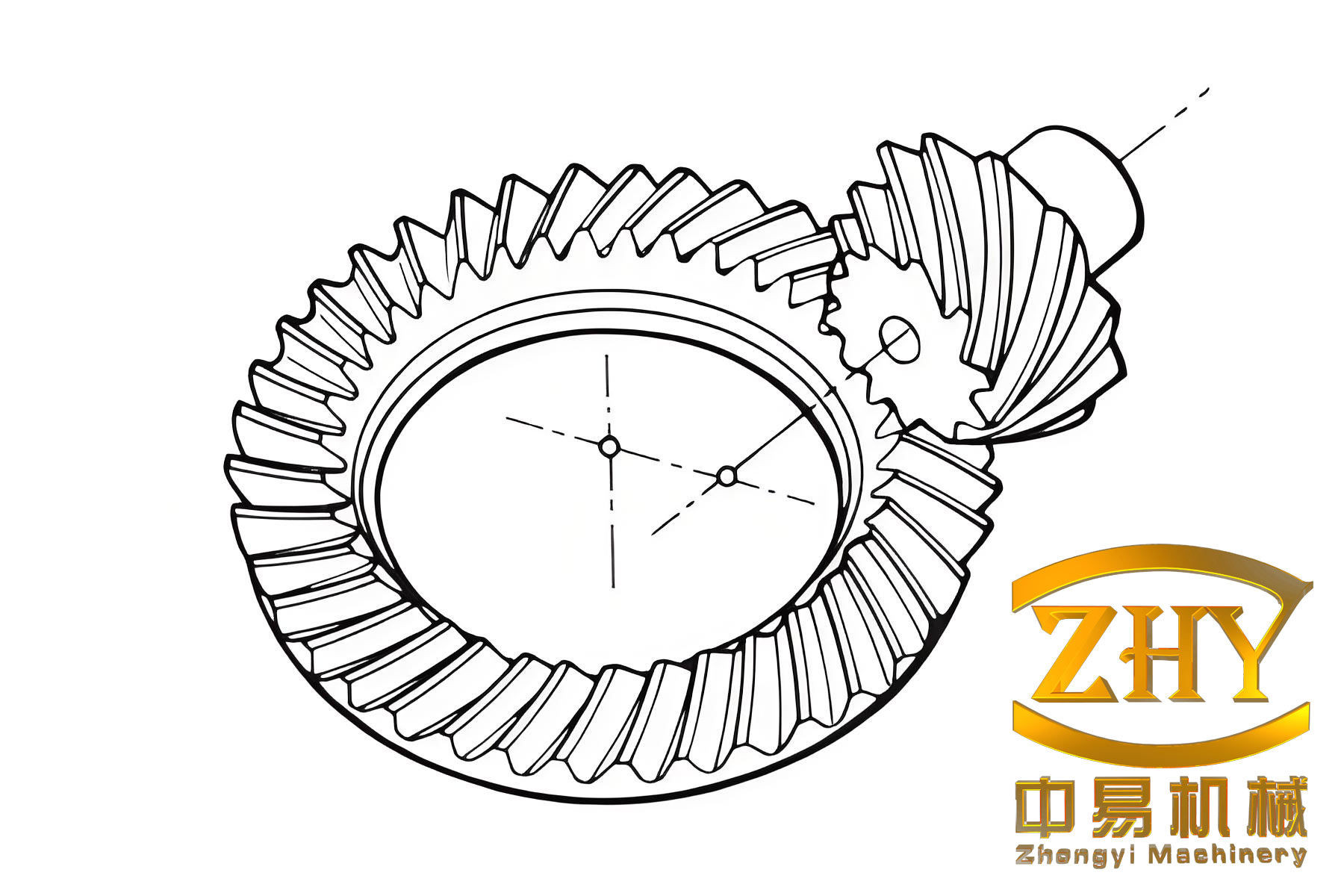
The optimization results show that the optimal ease-off surface primarily involves profile modification, with some lead modification. The ease-off deviations are larger near the pinion root and tip regions, where contact pressures and sliding velocities are high. This reduces the Hertzian pressure in critical areas and improves wear resistance. The ease-off surface matches the contact pattern well, ensuring uniform load distribution. Below is an illustration of a hypoid bevel gear, which helps visualize the complex tooth geometry involved in this study.
We simulate the wear progression and dynamic response under nominal conditions. Figure 1 shows the number of wear cycles required to reach a maximum wear depth of 2 μm for different tooth surfaces: conjugate, theoretical, and optimized ease-off. The optimized ease-off surface requires the most cycles, indicating superior anti-wear performance. For example, after 6 wear updates (k=6), the optimized surface has about 50% more cycles than the conjugate surface. This is because the modification reduces contact pressures in high-wear regions.
| Tooth surface | Wear cycles at k=6 | Relative improvement |
|---|---|---|
| Conjugate | 1200 | Baseline |
| Theoretical | 800 | -33% |
| Optimized ease-off | 1800 | +50% |
The dynamic response is evaluated through the normal vibration acceleration. Under no-wear conditions, the optimized ease-off surface reduces the root mean square vibration by about 30% compared to the conjugate surface. The frequency spectrum shows that the conjugate surface has dominant harmonics at multiples of the mesh frequency, while the optimized surface suppresses these harmonics, leading to smoother operation. The mesh stiffness variation is also analyzed. For the conjugate surface, the stiffness curve contains significant harmonics, whereas for the optimized ease-off surface, the stiffness is primarily at the mesh frequency with minimal harmonics. This explains the vibration reduction, as stiffness fluctuations excite dynamic responses.
The contact pressure and wear depth distributions are computed across the tooth surface. For hypoid bevel gears, the sliding velocity increases from the root to the tip and from the heel to the toe. The contact pressure is highest near the pitch line due to smaller curvature radii. The optimized ease-off surface reduces the maximum contact pressure by 15-20% in critical regions. The wear depth distribution is complex: along the profile, it depends on both pressure and sliding velocity; along the lead, it generally increases toward the toe due to higher sliding. The maximum wear depth for the optimized surface occurs near the mid-region of the contact line, where sliding is high but pressure is moderated by modification.
We also investigate the coupling between wear and dynamic response under varying speeds and loads. For the conjugate surface, at resonance speeds (e.g., 4000 rpm and 5600 rpm), wear can initially improve vibration by acting as a mild modification, but excessive wear causes tooth separation and increased vibration. For the optimized ease-off surface, resonance speeds are fewer and vibration amplitudes are lower overall. As speed increases, the lubrication improves (higher film thickness), reducing the wear coefficient and thus wear rate. As load increases, the wear cycles decrease but tend to saturate due to increased contact pressures.
The following table summarizes the dynamic performance under different loads for the optimized ease-off surface after 3 wear updates (k=3). The vibration level is given as a percentage of the conjugate surface’s vibration at nominal load.
| Load (N·m) | Vibration (% of baseline) | Wear cycles to 2 μm |
|---|---|---|
| 200 | 85% | 2000 |
| 300 (nominal) | 70% | 1800 |
| 400 | 75% | 1600 |
| 500 | 80% | 1500 |
| 600 | 90% | 1400 |
These results highlight that the optimized ease-off surface maintains low vibration and high wear resistance across a range of loads, though performance degrades slightly at higher loads due to increased dynamic effects. For hypoid bevel gears, this robustness is crucial for real-world applications where operating conditions vary.
In terms of wear depth calculation, we use Archard’s formula with dynamic loads. The wear depth per cycle at a point is:
$$ h_i = a_i P_{h,i} v_{s,i} \Delta t_i $$
where the subscript \(i\) denotes the discrete contact point. The total wear depth after \(N\) cycles is the sum over all engagements. The time increment \(\Delta t_i\) is based on the pinion rotation:
$$ \Delta t_i = \frac{60}{z_p N r_p} $$
with \(z_p\) as pinion teeth, \(N\) as number of points per cycle, and \(r_p\) as pinion speed in rpm. This discretization allows efficient computation of wear distribution.
The mesh stiffness \(k_n\) is a key parameter in dynamics. For hypoid bevel gears, we compute it from LTCA by applying unit loads at different contact positions and measuring the total deformation. The stiffness varies with the ease-off modification and wear. As wear progresses, the initial gaps increase, reducing the effective stiffness slightly. However, the shape of the stiffness curve (its harmonic content) is more critical for vibration than its magnitude. Our results show that the optimized ease-off surface flattens the stiffness curve, reducing harmonics and thus vibration.
In conclusion, this paper presents a dynamic anti-wear design and analysis method for hypoid bevel gears using ease-off flank modification. We propose a WLTCA numerical approach that integrates ease-off modification, dynamic modeling, and wear simulation to optimize tooth surfaces for minimal vibration and wear. The optimized ease-off surface, characterized primarily by profile modification, significantly improves wear resistance and dynamic performance. Key findings include:
- Ease-off modification reduces contact pressures in critical regions, delaying wear progression.
- The shape of the mesh stiffness curve (reduced harmonics) is more important for vibration reduction than its magnitude.
- Mild wear can improve dynamic response by acting as a natural modification, but excessive wear leads to tooth separation and instability.
- The coupling between wear and dynamics is complex and depends on speed and load conditions.
This method provides a theoretical foundation for designing high-performance hypoid bevel gears with enhanced durability and quiet operation. Future work could extend to include thermal effects, more detailed lubrication models, and experimental validation. The approach is applicable to other gear types, such as spiral bevel gears, but hypoid bevel gears are particularly challenging due to their offset axes and complex contact conditions. By leveraging ease-off modification and dynamic analysis, engineers can develop more reliable and efficient gear systems for automotive and industrial applications.
Overall, the integration of ease-off modification, dynamic analysis, and wear simulation offers a comprehensive solution for the anti-wear design of hypoid bevel gears. This work underscores the importance of considering the interplay between geometry, dynamics, and wear in gear design, and it opens avenues for further research in optimized tooth surface topologies for various operating conditions.