
In the realm of mechanical transmission systems, hypoid gears stand out as critical components, directly influencing the performance, efficiency, and economic viability of machinery. Their unique offset-axis design enables smooth power transfer between non-intersecting shafts, making them indispensable in automotive, aerospace, and industrial applications. The replication of hypoid gears, particularly when imitating advanced foreign equipment like the Gleason 406HL gear lapping machine, presents a formidable technical challenge. This article, written from a first-person perspective, delves into the intricate process of replicating hypoid gears, focusing on the key technical steps, calculations, and manufacturing insights gained through practical experience. The goal is to provide a detailed account that can serve as a reference for single-piece processing and broader application of hypoid gear technology.
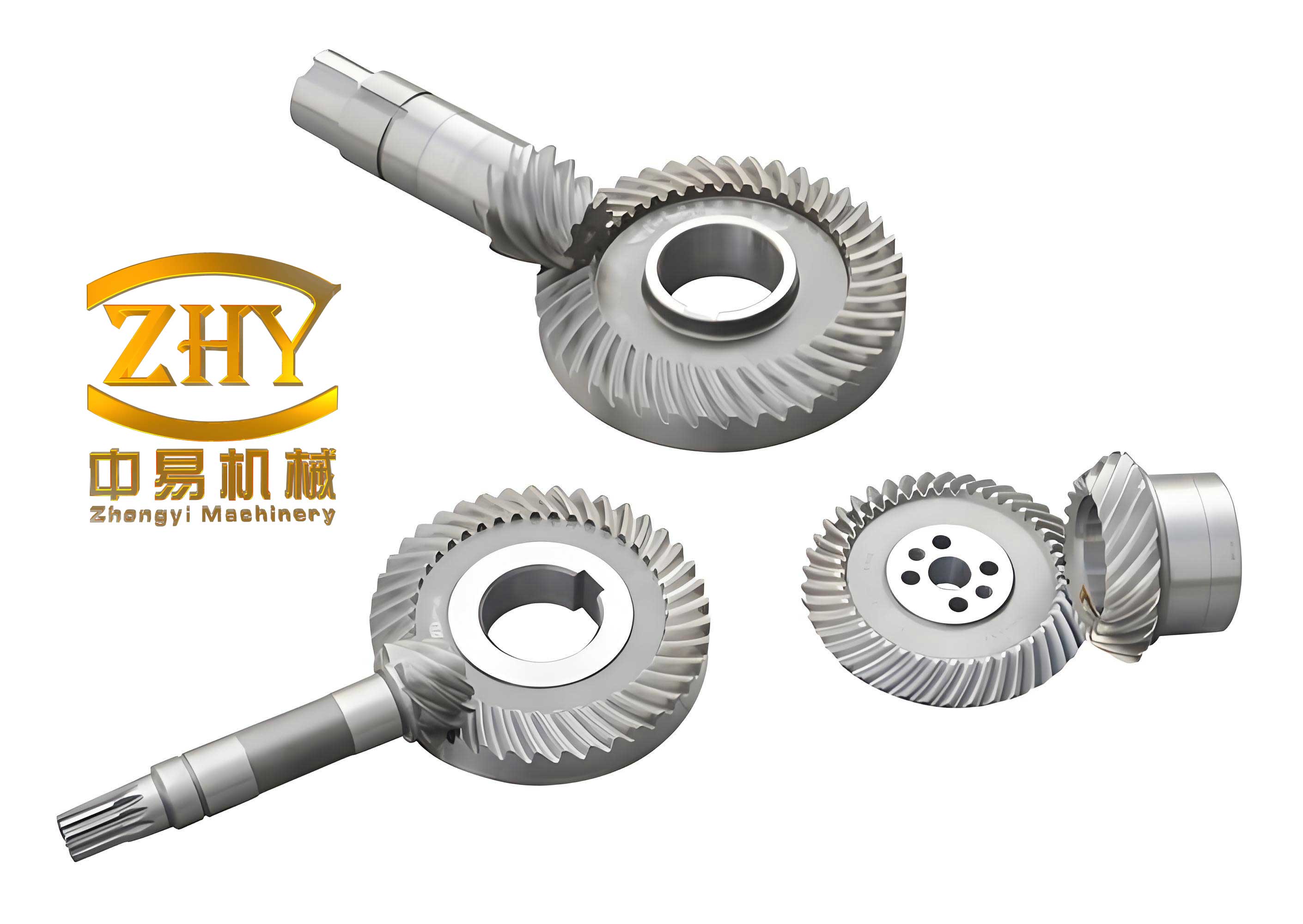
The replication of hypoid gears is a multifaceted endeavor that requires a deep understanding of gear geometry, kinematics, and manufacturing techniques. Hypoid gears, characterized by their offset axes and spiral teeth, involve complex spatial啮合 relationships that must be precisely replicated to ensure optimal functionality. The process begins with mastering the fundamental concepts and characteristics of hypoid gears, including their geometric parameters, load distribution, and operational advantages. Following this, selecting an appropriate tooth-cutting method based on the principles of hypoid gear generation is crucial. Subsequently, machine tool adjustment calculations using established systems like the Gleason G-Data method are performed. Then, specialized cutter heads must be designed and manufactured to meet the specific requirements of the hypoid gears. Finally, tooth cutting, contact pattern adjustment, and gear lapping are addressed to achieve the desired performance. Throughout this journey, hypoid gears demand meticulous attention to detail, iterative refinement, and practical ingenuity.
To elaborate on the technical phases, the first step involves a thorough grasp of hypoid gear basics. Hypoid gears differ from standard bevel gears due to their offset, which introduces unique geometric properties. The offset distance \( E \) between the gear axes allows for lower shaft positions, enhancing design flexibility and load capacity. Key parameters include the module \( m \), pressure angle \( \alpha \), spiral angle \( \beta \), pitch cone angles \( \delta_1 \) and \( \delta_2 \), and number of teeth \( Z_1 \) and \( Z_2 \). The geometry can be described using mathematical equations, such as the relationship between spiral angle and offset: $$ \tan \beta = \frac{E}{R_p} $$ where \( R_p \) is the pitch radius. However, actual hypoid gear design involves more complex formulas to account for tooth curvature and contact patterns. Understanding these fundamentals is essential for accurate replication of hypoid gears.
The next phase involves selecting the tooth-cutting method. Hypoid gears can be cut using various approaches, such as the Formate method (non-generated) or the Duplex method (generated). For replication, the Gleason system is often preferred due to its comprehensive generated process that simulates gear mating. The choice depends on factors like production volume and gear specifications. The following table compares common cutting methods for hypoid gears:
| Cutting Method | Description | Advantages for Hypoid Gears |
|---|---|---|
| Formate Method | Uses a form cutter that replicates the tooth shape directly without generation. | Faster for large batches; suitable for simple hypoid gear profiles. |
| Duplex Method | Employs two cutters for roughing and finishing in a generated process. | Higher accuracy and flexibility for complex hypoid gear designs. |
| Gleason System | A comprehensive generated process using cradle-type machines and calculated adjustments. | Widely used for precision hypoid gears; allows fine-tuning of contact patterns. |
Machine tool adjustment calculations form the backbone of hypoid gear replication. The Gleason G-Data system provides a detailed calculation table with 194 items, covering gear geometry, cutter parameters, machine settings, and contact pattern corrections. For replication on a domestic Y2250 machine, conversions are necessary. The key conversions are summarized below, with formulas expressed using LaTeX for clarity. These adjustments ensure that the machine tool accurately replicates the hypoid gears’ geometry and tooth forms.
| Gleason G-Data Parameter | Conversion Formula for Y2250 Machine |
|---|---|
| Cutter Position (E) | Eccentric Angle: $$ \alpha = \arctan\left(\frac{E}{R}\right) $$ where \( R \) is the cutter radius. |
| Cradle Angle (Q) for right-hand gears | $$ Q_{\text{right}} = Q – \Delta $$ with \( \Delta \) as a correction factor. |
| Cradle Angle (Q) for left-hand gears | $$ Q_{\text{left}} = Q + \Delta $$ |
| Blade Tilt Angle (i) | $$ i = i_{\text{Gleason}} $$ (typically unchanged) |
| Roll Ratio (R_r) for rough cutting large gear | $$ R_r = R_{\text{rough, large}} $$ from G-Data calculations. |
| Roll Ratio (R_r) for rough cutting small gear | $$ R_r = R_{\text{rough, small}} $$ |
| Roll Ratio (R_r) for finish cutting both gears | $$ R_r = R_{\text{finish}} $$ |
| Index Ratio (R_i) for rough cutting large gear | $$ R_i = R_{\text{index, large}} $$ |
| Index Ratio (R_i) for rough cutting small gear | $$ R_i = R_{\text{index, small}} $$ |
| Index Ratio (R_i) for finish cutting both gears | $$ R_i = R_{\text{index, finish}} $$ |
| Number of Teeth for Index Jump (Z_j) | $$ Z_j = Z_{\text{jump, Gleason}} $$ |
| Carriage Setback (S) | $$ S = S_{\text{Gleason}} \times \text{conversion factor} $$ |
| Roll Check Angle (θ_rc) | $$ \theta_{\text{rc}} = Q_{\text{cradle}} – \theta_{\text{offset}} $$ |
| Tooth Thickness Reduction per Division Scale (Δs) | $$ \Delta s = \frac{\Delta s_{\text{Gleason}}}{k} $$ where \( k \) is a machine-specific constant. |
During these calculations, several critical points must be observed to ensure accurate replication of hypoid gears. First, the difference between the calculated cutter radius and the pre-selected radius must be less than 1% of the pre-selected radius. If not, iterations are required from item 104 to 174 in the G-Data table. The rule is: if the calculated radius exceeds the pre-selected radius, the tangent of the offset angle in the small gear’s rotation plane should be decreased; if it is smaller, the tangent should be increased. This iterative process continues until the criterion is met. Second, relationships between gear dimensions must be considered. For example, if the module decreases, the large gear’s pitch diameter, spiral angle, and small gear’s midpoint radius all decrease, while the large gear’s pitch cone angle increases. These relationships are vital for maintaining the correct geometry of hypoid gears. Additionally, the following table outlines typical parameter ranges for hypoid gears to guide calculations:
| Parameter | Symbol | Typical Range for Hypoid Gears |
|---|---|---|
| Module | m | 2 to 10 mm |
| Pressure Angle | α | 20° to 25° |
| Spiral Angle | β | 30° to 50° |
| Offset Distance | E | 10 to 100 mm |
| Pitch Cone Angle (Large Gear) | δ_1 | 30° to 70° |
| Pitch Cone Angle (Small Gear) | δ_2 | 20° to 60° |
Designing and manufacturing specialized cutter heads is another cornerstone of hypoid gear replication. The cutter head must meet stringent technical requirements to ensure precision in cutting hypoid gear teeth. The design elements include nominal diameter, blade offset, tip form diameter, blade profile angle, blade rake angle, blade clearance angle, blade base distance, blade tip width, number of blades, cutting direction, cutter body base distance, shim thickness, and adjustment shims. Each element plays a specific role in achieving the desired tooth profile and contact pattern for hypoid gears. The following table details these elements and their functions:
| Design Element | Role in Hypoid Gear Cutting |
|---|---|
| Nominal Diameter | Determines the cutter head size, affecting cutting speed and tool rigidity for hypoid gears. |
| Blade Offset | Influences the tooth profile curvature and contact pattern alignment in hypoid gears. |
| Tip Form Diameter | Defines the diameter at blade tips, critical for controlling tooth depth in hypoid gears. |
| Blade Profile Angle | Sets the pressure angle of the hypoid gear teeth, affecting load capacity and meshing. |
| Blade Rake Angle | Governs chip formation and cutting forces during machining of hypoid gears. |
| Blade Clearance Angle | Prevents rubbing and ensures smooth cutting of hypoid gear tooth surfaces. |
| Blade Base Distance | Positions the blade relative to the cutter body, crucial for accuracy in hypoid gear replication. |
| Blade Tip Width | Controls the tooth thickness and backlash of hypoid gears. |
| Number of Blades | Affects surface finish and cutting efficiency for hypoid gears; more blades yield finer finishes. |
| Cutting Direction | Determines the hand of the spiral in hypoid gears (right-hand or left-hand). |
| Cutter Body Base Distance | Ensures proper alignment in the machine tool for consistent hypoid gear cutting. |
| Shim Thickness | Allows fine adjustments to achieve precise tooth forms in hypoid gears. |
| Adjustment Shims | Used to calibrate the cutter head for specific hypoid gear designs and tolerances. |
The technical requirements for hypoid gear cutter heads are rigorous: blade tip face runout must be minimal, cutting edge radial runout should be within tight limits, the cutting edge must pass through the central vertical plane of the cutter head with minimal deviation over the full tooth height, and the blade’s back surface must exhibit consistency in any section through the cutter head’s centerline. This consistency includes tip diameter uniformity, cutting edge profile angle uniformity, clearance angle uniformity, and cutting edge linearity. Meeting these requirements is essential for producing high-quality hypoid gears with accurate geometry and smooth operation.
Based on the Gleason G-Data calculations for replicating the hypoid gears in the 406HL machine, five cutter heads are required. The specifications and applications are summarized in the table below:
| Cutter Head Type | Specifications | Application in Hypoid Gear Replication |
|---|---|---|
| Large gear rough cutting double-sided | 6-inch diameter, 10.5 mm tip width | Initial tooth cutting for the large hypoid gear to remove bulk material. |
| Large gear finish cutting double-sided | 6-inch diameter, 6.5 mm tip width | Final tooth finishing for the large hypoid gear to achieve precise profile. |
| Small gear rough cutting double-sided | 6-inch diameter, 6.3 mm tip width | Initial tooth cutting for the small hypoid gear, forming basic tooth shape. |
| Small gear finish cutting inner | 6-inch diameter, 7.85 mm tip width | Finishing the inner teeth of the small hypoid gear for accurate meshing. |
| Small gear finish cutting outer | 6-inch diameter, 9.65 mm tip width | Finishing the outer teeth of the small hypoid gear to complete the tooth form. |
Manufacturing these cutter heads involves precision machining of the blade back surfaces. Instead of generating an exact Archimedean spiral, a conical surface is approximated to meet design requirements efficiently. This is achieved using an eccentric fixture on a lathe or universal grinder. The blade is offset in the fixture by distances calculated for outer and inner blades. The formulas for these offsets are derived from geometric considerations and are crucial for replicating hypoid gears accurately. For outer blades, the offset distances are given by: $$ d_o = \frac{r}{2} \sin(\alpha_o) $$ $$ d_b = \frac{r}{2} \cos(\alpha_o) + e $$ For inner blades: $$ d_i = \frac{r}{2} \sin(\alpha_i) $$ $$ d_b = \frac{r}{2} \cos(\alpha_i) + e $$ Here, \( d_o \) and \( d_i \) represent the offset distances for the blades in the fixture, \( d_b \) is the distance from the slot bottom to the fixture center, \( r \) is the blade radius, \( \alpha_o \) and \( \alpha_i \) are the clearance angles for outer and inner blades respectively, and \( e \) is the eccentricity of the fixture. This method ensures that the cutter heads produce the correct tooth profiles for hypoid gears while maintaining manufacturing feasibility with available equipment.
Tooth cutting for hypoid gears requires meticulous setup of the machine tool based on the calculated adjustments. The cutter head and gear blank are positioned according to parameters like cradle angle, cutter position, and roll ratio. The cutting process simulates the mating of hypoid gears through relative motions, generating the spiral teeth. After cutting, the contact pattern is inspected using marking compound. The pattern should be centered on the tooth flank and have an elliptical shape for optimal load distribution in hypoid gears. If adjustments are needed, parameters such as the cradle angle or cutter offset can be modified. The relationship between cradle angle change \( \Delta Q \) and contact pattern shift \( \Delta C \) can be approximated by: $$ \Delta C = k \cdot \Delta Q $$ where \( k \) is a constant dependent on the hypoid gear geometry. This empirical formula aids in fine-tuning during replication. Finally, gear lapping with abrasive paste refines the tooth surfaces, reducing noise and improving the efficiency and durability of hypoid gears. Lapping involves running the gears under light load with a abrasive compound to remove minor imperfections and perfect the contact pattern.
The replication of hypoid gears also involves addressing broader challenges such as reverse engineering from worn components, material selection, and heat treatment. Hypoid gears often undergo surface hardening processes like carburizing or nitriding to enhance wear resistance. The material properties at high temperatures can affect cutting simulations; for instance, in finite element analysis, interpolation of high-temperature properties may be used, impacting accuracy. However, practical testing validates the replication process. Moreover, advancements in digital tools like 3D scanning and CNC machining are streamlining hypoid gear replication. 3D scanning can capture the geometry of existing hypoid gears with high precision, facilitating accurate measurement and modeling. CNC machines enable precise execution of calculated adjustments, reducing human error. These technologies complement traditional methods, enhancing the replication of hypoid gears for various applications.
In conclusion, the replication of hypoid gears is a complex yet rewarding endeavor that blends theoretical knowledge with hands-on expertise. From understanding the offset geometry and performing intricate calculations to designing specialized cutter heads and executing precise machining, each step is vital for success. The experience gained from replicating the Gleason 406HL hypoid gears provides valuable insights for single-piece processing and can serve as a benchmark for broader adoption of hypoid gear technology. Hypoid gears, with their unique advantages in mechanical transmissions, continue to be pivotal in advancing machinery performance. As technology evolves, the replication process will benefit from digital innovations, but the foundational principles outlined here will remain essential. This comprehensive guide aims to contribute to the knowledge base for hypoid gear replication, fostering innovation and quality in gear manufacturing.