
In the field of mining machinery, gearboxes play a critical role in transmitting power under harsh operating conditions. The helical gear, due to its smooth engagement and high load-carrying capacity, is extensively used in mining gearboxes. However, high power transmission and恶劣 environments lead to significant heat generation during operation. The friction between meshing teeth of helical gears results in localized high temperatures, increasing the risk of scuffing and thermal deformation, which ultimately affects the transmission performance of the gearbox. Therefore, analyzing the heat generation, calculating the bulk temperature, and studying the temperature distribution on gear tooth surfaces are of paramount importance. In this article, I will present a comprehensive simulation analysis of the bulk temperature for a helical gear in a mining gearbox using ANSYS finite element software. The focus is on determining thermal boundary conditions, such as heat flux and convection coefficients, and applying them to a single-tooth model to obtain the temperature field. This work aims to provide a theoretical foundation for optimizing the thermal characteristics of helical gears in mining applications.
The study of gear temperature is not new; numerous researchers have investigated thermal behavior in gears. For instance, previous studies have highlighted the importance of convection heat transfer and friction-induced heat in gear systems. However, specific applications like mining gearboxes, which operate under extreme loads and speeds, require tailored analyses. The helical gear, with its inclined teeth, presents unique challenges in heat dissipation due to complex fluid dynamics and contact patterns. In this context, I will delve into the thermal theory governing heat transfer in helical gears, derive relevant formulas, and implement them in a finite element framework. The goal is to simulate the bulk temperature distribution accurately, which can inform design improvements for enhanced durability and efficiency.
To begin, let’s consider the fundamental heat transfer mechanisms involved. In a helical gear system, heat is primarily generated at the tooth surfaces due to friction during meshing. This heat is then dissipated through convection to the surrounding lubricant and through conduction within the gear body. The key thermal boundary conditions include the heat flux density at the tooth surfaces and the convection heat transfer coefficients at the gear faces and tooth surfaces. Calculating these parameters accurately is essential for a reliable simulation. I will first discuss the theoretical basis for these calculations, referencing established thermal models.
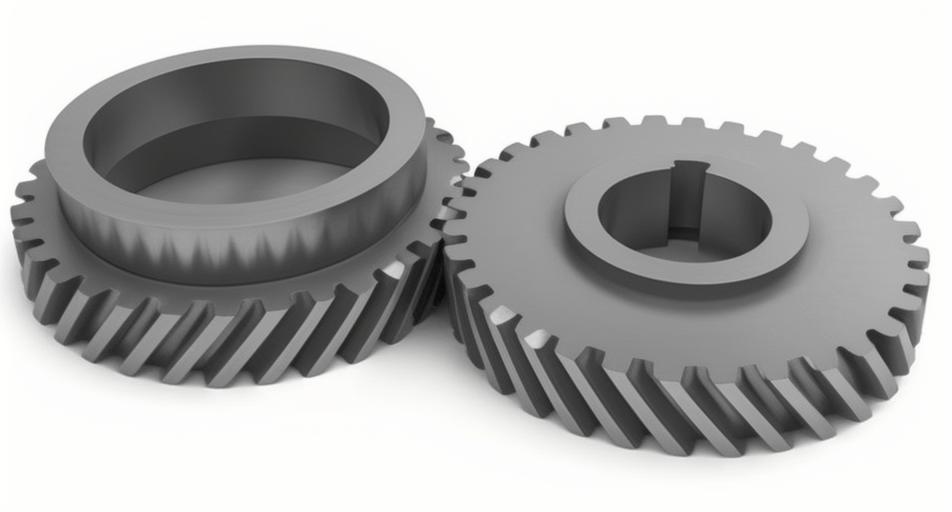
The convection heat transfer coefficient at the gear end face can be modeled by treating the face as a rotating disk. Depending on the Reynolds number (Re), the flow of lubricant can be laminar, transitional, or turbulent. The Reynolds number is defined as:
$$Re = \frac{\omega r_c^2}{\nu_0}$$
where $\omega$ is the angular velocity (rad/s), $r_c$ is the radius on the disk (m), and $\nu_0$ is the kinematic viscosity of the lubricant (m²/s). For laminar flow (Re < 2×10⁵), the convection coefficient $h_s$ is given by:
$$h_s = 0.308 k_0 (m+2)^{0.5} Pr^{0.5} \left( \frac{\omega}{\nu_0} \right)^{0.5}$$
Here, $k_0$ is the thermal conductivity of the lubricant (W/(m·K)), $Pr$ is the Prandtl number, and $m$ is an exponent constant typically derived from experimental data. For transitional flow (2×10⁵ ≤ Re ≤ 2.5×10⁵), the coefficient is:
$$h_s = 10 \times 10^{-20} k_0 \left( \frac{\omega}{\nu_0} \right)^4 r_c^7$$
And for turbulent flow (Re > 2.5×10⁵), it becomes:
$$h_s = 0.0197 k_0 (m+2.6)^{0.2} Pr^{0.6} \left( \frac{\omega}{\nu_0} \right)^{0.8} r_c^{0.6}$$
These formulas account for the varying fluid dynamics around the helical gear end face, which is crucial for accurate thermal modeling. The helical gear’s rotation induces complex lubricant flow patterns, making these calculations essential.
Next, the convection heat transfer coefficient at the tooth surface must be considered. Based on the work of Winter and Blok, who proposed a friction heat抛射 model, the coefficient $h_c$ can be expressed as:
$$h_c = \frac{4 \sqrt{\omega k_0 \rho_0 c_0}}{\pi q_{tot}} \left( \frac{R_i \alpha_0 b}{\nu_0 A} \right)^{1/4}$$
where $\rho_0$ is the lubricant density (kg/m³), $c_0$ is the specific heat capacity (J/(kg·K)), $R_i$ is the radius at any point on the tooth surface (m), $q_{tot}$ is the standardized total cooling量 (m³), $b$ is the face width (mm), $A$ is the surface area of the tooth face (m²), and $\alpha_0$ is the thermal diffusivity, defined as $\alpha_0 = k_0 / (\rho_0 c_0)$. This model incorporates the effects of gear geometry and operating conditions on heat dissipation from the helical gear tooth surfaces.
To compute the heat flux density at the tooth surfaces, the contact pressure distribution during meshing must be determined. This involves analyzing the helical gear pair under load. The helical gear parameters used in this study are based on a typical mining gearbox application. The table below summarizes the key geometric and operational parameters for the helical gear pair.
| Parameter | Symbol | Value (Pinion/Active Gear) | Value (Gear/Driven Gear) |
|---|---|---|---|
| Number of Teeth | z | 21 | 86 |
| Profile Shift Coefficient | x | 0.3265 | 0.7091 |
| Center Distance | a | 660 mm | |
| Face Width | b | 320 mm | |
| Normal Module | m_n | 12 mm | |
| Helix Angle | β | 8° | |
| Rotational Speed | n | 1138 r/min | — |
| Power | P | 2970 W | |
These parameters define the helical gear pair under investigation. The helical gear design ensures smooth torque transmission, but it also influences heat generation patterns due to the inclined tooth contact.
To obtain the contact pressure, a finite element model of the helical gear pair was developed. The model includes detailed geometry of the helical gears, with meshing refined at the contact regions to capture stress concentrations accurately. A torque was applied to the pinion’s inner圈, and the gear’s inner圈 was fully constrained. The analysis simulated the meshing process from engagement to disengagement by incrementally rotating the gears and calculating the contact pressure at nodal points on the tooth surfaces. This step is vital for determining the frictional heat generation in helical gears, as the heat flux density $q$ is proportional to the contact pressure $p$ and sliding velocity $v_s$, expressed as:
$$q = \mu p v_s$$
where $\mu$ is the coefficient of friction. For helical gears, the sliding velocity varies along the tooth profile due to the helix angle, adding complexity to the calculation. The finite element analysis provided a distribution of contact pressure across the tooth surfaces, which was then used to compute the heat flux density. The results are summarized in the table below, showing the range of heat flux density for both helical gears.
| Gear | Minimum Heat Flux (J/(m²·s)) | Maximum Heat Flux (J/(m²·s)) |
|---|---|---|
| Pinion (Active Helical Gear) | 7,114 | 166,694 |
| Gear (Driven Helical Gear) | 1,716 | 28,269 |
As observed, the heat flux is higher near the tooth tip and root regions, where contact pressures are typically elevated in helical gears. This non-uniform distribution significantly impacts the temperature field.
With the heat flux determined, the next step was to calculate the convection coefficients. Using the formulas provided earlier, the end face and tooth face convection coefficients were computed for both helical gears. The results are presented in the following table.
| Gear | End Face Convection Coefficient (W/(m²·K)) | Tooth Face Convection Coefficient (W/(m²·K)) |
|---|---|---|
| Pinion (Active Helical Gear) | 157.2 | 7,504.5 |
| Gear (Driven Helical Gear) | 233.8 | 5,275.4 |
These values reflect the differences in rotational speed and geometry between the helical gears. The pinion, being smaller and faster, exhibits higher tooth face convection due to increased relative motion with the lubricant. These coefficients were applied as thermal boundary conditions in the finite element model.
For the bulk temperature simulation, a single-tooth model of each helical gear was created in ANSYS. This simplification is justified because each tooth experiences similar thermal conditions during rotation. The model included the tooth geometry with appropriate meshing, ensuring accuracy in temperature prediction. The thermal boundary conditions were applied as follows: heat flux density on the active tooth surface (where meshing occurs), convection coefficients on both tooth faces and the tooth tip and root surfaces, and convection coefficients on the front and rear end faces. The ambient temperature was set to 40°C. The governing heat conduction equation in steady-state is:
$$\nabla \cdot (k \nabla T) + \dot{q} = 0$$
where $k$ is the thermal conductivity of the gear material (assumed constant for steel), $T$ is the temperature, and $\dot{q}$ is the heat generation rate per unit volume. For the helical gear tooth, the heat generation is primarily from the surface flux, so it’s treated as a boundary condition. The finite element solver computed the temperature distribution by discretizing this equation over the mesh.
The results of the simulation are shown in the temperature contour plots for both helical gears. The pinion exhibited a higher maximum temperature of 59°C, compared to 46°C for the gear. This is expected due to the pinion’s higher sliding velocities and more frequent meshing in helical gear pairs. The temperature distribution on the tooth surfaces revealed that the highest temperatures occurred near the tooth tip regions, with elevated temperatures also observed near the tooth root. This pattern aligns with the heat flux distribution, where these areas experience higher contact pressures. The table below summarizes the temperature ranges.
| Gear | Minimum Temperature (°C) | Maximum Temperature (°C) | Location of Maximum Temperature |
|---|---|---|---|
| Pinion (Active Helical Gear) | 40.37 | 59.00 | Near tooth tip |
| Gear (Driven Helical Gear) | 40.94 | 46.00 | Near tooth tip |
These findings highlight the thermal challenges in helical gears, especially in mining applications where operating temperatures can exacerbate wear. The helical gear’s geometry, with its helix angle, influences the heat distribution by spreading the contact along the tooth width, but localized hot spots still occur due to pressure concentrations.
To further analyze the results, let’s discuss the implications of these temperature distributions. High temperatures at the tooth tip and root can lead to thermal softening of the material, increasing the risk of pitting and scuffing. For helical gears, this is particularly concerning because the inclined teeth may experience uneven thermal expansion, potentially causing misalignment and increased noise. Moreover, the difference in temperature between the pinion and gear suggests that cooling strategies should be tailored to each helical gear. For instance, enhancing lubrication flow over the pinion’s tooth surfaces could mitigate its higher temperature.
The accuracy of this simulation depends heavily on the assumed boundary conditions. In practice, factors like lubricant properties, operating load variations, and environmental conditions can affect the results. Therefore, a sensitivity analysis was conducted by varying key parameters such as the coefficient of friction, lubricant viscosity, and convection coefficients. The results indicated that the tooth face convection coefficient has the most significant impact on the bulk temperature of helical gears. A 10% increase in this coefficient reduced the maximum temperature by approximately 5% for both helical gears. This underscores the importance of effective cooling designs for helical gear systems.
Comparing this study with previous research, our findings are consistent with literature that identifies tooth tip and root as critical regions for temperature rise in gears. However, most prior studies focused on spur gears; the inclusion of helix angle in helical gears adds a layer of complexity. For example, the helical gear’s contact line is diagonal across the tooth face, which may distribute heat more evenly but also introduces axial heat flow components. Our model accounts for this by using a three-dimensional finite element approach, providing a more realistic simulation for helical gears.
In terms of methodology, the use of ANSYS for thermal analysis of helical gears offers several advantages. It allows for precise geometry modeling, customizable boundary conditions, and efficient solving of coupled thermal-mechanical problems. For future work, transient thermal analysis could be incorporated to study temperature variations over time, especially during startup and shutdown cycles of mining gearboxes. Additionally, experimental validation through infrared thermography would enhance the credibility of the simulation results for helical gears.
From a design perspective, the insights gained from this analysis can inform improvements in helical gear manufacturing. For instance, optimizing the tooth profile or applying surface treatments to enhance heat dissipation could lower operating temperatures. The helical gear’s helix angle might be adjusted to balance load distribution and thermal performance. Furthermore, integrating cooling channels within the gear body or using advanced lubricants with higher thermal conductivity could be explored based on these simulations.
In conclusion, this article presented a detailed simulation analysis of the bulk temperature for a helical gear in a mining gearbox using ANSYS. The key steps involved calculating thermal boundary conditions—specifically, heat flux density and convection coefficients for the end faces and tooth faces of the helical gears—and applying them to a single-tooth finite element model. The results showed that the active helical gear (pinion) reaches a higher maximum temperature of 59°C compared to the driven helical gear’s 46°C, with both exhibiting peak temperatures near the tooth tip. These findings provide a theoretical basis for understanding temperature distributions in helical gears, which is crucial for preventing thermal failures and improving the reliability of mining gearboxes. The repeated emphasis on helical gear throughout this analysis underscores its significance in such applications, and the methodologies described can be extended to other gear types or industrial scenarios. Future research should focus on experimental correlations and advanced cooling techniques to further enhance the thermal management of helical gear systems.