
In mechanical transmission systems, helical gears play a pivotal role due to their high load capacity, smooth operation, and reduced noise compared to spur gears. However, the dynamic behavior of helical gears during meshing is inherently nonlinear, influenced by factors such as time-varying mesh stiffness, impact forces, and system vibrations. Understanding these dynamics is crucial for noise reduction and performance optimization. In this study, we employ a three-dimensional contact finite element method to model a helical gear pair-shaft-bearing system, analyzing its dynamic responses and spectral characteristics under various boundary conditions. Our goal is to provide a detailed investigation into the vibration mechanisms, leveraging advanced simulation techniques to capture phenomena often overlooked in prior research.
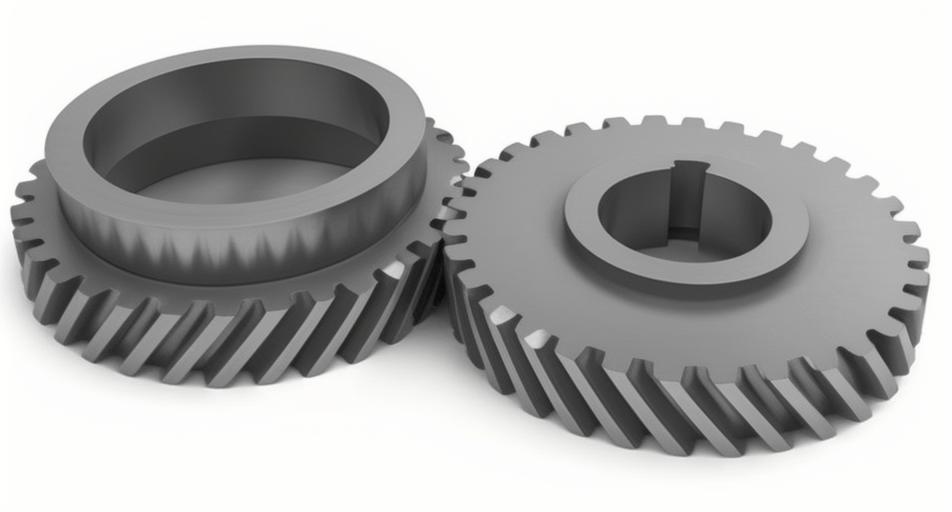
The significance of helical gears in industries like aerospace and marine engineering cannot be overstated. Their design allows for gradual tooth engagement, which minimizes shock loads and acoustic emissions. Yet, dynamic excitations during operation can lead to excessive vibrations, fatigue failures, and noise issues. Traditional modeling approaches, such as lumped-parameter methods, simplify the system by representing shafts and bearings as spring elements, potentially missing critical rotor-dynamic effects. Finite element analysis (FEA) offers a more accurate alternative by directly simulating contact interactions and structural flexibilities. Here, we develop a comprehensive FEA model using ABAQUS software to explore the dynamic mesh behavior of helical gears, focusing on angular velocity, angular acceleration, and normal contact force responses. We examine three operational scenarios: constrained driven gear rotation, fully released driven gear degrees of freedom, and the addition of axial static thrust. Our analysis reveals enhanced vibration responses when shaft and bearing stiffness are considered, along with distinct modulation patterns in the frequency domain, characterized by sidebands around the mesh frequency. This work advances the understanding of helical gear dynamics, providing insights for design improvements and predictive maintenance strategies.
Finite Element Modeling Methodology
To accurately capture the dynamic behavior of helical gears, we constructed a detailed three-dimensional finite element model. The helical gear pair was designed with parameters typical for industrial applications, as summarized in Table 1. The gears were modeled in SolidWorks, ensuring precise tooth geometry with a right-hand helix for the driving gear and a left-hand helix for the driven gear. This configuration promotes axial force components that must be accounted for in dynamic analyses. The model was then imported into HyperMesh for meshing, where we generated a high-quality hexahedral dominant mesh to improve solution accuracy and convergence. The finite element discretization resulted in 647,992 C3D8 elements for the gears, 28 B31 beam elements for the shafts, and 4 wire elements with stiffness properties to simulate bearings. This approach allows us to incorporate the effects of shaft flexibility and bearing support conditions, which are often simplified in lumped-parameter models.
| Parameter | Driving Gear | Driven Gear |
|---|---|---|
| Number of Teeth | 17 | 44 |
| Handedness | Right-handed | Left-handed |
| Normal Module (mm) | 6 | 6 |
| Transverse Pressure Angle (°) | 20 | 20 |
| Helix Angle (°) | 24.43 | 24.43 |
| Face Width (mm) | 55 | 55 |
The assembled system includes shafts connected to the gear hubs via kinematic coupling constraints, enabling controlled application of loads and boundary conditions. The driving gear shaft has a diameter of 60 mm, while the driven gear shaft is 120 mm in diameter, reflecting a realistic power transmission setup. Bearings are modeled as linear springs with stiffness values in translational and rotational directions, as detailed in Table 2. These stiffness values are chosen to represent typical rolling element bearings, ensuring that the model captures the support dynamics accurately. The contact between the helical gears is defined using a surface-to-surface interaction with finite sliding formulation. The normal behavior is set to “hard contact,” while tangential friction is neglected to simplify the analysis, focusing primarily on normal force variations. This assumption is valid for well-lubricated helical gears where friction effects are secondary to mesh stiffness variations.
| Parameter | Value |
|---|---|
| Driving Gear Speed (rad/s) | 125.66 |
| Driven Gear Torque (N·m) | 300 |
| Driving Shaft Diameter (mm) | 60 |
| Driven Shaft Diameter (mm) | 120 |
| Bearing Stiffness (N/m or N·m/rad) | $k_{xx} = 1 \times 10^8$, $k_{yy} = 1 \times 10^8$, $k_{zz} = 5 \times 10^7$, $k_{\theta_x \theta_x} = 5 \times 10^6$, $k_{\theta_y \theta_y} = 5 \times 10^6$ |
The simulation is conducted using the ABAQUS/Implicit dynamic solver, which is suitable for nonlinear transient analyses involving contact. We define two analysis steps: an initial step where the driven gear is fixed to establish contact, and a subsequent step where boundary conditions are applied for dynamic analysis. The total simulation time is 1 second, with an automatic time incrementation scheme and a minimum increment of $1 \times 10^{-8}$ seconds to ensure stability. Outputs include the angular velocity and acceleration of the driven gear center, as well as the normal dynamic contact force at the mesh interface. These metrics are critical for evaluating the dynamic transmission error (DTE), a key indicator of gear vibration. The DTE is derived from the relative acceleration between gear pairs, given by:
$$a_{\text{DTE}} = r_p \ddot{\theta}_p + r_g \ddot{\theta}_g$$
where $r_p$ and $r_g$ are the base circle radii, and $\ddot{\theta}_p$ and $\ddot{\theta}_g$ are the angular accelerations of the driving and driven helical gears, respectively. In our setup, the driving gear acceleration is zero, simplifying the DTE to a function of the driven gear’s response. This formulation helps quantify the dynamic performance of helical gears under varying conditions.
Definition of Operational Scenarios
We investigate three distinct scenarios to assess the influence of boundary conditions on helical gear dynamics. These scenarios are designed to progressively increase system flexibility and external loading, mimicking real-world operational variations.
Scenario 1: Driven Gear with Only Rotational Freedom. In this case, the driven gear’s center is constrained to rotate only about its axis, while all other degrees of freedom are fixed. This represents an idealized condition where the shaft and bearing supports are extremely rigid, akin to a perfectly aligned system mounted on a stiff foundation. It serves as a baseline to isolate the effects of mesh-induced vibrations without rotor-dynamic interactions.
Scenario 2: Fully Released Driven Gear. Here, all degrees of freedom at the driven gear center are released, with the system’s motion constrained solely by the bearing springs. This scenario introduces the compliance of the shaft and bearings, allowing for translational and rotational vibrations. It reflects a more realistic operational state where support stiffness influences the dynamic response of helical gears.
Scenario 3: Fully Released Driven Gear with Axial Static Thrust. This scenario builds upon Scenario 2 by applying a constant axial force of 1000 N at the driven gear center. Axial loads are common in helical gear applications due to the helix angle, and this condition tests the system’s sensitivity to such thrust forces. It helps evaluate whether axial preloads significantly alter vibration characteristics or contact forces.
These scenarios enable a comprehensive analysis of how boundary conditions affect the dynamic behavior of helical gears. By comparing results, we can identify the contributions of structural flexibility and external loads to overall system vibrations.
Dynamic Response Analysis in Time Domain
The time-domain responses of the helical gear system are evaluated through angular velocity, angular acceleration, and normal dynamic contact force. Under Scenario 1, where the driven gear has only rotational freedom, the outputs exhibit periodic fluctuations with sharp peaks, as shown in Figure 2 (note: figures are referenced conceptually; actual plots are embedded in simulation outputs). The angular velocity oscillates around a mean value of 48.5508 rad/s, closely matching the theoretical steady-state value calculated from gear ratios. The peaks occur at intervals of approximately 0.05 seconds, corresponding to the driving gear’s rotational period of 0.05 seconds (20 Hz frequency). This indicates repetitive impact-like events due to time-varying mesh stiffness and engagement shocks. The root mean square (RMS) of angular acceleration is 70.6920 rad/s², and the dynamic contact force has an RMS of 2453.6 N. Compared to the theoretical static contact force $F_n$ computed as:
$$F_n = \frac{2 T_m}{m_n z_g \cos \alpha_t}$$
where $T_m = 300$ N·m is the torque, $m_n = 6$ mm is the normal module, $z_g = 44$ is the number of teeth on the driven helical gear, and $\alpha_t = 20^\circ$ is the transverse pressure angle. Substituting values yields $F_n = 2419$ N. The dynamic force in Scenario 1 exceeds this by only 1.4%, suggesting that nonlinear effects are minimal when the gear is rotationally constrained.
In Scenario 2, with the driven gear fully released, the time-domain responses show increased oscillation amplitudes without distinct impact peaks. The angular velocity RMS rises to 48.5563 rad/s, indicating greater speed fluctuations. The angular acceleration RMS jumps to 143.6954 rad/s², more than doubling from Scenario 1, highlighting intensified vibrations. The dynamic contact force RMS increases to 2677.5 N, a 10.6% rise over the static value. This underscores the significant influence of shaft and bearing compliance on helical gear dynamics. The absence of sharp peaks suggests that flexibility dampens sudden impacts but amplifies overall vibratory motion.
Scenario 3, with added axial thrust, produces responses similar to Scenario 2. The angular velocity RMS is 48.5574 rad/s, angular acceleration RMS is 153.9685 rad/s², and dynamic contact force RMS is 2680.8 N. The marginal differences from Scenario 2 indicate that a 1000 N axial load has negligible effect on the dynamic behavior of these helical gears. This implies that, for the given design, axial forces from helix angles may not drastically alter vibration levels unless magnitudes are substantially higher.
Table 3 summarizes the key metrics across scenarios, emphasizing the trend of increasing vibration with added flexibility. The dynamic contact force is particularly sensitive, reflecting how mesh loads are transmitted through the compliant supports.
| Metric | Scenario 1 | Scenario 2 | Scenario 3 | Theoretical Steady State |
|---|---|---|---|---|
| Angular Velocity Mean (rad/s) | 48.5508 | 48.5563 | 48.5575 | 48.5505 |
| Angular Velocity RMS (rad/s) | 48.5508 | 48.5536 | 48.5574 | – |
| Angular Acceleration Mean (rad/s²) | -8.9214 | -10.1836 | -11.6293 | 0 |
| Angular Acceleration RMS (rad/s²) | 70.6920 | 143.6954 | 153.9685 | – |
| Dynamic Contact Force Mean (N) | 2452.3 | 2662.1 | 2665.8 | 2419 |
| Dynamic Contact Force RMS (N) | 2453.6 | 2677.5 | 2680.8 | – |
Spectral Characteristics and Modulation Phenomena
Frequency-domain analysis provides deeper insights into the vibration mechanisms of helical gears. We convert the time-domain signals to frequency spectra using Fourier transforms with a 1 Hz resolution, focusing on the fluctuation components after mean removal. In Scenario 1, the spectra are dominated by the driving gear rotational frequency (20 Hz) and its harmonics, as seen in Figure 3. Peaks at 340 Hz and 680 Hz correspond to the mesh frequency $f_z$ and its second harmonic, where $f_z$ is calculated from the driving gear speed $n$ and tooth count $z_p$:
$$f_z = \frac{n \cdot z_p}{60}$$
For $n = 1200$ rpm (125.66 rad/s) and $z_p = 17$, $f_z = 340$ Hz. Additional peaks at 640 Hz and 720 Hz are combinations of these frequencies, indicating nonlinear interactions. However, sidebands around the mesh frequency are absent, suggesting minimal modulation effects when the driven helical gear is rotationally constrained.
In Scenario 2, the spectra exhibit significant changes, as shown in Figure 5. The amplitude at the mesh frequency increases dramatically—for angular velocity, it rises from 0.005 to 0.03 in normalized units. Moreover, distinct sidebands appear around $f_z$, spaced at the driven gear rotational frequency $f_n = 7.7$ Hz (calculated from the gear ratio). For instance, peaks at 332 Hz ($f_z – f_n$) and 348 Hz ($f_z + f_n$) are visible, along with higher-order sidebands at $f_z \pm 2f_n$. This pattern indicates a modulation phenomenon, where the mesh frequency is modulated by the driven gear’s rotation. Similar sidebands are observed in the angular acceleration and dynamic contact force spectra, confirming that modulation is a systemic feature when shaft and bearing stiffness are considered.
Scenario 3 spectra closely resemble those of Scenario 2, with no notable shifts in frequency content or amplitude distribution. This reinforces that axial thrust has minimal impact on the spectral characteristics of these helical gears.
The modulation phenomenon can be explained through both amplitude modulation (AM) and frequency modulation (FM) theories. In AM, the dynamic response $x(t)$ of helical gears can be expressed as a carrier signal at the mesh frequency multiplied by a modulating function related to rotational frequencies:
$$x(t) = \sum_{m=0}^{N} A_m [1 + a_m(t)] \cos(2\pi m f_z t + \phi_m)$$
where $A_m$ is the amplitude of the $m$-th harmonic, $f_z$ is the mesh frequency, and $a_m(t)$ is the modulating signal. For a single modulating frequency $f_n$, $a_m(t) = \beta_m \cos(2\pi f_n t)$, with $\beta_m$ as the modulation index. Expanding this using trigonometric identities yields:
$$x_m(t) = A_m \cos(2\pi m f_z t + \phi_m) + \frac{1}{2} \beta_m A_m \left\{ \cos[2\pi m (f_z + f_n)t + \phi_m] + \cos[2\pi m (f_z – f_n)t + \phi_m] \right\}$$
This results in sidebands at $f_z \pm f_n$, matching our observations. In FM, the mesh frequency itself varies due to speed fluctuations caused by elastic deformations. The time-varying mesh stiffness $k(t)$ can be Fourier-expanded as:
$$k(t) = K_0 + \sum_{i=0}^{I} k_i \cos(2\pi i f_z t + \alpha_i)$$
If the rotational speed $n(t)$ fluctuates around a mean $n_0$ with components at $f_n$, then the instantaneous mesh frequency becomes:
$$f_z(t) = \frac{n(t) \cdot z}{60} = f_z + \Delta f(t)$$
where $\Delta f(t)$ includes terms proportional to $\cos(2\pi f_n t)$. Substituting into the stiffness expression introduces phase modulation, generating sidebands in the frequency spectrum. Thus, the observed modulation in helical gears arises from both amplitude variations due to load changes and frequency variations due to rotational speed oscillations.
Discussion on Helical Gear Dynamics
The results highlight several key aspects of helical gear behavior. First, the inclusion of shaft and bearing stiffness markedly increases vibration levels, as seen in the higher RMS values of angular acceleration and dynamic contact force in Scenarios 2 and 3. This underscores the importance of modeling support compliance in dynamic analyses of helical gears. Flexible supports allow for more degrees of freedom, leading to complex rotor-dynamic interactions that amplify responses. Second, the spectral analysis reveals that modulation is a dominant feature when the system is not overly constrained. The sidebands around the mesh frequency provide diagnostic markers for condition monitoring; for instance, increased sideband amplitudes could indicate wear or misalignment in helical gears. Third, the insensitivity to axial thrust suggests that, for moderate loads, the dynamic response is governed primarily by mesh stiffness and support conditions rather than axial forces. However, this may change with higher thrust levels or different helix angles.
Comparisons with prior studies show that our finite element approach captures richer spectral details, such as clear sidebands, which are often omitted in lumped-parameter models. The high frequency resolution (1 Hz) allows for precise identification of modulation components. Additionally, the dynamic transmission error, derived from angular accelerations, serves as a reliable metric for evaluating gear vibration performance. These insights can guide the design of quieter and more durable helical gear systems, for instance, by optimizing bearing stiffness or tooth modifications to reduce modulation effects.
Conclusion
In this study, we developed a three-dimensional contact finite element model to analyze the dynamic response and spectral characteristics of helical gears under varying boundary conditions. The model incorporates shaft and bearing stiffness, providing a realistic representation of gear-shaft-bearing systems. We examined three scenarios: driven gear with only rotational freedom, fully released driven gear, and released gear with axial static thrust. Time-domain results show that vibration amplitudes increase significantly when support flexibility is considered, with angular acceleration and dynamic contact force rising by over 100% and 10%, respectively. Frequency-domain analysis reveals distinct modulation phenomena, where the mesh frequency is modulated by the driven gear’s rotational frequency, producing sidebands in the spectrum. This modulation is explained through amplitude and frequency modulation theories, linking it to load variations and speed fluctuations. The axial thrust has negligible impact on dynamics for the given load. These findings enhance our understanding of helical gear vibrations, emphasizing the role of support compliance and modulation effects. Future work could explore the influence of damping, tooth friction, and varying operational speeds on helical gear behavior, further refining predictive models for noise and vibration control.