
The smooth, quiet, and reliable transmission of power in modern machinery hinges on understanding the complex interplay between internal excitations and the external vibration signature of gear systems. Among these, helical gears are a cornerstone of advanced drivetrain design due to their superior load capacity and smooth operation resulting from higher contact ratios. However, their performance and longevity are critically challenged by inherent nonlinear dynamic phenomena such as tooth surface friction and gear tooth surface damage like pitting spalling. Friction is not merely a source of power loss but a significant excitation mechanism that induces vibration and noise. Simultaneously, surface fatigue in the form of pitting spalling represents a common failure mode that alters the gear mesh stiffness and introduces impulsive forces. Crucially, these phenomena are not isolated; surface damage can exacerbate friction, and friction can accelerate the progression of surface damage, creating a coupled degradation cycle. Therefore, a deep investigation into the relationship between these coupled internal nonlinear excitations—friction and spalling—and the external dynamic response of helical gears is paramount for predictive maintenance, noise reduction, and the design of more robust transmissions. This analysis aims to bridge that gap by developing comprehensive mathematical models for these excitations and examining their individual and combined effects on the vibration characteristics of a helical gear pair.
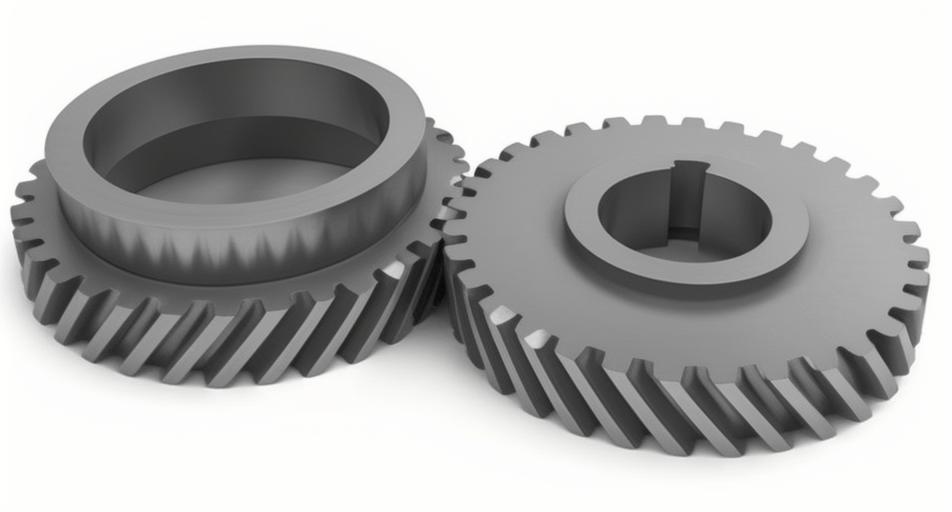
The dynamic behavior of helical gears is intrinsically more complex than that of spur gears due to the axial force component introduced by the helix angle. This leads to a coupled bending-torsional-axial vibration system. When considering friction, which acts tangentially to the tooth profile, an additional degree of freedom perpendicular to the line of action must be accounted for. This study builds upon the fundamental kinematics of helical gears, specifically the time-varying contact line. The total friction force and torque on a gear are derived from the difference in friction forces acting on either side of the pitch line along the instantaneously engaged contact lines. Assuming load is uniformly distributed along each segment of the contact line, the friction force and moment for a single tooth pair can be expressed as functions of the meshing position.
Let $\mu$ represent the coordinate of the meshing position in the transverse plane, defined as the distance from point 2B (the start of engagement in the transverse plane) to the projection of the contact line intersection. The friction force $f_f(\mu)$ and friction moments $t_{fp}(\mu)$ and $t_{fg}(\mu)$ for the pinion and gear, respectively, for a single tooth pair are:
$$
\begin{cases}
f_f(\mu) = \eta \frac{F_n}{L(\mu)} \left[ l_L(\mu) – l_R(\mu) \right] \\[6pt]
t_{fp}(\mu) = \eta \frac{F_n}{L(\mu)} \left[ l_L(\mu) \cdot h_{Lp}(\mu) – l_R(\mu) \cdot h_{Rp}(\mu) \right] \\[6pt]
t_{fg}(\mu) = \eta \frac{F_n}{L(\mu)} \left[ l_R(\mu) \cdot h_{Rg}(\mu) – l_L(\mu) \cdot h_{Lg}(\mu) \right]
\end{cases}
$$
where $\eta$ is the coefficient of friction, $F_n$ is the normal load, $L(\mu)$ is the total contact line length, $l_L(\mu)$ and $l_R(\mu)$ are the lengths of the contact line segments on the left and right sides of the pitch line, and $h_{Lj}(\mu), h_{Rj}(\mu)$ (for $j = p, g$) are the friction arms (radii) for the pinion and gear segments. Over one base pitch $p_{bt}$, with $N$ denoting the number of simultaneously engaged tooth pairs, the total friction excitation terms are:
$$
\begin{cases}
F_f(\mu) = \sum_{i=0}^{N-1} f_f(\mu + i \cdot p_{bt}) \\[6pt]
T_{fp}(\mu) = \sum_{i=0}^{N-1} t_{fp}(\mu + i \cdot p_{bt}), \quad \mu \in [0, p_{bt}] \\[6pt]
T_{fg}(\mu) = \sum_{i=0}^{N-1} t_{fg}(\mu + i \cdot p_{bt})
\end{cases}
$$
Modeling the stiffness reduction due to pitting spalling requires characterizing the loss of contact along the tooth flank. The spall is modeled as a parallelogram, with its long side parallel to the contact line and its short side parallel to the transverse plane. The geometry is defined by the spall center $o$, its length $l_s$, and its width $w_s$. The key effect is the reduction in the effective contact line length $l_p(\mu)$ at a given meshing position $\mu$, calculated based on the intersection of the spall area with the instantaneous contact path. The reduction $\Delta l_p(\mu)$ is:
$$
\Delta l_p(\mu) =
\begin{cases}
0, & \mu \le x_1 \\
l_s, & x_1 < \mu \le x_2 \\
0, & x_2 < \mu \le \epsilon_{\gamma} p_{bt}
\end{cases}
$$
where $x_1$ and $x_2$ are the meshing positions where the contact line enters and exits the spall region, respectively, and $\epsilon_{\gamma}$ is the total contact ratio. The resulting effective single-tooth-pair stiffness $k_{sp}(\mu)$ for a spalled tooth is then a function of the reduced contact line length $l_p(\mu) = l(\mu) – \Delta l_p(\mu)$ and the unit stiffness distribution $k_0(\mu)$. The unit stiffness for a helical gear pair is often approximated by a parabolic function:
$$
k_0(\mu) = 4 \alpha_k (1 – \alpha_k) \frac{\mu}{p_{bt}} – 4 (1 – \alpha_k) \left( \frac{\mu}{p_{bt}} \right)^2 + \alpha_k
$$
where $\alpha_k$ is the ratio of minimum to maximum single-tooth stiffness, typically taken as 0.55. The single-tooth-pair stiffness is $k(\mu) = k_{max} \cdot l(\mu) \cdot k_0(\mu)$, where $k_{max}$ is the maximum single-tooth-pair stiffness calculable from standards like ISO 6336. The total mesh stiffness $K(\mu)$ is the sum of the stiffnesses of all $N$ engaged tooth pairs.
To analyze the dynamic response, an eight-degree-of-freedom (8-DOF) lumped-parameter, translational-torsional coupled dynamic model is established. The model accounts for vibrations along the line of action (LOA, y-direction), off-line of action (OLOA, x-direction), and axial direction (z-direction), as well as torsional vibrations ($\theta$) for both the pinion (p) and gear (g). The displacement vector is:
$$
\mathbf{X} = \{ x_p, y_p, z_p, \theta_p, x_g, y_g, z_g, \theta_g \}^T
$$
The bearings, shafts, and housing supports are simplified as equivalent stiffness $k_{ij}$ and damping $c_{ij}$ elements ($i=p,g; j=x,y,z$). The dynamic transmission error along the normal direction of the tooth surface is a composite of displacements:
$$
\begin{cases}
\delta_n = \delta_y \cos \beta_b + \delta_z \sin \beta_b \\[4pt]
\delta_y = (y_p – y_g) + (r_{bp} \theta_p – r_{bg} \theta_g) \\[4pt]
\delta_z = z_p – z_g
\end{cases}
$$
where $\beta_b$ is the base helix angle, and $r_{bp}, r_{bg}$ are the base circle radii. The dynamic meshing force $F_m$ is given by the linear spring-damper model: $F_m = k_m \delta_n + c_m \dot{\delta}_n$, where $k_m$ is the total mesh stiffness (incorporating spalling effects) and $c_m$ is the mesh damping. This force is decomposed into components along the LOA and axial directions: $F_y = F_m \cos \beta_b$, $F_z = F_m \sin \beta_b$. The coupled equations of motion are derived from Newton’s second law:
$$
\begin{cases}
m_p \ddot{x}_p + c_{px} \dot{x}_p + k_{px} x_p = F_f(\mu, t) \\
m_p \ddot{y}_p + c_{py} \dot{y}_p + k_{py} y_p = -F_y \\
m_p \ddot{z}_p + c_{pz} \dot{z}_p + k_{pz} z_p = -F_z \\
J_p \ddot{\theta}_p = T_p – F_y r_{bp} + T_{fp}(\mu, t) \\[6pt]
m_g \ddot{x}_g + c_{gx} \dot{x}_g + k_{gx} x_g = -F_f(\mu, t) \\
m_g \ddot{y}_g + c_{gy} \dot{y}_g + k_{gy} y_g = F_y \\
m_g \ddot{z}_g + c_{gz} \dot{z}_g + k_{gz} z_g = F_z \\
J_g \ddot{\theta}_g = -T_g + F_y r_{bg} – T_{fg}(\mu, t)
\end{cases}
$$
Here, $m_i$, $J_i$ are masses and moments of inertia; $T_p$ and $T_g$ are input and output torques; and $F_f$, $T_{fp}$, $T_{fg}$ are the friction force and moments from the earlier formulation. This model captures the essential bending-torsion-axial coupling inherent to helical gears under combined friction and spalling excitation.
The analysis proceeds with a specific set of system parameters, as summarized in the table below. The numerical solution is obtained using the Runge-Kutta method to simulate the system’s dynamic response under various conditions.
| Gear Parameter | Pinion | Gear |
|---|---|---|
| Number of Teeth | 16 | 107 |
| Module (mm) | 5.5 | |
| Face Width (mm) | 80 | 75 |
| Pressure Angle (°) | 20 | |
| Helix Angle (°) | 17 | |
| Mass (kg) | 5.1 | 171 |
| Moment of Inertia (kg·m²) | 0.0067 | 8.1 |
| Bearing Support Stiffness (N/m) | 1.2 × 10⁹ | |
| Bearing Support Damping (Ns/m) | 4 × 10³ | |
| Input Speed (rpm) | 1800 | |
| Input Torque (N·m) | 1008 | |
The mesh damping $c_m$ is estimated using the empirical formula $c_m = 2 \xi_m \sqrt{k_m \frac{I_p I_g}{I_p r_{bg}^2 + I_g r_{bp}^2}}$, with a damping ratio $\xi_m$ of 0.07. The primary meshing frequency $f_m$ is $f_m = n \cdot z_p / 60 = 480$ Hz.
The first investigation concerns the influence of the equivalent support stiffness. The mean LOA displacement of the pinion was computed for a range of stiffness values. The results indicate high sensitivity and variability when the support stiffness is low (below $0.5 \times 10^9$ N/m). As stiffness increases, the displacement response stabilizes. To minimize this sensitivity in subsequent analyses, a stiffness value of $1.2 \times 10^9$ N/m is adopted, representative of a rigidly supported system.
The impact of tooth surface friction on the dynamic response is significant and multifaceted. In the time domain, friction causes a slight reduction (approximately 0.6%) in the mean value of the dynamic meshing force $F_m$. However, its most pronounced effect is seen in the frequency domain, where the amplitudes at the meshing frequency $f_m$ and its second harmonic $2f_m$ increase substantially. This confirms that friction acts as a potent excitation source, intensifying the vibration levels of the helical gear system. Similarly, friction increases the peak-to-peak value of the dynamic transmission error (DTE) and the amplitude at $f_m$ in its spectrum, indicating a degradation in kinematic accuracy under load.
The coupling effects in helical gears make the influence of friction spatially complex. Friction directly excites vibration in the OLOA direction (x-direction). The pinion’s OLOA displacement, which is negligible without friction, exhibits clear periodic vibration at $f_m$ and its harmonics when friction is considered. More interestingly, due to the bending-torsion-axial coupling, friction also significantly affects the primary LOA vibration. While the mean LOA displacement slightly decreases with friction, its oscillation amplitude increases. The frequency spectrum of the LOA displacement shows marked growth at $f_m$ and $2f_m$. This demonstrates that friction cannot be treated as an isolated excitation affecting only one direction; it perturbs the entire coupled dynamic state of the helical gear pair.
Introducing pitting spalling as a fault introduces characteristic impulsive behavior. The analysis compares three cases: healthy gears without friction, spalled gears without friction, and spalled gears with friction. In the time domain, both the DTE and dynamic meshing force for the spalled case exhibit distinct double-impact patterns as the meshing contact enters and exits the spall region. The inclusion of friction with spalling further amplifies the oscillatory response within and around these impact zones. In the frequency domain, spalling generates a tell-tale modulation pattern: the spectrum becomes populated with numerous sidebands around the meshing frequency and its harmonics. These sidebands are a direct signature of the periodic impulse induced once per gear revolution due to the localized fault. The pinion’s LOA displacement response follows the same trend, showing clear impact features and sideband activity, underscoring the primary role of the pinion’s motion in the system’s overall vibration due to its higher rotational speed.
The severity of the spalling fault, characterized here by its length $l_s$, has a predictable and quantifiable effect. The table below summarizes the observed trends in vibration response features with increasing spall length.
| Response Metric | Trend with Increasing Spall Length ($l_s$) |
|---|---|
| DTE Impact Amplitude | Increases |
| Meshing Force Impact Amplitude | Increases |
| LOA Displacement Impact Amplitude | Increases |
| Sideband Amplitude in Spectra | Increases |
For all dynamic signals—DTE, meshing force, and LOA displacement—the time-domain impact amplitude grows monotonically with $l_s$. In the frequency domain, the amplitudes of the fault-induced sidebands around the gear meshing frequency and its harmonics also increase. This provides a potential diagnostic link between the severity of the surface damage and measurable vibration metrics.
In conclusion, this comprehensive analysis elucidates the complex vibration characteristics of helical gear transmissions under the coupled excitation of tooth surface friction and pitting spalling. The derived mathematical models for time-varying friction and spalling-dependent mesh stiffness, integrated into an 8-DOF coupled dynamic model, provide a robust framework for simulation. The key findings are that tooth surface friction significantly amplifies vibratory activity, particularly at the meshing frequency, and degrades transmission error, with its effects permeating all coupled vibration directions due to the unique geometry of helical gears. Pitting spalling introduces distinct double-impact signatures in the time domain and characteristic sidebands in the frequency domain, with the severity of these features scaling with the spall’s length. Furthermore, the presence of friction exacerbates the oscillatory response during spall engagement. These insights into the relationship between internal nonlinear excitations and external vibration responses are crucial for advancing the condition monitoring, fault diagnosis, and dynamic design of high-performance helical gear systems operating under realistic conditions of wear and surface fatigue.