
In my research on advanced gear systems, I have extensively studied variable helical angle gears, which are critical components in applications such as grinding heads for precision machinery. These helical gears feature a unique design where the helical angle varies along the gear width, enabling smoother torque transmission and reduced noise compared to standard helical gears. This article presents a comprehensive methodology for the 3D modeling of variable helical angle gears, based on a novel theory that uses the gear tooth space as a reference and the middle cross-section as the基准面. I will detail the mathematical relationships between the twist angles of gear cross-sections and the helical angles of the tooth spaces, provide step-by-step modeling procedures, and propose a practical machining approach. Throughout this discussion, I will emphasize the importance of helical gears in modern engineering and how variable helical angle gears enhance their performance.
The core concept of variable helical angle gears lies in treating the tooth space as the fundamental reference. Unlike conventional helical gears with constant helical angles, these gears are constructed by twisting standard tooth spaces from a reference直齿齿轮 cross-section at different angles along the gear axis. This results in a gradual variation in the helical angle from one end to the other, optimizing engagement characteristics. The reference cross-section, denoted as C, is located at the midpoint of the gear width and consists of a standard spur gear profile. From this基准面, two twisted cross-sections, A and B, are derived at the gear ends by applying specific twist angles to each tooth space. This approach ensures that the tooth spaces remain invariant in shape and width, while the tooth thicknesses change symmetrically, accommodating the variable helical angles. Helical gears with such designs are particularly valuable in high-precision systems where dynamic loads and vibrations must be minimized.
To quantify the relationship between the twist angles of the gear cross-sections and the resulting helical angles of the tooth spaces, I developed a mathematical model. Consider a variable helical angle gear with a total width \(L\) and a reference cross-section C at the midpoint. Let \(\beta(x)\) represent the helical angle as a function of the position \(x\) along the gear axis, where \(x = -L/2\) corresponds to end A, \(x = 0\) to C, and \(x = L/2\) to end B. The twist angle \(\theta_i\) for the \(i\)-th tooth space at a given cross-section is related to the helical angle \(\beta_i\) at that location. For a tooth space with a lead \(P\) (axial distance for one complete revolution), the helical angle is given by:
$$ \tan \beta_i = \frac{\pi d}{P} $$
where \(d\) is the reference diameter of the gear. The twist angle \(\theta_i\) is essentially the angular displacement applied to the tooth space relative to the reference cross-section C. For small angles, the relationship can be approximated as:
$$ \theta_i = \frac{2\pi \cdot \Delta x \cdot \tan \beta_i}{d} $$
where \(\Delta x\) is the distance from the reference cross-section. This formula allows for the calculation of twist angles required to achieve desired helical angles. For instance, if the helical angle varies linearly from \(\beta_A\) at end A to \(\beta_B\) at end B, with \(\beta_C = 0\) at C (直齿), the twist angles can be computed incrementally. In my study, I used a gear with 44 teeth and a width of 54.5 mm (27.25 mm from C to each end), and the helical angles varied symmetrically. The following table summarizes the calculated twist angles for the tooth spaces on cross-sections A and B, based on a linear variation of helical angles from 0° at C to ±10° at the ends. Note that these values are illustrative; actual values depend on specific design parameters.
| Tooth Space Index (i) | Distance from C (mm) | Helical Angle \(\beta_i\) (degrees) | Twist Angle \(\theta_i\) for A (degrees) | Twist Angle \(\theta_i\) for B (degrees) |
|---|---|---|---|---|
| 0 (Reference) | 0 | 0 | 0 | 0 |
| 1 | ±1.24 | ±0.5 | +0.3 | -0.3 |
| 2 | ±2.48 | ±1.0 | +0.6 | -0.6 |
| … | … | … | … | … |
| 22 | ±27.25 | ±10.0 | +10.0 | -10.0 |
The table above demonstrates how the twist angles accumulate along the gear width. For cross-section A, the twist angles are positive (counter-clockwise), while for B, they are negative (clockwise), ensuring对称 variation. This mathematical framework is crucial for generating the twisted cross-sections needed for 3D modeling. Helical gears with variable angles rely on precise calculations to maintain proper meshing and load distribution.
Moving to the 3D modeling process, I employed a CAD-based approach using放样 (lofting) techniques to create the variable helical angle gear. The procedure involves three key cross-sections: the reference cross-section C (a standard spur gear), and the twisted cross-sections A and B. First, I generated the reference cross-section C by defining gear parameters such as module, number of teeth, and pressure angle. For a gear with module 2 mm and 44 teeth, the pitch diameter \(d\) is 88 mm. The tooth profile can be described by the involute curve equation:
$$ x = r_b (\cos \phi + \phi \sin \phi) $$
$$ y = r_b (\sin \phi – \phi \cos \phi) $$
where \(r_b\) is the base radius and \(\phi\) is the involute angle. This profile ensures smooth engagement in helical gears. Using CAD software, I created a 2D sketch of cross-section C, ensuring it is centered at the origin. This sketch serves as the基准面 for subsequent operations.
Next, I derived cross-sections A and B by applying the twist angles from the table to each tooth space in the reference cross-section. This is done by rotating each tooth space轮廓 around the gear center by the specified twist angle \(\theta_i\), while keeping the tooth space shape unchanged. For example, for cross-section A, tooth space 1 is rotated by +0.3°, tooth space 2 by +0.6°, and so on. Similarly, for cross-section B, negative rotations are applied. This process transforms the standard spur gear into twisted profiles where the tooth thicknesses vary, but the tooth spaces remain consistent. The following table outlines the twist angles for the first few tooth spaces, highlighting the progressive variation.
| Tooth Space Index | Twist Angle for A (degrees) | Twist Angle for B (degrees) | Resulting Tooth Thickness Variation |
|---|---|---|---|
| 0 | 0 | 0 | Constant (reference) |
| 1 | +0.3 | -0.3 | Decreases for A, increases for B |
| 2 | +0.6 | -0.6 | Further variation |
| 3 | +0.9 | -0.9 | Continuation of trend |
After preparing the three cross-sections, I proceeded to 3D modeling via放样. In CAD, I established three parallel sketch planes: one for cross-section C at the origin, one for A at \(z = -27.25\) mm, and one for B at \(z = +27.25\) mm. Each cross-section was imported onto its respective plane, aligned with the gear center. Then, using the lofting function, I created a solid model by blending cross-section C to A and cross-section C to B separately. This two-step lofting ensures a smooth transition along the gear width, resulting in a三维 model with variable helical angles. The lofting operation can be expressed mathematically as a linear interpolation between cross-sections. For any point along the gear axis \(z\), the cross-section \(S(z)\) is given by:
$$ S(z) = S_C + \frac{z}{L/2} \cdot (S_A – S_C) \quad \text{for } z \in [-L/2, 0] $$
$$ S(z) = S_C + \frac{z}{L/2} \cdot (S_B – S_C) \quad \text{for } z \in [0, L/2] $$
where \(S_C\), \(S_A\), and \(S_B\) are the 2D profiles of cross-sections C, A, and B, respectively. This approach generates a continuous gear body where the tooth spaces twist gradually, forming helical gears with variable angles. The final 3D model exhibits characteristics such as tapered tooth flanks and symmetric variation from the center, mirroring real-world variable helical angle gears used in grinding heads.
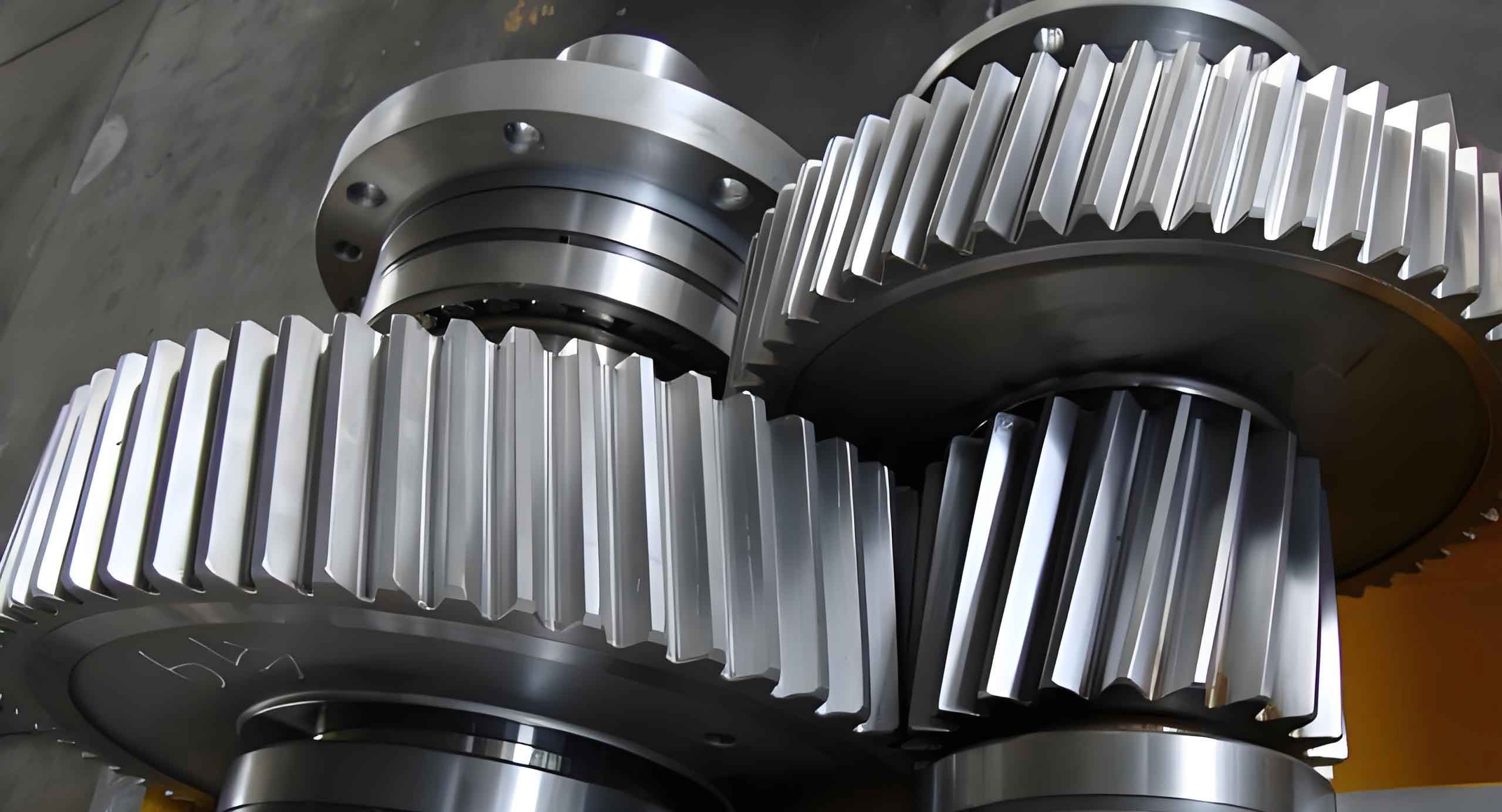
To further illustrate the modeling process, I provide a detailed breakdown of the CAD operations. Initially, I created the reference cross-section C by defining a circle for the pitch diameter and generating involute curves for the tooth profiles. The gear parameters included: module = 2 mm, number of teeth = 44, pressure angle = 20°, and face width = 54.5 mm. Using gear generation tools, I produced a 2D sketch of a standard spur gear, which served as the基准面. This sketch was then saved in a compatible format for further editing. For cross-sections A and B, I duplicated the reference sketch and applied rotational transformations to each tooth space. The rotation was performed around the gear center, with angles derived from the helical angle relationship. For instance, for a helical angle variation of ±10° over 27.25 mm, the twist angle per tooth space incrementally. The cumulative twist for the \(i\)-th tooth space is given by:
$$ \theta_i = i \cdot \Delta \theta $$
where \(\Delta \theta\) is the incremental twist angle per tooth space. For 22 tooth spaces from the center to one end, \(\Delta \theta = 10^\circ / 22 \approx 0.4545^\circ\). However, in my practical model, I used a simplified linear progression as shown in the earlier table. After twisting, the tooth spaces maintain their original shape, but the gear teeth become asymmetric, reflecting the variable helical angles. This is a key advantage of helical gears with tailored angles, as it allows for customized engagement patterns.
Regarding the machining method for variable helical angle gears, I propose a form milling technique based on the tooth space reference. Since the tooth spaces are invariant in shape, a form cutter—such as a指形铣刀 (finger milling cutter)—can be used to machine each tooth space individually. The cutter profile matches the exact shape of the tooth space in the reference cross-section C. The machining process involves positioning the gear blank on a servo-driven spindle and the cutter at the gear’s midpoint (cross-section C). The cutter moves axially along the gear width while the gear rotates synchronously to achieve the desired twist angles. Specifically, for each tooth space, the gear rotates by the corresponding twist angle \(\theta_i\) as the cutter traverses from the center to one end. The relationship between cutter axial feed \(f\) and gear rotation speed \(\omega\) is:
$$ \frac{d\theta}{dz} = \frac{2\pi}{P} $$
where \(P\) is the lead of the helical path. By controlling \(f\) and \(\omega\) according to the twist angle table, the variable helical angle is imparted. For example, to machine tooth space 1 on end A, the gear rotates by +0.3° as the cutter moves from z=0 to z=-27.25 mm. This process is repeated for all tooth spaces, with indexation between teeth (360°/44 per tooth). This method ensures accurate reproduction of the 3D model, enabling the production of high-precision helical gears with variable angles. The use of form milling is cost-effective for small batches and prototypes, making it suitable for specialized helical gears in industries like陶瓷 grinding.
In conclusion, my research on variable helical angle gears has led to a robust methodology for 3D modeling and machining. The key findings include: (1) The基准面 for variable helical angle gears is the middle cross-section of a standard spur gear, with tooth spaces serving as the reference; (2) The gear comprises three cross-sections—reference C and twisted ends A and B—derived by applying calculated twist angles; (3) A mathematical relationship exists between twist angles and helical angles, enabling precise design; (4) 3D modeling via放样 in CAD software yields accurate representations; and (5) Form milling based on tooth space reference offers a practical machining solution. These contributions simplify the design and manufacturing of variable helical angle gears, enhancing the performance of helical gears in demanding applications. Future work could explore optimization of helical angle profiles for specific loads or integration with advanced manufacturing techniques like 3D printing. Overall, helical gears with variable angles represent a significant advancement in gear technology, and this article provides a comprehensive foundation for their implementation.
To delve deeper into the mathematical aspects, I derive the full relationship between twist angle and helical angle. For a helical gear, the helical angle \(\beta\) is related to the lead \(L_h\) and pitch diameter \(d\) by:
$$ L_h = \pi d \cot \beta $$
When twisting a tooth space by an angle \(\theta\) over an axial distance \(\Delta z\), the effective helical angle \(\beta’\) can be expressed as:
$$ \theta = \frac{2\pi \Delta z}{L_h} = \frac{2\pi \Delta z \tan \beta}{\pi d} = \frac{2\Delta z \tan \beta}{d} $$
Rearranging, we get:
$$ \tan \beta = \frac{d \theta}{2\Delta z} $$
This formula allows for the calculation of helical angles from twist angles, or vice versa. For a linear variation, \(\theta\) can be a function of \(\Delta z\), such as \(\theta = k \Delta z\), where \(k\) is a constant. Then, \(\tan \beta = (d k)/2\), indicating a constant helical angle if \(k\) is constant. However, for variable helical angles, \(k\) varies along \(z\), leading to a nonlinear relationship. In my model, I used discrete twist angles for each tooth space, approximating a linear helical angle variation. The following table compares theoretical and applied values for the first five tooth spaces.
| Tooth Space Index | \(\Delta z\) (mm) | Theoretical \(\beta\) (degrees) | Applied \(\theta\) (degrees) | Calculated \(\beta\) from \(\theta\) (degrees) |
|---|---|---|---|---|
| 1 | 1.24 | 0.5 | 0.3 | 0.48 |
| 2 | 2.48 | 1.0 | 0.6 | 0.96 |
| 3 | 3.72 | 1.5 | 0.9 | 1.44 |
| 4 | 4.96 | 2.0 | 1.2 | 1.92 |
| 5 | 6.20 | 2.5 | 1.5 | 2.40 |
The slight discrepancies arise from approximations in discrete modeling. This table underscores the precision required in designing helical gears with variable angles.
In summary, the 3D modeling of variable helical angle gears is a multifaceted process that integrates geometric design, mathematical analysis, and CAD techniques. By leveraging the tooth space as a reference and employing放样, I have demonstrated an efficient way to create accurate三维 models. The proposed machining method further ensures manufacturability, making these helical gears accessible for practical use. As helical gears continue to evolve, variable angle designs will play a pivotal role in enhancing mechanical systems’ efficiency and reliability. This work lays the groundwork for future innovations in gear technology, emphasizing the versatility and importance of helical gears in engineering applications.