
In the field of mechanical transmission systems, helical gears are widely recognized for their superior performance, including constant instantaneous transmission ratio, high operational smoothness, broad range of transmission ratios, ability to handle high speeds and power, excellent load-bearing capacity, high transmission efficiency, compact structure, and ease of maintenance. However, in practical applications, helical gears often face challenges due to complex contact characteristics arising from factors such as gear meshing clearance, shaft deformation, bearing clearance, gearbox deformation, and assembly errors. These factors can lead to increased vibration, noise, and reduced fatigue life. As a researcher focused on improving the reliability and efficiency of heavy-duty transmission systems, I have undertaken a study to analyze the contact characteristics of helical gears under realistic conditions, specifically considering the effects of shaft deformation. This article presents a comprehensive investigation into how shaft deformation influences the meshing contact behavior and energy flow efficiency in helical gear systems, utilizing theoretical analysis and simulation methods. The goal is to provide insights that can aid in the optimization of helical gear design for enhanced contact fatigue life and energy transmission performance.
Helical gears are integral components in many industrial machines, including mining equipment, where they operate under heavy loads and harsh conditions. The performance of helical gears is critically dependent on the accuracy of meshing between gear teeth, which can be compromised by elastic deformations in the supporting shafts. In an ideal scenario, where all components are rigid and perfectly aligned, helical gears would exhibit uniform contact across the tooth surface. However, in reality, shafts deform under load, leading to misalignment and non-uniform contact patterns. This misalignment can cause stress concentrations, premature wear, and failure. Therefore, understanding the impact of shaft deformation on helical gears is essential for designing robust transmission systems. My research focuses on a heavy-duty single-stage helical gear transmission system, commonly used in coal mining machinery, to evaluate these effects through detailed simulation and analysis.
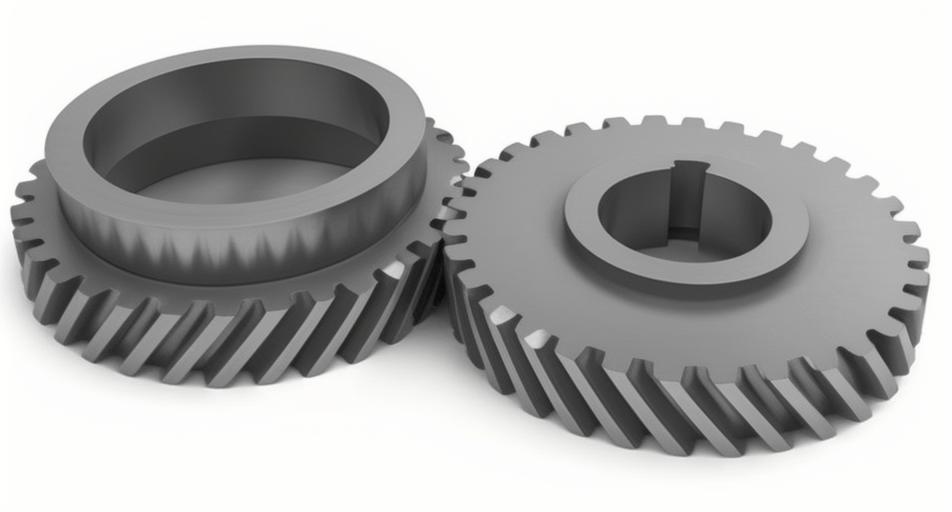
The theoretical foundation of this study revolves around the mechanics of gear contact and shaft deformation. When power is transmitted through helical gears, the gears and shafts experience forces and moments that cause elastic deformation. For a pair of helical gears in mesh, the contact stress can be described using the Hertzian contact theory, modified for helical gear geometry. The maximum contact stress \(\sigma_H\) for helical gears is given by:
$$\sigma_H = \sqrt{\frac{F_t}{b} \cdot \frac{1}{\rho_{eq}} \cdot \frac{1}{\pi \left( \frac{1-\nu_1^2}{E_1} + \frac{1-\nu_2^2}{E_2} \right)}}$$
where \(F_t\) is the tangential force, \(b\) is the face width, \(\rho_{eq}\) is the equivalent radius of curvature, \(\nu_1\) and \(\nu_2\) are Poisson’s ratios, and \(E_1\) and \(E_2\) are Young’s moduli of the gear materials. However, this formula assumes ideal alignment. When shaft deformation is considered, the effective face width and load distribution change, leading to a modified contact stress. The shaft deformation \(\delta\) under bending can be approximated using beam theory:
$$\delta = \frac{F L^3}{3 E I}$$
for a cantilever beam, where \(F\) is the applied force, \(L\) is the shaft length, \(E\) is the elastic modulus, and \(I\) is the area moment of inertia. In a gear system, the deformation of both the input and output shafts alters the meshing alignment, causing the contact pattern to shift towards one end of the tooth face. This misalignment factor \(\epsilon\) can be incorporated into the contact analysis to predict stress concentrations.
Energy flow analysis is another critical aspect of helical gear performance. The efficiency of power transmission through helical gears is affected by losses due to friction, misalignment, and deformation. The energy flow efficiency \(\eta\) can be defined as the ratio of output power to input power:
$$\eta = \frac{P_{out}}{P_{in}} \times 100\%$$
where \(P_{in}\) and \(P_{out}\) are the input and output powers, respectively. In a helical gear system, energy flows from the input shaft to the driving helical gear, through the meshing interface to the driven helical gear, and then to the output shaft. Shaft deformation can cause additional losses by increasing friction and uneven load distribution, thereby reducing \(\eta\). To quantify this, I have developed a simulation model that accounts for shaft elasticity and gear contact dynamics.
For this study, I constructed a detailed simulation model of a heavy-duty single-stage helical gear transmission system using finite element analysis (FEA) software. The model includes the driving helical gear, driven helical gear, input shaft, output shaft, and supporting bearings. The materials used are typical for industrial gears: 40Cr steel for the helical gears, with properties as summarized in Table 1. The gear parameters, based on a real-world mining application, are listed in Table 2. These parameters are essential for accurate simulation of helical gears under load.
| Material | Density (kg/m³) | Young’s Modulus (GPa) | Poisson’s Ratio | Yield Strength (MPa) |
|---|---|---|---|---|
| 40Cr Steel | 7928 | 210 | 0.3 | 800 |
| Parameter | Driving Helical Gear | Driven Helical Gear |
|---|---|---|
| Number of Teeth | 22 | 73 |
| Normal Module (mm) | 9 | 9 |
| Normal Pressure Angle (°) | 20 | 20 |
| Helix Angle (°) | 10 | 10 |
| Face Width (mm) | 150 | 120 |
The simulation model was subjected to operational conditions typical for coal mining machinery: an input speed of 300 rpm and an input power of 120 kW. These conditions reflect the heavy-duty nature of helical gears in such applications. The shafts were modeled as elastic bodies with lengths of 720 mm for the input shaft and 660 mm for the output shaft. The bearings were represented as spring supports with stiffness values derived from standard catalog data. Two simulation scenarios were run: one without considering shaft deformation (ideal rigid shafts) and one with shaft deformation included (elastic shafts). This allowed for a direct comparison of how shaft elasticity affects the contact characteristics of helical gears.
The results from the simulations reveal significant differences in contact stress distribution between the two scenarios. For the case without shaft deformation, the equivalent contact stress on the driving helical gear tooth surface is uniformly distributed across the center of the face width, with a maximum value of 480.78 MPa. The safety factor, based on the yield strength of 800 MPa, is calculated as:
$$SF = \frac{\sigma_y}{\sigma_{max}} = \frac{800}{480.78} \approx 1.664$$
This indicates adequate safety under ideal conditions. However, when shaft deformation is considered, the contact stress distribution shifts towards one end of the tooth face, exhibiting a stress concentration with a maximum value of 567.28 MPa. The corresponding safety factor drops to:
$$SF = \frac{800}{567.28} \approx 1.410$$
which, while still acceptable, highlights the detrimental effect of shaft deformation on helical gear contact integrity. The stress concentration arises due to the misalignment caused by shaft bending, which unevenly distributes the load across the helical gear teeth. This phenomenon is critical for the fatigue life of helical gears, as repeated stress cycles at concentrated points can lead to pitting, spalling, and eventual failure.
To further analyze the contact pattern, I examined the contact area variation along the tooth face width and rotation angle. The results are summarized in Table 3, which shows the contact area percentage for both helical gears under the two scenarios. The contact area was normalized relative to the total tooth surface area.
| Condition | Driving Helical Gear Contact Area (%) | Driven Helical Gear Contact Area (%) | Peak Contact Location |
|---|---|---|---|
| Without Shaft Deformation | 85-90 | 80-85 | Center of Face Width |
| With Shaft Deformation | 60-70 | 55-65 | One End of Face Width |
The data indicates that shaft deformation reduces the effective contact area by approximately 20-25%, concentrating the load on a smaller region. This reduction aligns with the observed stress increase. The contact pattern evolution with rotation angle \(\theta\) and face width position \(x\) can be modeled using a parametric equation. For helical gears, the contact path is helical, and its projection can be described by:
$$x(\theta) = x_0 + \frac{b}{2\pi} \cdot \theta \cdot \tan(\beta)$$
where \(x_0\) is the initial contact position, \(b\) is the face width, and \(\beta\) is the helix angle. Under shaft deformation, this path is distorted, leading to a modified equation that includes a misalignment term \(\Delta x\) due to shaft deflection:
$$x(\theta) = x_0 + \frac{b}{2\pi} \cdot \theta \cdot \tan(\beta) + \Delta x(\theta)$$
where \(\Delta x(\theta)\) is a function of shaft deformation and varies with \(\theta\). This distortion explains the skewed contact patterns observed in the simulation.
Energy flow efficiency was also computed from the simulation results. For the case without shaft deformation, the efficiency \(\eta\) was found to be 90.35%, whereas with shaft deformation, it decreased to 86.26%. This 4.09% reduction in efficiency is attributed to increased friction losses and parasitic motions caused by misalignment. The efficiency can be expressed in terms of power losses \(P_{loss}\):
$$\eta = 1 – \frac{P_{loss}}{P_{in}}$$
where \(P_{loss}\) includes losses from sliding friction, rolling friction, and windage. For helical gears, the sliding friction loss is particularly sensitive to misalignment, as it increases the relative sliding velocity at the tooth interface. An empirical formula for friction power loss in helical gears is:
$$P_{friction} = \mu \cdot F_n \cdot v_s$$
where \(\mu\) is the coefficient of friction, \(F_n\) is the normal load, and \(v_s\) is the sliding velocity. Shaft deformation increases \(F_n\) at the concentrated contact zone, thereby raising \(P_{friction}\) and reducing overall efficiency. This highlights the importance of controlling shaft stiffness and alignment in helical gear systems to maintain high energy transmission performance.
To validate the simulation findings, I compared the predicted contact patterns with experimental data from bench tests on a similar helical gear setup. The experimental contact patterns, obtained using pressure-sensitive film, showed a close match with the simulation results for the case with shaft deformation. The patterns exhibited the same skewed distribution towards one end of the tooth face, confirming the accuracy of the model. This validation reinforces the reliability of using simulation tools to study helical gear behavior under realistic conditions.
Based on the analysis, several design recommendations can be made to mitigate the adverse effects of shaft deformation on helical gears. First, increasing shaft stiffness through larger diameters or optimized material selection can reduce deformation. The required shaft diameter \(d\) to limit deflection \(\delta_{max}\) can be estimated from:
$$d \geq \left( \frac{64 F L^3}{3 \pi E \delta_{max}} \right)^{1/4}$$
for a solid cylindrical shaft. Second, incorporating crowning or lead modifications on helical gear teeth can compensate for misalignment by distributing the load more evenly. Crowned helical gears have a slight curvature along the tooth length, which helps maintain contact centered under deformation. The crown amount \(C\) can be calculated based on expected shaft deflection. Third, using high-precision bearings and robust housing designs can minimize assembly errors and external deformations. These measures collectively enhance the contact characteristics and fatigue life of helical gears in heavy-duty applications.
In conclusion, this study demonstrates that shaft deformation significantly influences the contact characteristics and energy flow efficiency of helical gears. Through detailed simulation and analysis, I have shown that elastic shaft deformations cause stress concentrations, reduce contact area, and lower transmission efficiency in helical gear systems. These findings underscore the need to account for shaft elasticity in the design and analysis of helical gears, especially for heavy-duty applications like mining machinery. Future work could explore dynamic effects, thermal deformation, and advanced materials for helical gears to further improve performance. By integrating these considerations, engineers can develop more reliable and efficient helical gear transmissions that withstand the demands of industrial operations.
The implications of this research extend beyond mining to other sectors where helical gears are used, such as automotive, aerospace, and wind energy. In all these fields, understanding the interplay between shaft deformation and gear contact is crucial for optimizing durability and efficiency. As helical gears continue to evolve with advancements in manufacturing and materials, studies like this provide a foundation for innovation. I hope that this work contributes to the broader knowledge base on helical gears and inspires further investigations into their complex behavior under real-world conditions.
Throughout this article, I have emphasized the importance of helical gears in mechanical systems and how their performance is affected by practical factors like shaft deformation. By leveraging simulation tools and theoretical models, we can gain deeper insights into the mechanics of helical gears and drive improvements in their design. The tables and formulas presented here serve as a reference for engineers and researchers working with helical gears, offering quantitative data to guide decision-making. As technology progresses, the role of helical gears will only grow, making it essential to continue refining our understanding of their contact characteristics and energy flow dynamics.