
In the field of mechanical transmission, helical gears are widely used due to their superior meshing characteristics and smooth operation. During equipment maintenance, various constraints such as cost, time, and availability often necessitate the disassembly, measurement, and replacement of a single damaged helical gear without its mating counterpart. This process, known as single-adapted gear measurement, poses significant challenges, particularly in accurately determining the helical gear’s spiral angle and identifying modification types. Traditional methods for measuring spiral angles—such as the rolling imprint method, universal milling machine method, steel ball method, and microscope method—are often cumbersome, prone to errors, and insufficiently precise. Moreover, for modified helical gears, the spiral angle and modification coefficient can compensate for each other, further complicating parameter identification. To address these issues, I propose a new measurement approach that leverages the length of the common normal line to calculate the normal module, utilizes a three-coordinate measuring machine for precise spiral angle determination, and employs a mutual derivation method between the spiral angle and tip diameter to ascertain the gear modification type. Additionally, I have developed a corresponding measurement system through programming, which has been successfully applied in practical scenarios. This article details this innovative method, providing a comprehensive guide and reference for the measurement of single-adapted helical gears.
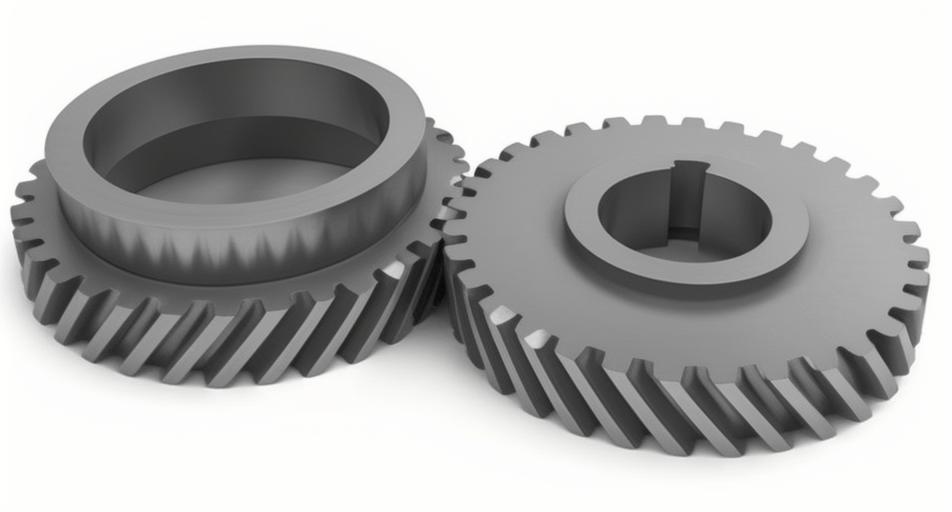
The core of my method is based on the module system, ensuring compatibility with standard gear design practices. The measurement procedure is systematic and involves several key steps, each contributing to the accurate determination of the helical gear parameters. Below, I outline the fundamental principles and steps, supported by formulas and tables for clarity.
Measurement Principles and Steps
The measurement process begins with basic geometric assessments and progresses to more complex calculations and instrumental measurements. The following steps are essential for a complete analysis of a single-adapted helical gear.
| Step | Description | Tool/Method |
|---|---|---|
| 1 | Count the number of teeth (Z) for both gears if available, or for the single gear. | Visual inspection |
| 2 | Measure the assembly center distance (a) between the gear axes. | Calipers or gauge |
| 3 | Measure the tip diameter (d_a) of the helical gear. | Vernier calipers |
| 4 | Measure the common normal line lengths (W_k and W_{k+1}). | Gear tooth calipers |
| 5 | Calculate the normal module (m_n) from common normal lengths. | Formula-based calculation |
| 6 | Precisely measure the spiral angle (β) using a three-coordinate measuring machine and UG software. | Coordinate measuring machine (CMM) and CAD software |
| 7 | Determine modification type via mutual derivation between β and d_a. | Algorithmic comparison |
Each step is critical, and I will elaborate on them in detail, emphasizing the underlying formulas and methodologies.
Step 1: Tooth Count and Center Distance
The number of teeth, denoted as Z, is straightforward to obtain by visual counting. For a helical gear pair, if both gears are accessible, count the teeth for each (Z1 and Z2). The assembly center distance, a, is measured using precision tools such as calipers or internal gauges. This distance is vital for subsequent calculations, especially when dealing with modified gears where the center distance may deviate from the standard value.
Step 2: Tip Diameter Measurement
The tip diameter, d_a, is measured using vernier calipers. Due to potential wear on the gear teeth, it is advisable to take multiple measurements across different sections and average them. A reduction in tolerance may be applied to account for wear, facilitating easier assembly later. The tip diameter is related to other gear parameters through the formula:
$$ d_a = d + 2h_a = m_n \cdot Z / \cos \beta + 2m_n \cdot (1 + x) $$
where d is the reference diameter, h_a is the addendum, m_n is the normal module, β is the spiral angle, and x is the modification coefficient. However, at this stage, not all parameters are known, so d_a serves as an input for later derivation.
Step 3: Common Normal Line Length Measurement
The common normal line length, often referred to as the base tangent length, is a crucial metric for determining the normal module. For a helical gear, the measurement involves selecting an appropriate number of spanned teeth, k. The formula for k is:
$$ k = \frac{\alpha_n Z}{180^\circ} + 0.5 $$
where α_n is the normal pressure angle, typically 20° for standard gears. The result is rounded to the nearest integer. Then, using gear tooth calipers, measure the common normal line lengths for k and k+1 spanned teeth, denoted as W_k and W_{k+1}, respectively. These measurements must be taken carefully to avoid errors from tooth wear.
Step 4: Normal Module Calculation
The normal module, m_n, can be derived from the difference between W_{k+1} and W_k. The relationship is given by:
$$ m_n = \frac{W_{k+1} – W_k}{\pi \cos \alpha_n} $$
Since the normal module is a standardized value, the calculated m_n should be compared against standard module series (e.g., as per ISO 54) to identify the closest standard value. This step is fundamental because an accurate m_n ensures the correctness of subsequent parameter determinations. For instance, standard modules include 1, 1.25, 1.5, 2, 2.5, 3, 4, 5, etc. A table of common standard normal modules can be referenced for this purpose.
| Series | Values (mm) |
|---|---|
| First choice | 1, 1.25, 1.5, 2, 2.5, 3, 4, 5, 6, 8, 10 |
| Second choice | 1.125, 1.375, 1.75, 2.25, 2.75, 3.5, 4.5, 5.5, 7, 9 |
Step 5: Spiral Angle Measurement with Three-Coordinate Measuring Machine
The spiral angle β is perhaps the most challenging parameter to measure accurately in helical gears. Traditional methods lack precision, but using a three-coordinate measuring machine (CMM) combined with CAD software like UG (now Siemens NX) offers a high-accuracy solution. The procedure is as follows:
- Gear Mounting: Secure the helical gear on the CMM worktable in an orientation that allows easy probe access to the tooth flanks.
- Coordinate System Establishment: Manually establish a coordinate system using reference points on the gear, such as the bore or face.
- Data Acquisition: Control the CMM via its operating unit to move the probe along the tooth flank, collecting point cloud data through contact measurement. The CMM software (e.g., Metrosoft CM) records these points.
- Data Processing: The software filters out erroneous points or defects, ensuring clean data. The processed data is exported in a format compatible with UG, such as a .dat file.
- UG Integration: Import the point cloud into UG’s modeling environment. Use UG’s fitting tools to generate a surface or curve from the points, representing the tooth flank.
- Angle Calculation: Utilize UG’s measurement tools to determine the angle between the tooth trace and the gear axis, which is the spiral angle β. Multiple measurements across different teeth can be averaged for higher accuracy.
Based on my experience, this method achieves a measurement precision within 2 arcminutes (2′), which is sufficient for most engineering applications. The accuracy stems from the CMM’s capability to capture precise spatial coordinates and UG’s advanced geometric analysis functions.
Step 6: Determination of Modification Type
For modified helical gears, distinguishing between various modification types (e.g., profile shift, addendum modification) is essential. I employ a mutual derivation method between the spiral angle β and the tip diameter d_a. The theoretical relationship for a standard helical gear without modification is:
$$ d_a = \frac{m_n Z}{\cos \beta} + 2m_n $$
However, with modification, the addendum changes, and the formula becomes:
$$ d_a = \frac{m_n Z}{\cos \beta} + 2m_n (1 + x) $$
where x is the modification coefficient. By comparing the measured d_a with the calculated d_a using the measured β and standard parameters, one can infer the modification type. If the measured d_a deviates significantly, it indicates modification. Additionally, the center distance a provides another check. For a pair of helical gears, the theoretical center distance is:
$$ a = \frac{m_n (Z_1 + Z_2)}{2 \cos \beta} $$
If the measured a differs, it suggests modification or a non-standard spiral angle. By iteratively comparing these values, the modification type and coefficient can be deduced. This process is automated in the developed measurement system, which I will describe later.
Development of the Helical Gear Measurement System
To streamline the measurement process and minimize manual calculations, I developed an interactive measurement system using Visual Basic (VB). This system integrates all the aforementioned steps into a user-friendly interface, automating parameter determination and outputting results for analysis. The system’s workflow is illustrated in the following diagram, and its core components are detailed below.
The system architecture is designed around a modular approach, with each module handling a specific task. The main modules include:
- Input Module: Accepts user-entered parameters such as tooth count (Z), center distance (a), measured tip diameter (d_a), common normal lengths (W_k, W_{k+1}), and measured spiral angle (β).
- Database Module: Contains a comprehensive database of standard normal modules and pressure angles, allowing for quick lookup and comparison.
- Calculation Module: Performs all necessary computations, including m_n calculation, β verification, and modification analysis.
- Output Module: Displays the determined gear parameters (e.g., standard m_n, corrected β, modification type) and provides calculated dimensions for manufacturing.
The system operates on the following logic flow:
- The user inputs the measured data.
- The system calculates the normal module using the common normal length difference and compares it with the standard database to identify the closest standard m_n.
- Using the measured spiral angle from the CMM, the system computes theoretical values for tip diameter and center distance.
- By comparing measured and theoretical values, the system determines if the helical gear is modified and identifies the modification type (e.g., positive or negative profile shift).
- Finally, the system outputs all key parameters, including reference diameter, base diameter, and tooth thickness, for gear manufacturing.
The system’s algorithm can be summarized with key formulas implemented in the code. For instance, the normal module calculation is as described earlier. The spiral angle verification uses:
$$ \beta_{\text{calc}} = \arccos\left(\frac{m_n Z}{d – 2m_n x}\right) $$
where d is the reference diameter derived from center distance. The modification coefficient x is estimated through iterative solving based on d_a and a comparisons.
To enhance accuracy, the system incorporates tolerance adjustments for wear. For example, users can specify a reduction factor for d_a and W_k to account for tooth surface degradation. This flexibility ensures that the system is practical for real-world maintenance scenarios.
Practical Application and Case Study
The effectiveness of this method and system was validated through a real-world application involving a 400-ton bridge crane travel mechanism gearbox. The gearbox, an imported SEW type, had a broken input helical gear shaft with unknown parameters. Disassembling and transporting the entire gearbox was impractical, so a single-adapted measurement was necessary. Using the described approach, I performed the following steps:
| Parameter | Measured Value | Unit |
|---|---|---|
| Number of teeth (Z) | 24 | – |
| Center distance (a) | 150.5 | mm |
| Tip diameter (d_a) | 108.2 | mm |
| Common normal length W_k (k=3) | 32.45 | mm |
| Common normal length W_{k+1} (k=4) | 41.68 | mm |
| Spiral angle (β) from CMM | 15.25° | degrees |
First, I calculated the normal module:
$$ m_n = \frac{41.68 – 32.45}{\pi \cos 20^\circ} = \frac{9.23}{3.1416 \times 0.9397} \approx 3.12 \text{ mm} $$
Comparing with standard modules, 3.12 mm is close to 3 mm, so I adopted m_n = 3 mm. Next, using the CMM-measured β = 15.25°, I computed the theoretical tip diameter for a standard gear:
$$ d_a = \frac{3 \times 24}{\cos 15.25^\circ} + 2 \times 3 = \frac{72}{0.9646} + 6 \approx 74.66 + 6 = 80.66 \text{ mm} $$
The measured d_a was 108.2 mm, significantly larger, indicating positive modification. Using the center distance a = 150.5 mm, the theoretical for standard gears would be:
$$ a = \frac{3 \times (24 + Z_2)}{2 \cos 15.25^\circ} $$
Assuming the mating gear had Z2 = 48 (based on gearbox ratio), a ≈ 112.3 mm, but the measured a was 150.5 mm, confirming modification. The system automated these comparisons and determined a modification coefficient x ≈ +0.5. The new helical gear was manufactured accordingly, and after assembly, the meshing was smooth, with minimal noise and vibration. To further improve contact, a run-in process with abrasive paste was performed, enhancing the tooth contact pattern.
This case demonstrates the practicality and accuracy of the method. The helical gear measurement system played a crucial role in reducing calculation time and eliminating human error.
Discussion on Accuracy and Limitations
While this method offers significant advantages, it is important to consider its accuracy and limitations. The primary source of error lies in the measurement of worn gear teeth. Tooth wear can affect the common normal length and tip diameter measurements, leading to inaccuracies in module and modification determination. To mitigate this, I recommend taking multiple measurements at different positions and applying statistical averaging. Additionally, as mentioned, reducing the measured dimensions by a tolerance value (e.g., 0.1-0.2 mm) can compensate for wear and ensure proper assembly clearance.
The spiral angle measurement via CMM and UG is highly accurate, but it requires access to such equipment, which may not be available in all settings. For situations without a CMM, alternative methods like precise scanning or optical measurement can be used, though with potentially lower accuracy. The developed VB system is flexible and can be adapted to incorporate data from other measurement tools.
Another consideration is the assumption of standard pressure angles. My method assumes α_n = 20°, which is common, but some gears may use other angles (e.g., 14.5° or 25°). The system can be extended to include a database of pressure angles for broader applicability.
Formulas and Tables for Quick Reference
To facilitate understanding and implementation, below is a consolidated list of key formulas and tables relevant to helical gear measurement.
| Parameter | Formula | Description |
|---|---|---|
| Number of spanned teeth (k) | $$ k = \frac{\alpha_n Z}{180^\circ} + 0.5 $$ | Rounded to nearest integer |
| Normal module (m_n) | $$ m_n = \frac{W_{k+1} – W_k}{\pi \cos \alpha_n} $$ | Derived from common normal lengths |
| Reference diameter (d) | $$ d = \frac{m_n Z}{\cos \beta} $$ | For standard helical gears |
| Tip diameter (d_a) | $$ d_a = d + 2m_n(1 + x) $$ | Includes modification coefficient x |
| Center distance (a) | $$ a = \frac{m_n (Z_1 + Z_2)}{2 \cos \beta} $$ | For standard gear pairs |
| Spiral angle (β) verification | $$ \beta = \arccos\left(\frac{m_n Z}{d_a – 2m_n(1+x)}\right) $$ | Used in iterative solving |
Additionally, the modification coefficient x can be estimated by solving the system of equations involving d_a and a. For a single helical gear, if the mating gear is unknown, x may be approximated from the tip diameter deviation relative to standard.
Conclusion
In summary, the novel measurement method for single-adapted helical gears presented here combines traditional gear metrology with modern measurement technologies. By using the common normal line length to determine the normal module, leveraging a three-coordinate measuring machine for precise spiral angle acquisition, and applying a mutual derivation technique to identify modification types, this approach addresses the key challenges in helical gear测绘. The development of a Visual Basic-based measurement system automates complex calculations, enhancing efficiency and accuracy. Practical applications, such as the crane gearbox repair, validate the method’s effectiveness. While considerations for tooth wear and equipment availability are necessary, the method provides a robust framework for gear measurement in maintenance and repair contexts. Future work could involve integrating machine learning algorithms to further automate parameter identification and expanding the system to handle other gear types. This contribution aims to serve as a comprehensive reference for engineers and technicians working with helical gears in industrial settings.
The continuous evolution of measurement technologies, such as advanced CMMs and 3D scanning, will further refine helical gear analysis. However, the core principles outlined here—precision measurement, systematic calculation, and algorithmic verification—remain foundational. By adopting such methods, the reliability and longevity of gear-driven machinery can be significantly improved, underscoring the importance of accurate helical gear parameter determination in mechanical engineering.