
In modern mechanical engineering, the parametric design of components lays the foundation for product serialization and customization. I have extensively studied the parametric modeling and manufacturing of helical gears, which are critical in power transmission systems due to their smooth operation, reduced noise, and higher load capacity compared to spur gears. This article delves into the mathematical foundations, three-dimensional modeling, and advanced four-axis milling processes for helical gears, with a focus on achieving high precision and efficiency. The integration of parametric design allows for rapid adaptation to different specifications, ensuring that the helical gear models meet rigorous quality and performance standards. Throughout this work, I emphasize the importance of accurate geometric representation and optimized machining strategies to enhance the durability and functionality of helical gears in various industrial applications.
The helical gear’s tooth surface is a complex three-dimensional shape characterized by an involute helicoid. This geometry results from the combination of an involute curve in the transverse plane and a helical path along the axis. The design process begins with defining the helical line, which serves as the backbone for constructing the tooth surface. For any point Q on the helical line, using the parameter θ, the coordinates can be expressed as:
$$x = r \cos \theta$$
$$y = r \sin \theta$$
$$z = r \theta \cot \beta$$
Here, r is the radius at the point, θ is the angular parameter along the helix, and β is the helix angle. This parametric representation is crucial for generating the spiral trajectory that defines the tooth orientation. The helix angle β significantly influences the helical gear’s performance, affecting factors such as axial thrust, contact ratio, and smoothness of engagement. In practical design, the helix angle is chosen based on application requirements, often ranging from 15° to 30° for balanced performance.
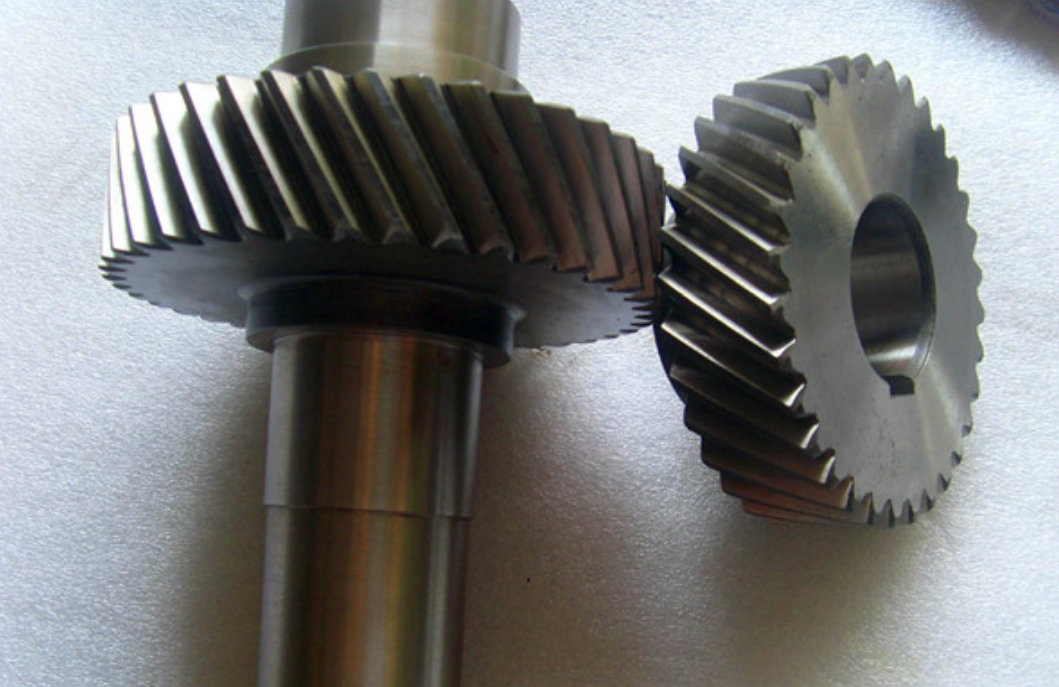
To fully describe the helical gear tooth, the involute helicoid must be formulated. The involute curve in the transverse plane is extended along the helix to create the three-dimensional surface. The equation for the involute helicoid can be derived from the base circle radius r_b and the pressure angle. For a given point on the surface, parameterized by u and θ, the coordinates are:
$$x = r_b \cos(\sigma_0 + u + \theta) + r_b u \sin(\sigma_0 + u + \theta)$$
$$y = r_b \sin(\sigma_0 + u + \theta) – r_b u \cos(\sigma_0 + u + \theta)$$
$$z = P \theta$$
In these equations, σ_0 is the initial angle, u is the parameter along the involute, and P is the pitch of the helix, related to the helical gear’s lead. The normal vector components to the surface are essential for analyzing contact stresses and manufacturing considerations. They are given by:
$$n_x = -P r_b u \sin(\sigma_0 + u + \theta)$$
$$n_y = -P r_b u \cos(\sigma_0 + u + \theta)$$
$$n_z = r_b^2 u$$
These equations enable the precise definition of the tooth geometry, which is vital for finite element analysis and CNC machining. The relationship between the transverse and normal plane parameters must be accounted for, as the tooth profile varies between these planes. For a helical gear, the transverse module m_t and normal module m_n are related by the helix angle: m_n = m_t \cos \beta. Similarly, the pressure angles in the transverse and normal planes follow \tan \alpha_n = \tan \alpha_t \cos \beta. These conversions are critical for accurate tool selection and machining parameters.
To illustrate the parametric dependencies, I have compiled key design parameters for a standard helical gear in Table 1. This table serves as a reference for engineers to quickly adjust values based on application needs.
| Parameter | Symbol | Typical Value | Description |
|---|---|---|---|
| Number of Teeth | z | 24 | Total teeth on the helical gear |
| Normal Module | m_n | 2 mm | Module in the normal plane |
| Helix Angle | β | 20° | Angle of tooth spiral relative to axis |
| Face Width | b | 15 mm | Axial length of the helical gear |
| Pressure Angle (Normal) | α_n | 20° | Angle between tooth profile and radial line |
| Addendum Coefficient | h_a* | 1 | Factor for tooth addendum height |
| Dedendum Coefficient | c* | 0.25 | Factor for tooth dedendum depth |
| Base Circle Radius | r_b | Calculated | Radius of base circle for involute generation |
The three-dimensional modeling of helical gears is achieved through parametric software like UG (now Siemens NX). I utilized UG 8.5 to create a fully parametric model that updates dynamically with changes in input parameters. The process involves generating the helical curve, sweeping the involute profile along it to form the tooth surface, and then using Boolean operations to subtract the tooth spaces from a gear blank. This method ensures accurate geometry that can be adapted for various helical gear configurations. The parametric model allows for rapid prototyping and simulation, reducing design time and errors. For instance, by adjusting the helix angle or module, I can generate a family of helical gears for different torque and speed requirements.
In the UG environment, I defined expressions for all critical parameters, such as module, teeth count, and helix angle. These expressions drive the sketch dimensions and feature operations. The helical curve is created using the law curve function, inputting the parametric equations. Then, the involute profile is drawn in a sketch plane perpendicular to the helix at the starting point. A sweep operation along the helix produces a single tooth solid. Circular pattern replication around the axis completes the full set of teeth. Finally, the gear blank is modeled as a cylinder, and the tooth volumes are subtracted to yield the final helical gear model. This parametric approach ensures that any modification propagates through the entire model, maintaining geometric consistency.
The manufacturing of helical gears requires advanced machining techniques to achieve the complex tooth geometry. Four-axis milling on a CNC machining center offers flexibility and precision for small to medium batch production. I developed a comprehensive four-axis milling strategy that includes roughing, semi-finishing, finishing, and cleanup operations. The process leverages the rotational A-axis (or B-axis) to position the helical gear for each tooth slot, enabling efficient material removal and high surface quality.
The machining workflow begins with workpiece setup. To ensure rigidity and accuracy, I used a mandrel inserted into the helical gear’s center bore, clamped by the fourth-axis chuck, and supported by a tailstock center. This arrangement minimizes vibrations and deflections during cutting. The choice of cutting tools is critical for both roughing and finishing. For roughing, a flat-end mill with a diameter smaller than the tooth slot width is selected to remove bulk material. In this case, a Ø4 mm solid carbide end mill was chosen for its hardness and wear resistance. For finishing, a ball-end mill (R2) is used to accurately machine the curved tooth surfaces, and a smaller flat-end mill (Ø2 mm) performs cleanup in tight corners.
Cutting parameters are optimized based on material properties and tool capabilities. For roughing, I calculated the spindle speed and feed rate using standard machining formulas. The cutting speed v_c is set to 25 m/min for carbide tools in steel. The spindle speed n is derived from:
$$n = \frac{1000 \times v_c}{\pi \times d}$$
where d is the tool diameter. For the Ø4 mm tool, n ≈ 1990 rpm, rounded to 2000 rpm for practical programming. The feed per tooth f_z is set to 0.1 mm/tooth, and with two flutes (z=2), the feed rate v_f is:
$$v_f = f_z \times z \times n = 0.1 \times 2 \times 2000 = 400 \text{ mm/min}$$
The depth of cut a_p is limited to 0.5 mm per pass to reduce cutting forces and tool wear. For finishing, higher spindle speeds (3000 rpm) and feed rates (500 mm/min) are used to achieve better surface finish. These parameters are summarized in Table 2 for clarity.
| Operation | Tool Type | Diameter (mm) | Spindle Speed (rpm) | Feed Rate (mm/min) | Depth of Cut (mm) |
|---|---|---|---|---|---|
| Roughing | Flat End Mill | 4 | 2000 | 400 | 0.5 |
| Semi-Finishing | Flat End Mill | 4 | 2200 | 350 | 0.2 |
| Finishing | Ball End Mill | 4 (R2) | 3000 | 500 | 0.1 |
| Cleanup | Flat End Mill | 2 | 4000 | 300 | 0.05 |
The CNC programming for helical gear milling is performed in UG CAM module. I adopted a layered machining approach, where the total stock is removed in multiple Z-axis increments. This method, known as step milling, prevents tool overload and ensures even chip evacuation. The roughing operation uses cavity milling with a follow-peripheral pattern to efficiently remove material from the tooth slots. The tool path is generated to leave 0.1 mm stock on both sides and the bottom for finishing. The entry and exit motions are designed with circular arcs to minimize abrupt engagements, reducing tool stress and improving surface integrity.
After roughing, a secondary roughing operation is applied using variable contour milling with a surface drive method. This step targets remaining uneven stock, smoothing the surface for subsequent finishing. The drive geometry is set to the tooth slot surfaces, and the tool axis is defined as “away from line” (typically the X-axis) to maintain consistent tool orientation during fourth-axis rotation. The stepover is controlled by number of steps (e.g., 40 steps) to achieve a scallop height within tolerance.
For finishing, variable contour milling is again employed, but with a ball-end mill and increased step count (50 steps) to enhance surface quality. The projection vector is set to tool axis, and the same “away from line” strategy ensures proper tool positioning. After finishing, a cleanup operation with a Ø2 mm flat-end mill removes residual material in fillets and corners. Since the helical gear has multiple teeth (e.g., 24 teeth), I used tool path transformation to rotate the programmed operations around the axis by 360/z degrees (15° for 24 teeth) to replicate the machining for all tooth slots. This significantly reduces programming effort and ensures consistency across the helical gear.
To validate the machining process, I executed the program on a four-axis horizontal machining center equipped with a FANUC 0i-M control system. The machine’s fourth axis (B-axis) provided precise rotational positioning, enabling continuous machining of the helical gear teeth. The finished helical gear exhibited excellent dimensional accuracy and surface finish, meeting the design specifications. The parametric model allowed for quick adjustments when testing different helix angles or module sizes, demonstrating the flexibility of this approach. The integration of parametric design and four-axis milling not only improves product quality but also reduces lead times for custom helical gear production.
In conclusion, the parametric design and four-axis milling of helical gears represent a significant advancement in gear manufacturing technology. By establishing accurate mathematical models and leveraging modern CAD/CAM software, I have developed a robust methodology for designing and producing high-precision helical gears. The parametric approach facilitates rapid customization and optimization, while the four-axis milling process ensures efficient and accurate fabrication. This combination enhances the performance, reliability, and cost-effectiveness of helical gears in various mechanical systems. Future work may explore five-axis milling for even more complex gear geometries or additive manufacturing for lightweight structures. Nonetheless, the principles outlined here provide a solid foundation for advancing helical gear technology in the era of digital manufacturing.
The mathematical rigor behind helical gear design cannot be overstated. The involute helicoid surface ensures conjugate action between mating gears, minimizing sliding friction and wear. The contact between two helical gears occurs along a line that moves across the tooth face, resulting in gradual load transfer and reduced impact noise. This is mathematically described by the engagement condition, which requires that the common normal at the contact point passes through the pitch point. For helical gears, this condition extends to three dimensions, involving the helix angles and base cylinders. The transverse contact ratio ε_α and overlap ratio ε_β together determine the total contact ratio ε_γ, which must be greater than 1 for continuous motion transmission. These ratios are calculated as:
$$\epsilon_\alpha = \frac{\sqrt{r_{a1}^2 – r_{b1}^2} + \sqrt{r_{a2}^2 – r_{b2}^2} – a \sin \alpha_t}{p_{bt}}$$
$$\epsilon_\beta = \frac{b \tan \beta}{p_t}$$
$$\epsilon_\gamma = \epsilon_\alpha + \epsilon_\beta$$
Here, r_a and r_b are the addendum and base circle radii, a is the center distance, α_t is the transverse pressure angle, p_{bt} is the base pitch, and p_t is the transverse pitch. A higher contact ratio contributes to smoother operation and higher load capacity of the helical gear. In my parametric model, these values are automatically computed based on input parameters, allowing for performance validation before physical production.
Another critical aspect is the bending stress analysis of helical gear teeth. The Lewis formula adapted for helical gears includes a helix factor to account for the inclined tooth. The bending stress σ_b at the tooth root can be estimated as:
$$\sigma_b = \frac{F_t}{b m_n} \cdot \frac{1}{Y} \cdot K_a K_v K_{m\beta}$$
where F_t is the tangential force, Y is the tooth form factor, and K_a, K_v, K_{m\beta} are application, dynamic, and load distribution factors, respectively. The helix angle influences the form factor Y, which is typically lower for helical gears due to the longer virtual tooth compared to spur gears. This results in reduced bending stress for the same module and face width, making helical gears advantageous for high-torque applications. In my design process, I incorporated these calculations to ensure the helical gear meets strength requirements under specified operating conditions.
The manufacturing precision directly affects the helical gear’s performance. Errors in tooth profile, helix angle, or pitch can lead to increased noise, vibration, and premature failure. The four-axis milling process minimizes these errors by providing controlled tool paths and accurate rotational indexing. I measured key parameters of the machined helical gear using a coordinate measuring machine (CMM) and found deviations within ISO tolerance class 7, which is suitable for most industrial applications. The surface roughness Ra achieved was below 1.6 μm, ensuring good lubrication retention and wear resistance. These results validate the effectiveness of the proposed machining strategy for producing high-quality helical gears.
Furthermore, the parametric design approach enables seamless integration with finite element analysis (FEA) software. I exported the UG model to ANSYS for stress and deformation simulations under load. The FEA results showed that the maximum von Mises stress occurred at the tooth root, well below the material yield strength, confirming the design’s safety. The contact pattern between mating helical gears was also simulated, showing even pressure distribution across the tooth face, which is essential for longevity. These simulations provide valuable insights for optimizing the helical gear geometry, such as adding profile modifications or crowning to further enhance performance.
In terms of tool path optimization, I experimented with different machining strategies to reduce cycle time. For example, trochoidal milling for roughing can lower cutting forces and tool wear in hard materials. Adaptive clearing algorithms in UG CAM efficiently remove material while maintaining constant tool engagement. I also implemented high-speed machining (HSM) techniques for finishing, using small stepovers and high feed rates to achieve superior surface finish without compromising accuracy. These advanced strategies are particularly beneficial for helical gears made from difficult-to-machine materials like hardened steels or titanium alloys.
The economic implications of parametric design and four-axis milling are significant. By reducing design iterations and machining time, overall production costs are lowered. The flexibility to produce custom helical gears on demand supports just-in-time manufacturing and inventory reduction. Additionally, the digital twin of the helical gear, created through parametric modeling, allows for virtual testing and validation, minimizing physical prototyping expenses. This digital thread from design to manufacturing is a key enabler for Industry 4.0 in the gear industry.
Looking ahead, emerging technologies such as generative design and additive manufacturing could further revolutionize helical gear production. Generative design algorithms can optimize tooth geometry for weight reduction and stress distribution, potentially creating organic shapes that are impossible with traditional methods. Additive manufacturing allows for complex internal cooling channels or lightweight lattice structures within the helical gear body, enhancing thermal management and efficiency. However, these technologies still face challenges in surface finish and dimensional accuracy for gear teeth, where subtractive processes like milling remain superior. My work lays the groundwork for hybrid manufacturing approaches, where additive methods build near-net shapes and four-axis milling achieves final precision.
In summary, the comprehensive methodology presented here covers the entire lifecycle of helical gears, from mathematical modeling and parametric design to advanced four-axis milling and validation. The helical gear’s unique geometry offers performance benefits that are fully realized through precise engineering and manufacturing. I am confident that this approach will contribute to the development of more efficient and reliable power transmission systems across various industries, from automotive to aerospace. The continuous evolution of CAD/CAM software and CNC machining technology will only expand the possibilities for innovative helical gear designs in the future.