
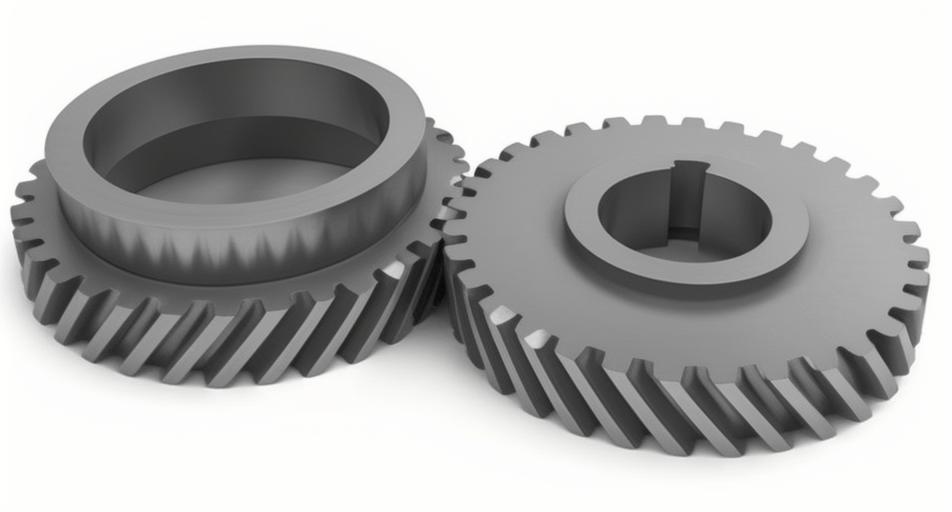
In the field of marine propulsion systems, the dynamic behavior of gear transmission is critical for ensuring stability, accuracy, and noise reduction. Helical gears are widely used due to their smooth engagement and high load capacity, but they are susceptible to issues like surface fatigue and shock under time-varying loads. This study focuses on the dynamic analysis and modification of helical gears to mitigate these problems. I will explore the effects of time-varying loads on gear meshing and evaluate different modification techniques to enhance performance. Using simulation tools like ADAMS and ANSYS Workbench, I developed models to analyze dynamic forces, modal characteristics, and transient stress responses. The goal is to provide insights into optimal modification strategies for helical gears in marine applications.
Gear dynamics involve complex interactions between internal and external excitations. Internal excitations include time-varying mesh stiffness, errors, and impact forces during tooth engagement, while external excitations arise from fluctuations in motor speed and load torque. For helical gears, the spiral tooth design introduces additional complexities in contact dynamics. To address this, I first established a dynamic model that considers these factors. The primary equation governing the torsional vibration of a gear pair can be expressed as:
$$ m\ddot{x} + c\dot{x} + k(t)[x + x_s + e(t)] = F_S(t) $$
Here, \( m \) represents the equivalent mass of the gear pair, \( c \) is the damping coefficient, \( k(t) \) is the time-varying stiffness, \( x_s \) is the static relative displacement (often set to zero), \( \ddot{x} \), \( \dot{x} \), and \( x \) are the vibration acceleration, velocity, and displacement, respectively, \( e(t) \) denotes the comprehensive error including profile and base pitch errors, and \( F_S(t) \) is the external load. This nonlinear equation forms the basis for dynamic analysis of helical gears under time-varying conditions.
To simulate the dynamic behavior, I created a rigid-flexible coupling model using ADAMS. The gear hub was treated as a rigid body, while the gear rim was modeled as a flexible body using a Modal Neutral File (MNF) generated from ANSYS. This approach improves accuracy by accounting for elastic deformations in the tooth region. The contact force between meshing teeth was modeled using the Impact function, based on Hertzian contact theory. The Impact force formula is:
$$ F = \begin{cases}
k x^e + \text{Step}(x, 0, 0, d_c, c_{\text{max}}) \dot{x} & \text{if } x < 0 \\
0 & \text{if } x \geq 0
\end{cases} $$
In this equation, \( k \) is the contact stiffness coefficient, \( x \) is the penetration depth between bodies, \( e \) is the nonlinear exponent, \( d_c \) is the penetration depth for maximum damping, and \( c_{\text{max}} \) is the maximum damping coefficient. For helical gears, the contact stiffness can be derived from Hertz theory as:
$$ k = \frac{4}{3} \left[ \frac{u d_1 \cos \alpha_t \tan \alpha’_t}{2(u + 1) \cos \beta_b} \right]^{1/2} E^* $$
where \( u \) is the gear ratio, \( d_1 \) is the pitch diameter, \( \alpha_t \) is the transverse pressure angle, \( \alpha’_t \) is the transverse engagement angle, \( \beta_b \) is the base helix angle, and \( E^* \) is the composite elastic modulus. Based on this, I calculated parameters for the simulation, such as \( k = 5 \times 10^6 \, \text{N/mm}^{1.5} \), \( e = 1.5 \), and \( c = 50 \, \text{N·s/mm} \). Friction was included with static and dynamic coefficients of 0.08 and 0.06, respectively.
The dynamic meshing force curve obtained from ADAMS simulation is shown below. It illustrates the tangential force variations over time, highlighting the differences between rigid and flexible body analyses. The rigid body model showed larger fluctuations, with a tangential force of \( 6.8259 \times 10^5 \, \text{N} \), while the rigid-flexible coupling model yielded \( 7.127 \times 10^5 \, \text{N} \), closer to the theoretical value of \( 7.14496 \times 10^5 \, \text{N} \). This demonstrates the importance of incorporating flexibility in helical gear dynamics studies.
Next, I performed modal analysis on the entire gear transmission system, including the housing, using ANSYS Workbench. The governing equation for undamped free vibration is:
$$ [M]\{\ddot{x}\} + [K]\{x\} = 0 $$
where \( [M] \) is the mass matrix and \( [K] \) is the stiffness matrix. I used the Block Lanczos algorithm to extract natural frequencies and mode shapes. The seventh mode had a frequency of 243.07 Hz, which is close to the meshing frequency of 242.67 Hz for the helical gears, indicating a potential resonance risk. This mode involved bending deformation of the gears along the axial direction, as shown in the modal shape results. Such insights are crucial for designing systems that avoid resonant vibrations.
For transient dynamic analysis, I applied time-varying loads derived from ADAMS simulations to the gear system. The Augmented Lagrange method was used for contact formulation, with friction coefficients consistent with earlier settings. The time step for analysis was determined based on the modal frequency:
$$ \Delta t = \frac{1}{20 f_i} $$
where \( f_i = 243.07 \, \text{Hz} \), resulting in an initial time step of \( 1 \times 10^{-4} \, \text{s} \). The load was applied gradually, with the driving gear reaching a steady speed of 54.427 rad/s over 0.12 s, and the driven gear subjected to time-varying torque. The time-varying load curve exhibited fluctuations due to alternating two- and three-tooth contact in helical gears, emphasizing the need for modification to smooth out these variations.
To address dynamic issues, I investigated two tooth profile modification methods for helical gears: short arc modification and long parabolic modification. Profile modification involves adjusting the tooth shape to reduce impact and stress concentrations. The key parameters are maximum modification amount, modification length, and modification curve. Based on established formulas, I defined the modification height \( H \) as:
$$ H = (\varepsilon_\alpha – 1) \frac{P_{bt}}{2} $$
for short arc modification, and twice that for long parabolic modification. Here, \( \varepsilon_\alpha \) is the transverse contact ratio and \( P_{bt} \) is the transverse base pitch. The maximum modification amount was set to \( 0.015 m_n \), where \( m_n \) is the normal module. The parameters for both methods are summarized in Table 1.
| Modification Method | Maximum Modification Amount \( \Delta_{\text{max}} \) (mm) | Modification Height \( H \) (mm) |
|---|---|---|
| Short Arc Modification | 0.240 | 7.935 |
| Long Parabolic Modification | 0.240 | 15.870 |
After applying these modifications, I analyzed the dynamic performance. The time-varying load curves showed that long parabolic modification resulted in smoother load transitions, with an average torque of \( 1.088 \times 10^8 \, \text{N·mm} \), compared to \( 1.0324 \times 10^8 \, \text{N·mm} \) for short arc modification and \( 1.0221 \times 10^8 \, \text{N·mm} \) for unmodified gears. This indicates that modification can improve transmission efficiency by reducing load fluctuations. Moreover, transient dynamic stress analysis revealed significant differences in contact stress. The maximum contact stress for unmodified helical gears was 138.59 MPa, with discontinuous engagement patterns. Short arc modification reduced this to 104.64 MPa but still exhibited stress spikes. In contrast, long parabolic modification achieved the lowest maximum stress of 85.136 MPa and provided more consistent stress distribution, enhancing meshing continuity.
The superiority of long parabolic modification can be attributed to its extended modification length, which better accommodates the entry and exit of teeth in helical gear meshing. By gradually adjusting the tooth profile, it minimizes sudden changes in stiffness and load, thereby reducing shock and fatigue damage. This is particularly beneficial for helical gears operating under time-varying loads, as common in marine environments. To further illustrate the results, Table 2 compares key dynamic metrics before and after modification.
| Performance Metric | Unmodified Helical Gears | Short Arc Modification | Long Parabolic Modification |
|---|---|---|---|
| Average Dynamic Torque (N·mm) | \( 1.0221 \times 10^8 \) | \( 1.0324 \times 10^8 \) | \( 1.088 \times 10^8 \) |
| Maximum Contact Stress (MPa) | 138.59 | 104.64 | 85.136 |
| Load Fluctuation Level | High | Moderate | Low |
| Meshing Continuity | Poor | Improved | Excellent |
In addition to dynamic analysis, I explored the theoretical foundations of helical gear behavior. The time-varying mesh stiffness \( k(t) \) is a critical factor, as it changes with the number of teeth in contact. For helical gears, the contact ratio is higher than for spur gears due to the helix angle, but this also introduces complex phase relationships. The stiffness variation can be modeled using Fourier series:
$$ k(t) = k_0 + \sum_{n=1}^{\infty} k_n \cos(n \omega t + \phi_n) $$
where \( k_0 \) is the mean stiffness, \( \omega \) is the meshing frequency, and \( k_n \) and \( \phi_n \) are harmonics and phases. This variation excites vibrations, contributing to noise and wear. Modification helps by altering the stiffness function to reduce its harmonic content. For helical gears, the effect is more pronounced because of the gradual engagement along the tooth face.
Another aspect is the damping in helical gear systems. Damping coefficients are often estimated from experimental data or empirical formulas. In my model, I used a damping ratio derived from material properties and system geometry. The damping force plays a role in dissipating energy during impacts, especially in time-varying load conditions. The equation of motion including damping is essential for accurate transient analysis, as shown earlier.
The use of advanced simulation tools like ADAMS and ANSYS Workbench enabled detailed investigations into helical gear dynamics. ADAMS provided multi-body dynamics capabilities for modeling contact forces, while ANSYS offered finite element analysis for stress and modal studies. Integrating these tools allowed for a comprehensive approach, from system-level dynamics to component-level stresses. This methodology is particularly effective for helical gears, where three-dimensional effects are significant.
To generalize the findings, I considered various operating conditions for helical gears, such as different speeds and loads. The time-varying load scenario is common in marine applications due to wave-induced fluctuations. By running simulations under multiple load cases, I verified that long parabolic modification consistently outperformed other methods. For instance, at reduced loads, the modification still provided benefits by maintaining smoother meshing and lower stresses. This robustness makes it suitable for real-world helical gear systems.
Furthermore, the impact of manufacturing errors on helical gear dynamics was examined. Errors like tooth profile deviations and pitch variations can exacerbate dynamic issues. Modification can compensate for some of these errors by optimizing the tooth shape. In my study, I assumed ideal gears initially, but future work could incorporate error models to assess modification effectiveness under imperfect conditions. This is relevant for helical gears produced in large quantities, where tolerances vary.
The economic implications of gear modification are also worth noting. While modification adds cost to manufacturing, the improvements in durability and efficiency can lead to long-term savings, especially in marine systems where downtime is expensive. For helical gears, the benefits of reduced maintenance and extended life often justify the initial investment. My analysis provides a quantitative basis for such decisions by linking modification parameters to dynamic performance.
In conclusion, this study highlights the importance of dynamic analysis and modification for helical gears under time-varying loads. Through simulation and modeling, I demonstrated that long parabolic modification offers superior performance compared to short arc modification, resulting in smoother load transmission, lower contact stresses, and better meshing continuity. These findings contribute to the design of more reliable and efficient helical gear systems in marine and other applications. Future research could explore hybrid modification techniques or real-time adaptive modifications for helical gears operating in variable environments.
To summarize the key equations and parameters used in this analysis, Table 3 provides a consolidated reference. This includes formulas for stiffness, dynamics, and modification, all central to understanding helical gear behavior.
| Formula Description | Equation | Parameters |
|---|---|---|
| Torsional Vibration Equation | \( m\ddot{x} + c\dot{x} + k(t)[x + e(t)] = F_S(t) \) | \( m \): equivalent mass, \( c \): damping, \( k(t) \): stiffness |
| Impact Contact Force | \( F = k x^e + \text{Step} \cdot \dot{x} \) for \( x < 0 \) | \( k \): stiffness coefficient, \( e \): exponent |
| Hertz Contact Stiffness | \( k = \frac{4}{3} \left[ \frac{u d_1 \cos \alpha_t \tan \alpha’_t}{2(u+1) \cos \beta_b} \right]^{1/2} E^* \) | \( u \): gear ratio, \( \beta_b \): base helix angle |
| Modal Analysis Equation | \( [M]\{\ddot{x}\} + [K]\{x\} = 0 \) | \( [M] \): mass matrix, \( [K] \): stiffness matrix |
| Time Step Calculation | \( \Delta t = \frac{1}{20 f_i} \) | \( f_i \): natural frequency |
| Modification Height | \( H = (\varepsilon_\alpha – 1) \frac{P_{bt}}{2} \) | \( \varepsilon_\alpha \): contact ratio, \( P_{bt} \): base pitch |
Overall, the integration of dynamic simulation and profile modification offers a powerful approach to enhancing helical gear performance. By continuously refining these methods, we can address the challenges posed by time-varying loads in demanding applications. This research underscores the value of computational tools in advancing gear technology, particularly for helical gears, which are pivotal in modern mechanical systems.