
In modern mechanical transmission systems, the reducer plays an indispensable role in matching speed and transmitting torque between the prime mover and the working machine. Among its core components, the output shaft is critical as it bears and delivers significant torque to the driven equipment. Its failure can lead to the complete shutdown of the entire drive line, resulting in substantial economic losses. This article focuses on the output shaft of a single-stage helical gear reducer. Helical gears are favored for their smoother and quieter operation compared to spur gears due to their gradual engagement characteristics. However, this also introduces axial forces that must be carefully considered in shaft design. The primary objective is to establish a comprehensive mechanical model, perform a series of strength and stiffness verifications, identify potential weak points, and provide a theoretical foundation for optimizing the design of such shafts.
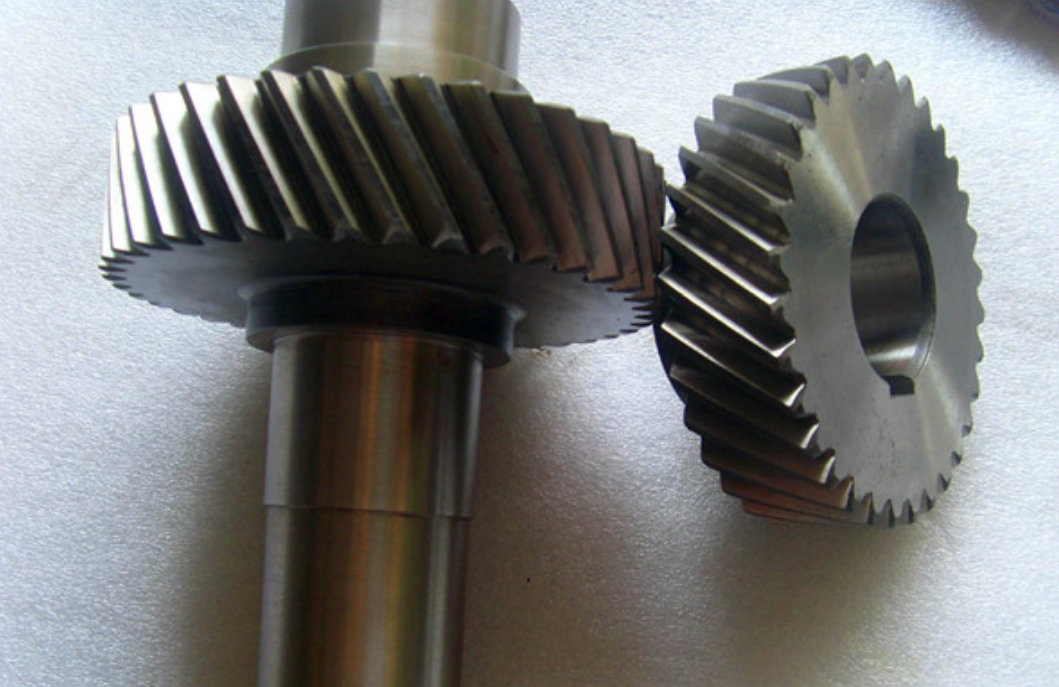
The design and reliability of shafts in gear reducers are paramount, especially when transmitting high torques through components like helical gears. The analysis begins with a detailed force analysis based on the power, speed, and geometry of the helical gear pair. For a single-stage reducer, the output shaft typically supports a large helical gear and connects to the external load via a coupling or, as in this case, a spline for higher torque capacity. The shaft is supported radially by two deep groove ball bearings and incorporates a thrust bearing to counteract the axial load generated by the helical gears.
1. Load Analysis and Mechanical Model Establishment
The first step in the mechanical performance analysis is to determine all forces acting on the shaft. For a helical gear, three mutually perpendicular force components act at the gear’s pitch circle:
- Tangential Force (Ft): Responsible for transmitting torque. Calculated from the transmitted power (P in kW) and rotational speed (n in rpm) or directly from the torque (T in N·m) and pitch diameter (d in m): $$F_t = \frac{2000 T}{d}$$
- Radial Force (Fr): Acts towards the center of the gear. For a helical gear with pressure angle α and helix angle β, it is: $$F_r = F_t \frac{\tan \alpha_n}{\cos \beta}$$ where αn is the normal pressure angle.
- Axial Force (Fa): A direct consequence of the helix angle. Its magnitude is: $$F_a = F_t \tan \beta$$ This force must be properly supported by a thrust bearing.
With these gear forces calculated, a static mechanical model of the shaft can be constructed. The shaft is treated as a simply supported beam. Reactions at the bearing supports are calculated using equilibrium equations (ΣF=0, ΣM=0). Bending moment diagrams (M) are then plotted for both the horizontal (H) and vertical (V) planes. The resultant bending moment at any section is the vector sum: $$M = \sqrt{M_H^2 + M_V^2}$$. The torque (T) diagram is also plotted along the shaft’s length.
Critical inspection of these diagrams reveals the cross-section subjected to the highest combination of bending moment and torque – the potential critical or “dangerous” section. For a typical layout where the gear is located between bearings, this is often at the gear’s location. The loads at this section are summarized for subsequent analysis.
| Load Type | Horizontal Plane (H) | Vertical Plane (V) |
|---|---|---|
| Support Reactions | RH1 = 4526 N, RH2 = 4719 N | RV1 = 1698 N, RV2 = 1770 N |
| Bending Moment (MH, MV) | MH = 222 N·m | MV = 83 N·m |
| Resultant Bending Moment (M) | $$M = \sqrt{222^2 + 83^2} = 237 \text{ N·m}$$ | |
| Torque (T) | T = 1315 N·m | |
2. Stress Analysis and Strength Verification
The shaft material is typically an alloy steel such as 40Cr, heat-treated (e.g., quenched and tempered) to achieve high strength and toughness. The verification process involves multiple checks.
2.1 Static Strength Check under Combined Loading
This initial check uses the maximum shear stress theory (or equivalent von Mises stress) to evaluate the combined effect of bending and torsion at the critical section. The equivalent stress (σca) is calculated as:
$$\sigma_{ca} = \frac{\sqrt{M^2 + (\alpha T)^2}}{W}$$
Where:
- W is the section modulus for a solid circular shaft: $$W = \frac{\pi d^3}{32}$$
- α is a factor that converts the fluctuating torsional shear stress into an equivalent alternating bending stress. For a rotating shaft with a steady applied torque, α is often taken as 0.6.
The calculated stress must be less than the allowable bending stress [σ-1b] for the shaft material under cyclic loading. For 40Cr under typical heat treatment, [σ-1b] ≈ 70 MPa. A sample calculation with d=0.06m, M=237 N·m, T=1315 N·m yields:
$$W = \frac{\pi (0.06)^3}{32} \approx 2.12 \times 10^{-5} m^3$$
$$\sigma_{ca} = \frac{\sqrt{237^2 + (0.6 \times 1315)^2}}{2.12 \times 10^{-5}} \approx 50.5 \text{ MPa} < 70 \text{ MPa}$$
This confirms the static strength at the critical section is sufficient.
2.2 Fatigue Strength Check Considering Stress Concentrations
Fatigue failure is the predominant mode of failure for rotating shafts. Stress concentrations at geometric discontinuities (shoulders, keyways, press-fit interfaces) drastically reduce fatigue life and must be accounted for precisely. For an output shaft with a press-fitted helical gear, the most severe stress concentrations often occur at the edges of the interference fit.
The fatigue safety factor is calculated for these critical locations (e.g., on the left and right sides of the gear hub). The process involves determining the mean and alternating components of stress. For a rotating shaft under constant torque:
- Bending stress is fully reversing (alternating): σa = σb = M/W, σm = 0.
- Torsional shear stress can be considered as steady (mean): τm = τ = T/WT, τa = 0. (Where WT = πd³/16 is the torsional section modulus).
The fatigue safety factors for bending (Sσ) and torsion (Sτ) are computed separately using the modified Goodman criterion, and then combined for the overall safety factor (Sca).
$$S_\sigma = \frac{\sigma_{-1}}{K_{\sigma} \sigma_a + \psi_\sigma \sigma_m}$$
$$S_\tau = \frac{\tau_{-1}}{K_{\tau} \tau_a + \psi_\tau \tau_m}$$
$$S_{ca} = \frac{S_\sigma S_\tau}{\sqrt{S_\sigma^2 + S_\tau^2}} \geq [S]$$
Where:
- σ-1, τ-1 are the fully reversed bending and torsional fatigue limits of the material (e.g., 350 MPa and 200 MPa for 40Cr).
- Kσ, Kτ are the combined fatigue influence factors, which are the product of several coefficients accounting for stress concentration, size effect, surface finish, and strengthening: $$K_\sigma = \left( \frac{k_\sigma}{\varepsilon_\sigma} + \frac{1}{\beta_\sigma} – 1 \right) \frac{1}{\beta_a}, \quad K_\tau = \left( \frac{k_\tau}{\varepsilon_\tau} + \frac{1}{\beta_\tau} – 1 \right) \frac{1}{\beta_a}$$
- kσ, kτ: Theoretical stress concentration factors (from charts based on geometry like shoulder fillet radius).
- εσ, ετ: Size effect factors (<1 for diameters > standard specimen).
- βσ, βτ: Surface finish factors (<1 for machined surfaces, improves with polishing).
- βa: Surface strengthening factor (>1 for processes like shot peening).
- ψσ, ψτ: Mean stress sensitivity coefficients.
- [S] is the required design safety factor, typically 1.5 to 2.5.
For example, at a press-fit location with d=60mm, calculations might yield local factors like kσ=1.567, εσ=0.411, βσ=0.9, leading to Kσ ≈ 3.92. With M=111 N·m and T=1315 N·m at a specific shoulder, one finds:
$$\sigma_a = \frac{M}{W} \approx 5.2 \text{ MPa}, \quad \tau_m = \frac{T}{W_T} \approx 31.0 \text{ MPa}$$
$$S_\sigma = \frac{350}{3.92 \times 5.2 + 0.2 \times 0} \approx 17.2, \quad S_\tau = \frac{200}{2.8 \times 0 + 0.1 \times 31.0} \approx 4.5$$
$$S_{ca} = \frac{17.2 \times 4.5}{\sqrt{17.2^2 + 4.5^2}} \approx 4.4 > [S]=1.5$$
Even though the safety factor is acceptable, the press-fit region (Section III in the model) consistently shows the lowest safety factor, identifying it as the fatigue-critical zone. This is a common finding for shafts with interference fits for helical gears.
3. Stiffness Verification
Excessive deformation can lead to misalignment, poor gear mesh (especially critical for helical gears which require precise alignment to maintain contact patterns), and bearing overload. Both torsional and bending stiffness must be checked.
3.1 Torsional Stiffness
Torsional stiffness is assessed by the angle of twist (φ) over the length of the shaft under torque. The maximum twist typically occurs in the smallest-diameter section under torque, often at the critical section identified earlier.
$$\varphi = \frac{T L}{G J} \times \frac{180}{\pi} \quad (\text{in degrees})$$
Where:
- T: Applied torque (N·m).
- L: Length of the shaft segment (m).
- G: Shear modulus of the material (~81 GPa for steel).
- J: Polar moment of inertia: $$J = \frac{\pi d^4}{32}$$ for a solid shaft.
The calculated twist per unit length (φ/L) must be less than the allowable value [φ’]. For general power transmission shafts, [φ’] is often taken as 0.5° to 1° per meter. A sample calculation for a segment with d=0.06m can reveal a potential issue:
$$J = \frac{\pi (0.06)^4}{32} \approx 1.27 \times 10^{-6} m^4$$
$$\frac{\varphi}{L} = \frac{T}{G J} \times \frac{180}{\pi} = \frac{1315}{81 \times 10^9 \times 1.27 \times 10^{-6}} \times \frac{180}{\pi} \approx 0.73 \text{ °/m}$$
While this might be borderline acceptable for some applications (close to 1°/m), it indicates that torsional deflection is a significant concern. For precision drives or shafts requiring high positional accuracy, this value may be too high, suggesting the need for a larger diameter.
3.2 Bending Stiffness
Bending stiffness is verified by calculating the maximum deflection (ω) and slope (θ) at critical points, such as at the gear location. Standard beam deflection formulas are used. For a simply supported shaft with a point load (the radial force from the helical gear) at distance ‘a’ from the left bearing and ‘b’ from the right bearing (span L = a+b), the maximum deflection (which occurs between the supports) and the slopes at the bearings are:
$$\omega_{max} = \frac{F b}{6 E I L} (L^2 – b^2 – x^2)^{3/2} \quad \text{(at } x=\sqrt{(L^2 – b^2)/3} \text{ from left)}$$
A more conservative and simpler check is the deflection at the point of load application, often very close to the maximum:
$$\omega \approx \frac{F a^2 b^2}{3 E I L}$$
$$\theta_A = \frac{F a b (L + b)}{6 E I L}, \quad \theta_B = \frac{F a b (L + a)}{6 E I L}$$
Where:
- F: Resultant radial force from the helical gear (from Ft and Fr).
- E: Young’s modulus (~210 GPa for steel).
- I: Area moment of inertia: $$I = \frac{\pi d^4}{64}$$.
Allowable values depend on application. A common rule is [ω] ≤ (0.0003 × bearing span L), and [θ] ≤ 0.001 rad for ball bearings. Using F ≈ 9874 N, a=0.049m, b=0.047m, L=0.096m, d=0.06m:
$$I = \frac{\pi (0.06)^4}{64} \approx 6.36 \times 10^{-7} m^4$$
$$\omega \approx \frac{9874 \times 0.049^2 \times 0.047^2}{3 \times 210 \times 10^9 \times 6.36 \times 10^{-7} \times 0.096} \approx 1.9 \times 10^{-6} m = 0.0019 mm$$
$$[\omega] = 0.0003 \times 96 mm = 0.0288 mm \quad \Rightarrow \quad \omega << [\omega]$$
$$\theta \approx \frac{9874 \times 0.049 \times 0.047 \times (0.096+0.049)}{6 \times 210 \times 10^9 \times 6.36 \times 10^{-7} \times 0.096} \approx 6.1 \times 10^{-5} rad < [\theta]=0.001 rad$$
The bending stiffness is clearly satisfactory. This highlights that for this configuration, torsional rigidity, not bending rigidity, is the governing stiffness constraint.
4. Synthesis, Weak Point Identification, and Design Optimization
The integrated analysis leads to several key conclusions regarding the mechanical performance of the helical gear reducer output shaft:
- Static and Fatigue Strength: The shaft meets both static strength under combined loading and fatigue strength requirements, with calculated safety factors exceeding the design minimum. However, the fatigue analysis definitively pinpoints the region adjacent to the press-fit interface of the large helical gear as the most critical location. This is due to the severe stress concentration caused by the interference fit combined with the high bending moment at that section.
- Stiffness Performance: While bending deflection and slope are well within acceptable limits, the torsional stiffness is marginal or insufficient. The calculated angle of twist per unit length approaches or exceeds the typical allowable value for general power transmission. Excessive torsional wind-up can cause control issues in servo systems, exacerbate torsional vibrations, and affect timing in synchronized drives.
Primary Weak Point: The cross-section with the smallest diameter (often at the gear location or a nearby shoulder) is the system’s Achilles’ heel, primarily governing torsional stiffness and serving as the focus for fatigue cracks due to stress concentrations.
Optimization Recommendations:
| Weakness Identified | Optimization Strategy | Mechanical Principle & Expected Benefit |
|---|---|---|
| Insufficient Torsional Stiffness | Modestly increase the diameter (d) of the smallest shaft segment, particularly in the region between the gear and the bearing. | Torsional rigidity is proportional to J ∝ d⁴. A small increase in d yields a large gain in stiffness (φ ∝ 1/d⁴). This also reduces bending stress (σ ∝ 1/d³). |
| High Stress Concentration at Press-Fit/Gear Shoulder | Implement a generous fillet radius at all shoulder transitions. Use a relief groove at the end of the press-fit zone to reduce the stiffness gradient. | Larger fillet radii (r/d > 0.05) dramatically reduce the theoretical stress concentration factor (kt). A relief groove helps distribute the press-fit stress more evenly. |
| Fatigue at Surface of Critical Section | Apply surface enhancement techniques such as shot peening or roller burnishing to the fillets and high-stress areas. | Introduces beneficial compressive residual stresses at the surface, inhibiting fatigue crack initiation. This increases the effective fatigue limit (raises βa > 1 in the Kσ formula). |
| Axial Load from Helical Gears | Ensure the thrust bearing is correctly sized and preloaded, and located as close to the helical gear as possible to minimize bending from the axial force. | Reduces the bending moment caused by the offset of the axial force (Fa) from the bearing reaction, thereby lowering stresses. |
5. Conclusion
A systematic mechanical analysis of a single-stage helical gear reducer output shaft, encompassing static, fatigue, and stiffness evaluations, is essential for reliable design. This analysis demonstrates that while standard strength checks may indicate adequacy, a deeper fatigue analysis reveals critical stress concentration zones, and stiffness checks often uncover torsional compliance as a limiting factor. For shafts transmitting high torque through helical gears, special attention must be paid to the diameter selection to ensure adequate torsional rigidity and to the detailing of geometric transitions (like fillet radii) to mitigate stress concentrations. The integration of these analytical steps, supported by calculations of gear forces, safety factors, and deformations, provides a robust framework for identifying weak points and guides effective design optimization to enhance the durability and performance of the power transmission system.