
In the field of precision machinery, the rotary vector reducer, commonly known as the RV reducer, plays a critical role due to its high transmission ratio, substantial load-bearing capacity, and excellent transmission accuracy. As a researcher focused on advanced mechanical systems, I have embarked on a comprehensive study to investigate the dynamic characteristics of the rotary vector reducer using a rigid-flexible coupling approach. This methodology is essential for understanding the complex interactions between elastic deformations and kinematic performance, which directly impact the precision and reliability of devices such as industrial robots, aerospace equipment, and CNC machines. The rotary vector reducer’s unique two-stage design, combining planetary gear transmission with cycloidal pin gear transmission, presents significant challenges in dynamic analysis, particularly when considering the effects of component flexibility on transmission error. In this article, I will detail the process of developing a parameterized three-dimensional model, establishing a rigid-flexible coupling dynamics model, and analyzing key dynamic responses to identify factors influencing transmission accuracy. The goal is to provide insights that can guide the precise design of rotary vector reducers, ensuring optimal performance in high-precision applications.
The rotary vector reducer has garnered extensive attention in recent years due to its superior performance metrics. Previous studies have explored various aspects of its dynamics, including virtual prototyping and error analysis. However, many of these investigations have relied on fully rigid body models or simplified assumptions, which may not fully capture the elastic deformations that occur under operational loads. In my work, I emphasize the importance of incorporating flexibility into critical components, such as the crankshaft and cycloidal gears, to achieve a more accurate simulation of the rotary vector reducer’s behavior. By integrating finite element analysis with multi-body dynamics, I aim to bridge the gap between theoretical models and real-world performance, focusing on how torsional elastic deformations, particularly in the crankshaft, affect transmission precision. This approach not only enhances the fidelity of the simulation but also offers a practical framework for optimizing the design of rotary vector reducers in industrial settings.
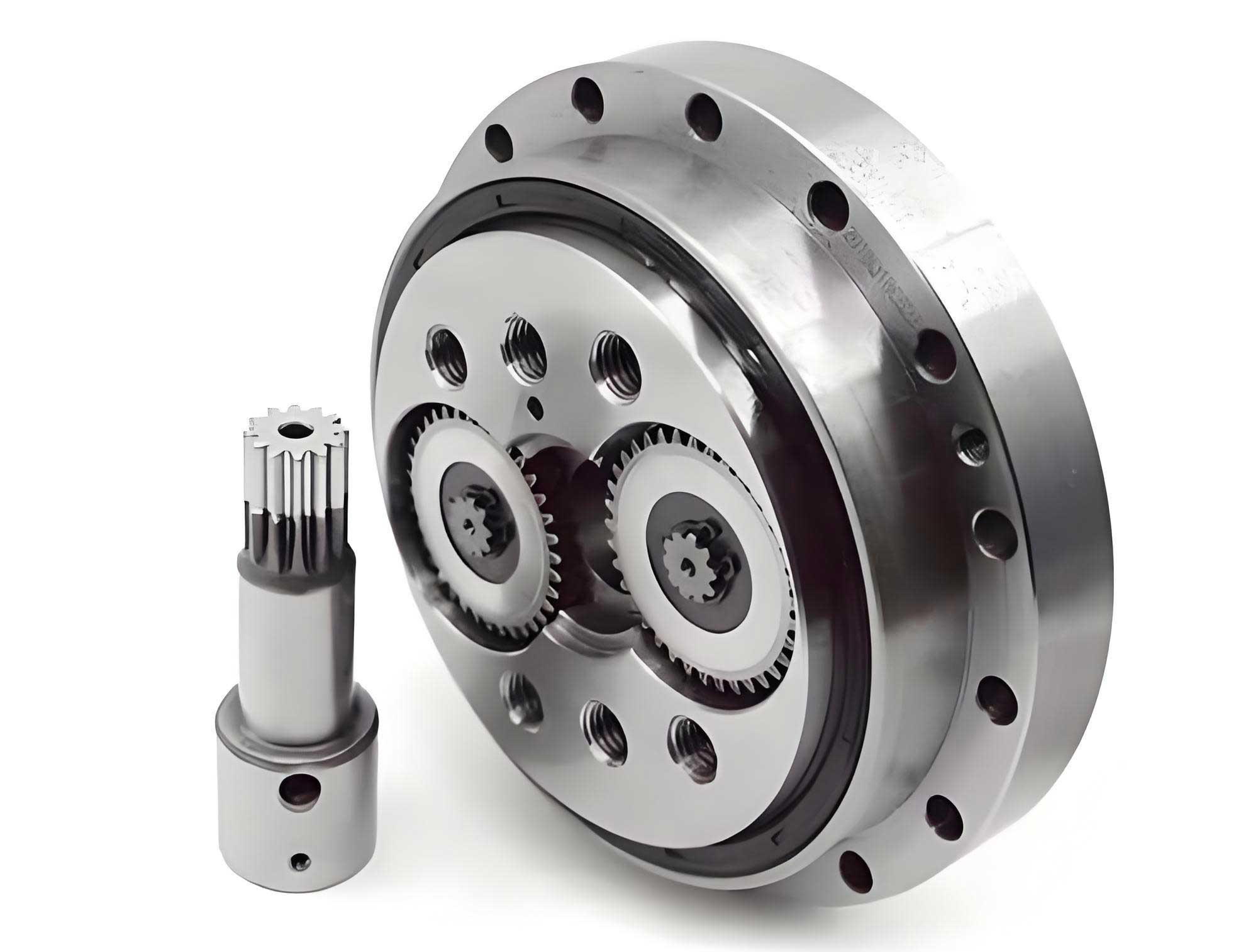
To begin the study, I developed a parameterized three-dimensional model of the rotary vector reducer using SolidWorks, a CAD software known for its robust modeling capabilities. This model accurately represents the two-stage transmission system: the first stage consists of an involute planetary gear mechanism, and the second stage comprises a cycloidal pin gear mechanism. The parameterization allows for easy modification of key design variables, facilitating sensitivity analysis and optimization. The basic technical parameters of the rotary vector reducer under investigation are summarized in Table 1. These parameters define the geometric and operational characteristics essential for the dynamics simulation, such as gear module, number of teeth, eccentricity, and load specifications. By establishing this parametric model, I ensured that the simulation could be adapted to various configurations of the rotary vector reducer, enhancing the generality of the findings.
| Parameter Name | Value |
|---|---|
| Module of Involute Gears (mm) | 1.5 |
| Pressure Angle of Involute Gears (°) | 20 |
| Number of Sun Gear Teeth | 16 |
| Number of Planetary Gear Teeth | 32 |
| Number of Cycloidal Gear Teeth | 39 |
| Number of Pin Gear Teeth | 40 |
| Crank Shaft Eccentricity (mm) | 1.3 |
| Short Amplitude Coefficient of Cycloidal Gear | 0.8125 |
| Distribution Circle Radius of Pin Gear (mm) | 64 |
| Pin Radius (mm) | 3 |
| Rated Load Torque (N·m) | 412 |
| Rated Output Speed (r/min) | 15 |
| Total Reduction Ratio | 81 |
The next step involved creating a rigid-flexible coupling dynamics model to simulate the behavior of the rotary vector reducer under operational conditions. This model integrates flexible bodies for components that experience significant elastic deformations, such as the crankshaft, cycloidal gears, and pin gears, while treating other parts as rigid bodies. I used Abaqus, a finite element analysis software, to generate modal neutral files (.mnf) for the flexible components. These files contain information about the natural frequencies and mode shapes, which are crucial for accurately representing elastic deformations in the dynamics simulation. The material properties assigned to the components are detailed in Table 2. These properties, including elastic modulus, Poisson’s ratio, and density, influence the stiffness and dynamic response of the rotary vector reducer. By defining these properties, I ensured that the simulation reflects the real-world material behavior of the rotary vector reducer components.
| Component | Material | Elastic Modulus (MPa) | Poisson’s Ratio | Density (10⁻⁶ kg/mm³) |
|---|---|---|---|---|
| Cycloidal Gear | GCr15 | 219,000 | 0.3 | 7.83 |
| Planet Carrier | 40Cr | 211,000 | 0.277 | 7.87 |
| Planetary Gear | 20CrMnTi | 212,000 | 0.289 | 7.86 |
| Crank Shaft | GCr15 | 219,000 | 0.3 | 7.83 |
| Pin Gear Housing | 40Cr | 211,000 | 0.277 | 7.87 |
| Input Shaft | 20CrMnTi | 212,000 | 0.289 | 7.86 |
In Abaqus, I followed a systematic procedure to generate the modal neutral files. First, I imported the components saved in .x_t format and defined a frequency extraction analysis step to extract the first 15 natural frequencies and mode shapes. This was followed by a substructure generation step to create the modal basis. The mesh was carefully划分 to balance accuracy and computational efficiency, with finer elements in regions of high stress concentration. Constraints were applied using beam elements and MPC couplings to define the connection between interface nodes and surrounding nodes, ensuring proper load transfer. Boundary conditions were set by fixing all degrees of freedom at the interface nodes during both analysis steps. After modifying the keyword file to include necessary parameters, I submitted the job for analysis. The resulting modal files captured the essential dynamic characteristics of the flexible components, such as the first two natural mode shapes, which depict bending and torsional vibrations critical for the rotary vector reducer’s performance.
With the modal neutral files prepared, I proceeded to build the dynamics model in Adams, a multi-body dynamics software. I imported the .x_t format of the three-dimensional model and replaced the rigid bodies of the crankshaft, cycloidal gears, and pin gears with their flexible counterparts using the .mnf files. This integration allowed for a coupled simulation where elastic deformations interact with the rigid body motions of other components. The joints and constraints were defined according to the kinematic pairs in the rotary vector reducer, as summarized in Table 3. These constraints ensure that the model accurately replicates the relative motions between components, such as rotations and fixed connections, which are fundamental to the operation of the rotary vector reducer.
| Component 1 | Component 2 | Constraint Type |
|---|---|---|
| Pin Gear Housing Node | Ground | Fixed Joint |
| Input Shaft | Ground | Revolute Joint |
| Planet Carrier 1 | Ground | Revolute Joint |
| Crank Shaft 1 | Planet Carrier 1 | Revolute Joint |
| Planetary Gear 1 | Crank Shaft 1 | Fixed Joint |
| Crank Shaft 2 | Planet Carrier 1 | Revolute Joint |
| Planetary Gear 2 | Crank Shaft 2 | Fixed Joint |
| Cycloidal Gear 1 | Crank Shaft 1 | Revolute Joint |
| Cycloidal Gear 1 | Crank Shaft 2 | Revolute Joint |
| Cycloidal Gear 2 | Crank Shaft 1 | Revolute Joint |
| Cycloidal Gear 2 | Crank Shaft 2 | Revolute Joint |
| Planet Carrier 2 | Planet Carrier 1 | Revolute Joint |
| Planet Carrier 2 | Crank Shaft 1 | Revolute Joint |
| Planet Carrier 2 | Crank Shaft 2 | Revolute Joint |
To simulate the contact forces between mating gears, I defined impact functions in Adams using the IMPACT-FUNCTION for normal contact forces, neglecting friction for simplicity. The parameters for contact stiffness, damping, and penetration depth were calibrated based on material properties and geometric considerations. The input conditions were specified as a step function for the input shaft speed, increasing from 0 to 1,215 r/min over 0.1 seconds, and a load torque applied to the output shaft, ramping from 0 to 412 N·m between 0.1 and 0.2 seconds. These conditions represent the rated operational scenario of the rotary vector reducer. The simulation was set to run for 0.8 seconds with 8,000 steps, capturing multiple cycles of gear engagement to ensure statistical reliability. The completed rigid-flexible coupling model in Adams provided a comprehensive virtual environment for analyzing the dynamic behavior of the rotary vector reducer under load.
Upon running the simulation, I obtained dynamic response curves for key components of the rotary vector reducer. The input shaft angular velocity stabilized at the rated speed of 1,215 r/min after an initial transient period, as shown in the response plot. The crank shaft angular velocity oscillated around its theoretical value of 585 r/min, indicating dynamic interactions due to gear meshing and elastic deformations. The output planet carrier angular velocity fluctuated near 15 r/min, with variations attributed to transmission errors and impact forces. The input torque also exhibited oscillations around the theoretical value of 5.086 N·m, reflecting the dynamic load sharing in the rotary vector reducer. Notably, the meshing force between the cycloidal gears and pin gears displayed periodic oscillations with significant peaks, driven by the impact function parameters and the flexibility of the components. These dynamic responses highlight the complex interplay between inertia, stiffness, and damping in the rotary vector reducer, underscoring the need for a rigid-flexible coupling approach to capture such phenomena accurately.
A critical aspect of this study is the analysis of transmission error in the rotary vector reducer. Transmission error is defined as the deviation between the actual output angular displacement and the theoretical output angular displacement based on the input and reduction ratio. Mathematically, it can be expressed as:
$$ \Delta E = \theta_{out} – \frac{\theta_{in}}{i} $$
where \( \Delta E \) is the transmission error, \( \theta_{out} \) is the actual output angular displacement, \( \theta_{in} \) is the input angular displacement, and \( i \) is the total reduction ratio of the rotary vector reducer. From the simulation data, I calculated the transmission error over the stable operational period from 0.2 to 0.8 seconds. The results revealed a periodic pattern with peaks and troughs, indicative of the cyclical nature of gear engagements and elastic deformations. To assess the impact of flexibility, I compared the transmission error from the rigid-flexible coupling model with that from a fully rigid body model simulated under identical conditions. The rigid-flexible coupling model exhibited larger error magnitudes, emphasizing the significance of component deformations in the rotary vector reducer’s transmission accuracy.
To delve deeper into the frequency characteristics of the transmission error, I performed a spectral analysis using Fast Fourier Transform (FFT). The theoretical rotational frequencies of various components in the rotary vector reducer are listed in Table 4. These frequencies serve as a reference for identifying peaks in the spectrum. For the rigid-flexible coupling model, the transmission error spectrum showed dominant peaks at multiples of the crank shaft’s rotational frequency—specifically at 2, 3, and 4 times the frequency—as well as at the first-stage involute gear meshing frequency and its harmonics. Additionally, peaks appeared near the second-stage cycloidal pin gear meshing frequency. In contrast, the fully rigid body model’s spectrum was dominated by peaks at the involute gear meshing frequency and its harmonics, with minimal contribution from the cycloidal stage. This comparison clearly demonstrates that incorporating flexibility unveils the influence of the crankshaft’s torsional elastic deformation on transmission error, which is masked in rigid body simulations. The crankshaft, being a critical link between the two stages of the rotary vector reducer, undergoes pure torsional deformation due to the eccentric loading from the cycloidal gears, thereby directly affecting the overall transmission precision.
| Component | Theoretical Frequency (Hz) |
|---|---|
| Input Shaft | 20.25 |
| Planetary Gear (Crank Shaft Rotation) | 10 |
| Planet Carrier (Crank Shaft Revolution) | 0.25 |
| First-Stage Gear Meshing Frequency | 320 |
| Second-Stage Cycloidal Pin Gear Meshing Frequency | 390 |
| Cycloidal Gear | 400 |
| Pin Gear | 400 |
The findings from this study have important implications for the design and optimization of rotary vector reducers. By identifying the crankshaft’s torsional elasticity as a primary factor influencing transmission error, designers can focus on enhancing the crankshaft’s stiffness through material selection, geometric modifications, or advanced manufacturing techniques. For instance, increasing the diameter or using high-strength alloys could reduce torsional deformations, thereby improving the accuracy of the rotary vector reducer. Additionally, the rigid-flexible coupling methodology presented here offers a robust framework for virtual prototyping, enabling engineers to predict dynamic performance without costly physical experiments. This approach can be extended to other precision reducers or mechanical systems where elastic deformations play a significant role. Future work could involve incorporating more detailed contact models, thermal effects, or wear simulations to further refine the analysis of the rotary vector reducer.
In conclusion, this research demonstrates the value of using a rigid-flexible coupling dynamics model to study the rotary vector reducer. The parameterized three-dimensional model, combined with finite element analysis and multi-body dynamics simulations, provides a comprehensive tool for analyzing dynamic responses and transmission errors. The results underscore that the crankshaft’s pure torsional elastic deformation is a key determinant of transmission accuracy in the rotary vector reducer. By addressing this factor, manufacturers can achieve higher precision and reliability in applications requiring exact motion control. This study not only advances the understanding of rotary vector reducer dynamics but also offers practical guidelines for their design, contributing to the ongoing evolution of precision mechanical systems. As technology progresses, such simulations will become increasingly vital in developing next-generation rotary vector reducers that meet the demanding requirements of modern industry.