
In modern industrial applications, such as robotics, CNC machine tools, and medical equipment, the rotary vector reducer stands out as a critical component due to its high efficiency, compact size, lightweight design, substantial torsional stiffness, and precise transmission capabilities. However, the design of a rotary vector reducer involves numerous parameters, complex constraints, and coupled performance metrics, making traditional design approaches inadequate for achieving optimal solutions. This paper addresses these challenges by proposing a multi-objective optimization framework that integrates Kriging surrogate modeling with an improved Non-dominated Sorting Genetic Algorithm II (NSGA-II). Our goal is to simultaneously minimize volume, maximize torsional stiffness, and maximize transmission efficiency, thereby enhancing the overall performance of the rotary vector reducer.
The rotary vector reducer operates through a two-stage transmission system: an involute planetary gear stage and a cycloidal-pin gear stage. The structural complexity necessitates a holistic optimization approach. We define 17 design variables, including gear teeth numbers, module, dimensions of bearings, and geometric parameters of the cycloidal disk. These variables directly influence the three objective functions: volume (V), torsional stiffness (K’), and transmission efficiency (η). The optimization model is formulated as a Multi-Objective Mixed-Integer Nonlinear Programming (MOMINLP) problem, with 21 constraints covering geometric, strength, and assembly conditions.
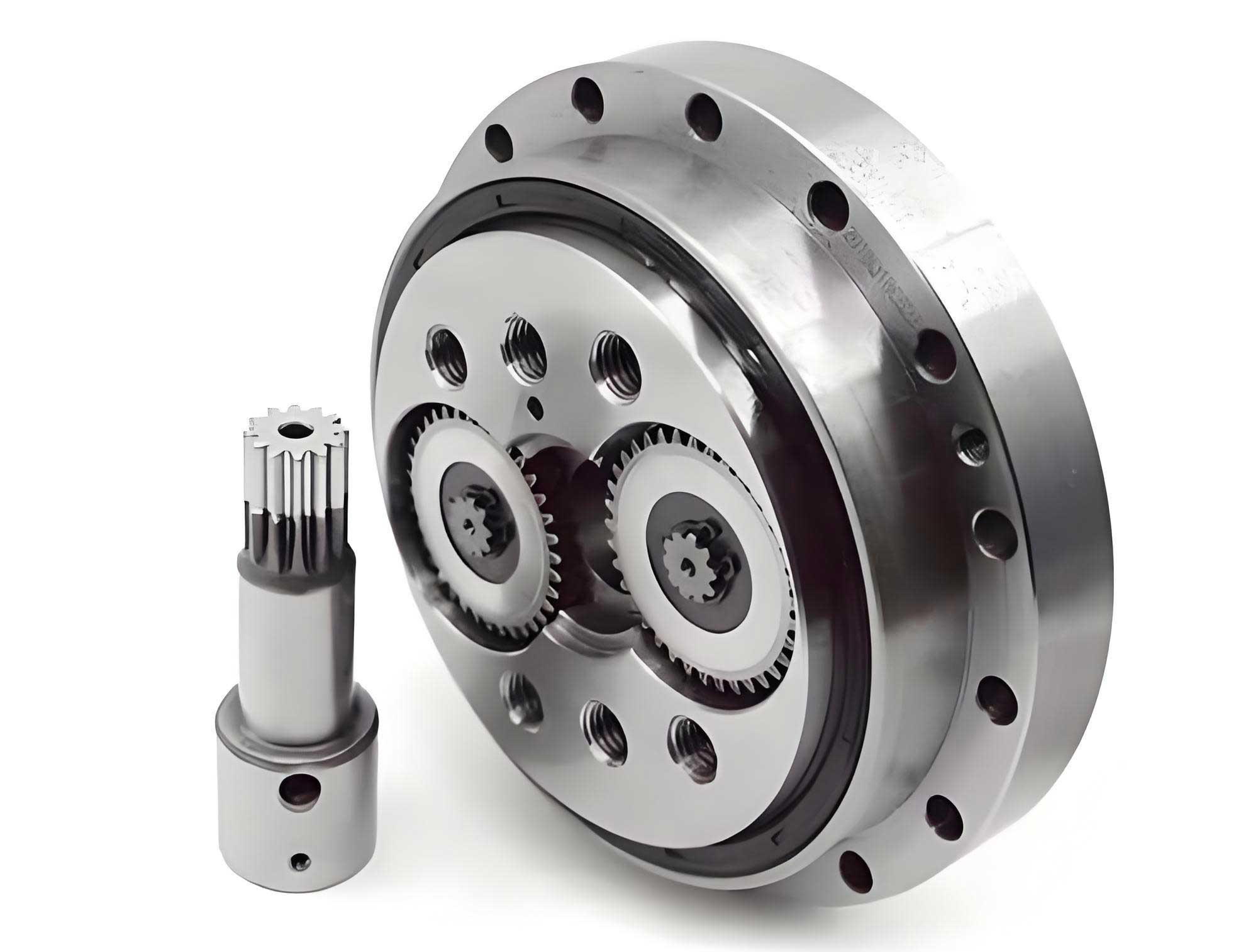
To efficiently handle the computational demands, especially for torsional stiffness evaluation, we develop a Kriging surrogate model for the stiffness contribution from the cycloidal-pin gear pair. This component significantly impacts the overall torsional stiffness of the rotary vector reducer. Using Latin Hypercube Sampling (LHS), we generate initial sample points and employ finite element analysis (FEA) via Abaqus Python scripting to compute stiffness values. The Kriging model approximates the nonlinear relationship between design variables and stiffness with high accuracy, reducing the need for extensive FEA simulations during optimization. The Kriging predictor is expressed as:
$$y(\mathbf{x}) = F(\boldsymbol{\beta}, \mathbf{x}) + z(\mathbf{x})$$
where \(F(\boldsymbol{\beta}, \mathbf{x})\) is a global trend function, and \(z(\mathbf{x})\) is a Gaussian process with zero mean and variance \(\sigma^2\). The correlation function uses a Gaussian kernel:
$$R(\mathbf{x}_i, \mathbf{x}_j) = \exp\left(-\sum_{k=1}^{n_v} \theta_k |x_{ki} – x_{kj}|^2\right)$$
The prediction and variance at an untried point \(\mathbf{x}\) are given by:
$$\hat{y}(\mathbf{x}) = F(\hat{\boldsymbol{\beta}}, \mathbf{x}) + \mathbf{r}^T(\mathbf{x}) \mathbf{R}^{-1} (\mathbf{g} – \mathbf{F}\hat{\boldsymbol{\beta}})$$
$$\hat{e}^2(\mathbf{x}) = \sigma^2 \left[1 – \mathbf{r}^T \mathbf{R} \mathbf{r} + \frac{(1 – \mathbf{q}^T \mathbf{R}^{-1} \mathbf{r})^2}{\mathbf{q}^T \mathbf{R}^{-1} \mathbf{q}}\right]$$
For the multi-objective optimization, we propose an enhanced algorithm named MP-NSGA-II (Mixed Population NSGA-II), which handles continuous, integer, and discrete variables simultaneously. Traditional NSGA-II is limited to real-coded variables; our extension incorporates a novel encoding scheme for discrete variables. The design variables include continuous parameters (e.g., gear width, bearing dimensions), integer parameters (e.g., teeth numbers, roller counts), and discrete parameters (e.g., module, cycloidal teeth count). The MP-NSGA-II algorithm employs a mixed population approach:
- Initialization: Generate separate sub-populations for continuous and integer/discrete variables, then merge them into a mixed population matrix.
- Crossover: Apply two-point crossover to the mixed population to recombine chromosomes.
- Mutation: Use Gaussian mutation for continuous variables and integer-specific mutation operators for discrete/integer variables.
- Selection: Incorporate non-dominated sorting and crowding distance to maintain diversity and convergence.
The crowding distance calculation is modified for efficiency:
$$d_c = \frac{f(\mathbf{x}_j) – f(\mathbf{x}_i)}{f(\mathbf{x})_{\text{max}} – f(\mathbf{x})_{\text{min}}}$$
where \(f(\mathbf{x})\) is the objective value, and \(\mathbf{x}_i\) and \(\mathbf{x}_j\) are adjacent individuals in the sorted population.
The objective functions are derived as follows. The volume of the rotary vector reducer is approximated based on its outer dimensions, considering the housing, gears, and bearings:
$$V = \frac{\pi}{4} \left[ (d_3 + 2\tau_1)^2 (h_1 + h_2 + h_3) + \left((d_1 + 2(\tau_1 + \tau_2))^2 – (d_3 + 2\tau_1)^2\right) h_2 + \left((d_3 + 2(\tau_1 + \tau_2 + \tau_3))^2 – (d_3 + 2\tau_1)^2\right) h_3 \right]$$
where \(d_1, d_3, \tau_i, h_i\) are geometric parameters defined from the reducer’s layout.
The overall torsional stiffness \(K’\) is the inverse of the total angular deflection under load, summing contributions from each component:
$$K’ = \frac{T_2}{\sum_{i=1}^{6} \theta_i}$$
The angular deflections \(\theta_i\) arise from the input shaft, involute gear mesh, turning arm bearing, support bearing, crankshaft, and cycloidal-pin gear pair. For instance, the stiffness of the involute gear pair is computed using empirical formulas for mesh stiffness:
$$c_r = (0.75 \varepsilon_\alpha + 0.25) c’$$
where \(\varepsilon_\alpha\) is the contact ratio and \(c’\) is the single-tooth stiffness. The bearing stiffnesses are calculated using经验 formulas for roller bearings. The cycloidal-pin gear stiffness \(K”\) is obtained from the Kriging surrogate model, which predicts the stiffness based on design variables like cycloidal teeth count \(z_g\), pin circle diameter \(D_z\), pin diameter \(d_z\), short-width coefficient \(K_1\), and cycloidal disk width \(B\).
Transmission efficiency \(\eta\) accounts for gear mesh losses and bearing friction losses:
$$\eta = \eta_{16} \eta_B$$
where \(\eta_{16}\) is the efficiency of the closed differential gear train, and \(\eta_B\) is the combined bearing efficiency. The gear mesh efficiency for the involute stage is:
$$\eta_1^6 = 1 – \pi \mu’ \left( \frac{1}{z_1} + \frac{1}{z_2} \right) \left( \varepsilon_1^2 + \varepsilon_2^2 + 1 – \varepsilon_1 – \varepsilon_2 \right)$$
and for the cycloidal stage:
$$\eta_6^{6,2} = 1 – \frac{f C}{K_1} \left(1 – \frac{d_z}{D_z}\right)$$
where \(f\) is the friction coefficient, and \(C\) is a sliding characteristic coefficient.
The constraints ensure geometric feasibility, strength, and performance requirements. Key constraints include:
| Constraint Type | Mathematical Expression |
|---|---|
| Gear Interference | \((m z_1 + m z_2) \sin(\pi / n_p) > m z_2 + 2 h_a^* m\) |
| Bending Strength | \(\sigma_F = \frac{K F_t Y_{Fa} Y_{Sa}}{b m} \leq [\sigma_F]\) |
| Contact Strength | \(\sigma_H = \sqrt{\frac{K F_t}{b m z_1} \cdot \frac{u+1}{u}} Z_H Z_E \leq [\sigma_H]\) |
| Bearing Stress | \(268.71 \sqrt{Q_{\text{max}}} / D_r \leq [\sigma_c] / s\) |
| Cycloidal Root Cutting | \(d_z / D_z < \frac{27 z_g (1 – K_1^2)^{1/2}}{(z_g + 2)^{3/2}}\) |
To implement the optimization, we develop an integrated software tool using PySide2 for the graphical interface. The tool automates parameter setting, algorithm configuration, and result visualization. The MP-NSGA-II algorithm is configured with a population size of 3000, 1000 generations, crossover probability of 90%, and mutation probability of 10%. The Kriging model is updated during optimization using a dual-infilling strategy that adds sample points at locations of high expected improvement (EI) and from the Pareto-optimal set to balance exploration and exploitation.
The optimization results yield a Pareto front representing trade-offs among volume, torsional stiffness, and efficiency. Analysis shows that torsional stiffness and volume are strongly coupled (positively correlated), while efficiency remains relatively stable across designs. To select an optimal design from the Pareto set, we apply the entropy weight method, an objective weighting technique that assigns weights based on the information entropy of each objective. For a set of Pareto solutions with objectives \(\mathbf{X}_p = \{x_{p1}, x_{p2}, \dots, x_{pj}\}\), the entropy \(H_p\) and weight \(w_p\) are computed as:
$$H_p = -k_j \sum_{q=1}^{j} f_{pq} \ln f_{pq}, \quad k_j = \frac{1}{\ln j}$$
$$w_p = \frac{1 – H_p}{\sum_{p=1}^{i} (1 – H_p)}$$
where \(f_{pq} = r_{pq} / \sum_{q=1}^{j} r_{pq}\) and \(r_{pq}\) is the normalized value of objective \(p\) for solution \(q\). The composite score for each solution is:
$$Z_q = r_{1q} w_1 – r_{2q} w_2 + r_{3q} w_3$$
where objectives 1, 2, and 3 are efficiency, volume, and stiffness, respectively (volume is minimized, hence negative sign).
We compare the optimized rotary vector reducer parameters with a reference model, the BAJ-25E. The optimized design shows significant improvements: transmission efficiency increases by 1.24%, volume decreases by 1.69%, and torsional stiffness increases by 53.83%. The design variables after optimization are listed below, along with sensitivity analysis of torsional stiffness to ±1% changes in continuous variables, highlighting critical parameters for manufacturing tolerance control.
| Design Variable | Initial Value | Optimized Value | Sensitivity of K’ (-1%) | Sensitivity of K’ (+1%) |
|---|---|---|---|---|
| \(z_1\) | 19 | 22 | – | – |
| \(z_2\) | 57 | 59 | – | – |
| \(b\) (mm) | 10 | 8 | -0.004% | 0.004% |
| \(m\) (module) | 1.25 | 1.25 | – | – |
| \(z_g\) | 39 | 41 | – | – |
| \(D_z\) (mm) | 165 | 163.06 | -0.373% | 0.366% |
| \(d_z\) (mm) | 7 | 10 | 0.040% | -0.040% |
| \(B\) (mm) | 14 | 12.62 | -0.042% | 0.041% |
| \(K_1\) | 0.7273 | 0.8000 | -0.549% | 0.541% |
| \(D_m\) (mm) | 41.2 | 47.04 | 0% | 0% |
| \(D’_m\) (mm) | 36 | 41.95 | -0.064% | 0.061% |
| \(D_r\) (mm) | 8 | 6.80 | 0% | 0% |
| \(D’_r\) (mm) | 11 | 8.12 | 0.006% | -0.006% |
| \(Z\) | 15 | 20 | – | – |
| \(Z’\) | 9 | 15 | – | – |
| \(L\) (mm) | 12 | 12.06 | -0.442% | 0.438% |
| \(L’\) (mm) | 13.5 | 11.53 | -0.271% | 0.267% |
The sensitivity analysis reveals that parameters such as \(D_z\), \(K_1\), \(L\), and \(L’\) have a pronounced impact on torsional stiffness (changes >0.5%), indicating that tight manufacturing tolerances are essential for these variables to maintain performance. Other parameters show minimal sensitivity, allowing for more relaxed controls.
In conclusion, this paper presents a comprehensive optimization methodology for the rotary vector reducer, integrating Kriging surrogate modeling and an enhanced MP-NSGA-II algorithm. The approach effectively addresses the MOMINLP challenges, yielding a Pareto-optimal set of designs that balance volume, torsional stiffness, and efficiency. The entropy weight method provides a rational way to select a final design, resulting in a rotary vector reducer with superior performance compared to conventional designs. Future work could explore dynamic performance optimization and inclusion of additional objectives like noise reduction or cost. The developed software tool facilitates practical application, enabling designers to efficiently tailor rotary vector reducers for specific industrial needs.
The robustness of the MP-NSGA-II algorithm is validated through benchmark MOMINLP problems, where it matches or surpasses known optimal solutions. For the rotary vector reducer, the algorithm directly handles mixed variables without need for rounding, ensuring feasibility. The Kriging model achieves a high coefficient of determination (\(R^2 = 0.9208\)), confirming its accuracy in predicting cycloidal-pin gear stiffness. This combination of surrogate modeling and evolutionary optimization offers a scalable framework for complex engineering design problems, particularly for precision components like the rotary vector reducer.
Further insights into the coupling of objectives reveal that while efficiency is relatively insensitive to volume and stiffness variations, the trade-off between volume and stiffness is decisive. This underscores the importance of multi-objective optimization in achieving balanced designs. The rotary vector reducer, with its intricate mechanics, benefits greatly from such integrated approaches, paving the way for next-generation high-performance reducers in advanced machinery.