
The rotary vector reducer stands as the core component driving the motion of robotic joints. It is renowned for its high transmission efficiency, exceptional load-bearing capacity, and minimal backlash, leading to its widespread application in industrial robotics. However, domestic development of rotary vector reducers started relatively late. Challenges such as immature design theories, production processes, and high manufacturing costs have compelled many robotics enterprises to import high-performance rotary vector reducers from abroad. This reality underscores the critical importance of optimizing and improving the structure of domestic rotary vector reducers. Consequently, numerous scholars have dedicated research efforts to this field. Some researchers have taken the highest overall efficiency and the smallest volume as optimization objectives, employing Genetic Algorithm and NSGA-II for solutions. Others have conducted multi-objective optimization focusing on volume and efficiency based on genetic algorithms. Furthermore, studies have been performed on modifying the cycloidal gear profile using traditional combined equidistant and shift-distance methods to enhance the load-carrying capacity, establishing a mathematical model for searching modification amounts solved by the grid-point method. The contributions of these scholars have significantly advanced the parameter design of the rotary vector reducer. Building upon these foundational achievements, I attempt to apply a novel swarm intelligence algorithm with the aim of further refining the parameters of the rotary vector reducer to achieve superior overall performance.
The Shuffled Frog Leaping Algorithm (SFLA) is a novel heuristic bionic swarm intelligence optimization algorithm. It is characterized by its simple concept, fast computational speed, and commendable problem-solving and global search capabilities. It has been widely applied to practical engineering problems such as water resource distribution, bridge pier maintenance, and workshop scheduling. This paper proposes a new method for single-objective volume optimization of the rotary vector reducer based on a Discrete Shuffled Frog Leaping Algorithm (D-SFLA). The goal is to make further structural improvements to the rotary vector reducer under the premise of satisfying constraints regarding overall stiffness, strength, and transmission efficiency, enabling its flexible application in scenarios with more stringent spatial requirements.
Mathematical Model for Structural Optimization of the Rotary Vector Reducer
Structural Principle
The rotary vector reducer is a sealed differential gear train, structurally divided into two main stages. The differential gear train section consists of an input shaft, a sun gear, planetary gears, and a planetary carrier (or crank arms). The sealed section is a cycloidal pin-wheel planetary transmission mechanism comprising the crank shafts, cycloidal gears, pins (pin teeth), and the pin housing.
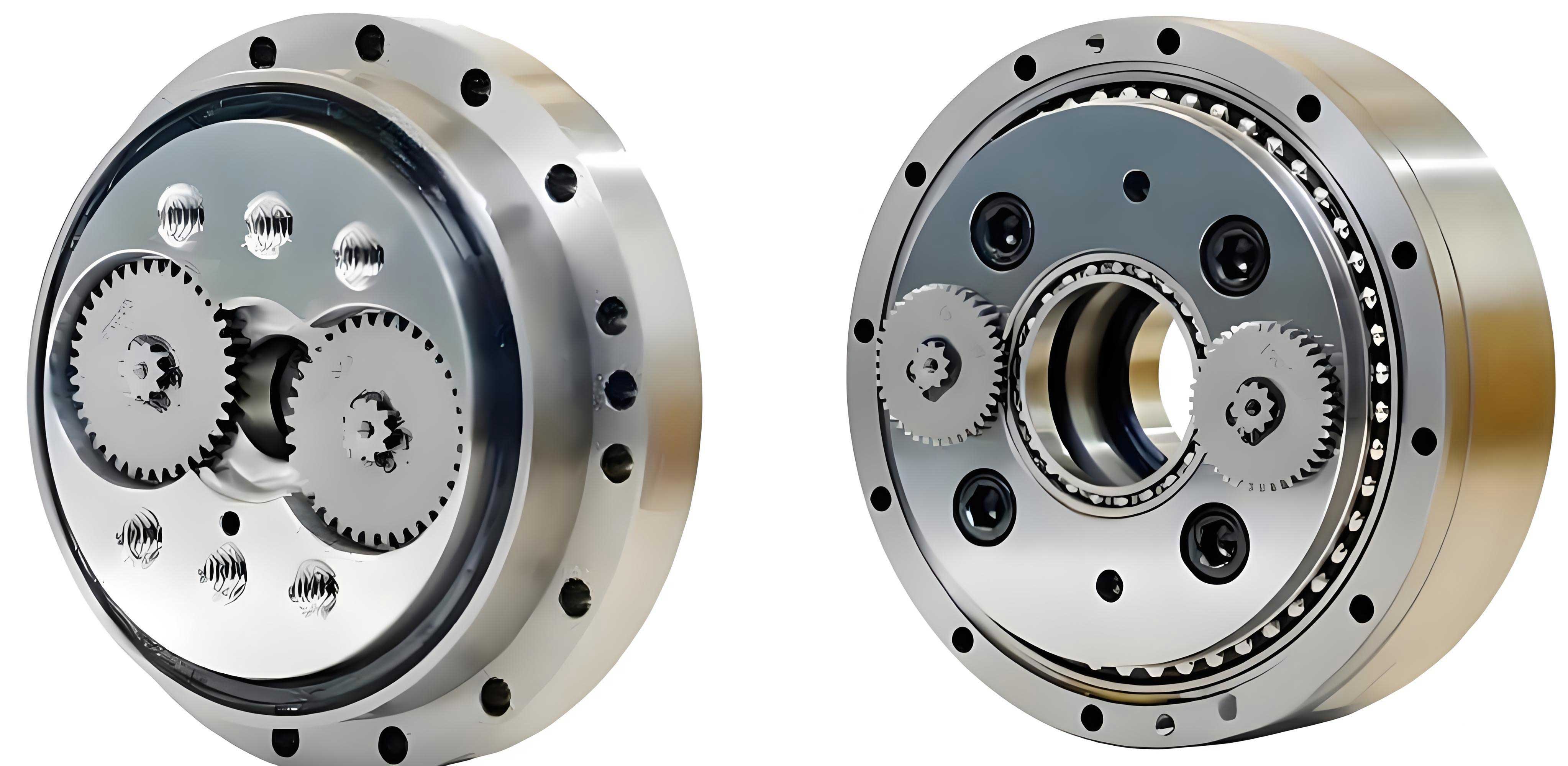
If the pin housing is fixed, the planetary carrier serves as the output member; if the planetary carrier is fixed, the pin housing becomes the output member. This study selects the pin housing as the output member.
Mathematical Modeling
The volume of the rotary vector reducer is primarily determined by the dimensions of its two stages: the primary involute gear transmission and the secondary cycloidal-pin transmission. To mitigate the interaction force between the cycloidal gears and the crank shafts in the secondary stage, the center distance of the primary gear transmission is required to be slightly larger than one-quarter of the pin wheel center circle diameter of the secondary stage. Since the volume occupied by the gear transmission can be approximately considered linearly proportional to its center distance, the center distance of the primary gear transmission is chosen as the objective function, denoted as $f(\mathbf{X})$. The optimization goal is to minimize this center distance.
Given the known input/output requirements and total transmission ratio of the rotary vector reducer, the independent variables are defined as the design variables:
$$\mathbf{X} = [x_1, x_2, x_3] = [z_1, z_2, m]$$
where $z_1$ and $z_2$ are the tooth numbers of the sun gear and planetary gear in the primary transmission, respectively, and $m$ is the module of the standard spur gears. Referring to literature on mechanical optimal design, the model must satisfy the following constraints:
- To prevent undercutting of the pinion:
$$g_1(\mathbf{X}) = 17 – z_1 \le 0$$ - To fully utilize the advantages of high torque capacity and smooth load transmission in the secondary cycloidal stage, the transmission ratio $i_1$ of the primary cylindrical gear stage should not be too small:
$$g_2(\mathbf{X}) = 1.5 – i_1 \le 0$$
where $i_1 = z_2 / z_1$. - To satisfy bending fatigue strength for the pinion:
$$g_3(\mathbf{X}) = \sqrt[3]{\frac{2 K T_1 Y_{Fa} Y_{Sa}}{\phi_d z_1^2 [\sigma_F]}} – m \le 0$$
where $m$ is selected from the first series of standard modules, $K$ is the load factor, $Y_{Fa}$ is the form factor, $Y_{Sa}$ is the stress correction factor, $\phi_d$ is the face width factor, $[\sigma_F]$ is the allowable bending fatigue stress. $T_1$ is the torque transmitted by the sun gear:
$$T_1 = \frac{9.55 \times 10^6 P}{n i}$$
where $n$ is the rated output speed and $i$ is the total transmission ratio of the rotary vector reducer. - To satisfy contact fatigue strength for the primary planetary gear transmission:
$$g_4(\mathbf{X}) = 2.32 \sqrt[3]{\frac{K T_1 (i_1+1) Z_E^2}{\phi_d i_1 [\sigma_H]^2}} – m z_1 \le 0$$
where $Z_E$ is the elasticity coefficient and $[\sigma_H]$ is the allowable contact fatigue stress. - Adjacency condition to prevent interference between two neighboring planetary gears (number of planets denoted as $n_p$):
$$g_5(\mathbf{X}) = z_2 + 2h_a^* – (z_1 + z_2) \sin\left(\frac{\pi}{n_p}\right) < 0$$
where $h_a^*$ is the addendum coefficient for spur gears. - To ensure structural balance, the maximum diameter of the involute planetary stage should be close to that of the cycloidal-pin stage. Let $r_p$ be the pin wheel center circle radius:
$$g_6(\mathbf{X}) = 0.9 r_p – m\left(\frac{z_1}{2} + z_2\right) \le 0$$
$$g_7(\mathbf{X}) = m\left(\frac{z_1}{2} + z_2\right) – 1.1 r_p \le 0$$
where $r_p$ is calculated as $r_p = (0.85 \sim 1.3) (2T)^{1/3}$, and $T$ is the output torque: $T = \frac{9.55 \times 10^6 P \eta}{n}$, with $\eta$ being the total transmission efficiency (ensured to be not less than 85% in practice). - To improve bearing load conditions on the crank shaft and avoid structural imbalance, constraints on the center distance are set as:
$$g_8(\mathbf{X}) = 0.5 r_p – \frac{m(z_1 + z_2)}{2} \le 0$$
$$g_9(\mathbf{X}) = \frac{m(z_1 + z_2)}{2} – 0.6 r_p \le 0$$
The constraints are denoted as $g_i(\mathbf{X})$, where $i$ is the constraint index ($i=1$ to $9$). Thus, the complete nonlinear constrained optimization model is formulated as:
$$\text{minimize} \quad f(\mathbf{X}) = \frac{x_3 (x_1 + x_2)}{2}$$
$$\text{subject to} \quad g_i(\mathbf{X}) \le 0 \quad (i=1,2,…,9)$$
This model aims to find the optimal set of discrete parameters $(z_1, z_2, m)$ that minimizes the center distance while satisfying all mechanical and geometric constraints for the rotary vector reducer.
Introduction to the Discrete Shuffled Frog Leaping Algorithm
Standard Shuffled Frog Leaping Algorithm
The SFLA is a metaheuristic inspired by the memetic evolution of frogs searching for food. Imagine a population of frogs, each representing a potential solution (its position) to an optimization problem, with fitness indicating how close it is to the “food” (the optimum). The population is divided into several parallel cultures (memeplexes). Within each memeplex, frogs engage in a local search, where less fit frogs learn from fitter ones within the same memeplex or from the globally best frog, adjusting their positions (solutions). After a predefined number of local evolutionary steps, all frogs are shuffled and reallocated into new memeplexes for global information exchange. This process of local evolution and global shuffling is repeated until a termination criterion is met. The basic steps are as follows:
- Define Parameters: Number of memeplexes $m$, number of frogs per memeplex $p$, total population size $U = m \times p$, maximum number of local evolutionary steps per memeplex $L_{\text{max}}$, maximum number of global shuffling iterations $G_{\text{max}}$, submemeplex size $q$, and maximum allowed step size $S_{\text{max}}$.
- Initialize Population: Randomly generate $U$ frogs within the feasible domain. Evaluate their fitness, sort the population, and identify the global best frog $\mathbf{U}_g$.
- Evolution Process:
- Partition the sorted population into $m$ memeplexes.
- For each memeplex, perform local search for $L_{\text{max}}$ steps:
- Identify the worst frog $\mathbf{U}_w$ and the best frog $\mathbf{U}_b$ within the memeplex.
- Attempt to improve $\mathbf{U}_w$ using the update rule: $\mathbf{S} = \text{rand}() \times (\mathbf{U}_b – \mathbf{U}_w)$, where $\mathbf{S}$ is clipped by $S_{\text{max}}$.
- The new position is $\mathbf{U}_w’ = \mathbf{U}_w + \mathbf{S}$. If $\mathbf{U}_w’$ is better, replace $\mathbf{U}_w$.
- If no improvement, repeat the step using $\mathbf{U}_g$ instead of $\mathbf{U}_b$.
- If still no improvement, replace $\mathbf{U}_w$ with a randomly generated frog within bounds.
- Shuffle and Iterate: After local searches in all memeplexes, all frogs are mixed, re-sorted, and re-partitioned into new memeplexes. Update $\mathbf{U}_g$. Check if $G_{\text{max}}$ is reached. If not, return to Step 3.
Discretization of the Shuffled Frog Leaping Algorithm
For optimization problems involving discrete variables, such as the gear teeth numbers and standard module in the rotary vector reducer design, the standard continuous SFLA requires modification:
- Discrete Encoding: Each permissible discrete value for a variable is assigned a unique index. A solution (frog) is represented by a vector of these indices rather than continuous values. The initial population is generated by randomly selecting indices for each dimension.
- Index-Based Operations: Before the local search update, the positions (actual variable values) of frogs $\mathbf{U}_g$, $\mathbf{U}_b$, $\mathbf{U}_w$ are converted to their corresponding index vectors $\mathbf{U}_{gs}$, $\mathbf{U}_{bs}$, $\mathbf{U}_{ws}$.
- Discrete Update Strategy: The step size calculation is modified to operate on indices and includes a rounding function to ensure the new index corresponds to a valid discrete value. The update rules become:
$$
\mathbf{S}_s =
\begin{cases}
\min(\text{round}(r_1 \times (\mathbf{U}_{bs} – \mathbf{U}_{ws})), S_{\text{max}}) & \text{if } \mathbf{U}_{bs} – \mathbf{U}_{ws} \ge 0 \\
\max(\text{round}(r_2 \times (\mathbf{U}_{bs} – \mathbf{U}_{ws})), -S_{\text{max}}) & \text{if } \mathbf{U}_{bs} – \mathbf{U}_{ws} < 0
\end{cases}
$$
$$ \mathbf{U}_{ws}’ = \mathbf{U}_{ws} + \mathbf{S}_s $$
Here, $\mathbf{S}_s$ is the step size in index space, $r_1, r_2$ are random numbers in (0,1), and $\text{round}()$ ensures the step is an integer. The new index vector $\mathbf{U}_{ws}’$ is then converted back to actual variable values for fitness evaluation. This discrete approach naturally handles the integer and standard-value nature of design variables without requiring post-processing rounding.
Optimization Case Study Based on the Discrete SFLA
Design Parameters for the Rotary Vector Reducer
The optimization targets an RV-450E type rotary vector reducer. The basic operational parameters are: total transmission ratio $i = 81$, output speed $n = 5 \, \text{r/min}$, and input power $P = 4.28 \, \text{kW}$. High-hardness, wear-resistant material 20Cr after carburizing and quenching is selected for the primary gears. Data is obtained from mechanical handbooks and literature: Load factor $K=1.10$; Form factor $Y_{Fa}=2.91$; Stress correction factor $Y_{Sa}=1.53$; Face width factor $\phi_d=0.3$; Total efficiency $\eta=0.88$; Allowable bending stress $[\sigma_F]=640 \, \text{MPa}$; Allowable contact stress $[\sigma_H]=1800 \, \text{MPa}$; Elasticity coefficient $Z_E=189.9 \, \text{MPa}^{1/2}$; Number of planetary gears $n_p=3$; Addendum coefficient $h_a^*=1$.
Construction of the Fitness Function for Swarm Intelligence Algorithms
Swarm intelligence algorithms typically require an unconstrained fitness function. To handle the nonlinear inequality constraints of the rotary vector reducer model, the penalty function method is employed. An exterior penalty function is constructed by adding a penalty term to the original objective function:
$$ F(\mathbf{X}, M) = f(\mathbf{X}) + M \cdot \sum_{i=1}^{n} [\max(g_i(\mathbf{X}), 0)]^2 $$
where $M$ is a sufficiently large penalty factor. As $M$ increases, the minimum of $F(\mathbf{X}, M)$ converges to the minimum of the constrained problem. This $F(\mathbf{X}, M)$ serves as the fitness function to be minimized by the D-SFLA and other algorithms.
Parameter Settings for the Swarm Intelligence Algorithms
To ensure a fair comparison, common parameters across all algorithms are set identically where applicable: maximum global iterations $G_{\text{max}}=200$, population size $F=400$. The design variable bounds are set as: $z_1 \in \{17, 18, …, 71\}$, $z_2 \in \{27, 28, …, 101\}$, and $m$ belongs to the first series of standard modules $\{0.2, 0.25, …, 20\}$.
Discrete Shuffled Frog Leaping Algorithm (D-SFLA) Settings: Number of memeplexes $m=20$, frogs per memeplex $p=20$, submemeplex size $q=15$, step size coefficient $L_{st}=0.5$ defining $S_{\text{max}}$ relative to variable ranges.
Particle Swarm Optimization (PSO) Settings: The standard PSO velocity and position update equations are used:
$$ \mathbf{v}^{k+1} = w \mathbf{v}^k + c_1 r_1 (\mathbf{p}_{\text{best}}^k – \mathbf{x}^k) + c_2 r_2 (\mathbf{g}_{\text{best}}^k – \mathbf{x}^k) $$
$$ \mathbf{x}^{k+1} = \mathbf{x}^k + \mathbf{v}^{k+1} $$
with inertia weight $w=0.9$, cognitive and social coefficients $c_1 = c_2 = 2$. Velocity is clamped to $[-1, 1]$. Results require manual rounding to the nearest valid discrete values.
Genetic Algorithm (GA) Settings: The MATLAB Global Optimization Toolbox’s `ga` function is utilized with a population size of 400 and 200 generations. Manual rounding of results is also necessary post-optimization.
Optimization Results and Comparative Analysis
Each algorithm (D-SFLA, PSO, GA) was independently run 20 times under the specified conditions. The results, along with the solution from the traditional nonlinear constrained solver `fmincon` (with manual rounding) cited in reference materials, are compared in the table below. The performance is evaluated based on the best, worst, and average objective function value (center distance in mm) found, as well as the variance across runs.
| Algorithm | Metric | Objective $f(\mathbf{X})$ (mm) | Design Variables $(z_1, z_2, m)$ |
|---|---|---|---|
| D-SFLA | Best Solution | 69.0 | (18, 27, 3) |
| Worst Solution | 73.5 | (18, 31, 3) | |
| Average | 69.75 | – | |
| Variance | 1.54 | – | |
| PSO | Best Solution | 72.0 | (18, 30, 3)* |
| Worst Solution | 83.0 | (33, 50, 2)* | |
| Average | 77.75 | – | |
| Variance | 2.66 | – | |
| GA | Best Solution | 72.0 | (27, 45, 2)* |
| Worst Solution | 80.0 | (30, 50, 2)* | |
| Average | 76.06 | – | |
| Variance | 11.28 | – | |
| fmincon | Best Solution | 79.5 | (18, 35, 3)* |
* Denotes manually rounded results.
The data clearly demonstrates the advantages of the proposed D-SFLA for optimizing the rotary vector reducer structure. The D-SFLA achieved a best center distance of 69.0 mm, which is approximately 13.2% smaller than the 79.5 mm obtained by the traditional `fmincon` approach. This represents a significant improvement in the compactness of the rotary vector reducer design.
Among the swarm intelligence algorithms, D-SFLA consistently outperforms both PSO and GA. Its best solution is superior, and notably, its worst-case solution (73.5 mm) is comparable to the best solutions found by PSO and GA (72.0 mm). The lower average value and significantly smaller variance of D-SFLA results indicate not only higher solution quality but also greater robustness and reliability, meaning it is less prone to getting trapped in local optima. A key practical advantage is that D-SFLA inherently searches within the discrete design space, eliminating the need for error-prone manual rounding of continuous results required by PSO, GA, and traditional solvers. This leads to more scientifically valid and directly applicable solutions for the rotary vector reducer.
The convergence characteristics of the D-SFLA are illustrated in the figure below, which plots the best and mean fitness values against the number of iterations for a typical run. The curves show that the algorithm converges rapidly to a near-optimal region very early in the process (within the first 10-20 iterations), demonstrating its computational efficiency and fast convergence speed for this rotary vector reducer optimization problem.
In conclusion, the application of the Discrete Shuffled Frog Leaping Algorithm to the single-objective volume minimization problem of the rotary vector reducer has yielded highly favorable results. The proposed method produces solutions that are markedly superior to those from a conventional nonlinear constraint solver. Furthermore, it exhibits higher precision, faster convergence, stronger global search capability, and greater stability compared to other popular swarm intelligence algorithms like PSO and GA. Crucially, by operating directly in the discrete variable space, it provides results that are immediately usable without subjective post-processing. These advantages establish the Discrete Shuffled Frog Leaping Algorithm as a powerful and effective new method for tackling discrete-variable optimization challenges in complex mechanical system design, such as the structural optimization of rotary vector reducers.