
The demand for high-precision, high-torque, and compact power transmission systems in modern industries such as robotics, CNC machine tools, and aerospace has driven the development and widespread application of the Rotary Vector (RV) reducer. As a two-stage精密减速器, the RV reducer synergistically combines a first-stage planetary gear train with a second-stage cycloidal-pin wheel planetary mechanism. This configuration endows it with exceptional advantages, including a large reduction ratio, high torsional stiffness, compact structure, and smooth motion transmission with minimal backlash. Traditional physical prototyping for such complex assemblies is time-consuming, costly, and offers limited insight into internal dynamics. Therefore, the adoption of virtual prototyping technology has become indispensable for design validation, performance prediction, and optimization. This study focuses on the complete virtual development process of a specific RV reducer model, encompassing parametric three-dimensional modeling, virtual assembly, and detailed kinematic/dynamic simulation analysis using Siemens NX software. Our aim is to establish a robust digital twin that can accurately reflect the operational behavior of the RV reducer, providing a foundation for subsequent research into startup characteristics, vibration and noise analysis, and fault diagnosis.
The operational principle of the RV reducer is fundamental to its modeling. The mechanism, as shown in the following schematic, consists of two primary reduction stages. The first stage is a standard K-H-V type planetary gear train. The input power is applied to the sun gear (center wheel), which meshes with multiple planet gears (planetary wheels) arranged circumferentially. These planet gears are mounted on crankshafts (also called cycloid gears or turning arm shafts). In the most common configuration, the ring gear is fixed. This stage provides the initial speed reduction. The second stage is a K-H type cycloidal drive. The crankshafts, now acting as the input from the first stage, have an eccentric section. On this eccentric section, a cycloidal wheel (also known as a摆线轮) is mounted via bearings. This cycloidal wheel meshes with a ring of stationary针齿 (pin teeth) housed in the casing or with a rotating针齿壳 (pin wheel). The fundamental kinematics can be described by the following relationships. For the first-stage planetary train with a fixed ring gear, the transmission ratio \( i_1 \) is given by:
$$ i_1 = 1 + \frac{z_r}{z_s} $$
where \( z_r \) is the number of teeth on the ring gear and \( z_s \) is the number of teeth on the sun gear. In the typical RV reducer layout discussed here, the ring gear is often integrated and fixed, leading to the planet carrier (the crankshaft assembly) serving as the output for the first stage, which becomes the input for the second stage. The second-stage cycloidal drive, where the pin wheel is fixed and the output is taken from the planet carrier (now supporting the crankshafts), has a transmission ratio \( i_2 \) given by:
$$ i_2 = \frac{z_p}{z_p – z_c} $$
where \( z_p \) is the number of pin teeth and \( z_c \) is the number of lobes on the cycloidal wheel. The total reduction ratio \( i_{total} \) of the RV reducer is the product of the two stages: \( i_{total} = i_1 \times i_2 \). The逆向 operation, where the planet carrier is fixed and the pin wheel rotates, is also possible but less common for final output. The motion is characterized by the compound rotation of the cycloidal wheel, which undergoes both revolution around the central axis (eccentric motion) and a slower rotation relative to the pins due to the difference in tooth counts.
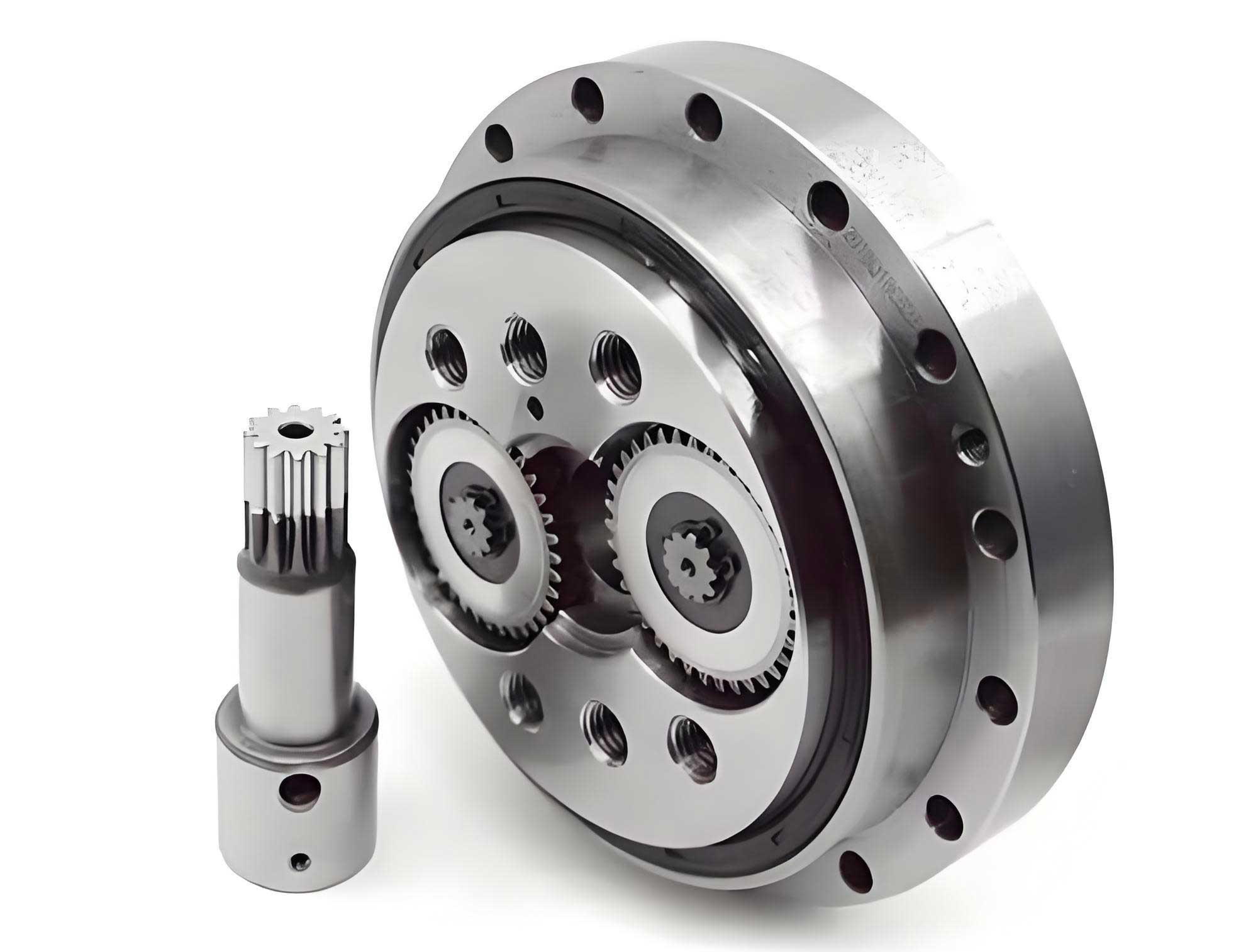
The foundation of an accurate virtual prototype is precise geometric modeling. For this study, a specific RV reducer model with a total ratio of 120, an input power of 0.5 kW, and an input speed of 3000 rpm was selected. The key parameters for the design are summarized in the table below. Special attention was paid to the modeling of the cycloidal wheel, as its tooth profile is non-involute and critical for proper meshing and performance. The profile is derived from the conjugate action between a rolling circle and a base circle, resulting in an epicycloid. To account for manufacturing and strength considerations, a shortened epicycloid (or trochoid) is used, achieved by offsetting the generating point inside the rolling circle. The parametric equations for the cycloidal wheel tooth profile are fundamental for accurate CAD modeling:
$$ x(\varphi) = r_p \sin\varphi – \frac{k_1}{z_c} r_p \sin(z_c \varphi) + r_{rp} \left[ -\sin\varphi + \frac{k_1 \sin(z_c \varphi)}{\sqrt{1 + k_1^2 – 2k_1 \cos(z_c \varphi)}} \right] $$
$$ y(\varphi) = r_p \cos\varphi – \frac{k_1}{z_c} r_p \cos(z_c \varphi) – r_{rp} \left[ \cos\varphi – \frac{k_1 \cos(z_c \varphi)}{\sqrt{1 + k_1^2 – 2k_1 \cos(z_c \varphi)}} \right] $$
Where:
\( \varphi \) is the generating angle (parameter),
\( r_p \) is the pin circle radius,
\( z_c \) is the number of lobes on the cycloidal wheel,
\( k_1 \) is the shortening coefficient ( \( k_1 = \frac{e z_c}{r_p} \) ),
\( e \) is the eccentricity of the crankshaft,
\( r_{rp} \) is the radius of the pin (针齿).
These equations were implemented within NX using its Expression tool. A parameter table was created to drive the model, allowing for easy modification and design iteration. The expressions defined in NX for generating the cycloidal curve are shown in the following table. This parametric approach ensures that the cycloidal wheel model is both precise and adaptable.
| NX Expression Parameter | Description | Value / Formula |
|---|---|---|
| a | Eccentricity | 1.0 |
| al | Phase Angle (UG parameter t * 360° * z_c) | 360*t*z_c |
| f | Auxiliary function \( f(\varphi) = 1/\sqrt{1+k_1^2-2k_1\cos(z_c \varphi)} \) | 1/sqrt(1+k1*k1-2*k1*cos(al)) |
| i_ratio | Stage 2 ratio \( z_p / z_c \) | z_p / z_c |
| k1 | Shortening Coefficient | 0.76923 |
| r_p | Pin Circle Radius | 52.0 |
| r_rp | Pin Radius | 2.0 |
| z_c | Cycloidal Wheel Lobe Count | 39 |
| z_p | Pin Tooth Count | 40 |
| xt | X-coordinate of profile | (r_p – r_rp * f) * cos((1-i_ratio)*al) – (a – k1*r_rp*f) * cos(i_ratio*al) |
| yt | Y-coordinate of profile | (r_p – r_rp * f) * sin((1-i_ratio)*al) + (a – k1*r_rp*f) * sin(i_ratio*al) |
| t | UG internal variable (0 to 1) | t |
Using the Law Curve function in NX, driven by these expressions, the precise cycloidal tooth profile was generated and then extruded to create the solid model of the cycloidal wheel. Similar parametric and feature-based modeling techniques were employed for all other components, including the sun gear, planet gears, crankshafts, housing, pins, and bearings. To enhance computational efficiency during subsequent simulation, minor features such as small fillets and chamfers that do not significantly affect the kinematic behavior were simplified or omitted.
The virtual assembly of the RV reducer is a critical step that validates the design’s integrity and spatial compatibility. Each component was imported into an NX assembly file. Constraints and mates were meticulously applied according to the mechanical relationships:
- Concentric and Touch Align constraints were used to mount the planet gears onto the crankshaft journals.
- The needle bearings on the eccentric sections of the crankshafts were assembled with the cycloidal wheels using Center and Distance constraints.
- The sun gear was constrained to rotate about the central axis.
- The pin teeth were fixed concentrically within the housing.
- The entire crankshaft-cycloidal wheel sub-assemblies were constrained to revolve around the central axis, simulating their connection to the planet carrier (output flange).
A comprehensive interference check was performed in two phases. First, a static check identified any gross geometric overlaps in the assembled state. Second, a preliminary dynamic clearance analysis was conducted by manually moving components through their expected ranges of motion to ensure no collisions occurred during operation. This process ensured the virtual RV reducer model was kinematically sound and ready for motion simulation.
The motion simulation within NX provides a powerful environment to analyze the dynamic behavior of the RV reducer without building a physical prototype. The process involves defining links, assigning joints (also called motion pairs), applying drivers and loads, and finally solving the equations of motion. The simulation was set up in two logical parts corresponding to the two reduction stages, though they operate simultaneously in the integrated model.
Stage 1: Planetary Gear Train Simulation Setup
In the Motion Simulation module, the analysis type was set to “Dynamics.” The “Joint Wizard” was disabled to allow manual control over the joint creation process. The first step was to define Links, which are rigid bodies. The sun gear shaft was defined as Link 1. Each planet gear, along with its associated section of the crankshaft (excluding the eccentric part), was defined as a composite link (e.g., Link 2). The needle bearings on the eccentric sections were defined as separate links (Links 3-6 for a two-planet design) because their motion relative to the crankshaft is critical. Next, Motion Joints were applied:
- A Revolute Joint was applied to the sun gear link, fixing its rotation axis along the central Z-axis.
- Revolute Joints were applied between each planet-crankshaft link and the ground (simulating the connection to the fixed planet carrier frame for input stage analysis), or between them and the output carrier link, depending on the chosen fixed element.
- Revolute Joints were also applied to each needle bearing link. For these, the “啮合连杆” (Coupling Link) option was used. The bearing was selected as the primary link, and the eccentric cylindrical surface on the crankshaft was selected as the coupling link. This accurately models the bearing rotating on the crankshaft journal.
Stage 2: Cycloidal-Pin Drive Simulation Setup
This stage involves more complex interactions. The cycloidal wheels were defined as separate links (Links 7, 8). To model their unique motion—revolution around the center due to the crankshaft eccentricity and rotation relative to the pins—a Point on Curve Joint was utilized. This joint constrains a specific point on one body (the cycloidal wheel) to lie on a curve defined on another body (the path of the needle bearing center). Essentially, it simulates the idealized rolling contact between the cycloidal wheel lobe and the pin. The housing连同所有针齿 was defined as a single fixed link (Link 9 – Ground) for the standard configuration where the housing is stationary. A Revolute Joint with a Driver was applied to the housing link to simulate the alternative output configuration. Finally, Point on Curve Joints were also applied between the theoretical contact points on the cycloidal wheel and the circular path defined by the fixed pins. For practical simulation stability, a simplified contact force or a “Curve-on-Curve” joint can be used as an approximation for the multiple simultaneous contacts. The driver for the entire system was applied to the sun gear’s revolute joint. A STEP function was used to simulate the startup transient: \( \text{ANG\_VEL}(t) = 18000 \times \text{step}(t, 0, 0, 1, 1) \) deg/s. This function ramps the input angular velocity from 0 to 18,000 deg/s (equivalent to 3000 RPM) over 1 second.
| Component | Link Definition | Joint Type | Notes / Driver |
|---|---|---|---|
| Sun Gear & Shaft | Link 1 | Revolute | Driven with STEP function. |
| Planet Gear & Crankshaft (Body) | Link 2, 4… | Revolute | Connected to ground or carrier. |
| Needle Bearing (Eccentric) | Link 3, 5… | Revolute | Coupling Link: Crankshaft Eccentric. |
| Cycloidal Wheel | Link 7, 8 | Point on Curve | Point on wheel constrained to bearing path. |
| Housing & Pins | Link 9 (Ground) | Fixed / Revolute | Typically fixed. Can be driven for alternate output. |
| Cycloidal Wheel vs. Pins | N/A | Point on Curve / Force | Models meshing contact (simplified). |
The simulation was solved for a duration of 1.2 seconds with an appropriate step size to capture the startup dynamics. Post-processing the results provides invaluable insights into the RV reducer’s behavior. While velocity plots confirm the expected speed reduction and steady-state operation, acceleration plots are particularly revealing as they indicate inertial forces, transmission smoothness, and potential shock loads. The angular acceleration graphs for key components were analyzed. The sun gear and planet gears showed nearly identical acceleration trends, which is logical given their direct meshing relationship. The acceleration profile during startup can be divided into three distinct phases:
- Initial Transient Phase (0-0.3s): A sharp acceleration peak occurs immediately upon startup, reflecting the inertial resistance of the system. This is followed by high-frequency, lower-amplitude oscillations as the gear teeth engage and disengage under load, and clearances are taken up.
- Transition Phase (0.3-0.6s): The system begins to stabilize. Acceleration oscillations become more regular and periodic, resembling a modulated sinusoidal wave. The dominant frequency here is related to the gear mesh frequency of the first stage (sun-planet meshing).
- Quasi-Steady-State Phase (0.6-1.0s): The mean acceleration approaches zero as constant input velocity is nearly achieved, but periodic oscillations persist. The amplitude of these oscillations is larger than in the transition phase but remains bounded and predictable. The frequency content is complex, combining harmonics from both the planetary stage and the cycloidal stage.
The housing acceleration, while following a similar phased pattern, exhibited a different characteristic. Its oscillations had a lower frequency and a longer periodicity compared to the gears. This is because the housing’s motion (or reaction force) is driven by the slower, secondary motion of the cycloidal wheel assembly. Despite larger amplitude swings in acceleration, the absolute values remained lower than those of the rapidly spinning sun and planet gears, indicating that the compact and rigid structure of the RV reducer housing effectively dampens and contains high-frequency vibrations.
The most dynamic response was observed in the cycloidal wheels. Their acceleration graphs displayed significant intermittent spikes or阶跃 (step-like jumps). These spikes correspond to the discrete engagement events as each lobe of the cycloidal wheel makes contact with a pin tooth. The magnitude of these spikes is the highest among all components, confirming that the cycloidal-pin interface is the primary location for contact stress and potential impact noise. After each engagement spike, the acceleration rapidly decays, and the motion becomes relatively smooth until the next lobe engages. The pattern is strongly periodic, with a period corresponding to the time it takes for the cycloidal wheel to advance by one lobe pitch relative to the pins—a direct consequence of the齿差 mechanism (\( z_p – z_c = 1 \)). The equation for this meshing period \( T_m \) is related to the input speed \( \omega_{in} \):
$$ T_m = \frac{2\pi}{\omega_{in}} \times \frac{1}{z_p – z_c} = \frac{2\pi}{\omega_{in}} $$ for a one-tooth difference.
The large but predictable accelerations of the cycloidal wheel underscore the importance of precise manufacturing and high-quality bearings to manage these inertial loads and ensure smooth operation of the RV reducer.
In conclusion, this study successfully demonstrates a complete virtual prototyping workflow for an RV reducer. Through parametric modeling based on rigorous mathematical definitions of the cycloidal profile, we created an accurate digital representation of the reducer. The virtual assembly process validated the geometric and kinematic integrity of the design. Most importantly, the detailed motion simulation provided deep insights into the dynamic behavior of the RV reducer during startup, particularly through the analysis of angular acceleration. The results confirm that the RV reducer operates with periodic vibrations within a well-defined and small range after the initial transient. The structure is confirmed to be compact and capable of stable operation with minimal energy loss from excessive vibration. The highest dynamic loads are predictably localized at the cycloidal-pin meshing interface. This comprehensive virtual model serves as a foundational digital twin. Future work will build upon this model to perform more advanced analyses, including flexible multibody dynamics to assess stress and deformation, detailed transient structural analysis for contact stresses, acoustic simulation for noise prediction, and durability studies for fatigue life estimation. The methodologies established here are essential for the rapid and cost-effective development of high-performance RV reducers.