
The precision RV reducer stands as the cornerstone of industrial robotic arms, representing a significant portion of the overall system cost. For years, the global market for these critical components has been dominated by a handful of international manufacturers, creating a substantial bottleneck for domestic robotics industries aiming for technological sovereignty and supply chain security. This reality underscores an urgent need to develop and rigorously evaluate indigenous reducer technologies. Our research focuses on a comparative analysis between a domestically developed novel reducer, designated the SG reducer, and an established, high-performance domestic RV reducer model, the RV-40E. Utilizing a comprehensive robotic reducer testing platform, we systematically evaluated and contrasted key performance parameters—including vibration characteristics, operational temperature, noise emission, and transmission efficiency—under no-load acceleration conditions. The primary objective is to dissect the inherent advantages and identify the shortcomings of the emerging SG design, thereby providing actionable insights and a foundational reference for its subsequent design iteration and optimization. This work is pivotal in accelerating the advancement of domestic core components for industrial robotics.
1. Test Methodology and Experimental Setup
To ensure a rigorous and fair comparison, a dedicated robotic reducer comprehensive performance test system was employed. The system’s core configuration consists of a drive motor, torque sensors, couplings, and the reducer unit under test, arranged to accurately measure input and output dynamics.
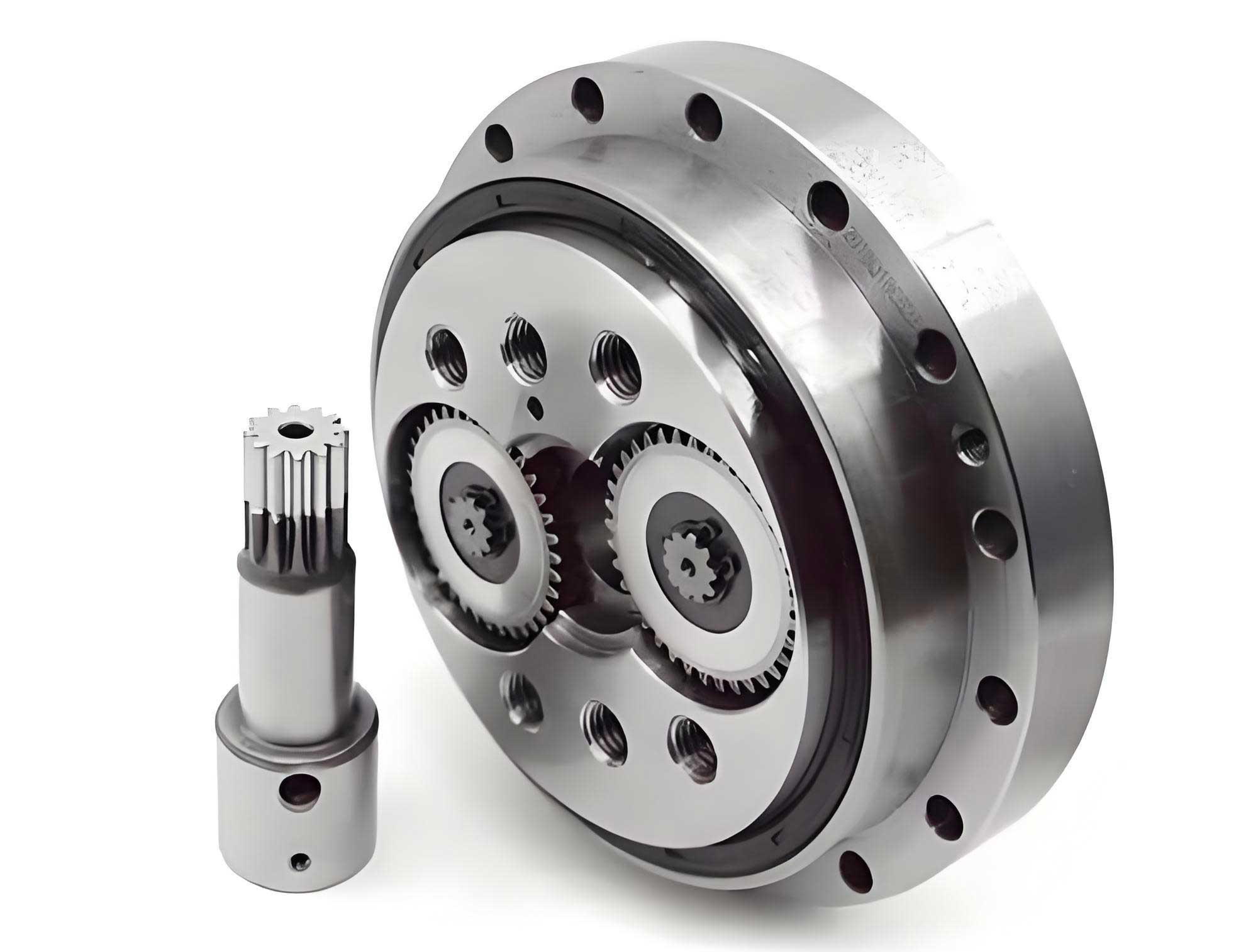
An array of sensors was strategically deployed to capture multi-faceted performance data. Uniaxial accelerometers were mounted on the reducer housing to acquire vibration signals along three orthogonal directions: the horizontal radial direction (X), the axial direction (Y), and the vertical radial direction (Z). A temperature sensor was attached to the base of the reducer housing to monitor operational thermal changes. An acoustic sensor was positioned at the midpoint of the test bench to record sound pressure levels. All data acquisition was synchronized, with vibration signals sampled at a frequency of 2,000 Hz to capture relevant dynamic content. The test protocol involved a no-load acceleration ramp, where the drive motor speed was progressively increased from 0 to 3,000 rpm. Data for vibration, temperature, noise, and efficiency were recorded throughout this transient and steady-state operational window for both the SG reducer and the benchmark RV-40E reducer.
2. Performance Data Analysis and Comparative Results
The collected data was analyzed in both the time and frequency domains, with a focus on trend analysis across the operational speed range.
2.1 Time-Domain Vibration Characteristics
Initial analysis focused on the time-domain vibration signatures at a fixed operational point (500 rpm input speed, 50 N·m load). The vibration signals for the RV-40E reducer exhibited oscillation around the zero point with minimal drift, indicating stable operation and low external noise interference. The axial (Y-direction) vibration amplitude was consistently the highest, a common characteristic in geared transmissions due to thrust loads and alignment sensitivities.
Key statistical metrics were calculated from the time-series data for a quantitative comparison, as summarized in the table below.
| Reducer Model | Direction | Mean Value (m/s²) | Max Value (m/s²) | Standard Deviation (m/s²) |
|---|---|---|---|---|
| RV-40E | X (Horizontal) | -0.0509 | 0.2936 | 0.0392 |
| Y (Axial) | -0.1199 | 0.7640 | 0.1850 | |
| Z (Vertical) | 0.0035 | 0.1250 | 0.0396 | |
| SG Reducer | X (Horizontal) | 0.2580 | 0.4650 | 0.0685 |
| Y (Axial) | 0.4850 | 0.8330 | 0.1582 | |
| Z (Vertical) | 0.1250 | 0.2580 | 0.0426 |
The data reveals distinct differences. The RV-40E reducer shows lower mean and maximum vibration amplitudes in the X and Z directions compared to the SG reducer. The standard deviation, a measure of signal volatility, is also lower for the RV reducer in these planes, indicating greater operational stability. In the critical axial (Y) direction, while the SG reducer’s standard deviation is slightly lower, its mean and maximum values are significantly higher. Notably, both reducers exhibited axial vibration levels exceeding common industry benchmarks (often below 0.1 m/s²), highlighting a potential area for improvement in both designs. The consistently positive mean values for the SG reducer suggest a more pronounced signal bias or drift, potentially pointing to different internal meshing dynamics or assembly preload conditions.
2.2 Speed-Dependent Vibration Trends
Analyzing vibration behavior across the entire speed spectrum is crucial. The average vibration amplitude for each direction was calculated at stable speed intervals during the ramp from 0 to 3,000 rpm. The trends for both reducers are plotted and compared below.
Observation for RV-40E Reducer: Vibration amplitudes in all three directions showed a general increasing trend with speed. The growth was non-linear and staged: a sharp rise from 0-500 rpm, a plateau between 500-1000 rpm, followed by a more gradual increase up to 2500 rpm before stabilizing. The Y-direction (axial) consistently displayed the highest amplitude, followed by X and then Z.
Observation for SG Reducer: A similar staged increasing trend was observed. However, the absolute vibration levels were substantially higher. The Y-direction amplitude was particularly prominent, reaching peak values approximately three times greater than those of the RV-40E reducer at comparable speeds. The X and Z-direction vibrations for the SG reducer were of similar magnitude to each other but higher than the corresponding axes for the RV reducer.
This comparative analysis indicates that while the SG reducer follows similar dynamic excitation patterns, its structural response or internal excitation sources generate significantly higher vibration levels, especially in the axial direction, across the operational range.
2.3 Operational Temperature Profile
Temperature rise is a key indicator of power loss mechanisms within a reducer, primarily stemming from friction in gears and bearings. The temperature was monitored during the no-load acceleration test.
Both reducers exhibited a similar profile: a negligible temperature increase in the low-speed range (0-1700 rpm), followed by a noticeable rise as speed entered the typical operating range (1700-2000 rpm), after which temperatures stabilized. This is characteristic of systems where viscous losses in lubrication become more significant at higher speeds. A direct comparison shows that the RV-40E reducer operated at a consistently higher temperature, starting approximately 7°C above the SG reducer and maintaining a 4°C difference after thermal stabilization. This suggests that the SG reducer may have advantageous thermal design aspects, such as more efficient heat dissipation from its housing or lower intrinsic friction losses under no-load conditions, contributing to its cooler operation.
2.4 Noise Emission Characteristics
Noise generation is a critical performance metric, closely linked to vibration, gear precision, and assembly quality. The sound pressure level was recorded throughout the speed ramp.
The noise levels for both reducers increased with rotational speed, as expected. The trend showed a steady rise up to around 1500 rpm, after which the noise output tended to plateau. Interestingly, the SG reducer started with a lower noise level at very low speeds but surpassed the RV-40E reducer’s noise output as speed increased, maintaining a higher level across the mid to high-speed range. The superior noise performance of the RV-40E reducer at operating speeds can likely be attributed to higher gear manufacturing precision, more optimal tooth profile modifications, and potentially better control of assembly tolerances and concentricity. For the SG reducer, noise optimization could focus on improving gear grade, ensuring precise alignment during assembly, and considering dynamic damping in the housing design.
2.5 Transmission Efficiency Assessment
Transmission efficiency is arguably the most critical parameter, directly impacting the robot’s power consumption, thermal management, and payload capacity. The efficiency was calculated from input and output torque/speed measurements during the no-load test.
The results revealed a stark contrast. The RV-40E reducer demonstrated excellent efficiency, stabilizing around 80% for most of the speed range and peaking at an impressive 98% near 3000 rpm. This performance meets and even exceeds the high standards (typically 85-95%) set by leading international RV reducer manufacturers.
Conversely, the SG reducer’s efficiency was markedly lower, remaining in a narrow band between 20% and 22% across the entire speed range. This value is substantially below the minimum thresholds (60-90%) expected for industrial robot reducers and represents the most significant performance gap identified in this study. This low efficiency has direct implications, likely contributing to its higher vibration levels (due to irregular meshing) and influencing other dynamic behaviors.
3. In-Depth Analysis of Transmission Efficiency Disparity and Optimization Pathways
The dramatic difference in transmission efficiency warrants a detailed mechanical analysis. The high efficiency of the RV reducer is well-documented and stems from its two-stage design combining a planetary gear stage and a cycloidal pinwheel (RV) stage, which offers high rigidity and efficient torque transmission through multiple tooth contacts.
The SG reducer employs a different architecture, specifically a double-stage planetary system of the NGWN type. This design can be conceptually decomposed into a primary NGW planetary stage and a secondary positive-mechanism NN stage connected in series. The theoretical transmission ratio $$i$$ and efficiency $$\eta$$ for such a system can be derived based on the individual stage ratios and single-pair gear mesh efficiency.
Let $$i_{12} = -7$$ be the ratio of the first meshing pair in the NGW stage, and $$i_{1”2”} = 1.043$$ be the ratio of the NN stage. Assuming a single gear pair meshing efficiency $$\eta_{pair} = 0.9506$$, the overall theoretical values are:
$$ i = i_{1s} \cdot i_{s”2”} = (1 – i_{12}) \cdot \frac{i_{1”2”}}{i_{1”2”} – 1} \approx 194 $$
$$ \eta = \eta_{1s} \cdot \eta_{s2”} = \frac{i_{12}\eta_{pair} – 1}{i_{12} – 1} \cdot \frac{i_{1”2”} – 1}{i_{1”2”} – \eta_{pair}} \approx 0.4453 \text{ or } 44.53\% $$
This calculation reveals a fundamental characteristic of the SG design: while capable of achieving very high reduction ratios, its theoretical efficiency for this specific ratio configuration is inherently limited to around 44.5%. However, the experimentally measured efficiency (20-22%) is only about half of this theoretical value. This severe discrepancy points to significant practical losses beyond the inherent design limitation. Our post-test inspection and analysis suggest two primary contributing factors:
- Insufficient Number of Load-Sharing Meshing Pairs: The theoretical efficiency assumes ideal simultaneous contact across multiple teeth. In practice, manufacturing errors and assembly tolerances can prevent perfect load distribution, reducing the effective number of load-bearing teeth. This “load-sharing deficiency” dramatically increases friction losses at the few contacting teeth, causing efficiency to plummet. Unlike the RV-40E, whose efficiency improved with running-in (suggesting better conformity over time), the SG reducer showed no such improvement, indicating a persistent meshing issue.
- Excessive Power Loss from Gear Friction: The dominant source of power loss in gearboxes is friction at the gear mesh interfaces. This is highly sensitive to gear tooth surface quality. Disassembly of the tested SG reducer revealed that the lubricant had turned black with metallic wear debris, and the gear teeth surfaces exhibited visible scratches and scoring. This is a clear indicator of a sub-optimal gear manufacturing grade (likely worse than the assumed level for calculation) and/or inadequate surface hardening, leading to high friction and wear losses.
Therefore, the path to optimizing the SG reducer’s efficiency is twofold. First, the inherent efficiency ceiling of the chosen NGWN configuration for a given ratio must be acknowledged; alternative ratio combinations within the same architecture might yield better theoretical efficiency. Second, and more critically, immediate and substantial gains can be achieved by focusing on precision manufacturing and assembly:
- Improve Gear Quality: Utilize higher-grade gear hobbing/grinding processes (aiming for AGMA 10 or better) to ensure precise tooth geometry, profile, and lead.
- Enhance Surface Treatment: Apply appropriate case hardening (e.g., carburizing) and finishing processes (e.g., honing) to achieve a hard, smooth, and wear-resistant tooth surface.
- Optimize Assembly Precision: Implement stricter tolerances and precision alignment procedures for bearing seats, planetary carriers, and sun/ring gear positioning to ensure optimal meshing alignment and improve load sharing among planets.
- Lubrication Optimization: Select a high-performance lubricant with extreme pressure (EP) additives suitable for the specific metallurgy and operating conditions.
Addressing these manufacturing and assembly aspects is essential to bring the SG reducer’s practical efficiency closer to its theoretical potential and, ultimately, into a competitive range.
4. Conclusion
Our comprehensive experimental comparison between the novel SG reducer and the established RV-40E reducer has yielded clear insights into their respective performance profiles. The SG reducer demonstrates certain advantages, notably in operational temperature management, where it runs cooler, and in low-speed noise emission. However, it currently faces significant challenges that hinder its competitiveness.
The most critical shortfall is in transmission efficiency, where its performance is drastically lower than that of the high-efficiency RV reducer. This is attributed to a combination of the inherent efficiency characteristics of its NGWN planetary design and, more pressingly, deficiencies in gear manufacturing precision and assembly quality that lead to poor load sharing and high friction losses. Furthermore, the SG reducer exhibits higher levels of vibration, particularly in the axial direction, across the entire operational speed range, indicating potential issues with dynamic balance, structural rigidity, or excitation from the gear meshing process.
The benchmark RV-40E reducer confirms that domestic technology can achieve world-class performance, particularly in efficiency and vibration stability in radial directions, though axial vibration remains an area for improvement even for this model. For the SG reducer to evolve as a viable alternative, the primary focus must be on radical improvement of its core mechanical efficiency. This necessitates a dedicated investment in high-precision manufacturing capabilities for gears and components, coupled with meticulous assembly processes. Subsequent design iterations could also explore refined tooth profiles, optimized bearing arrangements, and enhanced housing dynamics to mitigate vibration. This study provides a foundational performance baseline and clear technical directives for the ongoing development and optimization of this emerging reducer technology.